
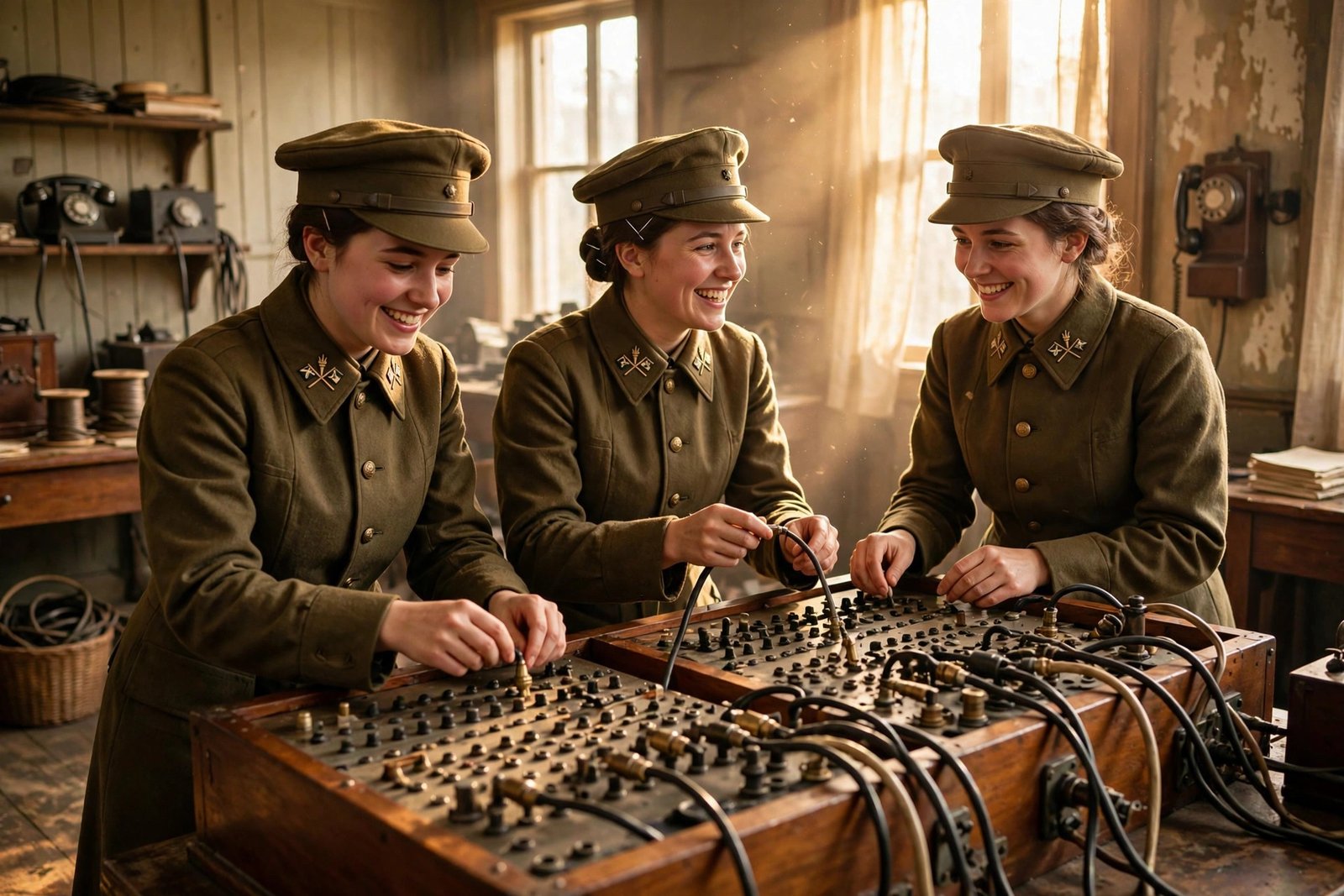
When American soldiers in France picked up a field telephone in 1918, the voice on the other end was often a woman’s. Calm, clear, and fluent in both English and French, she connected their call through a tangle of battlefield switchboards, sometimes while artillery fire shook the building around her. She wore an Army uniform, she had sworn the Army oath, and she served under the command of General John J. Pershing. But when she came home, her country told her she had never been a soldier at all. These were the Hello Girls, and their story is one of the most remarkable, and most unjust, chapters in American military history.
The Hello Girls were the women of the U.S. Army Signal Corps’ Female Telephone Operators Unit. In 1917 and 1918, the Army recruited bilingual American women to operate switchboards in France, connecting the American Expeditionary Forces with French allies and with headquarters across a chaotic battlefield. They were among the first American women to serve with the Army overseas, and they did their jobs brilliantly. Then they spent sixty years fighting for the recognition they had already earned.
A Communication Crisis in France
When the United States entered World War I in 1917, its military faced a problem that had nothing to do with weapons. The American Expeditionary Forces, led by General John J. Pershing, arrived in France and found themselves unable to communicate effectively with their French allies. The existing French commercial telephone networks were inadequate, the American and French armies spoke different languages, and the hastily built military telephone system needed skilled operators who could bridge the gap.
Pershing urgently requested the recruitment of women telephone operators who were completely fluent in both English and French. The idea was controversial within the military, but the need was undeniable. Modern warfare ran on communication. Orders, supply requests, artillery coordinates, and troop movements all traveled by telephone, and a slow or garbled connection could cost lives.
The response from American women was overwhelming. Thousands applied for the dangerous assignment. According to the U.S. Army, more than 7,000 women answered the call, and only 223 were ultimately selected and sent to France. The women who made the cut were, in the words of one account, smart, independent, and resilient. They were all single, fluent in French, and well educated, and the average age was just 26. Many were already experienced telephone operators.
They trained at the Signal Corps facility at Camp Franklin, Maryland, where they mastered military switchboard operations. Their leader was Grace Banker, a poised and capable 26-year-old who had been a telephone operator at AT&T. As Chief Operator, she would guide this select corps of women across the Atlantic and into history.
Life at the Switchboards
The work was relentless. The Hello Girls operated complicated switchboards connecting ever-shifting front lines with vital supply depots and military command posts. At the height of the fighting, they connected an enormous volume of calls each day, and speed mattered. Accounts of the time noted that the women could connect calls far faster than the men they replaced, a skill that made a real difference when seconds counted.
The conditions were far from comfortable. The operators worked long shifts, often in buildings near the front, and some were stationed just a few miles from the fighting. A dedicated team accompanied General Pershing to the forward command post at Souilly, France, near the Verdun battlefield. Outposts came under artillery fire, and the women worked through it, keeping the lines open while shells fell nearby.
The nickname ‘Hello Girls’ came from the greeting they used. The women were instructed to answer calls with ‘hello,’ and the friendly, professional greeting became their identity. The Army’s formal name for them was the Signal Corps Female Telephone Operators Unit, but ‘Hello Girls’ is the name that stuck, and it is the name history remembers.
They were not desk workers far from danger. They wore regulation Army uniforms, they followed Army orders, they underwent physical training and medical examinations, and they lived under military discipline. Two of them died during the war and were buried in France. One of them, Inez Crittenden, had served in France for a year before falling ill with pneumonia in the final days of the war. She died in Paris on the day the war ended.
Praise From the Top
The Hello Girls’ work did not go unnoticed by the men they served. General Pershing, who had issued the call that brought them to France, singled them out for praise. Two days after the Armistice, the chief signal officer for the First Army stated in his official report that a large part of the success of the army’s communications was due to its competent staff of women operators.
When the Armistice was signed in November 1918, 30 of the Hello Girls received formal commendations for their service. Chief Operator Grace Banker was awarded the Distinguished Service Medal, one of the Army’s highest honors, and one usually reserved for senior officers. It was an extraordinary recognition for a young woman who had started the war as a telephone operator in New York.
By any reasonable measure, the Hello Girls had served as soldiers. They had done the work, taken the risks, and earned the praise. What happened next remains one of the great injustices in American military history.
Sent Home as Civilians
When the war ended and the women returned home, they were shocked to learn they were not considered veterans. Though they had worn Army uniforms, followed Army orders, and operated under fire, the War Department classified them as civilian contractors, not official members of the military.
The reason was a technicality with enormous consequences. The Army did not enlist women during World War I, while the Navy did. Because the Hello Girls had never been formally enlisted, the Army argued they were not soldiers, no matter what they had done in France. The document Pershing had signed calling them into service implied military service without ever quite stating it, and that imprecision gave the government cover to deny them for decades.
The consequences were not abstract. Without veteran status, the Hello Girls received no benefits, no medical care, no honorable discharges, no military funerals, and not even the right to wear their uniforms. They had served their country in wartime, and their country refused to acknowledge it. Many of them spent the rest of their lives fighting a bureaucratic battle that should never have been necessary.
Over the years, more than 50 bills were introduced in Congress to recognize their service, and all of them failed. The women aged, their numbers dwindled, and the injustice stretched from one generation to the next. It was a slow, quiet scandal, the kind that persists because the people it harms are too polite, or too tired, or too few to force a reckoning.
Recognition at Last, Sixty Years Later
It was not until 1977, almost sixty years after the war, that Congress passed legislation recognizing the Hello Girls as veterans. The G.I. Bill Improvement Act of 1977 granted them veteran status, honorable discharges, and benefits. When President Jimmy Carter signed it into law, the surviving Hello Girls finally received the discharges they had earned in 1918.
By then, only 18 of the original women were still alive to receive them. The recognition came too late for the vast majority of the Hello Girls, including Grace Banker and most of her operators. But it mattered. It corrected the record, and it gave the survivors something they had waited a lifetime for: official acknowledgment that they had served.
The story did not end there. In 2024, the Senate passed legislation to award the Hello Girls the Congressional Gold Medal, and the measure was included in the National Defense Authorization Act for Fiscal Year 2025, which President Joe Biden signed into law in December 2024. More than a century after they first picked up their headsets in France, the Hello Girls received one of the highest civilian honors Congress can bestow.
Today, the Hello Girls are remembered in museums, documentaries, books, and classrooms. There is a display on the Signal Corps Female Telephone Operators Unit at the U.S. Army Signal Corps Museum. Their story is taught as part of women’s history and military history alike. And their fight for recognition helped pave the way for later generations of women in uniform, who serve today in every branch of the military with full status as soldiers, sailors, airmen, Marines, and guardians.
Why the Hello Girls Still Matter
The Hello Girls matter for several reasons. First, they were pioneers. They proved, under fire, that women could perform critical military work at the highest level, and they did it at a time when few Americans believed that. Their competence was not theoretical. It was measured in calls connected, orders delivered, and battles coordinated.
Second, their story is a reminder that recognition is not automatic. Doing the work is not always enough. Institutions can fail the people who serve them, and correcting those failures can take decades. The Hello Girls’ sixty-year fight is a cautionary tale about bureaucracy, and an inspiring one about persistence.
Finally, their story is simply a great American story. Young women from across the country, fluent in a second language, trained for a new technology, shipped to a war zone, and asked to hold the lines of communication together while the world fell apart around them. They did it with skill, courage, and good humor. They answered every call with ‘hello,’ and they kept answering until the war was over.
The next time you pick up a phone and hear a calm voice on the other end, spare a thought for the Hello Girls. They were the first to prove that the voice on the line could be a soldier, and it took America sixty years to say thank you properly.
Read more from the U.S. Army on America’s first female soldiers, the Department of Veterans Affairs on the Hello Girls’ quest for recognition, and NPR Illinois on the women who fought for America and for recognition.
Frequently Asked Questions
Who were the Hello Girls? The Hello Girls were the women of the U.S. Army Signal Corps’ Female Telephone Operators Unit, bilingual American women recruited in 1917 and 1918 to operate military switchboards in France during World War I.
How many Hello Girls served in France? The U.S. Army states that 223 women were selected and sent to France. Some histories count 233 women who served as telephone operators in total, including those who served stateside.
Why were they called the Hello Girls? They were instructed to answer military calls with ‘hello,’ and the cheerful greeting became their nickname.
Did the Hello Girls serve near the front lines? Yes. Some were stationed just a few miles from the front, including a team that accompanied General Pershing to the forward command post at Souilly, near Verdun. They worked through artillery fire.
When were the Hello Girls recognized as veterans? Not until 1977, when Congress passed the G.I. Bill Improvement Act. Only 18 of the original women were still alive to receive their honorable discharges.
Did the Hello Girls receive the Congressional Gold Medal? Yes. Legislation awarding them the Congressional Gold Medal was included in the National Defense Authorization Act for Fiscal Year 2025, signed into law in December 2024.