
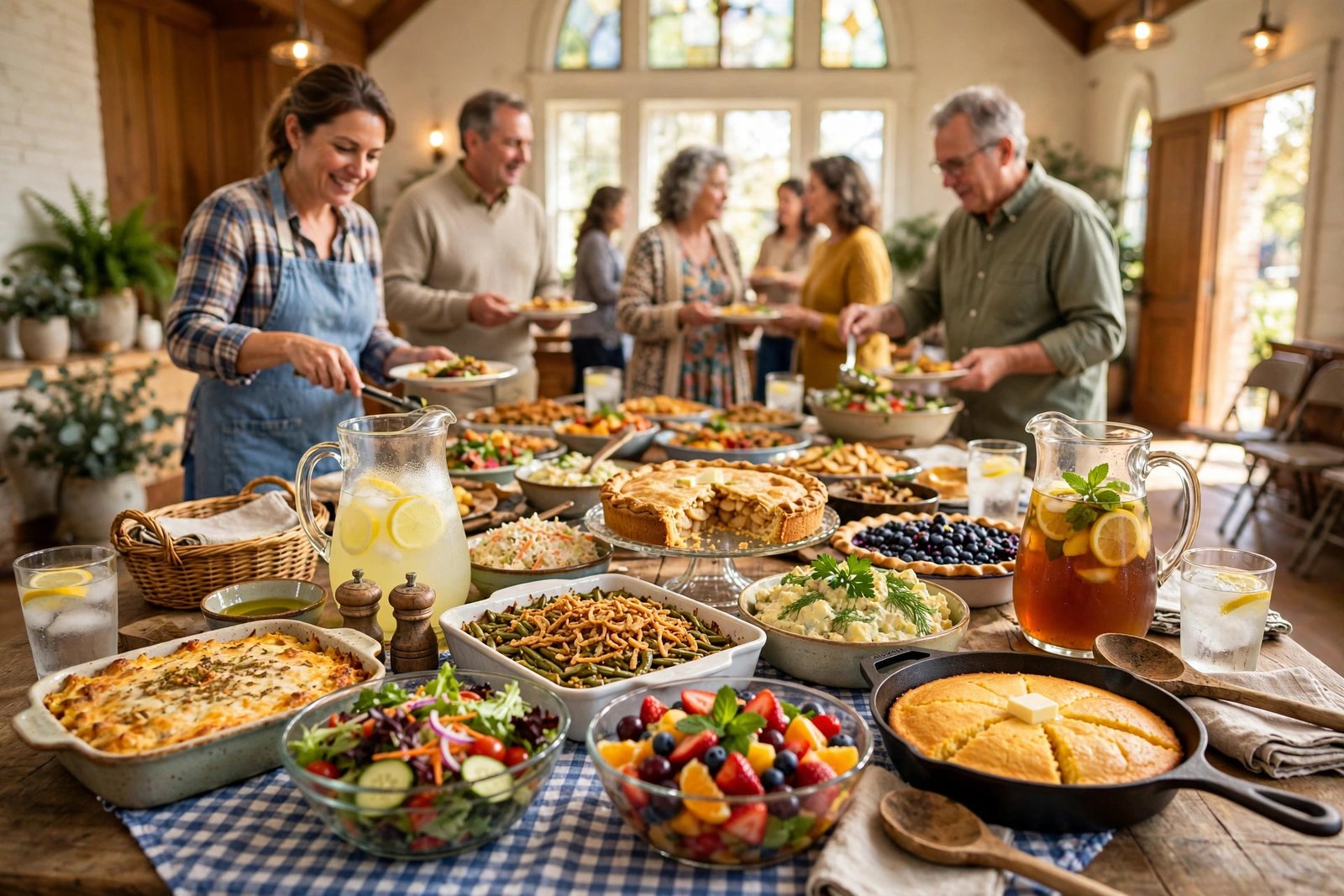
There is a particular kind of magic that happens when a long table fills up with dishes no single cook could have made alone. One neighbor brings a slow-cooked casserole still bubbling at the edges. Someone else arrives with a crisp salad, a loaf of bread, or a pie that has clearly been made with care. Nobody planned the menu together, yet somehow it works. That is the American potluck, and it has been feeding communities, friendships, and fundraisers for generations.
A potluck is a meal where each guest contributes a dish to share. It sounds simple, and it is, but that simplicity is exactly the point. Instead of one host carrying the whole cost and workload, everyone pitches in. The result is a table that reflects the people around it: their family recipes, their regions, their budgets, and their tastes. In a country as varied as the United States, no two potlucks ever taste quite the same.
This guide looks at where the tradition comes from, the unwritten rules that keep it running smoothly, the food-safety basics that matter more than most people realize, and the classic dishes that show up again and again. Whether you are heading to your first church supper, planning an office gathering, or hosting friends at home, these ideas will help you bring something people actually want to eat.
Where the potluck tradition comes from
The word potluck originally meant something humbler than a planned party. It described taking your chances with whatever happened to be in the pot, whatever a household could offer a guest at short notice. Over time in North America, that idea turned into something more deliberate: a shared meal where each person brings a dish. The Oxford Companion to Food notes that Protestant churches in North America were pioneers of potluck meals, using shared eating to build a sense of group identity, raise funds, and bring people together. You can read that history in the entry at https://app.ckbk.com/reference/food77337c16s001e297/potluck.
Church suppers were the natural home for this kind of meal. A congregation needed to feed a crowd without a catering budget, and asking every family to contribute solved the problem fairly. The work was spread around, nobody was singled out for being unable to provide a feast, and the meal itself became part of worship life and fellowship. In some parts of the country these gatherings were called covered dish suppers, while in others they were known as basket meals. The name changed by region, but the principle stayed the same.
From churches, the practice spread outward. Schools adopted it for class parties and parent nights. Workplaces used it for holiday lunches and farewell gatherings. Neighborhoods, sports teams, volunteer groups, and clubs all found the same appeal. A potluck does not require a fancy venue or a big budget. It requires a table, some outlets for slow cookers, and people willing to cook. That low barrier is a large part of why the tradition has lasted.
There is also a social side that is easy to overlook. A potluck is a quiet way of getting to know people. You learn who makes the legendary macaroni and cheese, who always brings a salad from their garden, and who has a grandmother whose pie recipe is treated like a family treasure. Food becomes a conversation starter, and the meal becomes a shared memory rather than just lunch.
Why casseroles became the potluck star
If there is one dish that defines the American potluck, it is the casserole. There are practical reasons for that. Casseroles are affordable, they scale up easily for a crowd, they can be assembled ahead of time, and they travel well. A hot dish in a covered pan arrives warm and still tastes good after the drive to the hall. Reliability matters more than presentation when you are feeding dozens of people.
Casseroles are also forgiving. Ingredients can be stretched, swapped, or adjusted to what is in the pantry. A tuna hotdish, a spaghetti bake, a chicken and rice casserole, or a green bean casserole can all be made with everyday ingredients and still feel like comfort food. That flexibility made casseroles a natural fit for church suppers and community meals, where cooks worked with different budgets, skills, and kitchen equipment.
Beyond practicality, casseroles carry a sense of nostalgia. Many Americans grew up eating a particular version at family gatherings, and bringing that same dish to a potluck feels like sharing a piece of home. The dish might not be fancy, but it is familiar, and familiar food has a way of making a room feel warmer.
The unwritten rules of a good potluck guest
Potlucks rarely come with a formal rulebook, but regulars know the expectations. The first rule is simple: bring enough to share. A dish meant for four people will disappear in minutes at a gathering of forty. Aim for a generous portion, and think about how many people are likely to attend. If you are unsure, ask the organizer. It is always better to bring a little too much than to watch your dish vanish before half the room has eaten.
The second rule is to label your dish. A small card with the name of the dish and its main ingredients helps everyone, especially guests with allergies or dietary needs. If your dish contains nuts, dairy, gluten, meat, or common allergens, say so clearly. It is a small kindness that prevents awkward questions and keeps people safe. If you made something vegetarian, vegan, or gluten-free, label that too, so people looking for those options can find them easily.
Third, bring your dish ready to serve. If it needs to stay hot, bring it in a slow cooker or an insulated carrier. If it needs to stay cold, keep it chilled until serving time and bring a cooler if needed. Bring your own serving spoon or spatula if you can, because organizers often run short. And take your dish and leftovers home with you at the end, unless the host says otherwise. Leaving an unclaimed pan behind creates extra work for someone else.
Fourth, respect the balance of the table. If the sign-up sheet already has five desserts, do not bring a sixth cake. Sign up for a main dish, a salad, or a side that is missing. A good potluck table needs variety: something hearty, something fresh, something warm, and something sweet. When everyone coordinates even a little, the meal feels complete.
Finally, be gracious. Try a little of everything if you can, compliment the cooks, and remember that not every dish will be a masterpiece. Someone may have tried a new recipe for the first time, or cooked on a tight budget. The spirit of a potluck is generosity, not a cooking competition.
Food safety basics every potluck cook should know
Food safety is the least glamorous part of a potluck, but it is the most important. When food is prepared in many different home kitchens and then left on a buffet table, the risks add up. The good news is that a few simple habits go a long way.
The U.S. Department of Agriculture warns about the danger zone, the temperature range between 40 degrees Fahrenheit and 140 degrees Fahrenheit where bacteria can multiply rapidly. Perishable foods should not sit at room temperature for more than two hours, and that window shrinks to one hour when the temperature is above 90 degrees. Hot foods should be kept at 140 degrees or above, and cold foods at 40 degrees or below. You can read the USDA guidance at https://www.usda.gov/node/17644.
In practical terms, that means keeping hot dishes in a slow cooker on the warm setting, keeping cold salads on ice or in the refrigerator until serving time, and not letting a dish linger on the table for hours. If a dish has been sitting out too long, it is safer to discard it than to save it. Reheating does not always make unsafe food safe again.
Other basics matter too. Wash your hands before and during cooking. Use separate cutting boards for produce and for raw meat or poultry. Cook meats to safe internal temperatures and use a food thermometer rather than guessing by color. Transport food in clean, covered containers, and keep raw and cooked foods separate. If you are sick, it is kinder to sit this one out or bring a store-bought item instead of cooking for a crowd.
These steps are not about being fussy. They are about making sure a joyful gathering stays joyful. A church supper or office party should be remembered for good food and good company, not for anyone feeling unwell afterwards.
Classic dishes people expect at an American potluck
Every region has its favorites, but some dishes show up across the country. Baked macaroni and cheese is a reliable crowd-pleaser, rich, comforting, and easy to scale. Fried chicken, served at room temperature, travels well and needs no reheating. Slow-cooker pulled pork or barbecue meatballs feed a crowd with little last-minute work. A hearty chili, especially in cooler months, warms a room and pairs well with cornbread.
On the lighter side, coleslaw, potato salad, and pasta salad are potluck staples. They are best kept cold and served in smaller batches so they do not sit out too long. A fresh green salad with dressing on the side adds color and crunch. Deviled eggs, a vegetable tray with dip, and a cheese and cracker board are easy starters that disappear quickly.
Dessert is where potluck cooks often shine. Brownies, lemon bars, cookies, and fruit pies are easy to portion and share. A classic apple pie or a peach cobbler feels seasonal and homemade. A simple sheet cake feeds many people without fuss. If you are bringing dessert, consider something that can be cut into small pieces so more people can try it.
Drinks and bread are often forgotten, and that is a missed opportunity. A large batch of lemonade, iced tea, or punch, plus a basket of rolls or cornbread, rounds out the table beautifully. If the sign-up sheet is already full of mains and desserts, offering to bring drinks or bread is a genuinely helpful move.
Modern twists on the tradition
Potlucks are evolving, and that is a good thing. Many gatherings now include dietary variety by design, with vegan, vegetarian, and gluten-free options labeled and welcomed rather than treated as an afterthought. Some hosts use online sign-up sheets so guests can see what is already covered and avoid duplicates. Others theme their potlucks around a cuisine, a season, or a holiday, which sparks creativity.
Store-bought dishes have also become more accepted. Not everyone has time to cook from scratch, and a good rotisserie chicken, a bakery pie, or a quality deli salad can be a perfectly generous contribution. What matters is that you bring something thoughtful and enough to share, not whether you made every element yourself.
Some modern potlucks even mix in new formats, like a taco bar where guests bring different fillings and toppings, or a soup night where several slow cookers line the table. These twists keep the tradition fresh while preserving its core idea: everyone contributes, everyone shares, and everyone belongs.
How to host a potluck without stress
If you are hosting, a little planning makes a big difference. Start with a sign-up list that covers categories: mains, sides, salads, bread, drinks, and desserts. Share the expected headcount so cooks can plan portions. Remind guests to label dishes and note allergens. Provide tables, outlets, serving utensils, plates, and plenty of trash and recycling bins.
Think about flow as well. Place drinks away from the food line so people are not crowding one spot. Put plates at the start of the line and napkins and cutlery at the end. Keep hot and cold dishes in their proper places, and set a timer in your head for perishable foods so nothing sits out too long.
Most importantly, relax and enjoy it. A potluck does not need to be perfect. It needs to be welcoming. The best potlucks are the ones where people linger, go back for seconds, swap recipes, and leave feeling like part of something bigger than a meal.
Frequently Asked Questions
What should I bring to my first potluck?
Bring a dish you know how to make well, in a generous portion, and label it with its main ingredients. A casserole, a salad, or a dessert you trust is a safe and welcome choice.
How much food should I bring?
Plan for the full guest count, not just your own household. If the organizer expects forty people, bring a dish that can serve a good share of the group, and ask if you are unsure.
Is it okay to bring a store-bought dish?
Yes. A quality store-bought dish, brought in a generous amount and presented nicely, is a perfectly good contribution, especially when time is tight.
How long can potluck food sit out safely?
Perishable food should not sit at room temperature for more than two hours, or one hour when it is above 90 degrees. Keep hot foods hot and cold foods cold.
What if I have dietary restrictions?
Tell the organizer, label your own dish clearly, and consider bringing something you can eat and share. Most potluck hosts are happy to make room for different needs.
Should I take leftovers home?
Take your own dish and any leftovers of it home unless the host asks you to leave them. Do not take other people’s dishes without asking.