
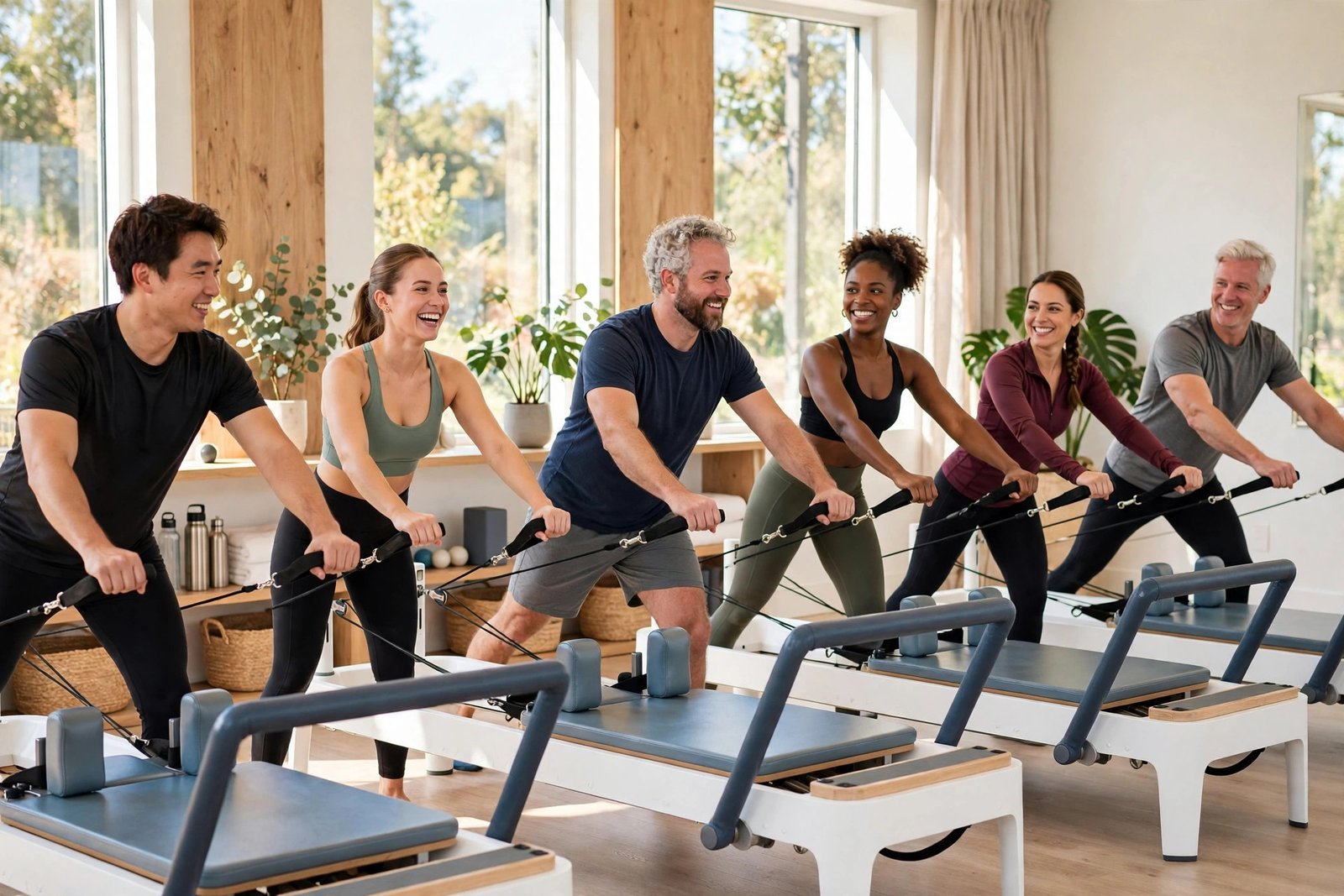
There is a new humbling ritual sweeping American fitness feeds, and it does not involve a heavier barbell or a faster sprint. It involves a mat, a reformer machine, slow movements, and a room full of very strong men discovering that strength is not the same as control. Viral videos show muscular male athletes wincing, shaking, and collapsing during Pilates and sculpt classes, and America cannot look away.
The joke writes itself: the biggest guy in the gym, brought low by what some people still dismiss as an easy workout. But the videos are funny for a deeper reason. They expose a real gap in how many people train. Lifting heavy weights builds impressive power, but Pilates asks for something different: slow control, deep core stability, balance on a moving carriage, and endurance in small stabilizer muscles that heavy lifting often overlooks. When those muscles are asked to work, even elite athletes shake.
Here is what is going viral, why Pilates humbles lifters, and how you can try it yourself without becoming the next viral clip, unless you want to.
The viral moment: gym bros meet Pilates
Viral videos show men wincing, clenching, and shaking their way through classes, both on mats and on reformers, the bed-like machines with springs, straps, and a sliding carriage that are central to reformer Pilates. The clips are short, funny, and instantly relatable. A man who can bench press an impressive weight struggles to hold a slow leg lift. A rugby player who tackles for a living wobbles on a moving platform. A group of friends who arrived confident leaves sweaty, sore, and laughing at themselves.
One of the most widely shared reports on the trend comes from Fox News Digital, in a piece titled Viral videos show ripped gym bros collapsing during Pilates workouts. You can read it at https://foxnews.com/health/viral-videos-show-ripped-gym-bros-collapsing-during-pilates-workouts. A syndicated version of the same reporting is also available at https://www.mackaytourism.com.au/news/viral-videos-show-ripped-gym-bros-collapsing-during-pilates-workouts/48970.
The trend is not limited to one studio or one city. It is a pattern: men who train hard in the gym, often with a focus on heavy lifting, high-intensity workouts, or team sports, try Pilates or sculpt classes and find them far harder than expected. The comments sections are full of delight, especially from women who have done Pilates for years and are enjoying watching the strongest guy in the room get humbled. But the tone, for the most part, is good-natured. The men in the videos are usually laughing too.
Melania Antuchas and the Florida classes that drew millions of views
One of the central figures in the viral wave is Melania Antuchas, a Florida-based hot Pilates and sculpt instructor. According to Fox News Digital reporting, Antuchas posted videos of private classes with men that have received millions of views. She teaches a 50-minute signature class combining strength training and mat Pilates, and she told Fox News Digital that athletic men find the class surprisingly difficult due to their training history.
Antuchas is not a newcomer to fitness. She spent years in weightlifting and strength training before building her sculpt teaching around mat Pilates, reformer work, mobility, and strength. That background matters. She understands both worlds: the gym world where heavier is better, and the Pilates world where slower, smaller, and more controlled is often harder. Her classes are intentionally challenging without requiring extra equipment, because the foundational movements themselves are demanding enough.
Her videos work because they are honest. There is no trick, no impossible move, just sustained, controlled work that exposes weak links. Men who are used to powering through a set with momentum suddenly have nowhere to hide. Every wobble, every shake, every pause is visible. And because Antuchas teaches with energy and humor, the classes feel like a challenge to rise to, not a punishment.
After her first all-men class, Antuchas said every single one of the men asked for the next one because of how much it challenged them, according to the Fox News Digital reporting. That detail is telling. The humbling did not drive them away. It hooked them. There is something appealing about finding a new weakness to work on, especially for people who thought they had already covered fitness.
Raleigh Rugby Club and the reformer reckoning
Another viral chapter came from North Carolina. After hosting the men of the Raleigh Rugby Club, Raleigh Pilates posted a video where the men appear to struggle through sets of leg lifts, lunges, shoulder presses, abs, and stretches on the reformer. Rugby players are not soft athletes. They are used to contact, endurance, and physical toughness. Watching them shake on a reformer made the point even clearer: this is not about toughness, it is about a different kind of strength.
Studio owner Rae Matthews noted that Pilates challenges stronger people in unexpected ways, according to the same reporting. That is a key insight. On a reformer, the carriage moves. Your base is unstable. Your muscles must control the movement in both directions, not just push a weight up and drop it. Lighter springs can mean less support, so your muscles have to do more of the controlling, not less. A bigger, heavier athlete may even face an extra challenge, because they are controlling more body weight on a moving platform.
The Raleigh video also shows why reformer Pilates is so shareable. The machine looks unusual to newcomers, almost like a bed with springs, and the movements look deceptively simple. A leg lift on a stable floor is one thing. A leg lift while balancing on a sliding carriage, keeping your core engaged and your hips level, is another thing entirely. The gap between how easy it looks and how hard it feels is perfect viral material.
Why Pilates humbles lifters: it is not weakness, it is a blind spot
So why does a strong lifter struggle? The answer is not that lifting is useless or that Pilates is magic. It is that different training builds different qualities, and most gym routines leave gaps.
First, Pilates trains control, not just force. Many lifts in the gym reward moving a heavy weight from point A to point B, often with momentum. Pilates rewards moving slowly, with precision, through a full range of motion, while keeping the rest of the body stable. That slow tempo creates sustained muscular tension, which burns in a way that a quick heavy set does not.
Second, Pilates targets small stabilizer muscles. The deep core, the muscles around the hips and shoulder blades, the small muscles that keep you balanced, these are the unsung heroes of movement. Heavy compound lifts use them too, but not always in isolation or under sustained, unstable conditions. On a reformer, those small muscles cannot hide behind bigger prime movers.
Third, Pilates demands core endurance. It is not one big brace for a single lift, but repeated, controlled engagement over a whole class. Your core must stay active while your limbs move, while you breathe, and while you balance. That endurance is different from maximal strength, and it fatigues quickly if you have not trained it.
Fourth, flexibility and mobility matter. Many lifters, especially those focused on heavy upper-body or leg work, have tight hips, shoulders, or hamstrings. Pilates asks for range of motion under control, not just flexibility for its own sake. Tight areas become obvious fast.
Finally, there is a mental shift. Pilates requires attention to breath, alignment, and small cues. Lifters used to zoning out with music and grinding through sets may find the focus itself tiring. That is not a flaw. It is a different skill, and like any skill, it improves with practice.
None of this means strong men are weak. It means strength is broader than a single number on a barbell. The viral videos are funny precisely because they reveal that breadth in real time.
Pilates was not originally a women’s workout
Part of the joke relies on an old stereotype: that Pilates is a girly workout. History says otherwise. Pilates was developed by Joseph Pilates in the 1920s, originally to help rehabilitate injured soldiers and dancers, according to fitness experts cited in the viral coverage. Joseph Pilates himself was a boxer and gymnast who built his method around strength, control, and resilience, not just flexibility.
The method was designed for athletes and soldiers as much as for anyone else. It only later became associated, in popular culture, with women’s fitness studios and pastel workout sets. That association is cultural, not historical. The viral gym-bro moment is, in a sense, a return: men rediscovering a method that was built for them in the first place, and finding it far from easy.
That history also helps explain why the trend feels wholesome rather than mean-spirited. The men are not being mocked for trying something new. They are being welcomed into a practice with a long, serious lineage, and discovering that it deserves respect.
What the comments get right, and what they miss
Online comments on these videos are a mix of celebration, teasing, and genuine curiosity. Women who have done Pilates for years enjoy the vindication. Men who have tried it chime in with their own stories of shaking legs and sore cores the next day. Fitness coaches note that the videos are a good reminder not to confuse one kind of fitness with overall fitness.
What the comments sometimes miss is that Pilates is not a replacement for lifting, and lifting is not a replacement for Pilates. The best athletes often do both. Strength training builds power, bone density, and muscle mass. Pilates builds control, mobility, stability, and endurance in supporting muscles. Together, they cover more of what a body needs than either alone.
That is why many of the men in the viral videos keep coming back. They are not abandoning the gym. They are adding a missing piece. And that is a healthier message than any single viral clip: fitness is not a contest between workouts, it is a toolkit, and a bigger toolkit is better.
Try it yourself: a beginner-friendly guide
If the videos have tempted you to try Pilates, good. Here is how to start without injury or embarrassment.
Start with a beginner or introductory class, not an advanced reformer session. Tell the instructor you are new and what you usually train. A good instructor will modify movements, adjust springs, and give you cues that make sense. Do not be shy about being a beginner. Every person in that room was new once, and instructors expect it.
Wear comfortable clothes you can move in, bring water, and bring grip socks if the studio requires them. Arrive a few minutes early so the instructor can show you the reformer, how the carriage moves, and how to adjust straps and springs safely. Do not try to guess the machine on your own.
Focus on breath and form, not on keeping up. If a movement is too hard, take the modification. If you need to rest, rest. Shaking is normal in Pilates, and it is not a sign of failure. It is a sign that small muscles are working hard. The goal is control, not speed or heavy resistance.
Expect soreness in surprising places the next day, especially in your core, inner thighs, and around your shoulder blades. That is normal if it is mild muscle soreness. Sharp pain, joint pain, or pain that does not fade is a sign to stop and check with an instructor or a health professional. Pilates should challenge you, not hurt you.
Try a few classes before judging it. The first class is often the hardest because everything is unfamiliar. By the third or fourth, your body starts to understand the cues, your balance improves, and the same movements feel more manageable. That progress is satisfying, and it is why so many gym-goers who were humbled on day one become regulars by week three.
Finally, keep your sense of humor. If you shake, laugh. If you wobble, laugh. The viral videos are popular because they are relatable, not because anyone is perfect. The best Pilates class is one where you work hard, learn something about your body, and leave wanting to come back.
Frequently Asked Questions
Why is Pilates so hard for strong men?
Pilates trains slow control, deep core endurance, balance, and small stabilizer muscles, which heavy lifting does not always develop. Strength in one area does not automatically transfer to control on a moving reformer.
Who is Melania Antuchas?
Melania Antuchas is a Florida-based hot Pilates and sculpt instructor whose videos of private classes with men drew millions of views and were covered by Fox News Digital.
What happened with the Raleigh Rugby Club?
Raleigh Pilates in North Carolina hosted the Raleigh Rugby Club men, who struggled through reformer leg lifts, lunges, shoulder presses, abs, and stretches in a video that spread widely online.
Is Pilates a good workout for men?
Yes. Pilates was originally developed by Joseph Pilates for rehabilitation and athletic resilience, and it complements lifting by building mobility, stability, and core endurance.
Do I need to be flexible to start Pilates?
No. Beginner classes include modifications, and flexibility improves with practice. Tell your instructor you are new so movements can be adjusted safely.
Will Pilates replace weight training?
Not necessarily. Many athletes use both. Lifting builds power and muscle mass, while Pilates builds control and stability. Together they make a more complete routine.