
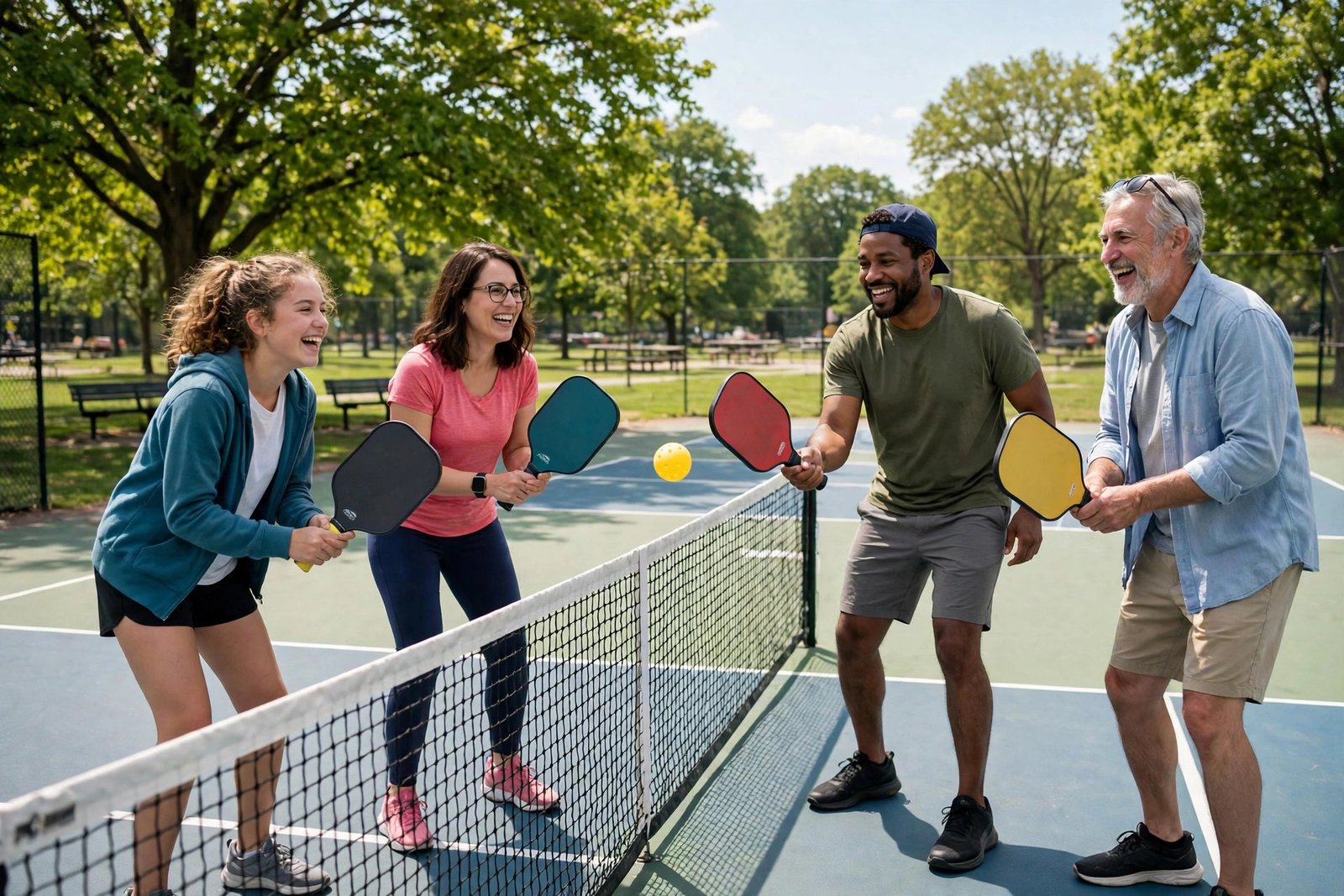
If you have driven past a public park in the last few years and heard a sharp, cheerful popping sound, you have probably heard pickleball. The game — a mix of tennis, badminton, and table tennis, played with a paddle and a perforated plastic ball on a court about a quarter the size of a tennis court — has become America’s fastest-growing sport, named to that title by the Sports and Fitness Industry Association for five consecutive years, 2021 through 2025. Its 2024 report counted nearly 20 million participants in the United States, a staggering rise for a game invented by three dads trying to entertain bored children.
Pickleball’s appeal is easy to understand once you play it. The court is small, so you do not need to be fast to cover it. The paddle is light and the ball is slow, so rallies last longer than in tennis and beginners can hold a real rally within minutes. The game is almost always played as doubles, so it is social by design. And it is cheap: a paddle, a ball, and a public court are often all you need. In a country where adult friendships and exercise both feel harder to come by, pickleball offers both at once — which may be the real secret of its success.
Invented on a Bainbridge Island driveway in 1965
Pickleball was invented in the summer of 1965 on Bainbridge Island, near Seattle, Washington, by Joel Pritchard, Bill Bell, and Barney McCallum. The story, retold by the sport’s governing body and by the families involved, goes like this: Pritchard and Bell returned from golf one afternoon to find their families bored, with a badminton court on site but no full set of rackets. They improvised with ping-pong paddles and a perforated plastic ball, lowered the badminton net, and invented a game on the spot. McCallum, a builder, crafted the first paddles by hand in his woodshop.
The name’s origin is affectionately disputed. One story says the game was named after the Pritchards’ dog, Pickles, who chased stray balls. Another says it comes from the “pickle boat” in rowing — a crew made up of leftover oarsmen from other boats — a fitting metaphor for a game assembled from leftover equipment. Either way, the name stuck, and the game spread first by word of mouth, then by clubs and tournaments. The first known pickleball tournament was held in Tukwila, Washington, in 1976, and the United States Amateur Pickleball Association was organized in 1984, publishing the first rulebook.
By 1990, pickleball was being played in all 50 states, but it remained a niche pastime, popular especially among retirees in the Sun Belt. The explosion came later, driven by the pandemic years, when outdoor, socially distanced recreation boomed, and by the game’s natural fit for social media: short, funny, shareable rallies. In 2022, Washington made pickleball its official state sport, a hometown honor for a game that had quietly gone national.
How the game actually works
For newcomers, the rules are simpler than they look. Pickleball is played on a court 20 feet wide and 44 feet long, with a net 36 inches high at the sidelines and 34 inches in the center. Players use solid paddles — wood, composite, or graphite — and a plastic ball with holes, similar to a Wiffle ball. The serve is underhand, hit diagonally, and the ball must clear a seven-foot “non-volley zone” near the net, universally nicknamed the kitchen.
The kitchen rule is the game’s great equalizer. You cannot smash a volley while standing in the kitchen, which prevents tall, powerful players from dominating the net and keeps rallies long and tactical. Scoring is also distinctive: only the serving side scores, games are usually played to 11, and you must win by two. The “two-bounce rule” requires the serve and the return to bounce before volleys are allowed, which slows the opening of each point and gives everyone time to get into position.
That design is why pickleball works across ages and abilities in a way tennis rarely does. A grandparent and a grandchild can play together and both have fun. A former tennis player can pick it up in an afternoon. A complete beginner can learn the basics in a single session at a park clinic. The learning curve is gentle, but the ceiling is high: professional players hit with spin, speed, and strategy that would surprise anyone who thinks of pickleball as a retirement hobby.
The boom: courts, clubs, and a little controversy
The numbers tell the story. The Sports and Fitness Industry Association’s 2024 report found 19.8 million participants, up 311 percent since 2021. Towns across America have converted underused tennis courts into pickleball courts, and dedicated pickleball facilities — indoor and outdoor — have opened in suburbs, cities, and resorts. Two professional tours, the Professional Pickleball Association and the Association of Pickleball Professionals, now draw television coverage and sponsors, and Major League Pickleball has turned the sport into a team event with drafts and franchises.
Growth has brought friction, too, and it is worth being honest about it. The popping sound of pickleball carries, and neighbors near new courts have complained about noise, leading some towns to restrict hours or require quieter equipment. Tennis players have grumbled about losing courts to conversion. And the sport’s rapid professionalization has sparked disputes over tours, contracts, and governance. None of this has slowed the recreational boom, but it is a reminder that any sport that grows this fast will have growing pains.
There is also a serious side to the fun. Studies and doctors note that pickleball provides genuine cardiovascular exercise, improves balance and coordination — especially valuable for older adults — and offers social connection that researchers link to better health. Injuries happen, of course, especially among enthusiastic newcomers who play hard without warming up, so the standard advice applies: warm up, wear court shoes, and build up gradually. The sport’s low-impact reputation should not be mistaken for no-impact.
How to start playing this week
Starting is easier than for almost any other sport. Search for public courts near you — many parks departments list them, and USA Pickleball, the sport’s governing body, maintains a places-to-play directory. Most parks have open play sessions where newcomers are welcomed and equipment is shared. If you buy a paddle, a mid-priced composite paddle is a good first investment; you do not need the lightest or most expensive model to enjoy the game.
Take a beginner clinic if one is offered. An hour of instruction will teach you the serve, the kitchen rule, and basic positioning, and it will connect you with other beginners. Wear court shoes, not running shoes — the lateral movement in pickleball punishes running shoes’ high soles — and bring water. Play doubles first; it is the social heart of the game, and a good partner will cover your mistakes while you learn.
Above all, embrace the culture. Pickleball’s etiquette is part of its charm: players rotate in and out during open play, call their own lines honestly, and applaud good shots even from opponents. It is a sport that takes itself seriously enough to be fun and lightly enough to welcome everyone. That combination is rare, and it is why the popping sound in the park is not going away.
The social side: why doubles matters
Ask regular players what keeps them coming back, and most will not mention fitness first. They will mention people. Pickleball is overwhelmingly a doubles game, and doubles changes the social math of sport. You share the court, cover for each other, celebrate good shots together, and — during open play at public parks — rotate partners constantly, meeting new people every session. For retirees who have moved to a new town, for remote workers whose social circles shrank, and for newcomers to a city, the pickleball court has become an unlikely community center.
That social structure also explains why the sport spreads the way it does: by invitation. A player brings a friend, the friend brings a spouse, the spouse brings a neighbor, and within weeks a new group has formed. Leagues and ladders formalize the habit, with weekly sessions and friendly rivalries, but the entry point is almost always personal. Pickleball’s growth, in other words, is not primarily a marketing story. It is a friendship story that happens to involve a paddle.
Frequently asked questions
When was pickleball invented? In the summer of 1965, on Bainbridge Island, Washington, by Joel Pritchard, Bill Bell, and Barney McCallum.
Why is it called pickleball? The origin is disputed: one story credits the Pritchards’ dog Pickles, another the rowing term “pickle boat” for a crew of leftovers.
How many Americans play pickleball? The Sports and Fitness Industry Association’s 2024 report counted 19.8 million participants, and named it America’s fastest-growing sport for the fifth straight year in 2025.
Is pickleball hard to learn? No. Most beginners can rally within a single session, thanks to the small court, light paddle, and slow ball.
What equipment do I need? A paddle, a perforated plastic ball, court shoes, and access to a court. Many parks offer open play with shared equipment for newcomers.
Related reading
- Gym Bros vs. Pilates: The Viral Workout Humbling America
- The Great American Gas-Station Snack Culture: A Road Tripper’s Guide
- Pumpkin Everything: How Fall Baking Became an American Autumn Lifestyle
Sources: USA Pickleball history and Sports and Fitness Industry Association participation reports, via EBSCO Research Starters (ebsco.com); DUPR, “The Real Story of How Pickleball Started” (dupr.com).