
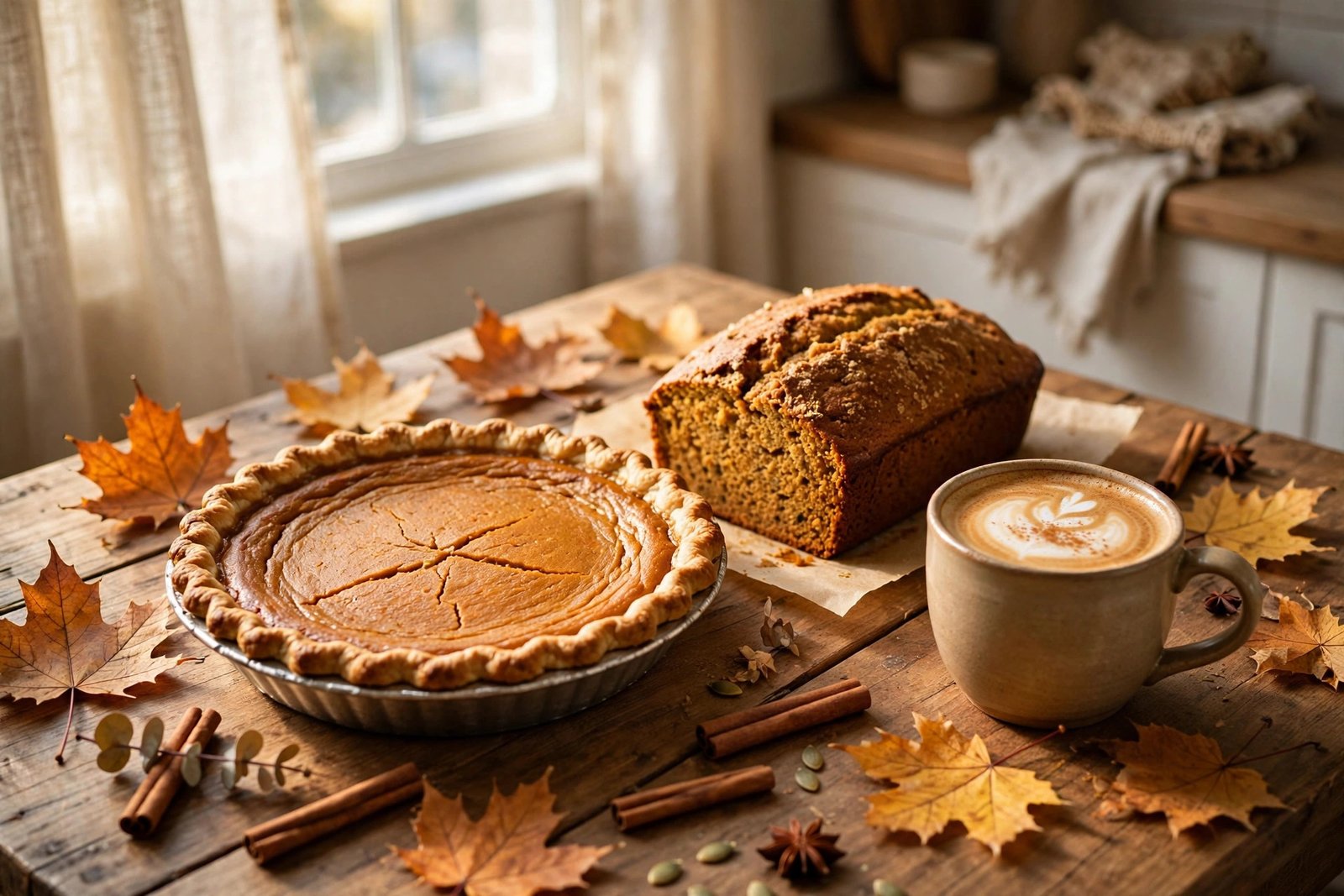
Every year, long before the first leaf turns in many parts of the country, the smell of cinnamon, nutmeg, ginger, and clove starts drifting out of American kitchens and coffee shops. It is the smell of fall baking, and for millions of people it has become as much a marker of the season as cooler evenings, football weekends, and Halloween decorations. Pumpkin pie was once the star of a single holiday meal. Today, pumpkin everything is a whole lifestyle — a way of slowing down, gathering people, and marking the change of seasons with food that feels warm, familiar, and a little bit celebratory.
What makes this story so interesting is that pumpkin spice itself is not new at all. The blend of warm spices used to flavor pumpkin pie has been part of American cooking for generations, and pumpkin has been grown and eaten in North America for centuries. What changed was not the ingredient, but the culture around it. A seasonal drink, a wave of home baking, social media, and a shared love of cozy rituals turned a Thanksgiving dessert into an autumn identity that now stretches from late summer through Thanksgiving and beyond.
From the Thanksgiving Table to the Center of Autumn
For most of American history, pumpkin belonged firmly to the harvest table. Pumpkin pie, made with a spiced custard filling in a flaky crust, was the dessert people expected at Thanksgiving, and for many families it still is. The pie carried memories: a grandmother’s recipe card, a kitchen crowded with relatives, the first slice served warm with whipped cream while everyone lingered at the table. That emotional connection matters, because pumpkin spice is rarely just about flavor. It is about nostalgia, and nostalgia is powerful when the days get shorter and people start looking for comfort.
Spice companies understood that connection early. McCormick launched its Pumpkin Pie Spice in 1934, giving home bakers a convenient blend so they no longer had to buy each spice separately. The idea was simple and practical: one jar, consistent flavor, less measuring. That jar quietly helped standardize what pumpkin pie should taste like across the country, and it kept the spice blend in American pantries for decades before anyone talked about a pumpkin spice season. Even today, a large share of the blend’s retail sales fall in autumn, which tells you how closely the flavor is tied to this one season.
Pumpkin itself has an even older American story. Pumpkins are native to North America, and early American cooks learned to bake, roast, and preserve them long before pumpkin pie became a holiday classic. The earliest known English recipe for pumpkin pie dates to the seventeenth century, and by the time Amelia Simmons published American Cookery in 1796, pumpkin-based dishes were already part of the new nation’s cooking. In other words, pumpkin did not arrive with modern marketing. Modern marketing arrived and found a food that already felt deeply American.
The Latte That Changed the Season
The turning point came in the fall of 2003, when Starbucks tested a new seasonal drink in about one hundred stores in Washington, D.C., and Vancouver, Canada. The Pumpkin Spice Latte, soon nicknamed the PSL, combined espresso, steamed milk, and a pumpkin spice sauce, topped with whipped cream and pumpkin pie spices. The test was an instant hit, and the following fall the drink rolled out across the United States and Canada. Starbucks has since described it as its best-selling seasonal beverage, and the company celebrated the drink’s twentieth anniversary in 2023.
The story behind the drink is a useful reminder that big cultural moments often start small. In 2003, Starbucks product developer Peter Dukes and his team were looking for a fall counterpart to the Peppermint Mocha, the winter seasonal drink that had become a hit the previous year. After brainstorming a long list of ideas, they settled on pumpkin pie as inspiration, sampling pumpkin pie and sipping espresso to find the flavors that worked best together. They spent months refining the balance of pumpkin and spice, and they briefly considered calling the result the Fall Harvest Latte before choosing Pumpkin Spice Latte, a name that put the two most recognizable words front and center.
At first, the original Starbucks version contained no actual pumpkin. That changed in 2015, when the company updated its pumpkin sauce to include real pumpkin puree. The change mattered less for taste than for credibility: fans who loved the drink wanted it to feel genuine, not just flavored. Around the same time, other coffee chains, bakeries, and grocery brands began offering their own pumpkin spice drinks and foods, and the season started to expand. What had been a single drink became a signal. When the PSL returned, fall had officially begun, even if the calendar and the weather had not quite caught up.
Why Pumpkin Spice Took Over Autumn
So why did this particular flavor take over, when so many other seasonal flavors come and go? Part of the answer is scarcity. Pumpkin spice products are available for a limited time, and limited time makes people pay attention. Psychologists who study nostalgia and consumer behavior have pointed to two forces working together: the comfort of familiar, sentimental flavors, and the urgency of a short season. When something you love disappears in a few weeks, you are more likely to buy it now, talk about it, and plan a trip to get it.
Social media gave that urgency a megaphone. As platforms like Facebook and Twitter grew in the mid-2000s, fans began sharing photos of their first PSL of the season, their fall baking projects, and their decorated porches. The drink became a photo, a ritual, and a conversation starter all at once. Soon, the return date itself became news, debated and anticipated like the start of a sports season. Brands noticed, and the season began creeping earlier each year, with pumpkin spice products now often appearing in stores in August, well before the autumn equinox.
The scale of that shift is striking. NielsenIQ recorded more than $1.1 billion in United States pumpkin spice product sales in 2023, a figure that covers a wide range of grocery and seasonal goods. That number does not mean every American loves pumpkin spice — in fact, recent consumer research has also found a real sense of pumpkin spice fatigue among some shoppers, with apple flavors gaining ground in preference surveys. But it does show how a once-narrow holiday flavor became a major seasonal category, spanning coffee, baked goods, breakfast foods, candles, and even beauty products.
Fall Baking at Home: Where the Lifestyle Really Lives
If the latte started the trend, home baking is where it became a lifestyle. Fall baking is slower, messier, and more personal than ordering a drink, and that is exactly the point. A pumpkin bread loaf cooling on the counter, a tray of pumpkin muffins for a school morning, a pumpkin cheesecake made the night before a family dinner — these are small acts of care that turn an ordinary week into something seasonal. Baking gives people a reason to gather in the kitchen, to use up a can of pumpkin puree, and to share something warm with neighbors, coworkers, and friends.
The classics still anchor the season. Pumpkin pie remains the centerpiece, and many families guard their recipe fiercely, debating canned versus fresh pumpkin, evaporated milk versus cream, and just how much spice is enough. Pumpkin bread is the everyday hero of fall baking: forgiving, freezable, and perfect for breakfast or an afternoon snack. Pumpkin muffins, pumpkin cookies with cream cheese frosting, pumpkin bars, and pumpkin cheesecake each offer a different way to enjoy the same warm spice profile without repeating the same dessert twice.
What home bakers love about pumpkin is how adaptable it is. Pumpkin puree adds moisture to cakes, breads, and muffins, which makes it forgiving for beginners. The spice blend — typically cinnamon, nutmeg, ginger, and clove, sometimes with allspice — pairs naturally with brown sugar, vanilla, butter, and cream cheese. That means a single spice jar can carry a baker through a whole season of recipes, from a simple loaf to a layered cake. It also means fall baking does not have to be fancy to feel special. A well-made pumpkin bread, still slightly warm, is often more memorable than an elaborate dessert.
Fall baking has also become a way to mark milestones. The first pumpkin pie of the season, the batch of muffins baked for a child’s first day of school in autumn, the dessert brought to a Friendsgiving table — these moments stitch the season together. In a busy, screen-filled life, measuring flour, stirring batter, and waiting for the oven timer offer a rare kind of focus. The kitchen smells wonderful, the house feels warmer, and for an hour or two, the season slows down enough to enjoy.
Beyond the Kitchen: Pumpkin Spice as a Way of Life
Once pumpkin spice left the kitchen, it became shorthand for autumn itself. Walk through a store in September and you will find pumpkin spice coffee creamer, cereal, cookies, candles, soap, and air fresheners, all promising the same cozy feeling. Some of these products are delightful. Others are jokes, novelties, or experiments that go viral precisely because they are unexpected. Either way, they keep the conversation going, and they show how a flavor can become a cultural symbol rather than just an ingredient.
That expansion has a playful side and a backlash side, and both are part of the story. Fans love the ritual, the annual return, and the sense of belonging that comes with sharing a seasonal favorite. Critics roll their eyes at the early launch dates and the sheer number of pumpkin-flavored products. Both reactions prove the same thing: pumpkin spice is no longer just a taste. It is a shared reference point, something people can bond over or joke about, and that shared language is what turns a food trend into a lifestyle.
The smartest way to enjoy the season is to keep it personal rather than commercial. Choose the pumpkin things you actually love — maybe it is a homemade pie, a favorite coffee order, or a candle that makes your living room feel like October — and skip the rest. Bake one recipe really well instead of buying everything with a pumpkin label. Invite someone over for coffee and pumpkin bread instead of just posting a photo of it. The lifestyle part of pumpkin everything was never really about buying more. It was about noticing the season and making room for it.
How to Make Fall Baking Part of Your Autumn
If you want to bring more fall baking into your own autumn, start small and build a rhythm. Pick one weekend in early fall to bake a pumpkin loaf and freeze half for later. Try a new recipe each week, but keep your favorite as an anchor. Stock your pantry with pumpkin puree, a good spice blend, brown sugar, and vanilla before the season gets busy, so baking feels easy rather than like another errand. And remember that pumpkin baking pairs beautifully with other autumn traditions: apple picking, a walk through falling leaves, a pot of soup on the stove, or a movie night with a warm slice of pie.
For beginners, pumpkin bread and pumpkin muffins are the best starting points because they are hard to ruin and easy to share. For more confident bakers, a pumpkin cheesecake or a lattice-topped pumpkin pie makes a wonderful project for a holiday table. Whatever you choose, let the spice do its work without overpowering the pumpkin. Taste your batter, trust your oven, and do not be afraid to adjust the spice to your own preference. Recipes are guides, not rules, and the best fall baking is the kind that tastes like your kitchen.
It is also worth remembering that autumn belongs to more than one flavor. Apple, cinnamon, maple, pecan, and cranberry all deserve a place on the fall table, and many bakers rotate through them as the season progresses. Pumpkin spice may get the headlines, but a good autumn kitchen makes room for all of it. That variety keeps the season from feeling repetitive, and it gives pumpkin its proper moment without asking it to carry every week from August to Thanksgiving.
Frequently Asked Questions
When did pumpkin spice become popular in America?
Pumpkin pie spice blends date back to the 1930s, when McCormick launched its Pumpkin Pie Spice in 1934, but the modern pumpkin spice boom began with the Starbucks Pumpkin Spice Latte, tested in the fall of 2003 and rolled out nationwide the following year. From there, the flavor spread from coffee into baking, groceries, and lifestyle products.
What spices are in pumpkin spice?
A typical pumpkin spice blend combines cinnamon, nutmeg, ginger, and cloves, sometimes with allspice. The blend was originally designed to flavor pumpkin pie, which is why it pairs so well with pumpkin puree, brown sugar, butter, and cream cheese in fall baking.
Does the Starbucks Pumpkin Spice Latte contain real pumpkin?
Yes, since 2015 the Starbucks pumpkin sauce has included real pumpkin puree. The original 2003 version was flavored with pumpkin spice sauce but did not contain actual pumpkin, a detail the company changed after fans asked for a more authentic recipe.
Why do pumpkin spice products appear so early in the year?
Brands release pumpkin spice products earlier each year because demand is strong and the short season creates urgency. Fans anticipate the return, stores compete to be first, and social media turns the launch date into an event, even when summer weather is still lingering.
Related reading
- Front-Yard Halloween Decorating Arms Race
- Salem, Massachusetts in October: Halloween Crowds
- National Candy Corn Day and the Halloween Candy Economy
Sources: Starbucks on the history of the Pumpkin Spice Latte, Pumpkin Spice Latte history, and Firstpost on pumpkin spice history and sales.