
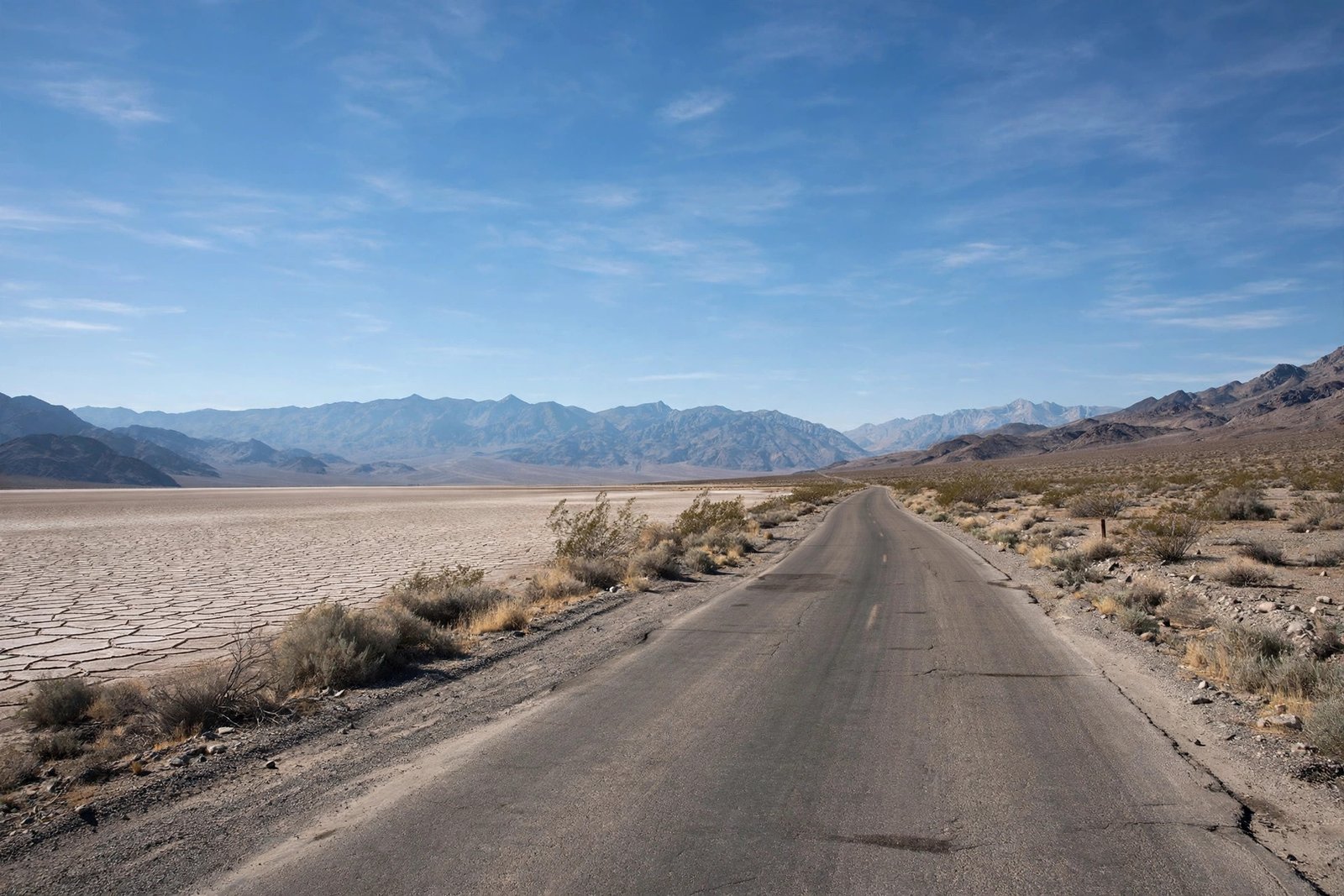
There is a place in the Nevada desert that the United States government refused to admit existed for more than half a century. It appears in movies, video games, and conspiracy theories. Millions of people showed interest in storming it in 2019. And yet, when the government finally acknowledged it, the truth was both more ordinary and more remarkable than the legends: Area 51 is a real, highly classified Air Force flight-test facility, and its confirmed job — testing some of America’s most advanced aircraft — is impressive enough without any aliens at all.
Area 51 sits at Groom Lake, a dry lake bed in southern Nevada, about 83 miles north-northwest of Las Vegas, inside the Nevada Test and Training Range. It is officially called Homey Airport, a remote detachment administered by Edwards Air Force Base in California. Its operations are not made public, but the Air Force describes it as an open training range, and it is widely understood to support the development and testing of experimental aircraft and weapons. That is the documented core. Everything else — the crashed saucers, the alien bodies, the secret hangars — belongs to a different category: stories that grew in the gap where facts were classified.
How a dry lake became the most secret place in America
The story begins in 1955, in the middle of the Cold War. The United States needed photographs of the Soviet interior, and its existing aircraft could not fly high enough to survive Soviet defenses. The answer was the U-2, a reconnaissance plane designed to fly above 70,000 feet — higher than any fighter or, it was believed, any missile of the time. But the U-2 needed a remote place to be tested in secret, far from prying eyes.
In April 1955, a small team from the CIA, the Air Force, and Lockheed’s Skunk Works — led by legendary aircraft designer Clarence “Kelly” Johnson and CIA officer Richard Bissell — surveyed the Nevada desert from a small plane and spotted an old airstrip beside the Groom Lake salt flat, inside the Nevada nuclear test range. President Dwight Eisenhower approved adding the area to the range, and the site took its name from its designation on Atomic Energy Commission maps: Area 51. The first U-2 arrived in July 1955, and test flights began that summer.
Secrecy was total. The site did not appear on public maps. Workers flew in on unmarked planes and were forbidden to discuss their jobs. The surrounding airspace was restricted, and the government answered questions about the base with silence — or, famously, with neither confirmation nor denial. For a country in the grip of Cold War anxiety and a growing fascination with flying saucers, that silence was an invitation.
Why UFO sightings and Area 51 became inseparable
The connection between Area 51 and UFOs is not a coincidence, and it is not entirely invented. In the mid-1950s, commercial airliners flew at 10,000 to 20,000 feet, and military aircraft rarely exceeded 40,000 feet. The U-2, cruising above 70,000 feet and catching sunlight long after sunset on the ground, looked like nothing anyone had ever seen: a bright, fast-moving object high in the sky, sometimes leaving unusual contrails. People reported what they saw, honestly, and the reports reached Project Blue Book, the Air Force’s UFO investigation program.
Blue Book’s analysts, according to the CIA’s own declassified history, quietly cross-checked sightings against classified flight logs. When a sighting matched a U-2 flight, they closed the case with a conventional explanation — a weather phenomenon, an astronomical object — that they knew was incomplete, because telling the truth would have revealed a top-secret program. The cover stories worked as security, but they also fed suspicion: when the official explanation plainly did not fit what people had seen, some concluded that something stranger was being hidden.
The pattern repeated with later aircraft tested at Groom Lake. The A-12, developed under the OXCART program and tested from 1962, was the forerunner of the SR-71 Blackbird and flew at more than three times the speed of sound at 80,000 feet. The F-117 Nighthawk, America’s first stealth fighter, was also developed and tested there. Each new shape in the Nevada sky — angular, silent, impossibly fast — generated a fresh wave of reports, and each wave added a layer to the legend. By the time popular culture caught up, Area 51 was shorthand for government secrets of every kind.
What the government actually admitted in 2013
For decades, the official position was silence. Then, in June 2013, the CIA released a declassified history of the U-2 and OXCART programs — The Central Intelligence Agency and Overhead Reconnaissance: The U-2 and OXCART Programs, 1954–1974 — in response to a Freedom of Information Act request filed in 2005 by Jeffrey Richelson of George Washington University’s National Security Archive. The document named Area 51 and Groom Lake, included a map of the area, and described the site’s selection and purpose in detail.
Headlines around the world announced that the government had finally “acknowledged Area 51.” That framing was, strictly speaking, misleading in an interesting way: the Air Force had acknowledged the site’s existence as early as 1998. What the 2013 release did for the first time was officially acknowledge specific activity at the site — that the U-2 was tested there. It contained, notably, no mention of extraterrestrials, crashed saucers, or alien technology. The CIA’s historians were explicit that the document was an institutional history of spy planes, not a UFO disclosure — a distinction that much of the coverage blurred.
That nuance matters, because it is the key to understanding Area 51 honestly. The declassified record confirms a real secret program, conducted for real strategic reasons, with real consequences for American security. It does not confirm — or even discuss — the legends. The absence is itself informative: after decades of secrecy, the document that finally opened the file described airplanes, not aliens.
The legends that will not die
And yet the legends persist, because they serve purposes that the documented record does not. The most famous claims — that the government recovered a crashed alien spacecraft near Roswell, New Mexico, in 1947 and stored it at Area 51, or that alien bodies were studied there — have no support in any declassified document, and the Air Force’s own explanation of Roswell involves a classified balloon program called Project Mogul. Believers reply that the most important documents would remain classified, which makes the theory unfalsifiable: no release, however complete, can disprove a secret that is defined as unreleasable.
Popular culture has done the rest. Area 51 appears in films, television, and games as the ultimate secret base, and in 2019, a joke Facebook event called “Storm Area 51, They Can’t Stop All of Us” attracted millions of responses, prompting the Air Force to warn people away and spawning a real, if much smaller, festival in the nearby towns of Rachel and Hiko, Nevada. The event was a joke that revealed something true: Area 51 has become a shared cultural myth, a place Americans argue about precisely because they cannot visit it.
It is worth stating plainly for anyone planning a trip: Area 51 is an active military installation, it is not open to the public, and its perimeter is guarded. The nearby Extraterrestrial Highway (Nevada State Route 375), the town of Rachel, and the Little A’Le’Inn restaurant are real and welcoming to visitors, and they offer a safe, legal way to experience the legend’s landscape. Trespassing on the base itself is a federal offense, and the guards, cameras, and warning signs are not theatrical props.
Why the real story is better than the myth
There is a temptation to treat Area 51 as a joke or a conspiracy, but the documented history deserves respect on its own terms. The U-2 program, for all its secrecy, was a genuine intelligence achievement that shaped Cold War diplomacy — including the 1960 crisis when a U-2 piloted by Francis Gary Powers was shot down over the Soviet Union. The A-12 and SR-71 pushed aviation to speeds and altitudes that still impress engineers today. The F-117 changed aerial warfare. All of that happened, in part, at a dry lake in Nevada that officially did not exist.
The deeper lesson of Area 51 is about secrecy itself. When a government hides something real — even for good reasons — the vacuum fills with stories, and those stories can outlive the secret by decades. The 2013 declassification answered the question of what Area 51 was for, but it could not unwrite fifty years of mythology. That is why the base remains, in the public imagination, both a place and an idea: a symbol of everything we suspect is kept from us, and a reminder that sometimes the truth, once released, is extraordinary enough.
Frequently asked questions
What is Area 51? A highly classified U.S. Air Force facility at Groom Lake in southern Nevada, officially called Homey Airport, used for testing experimental aircraft.
When did the government acknowledge Area 51? The Air Force acknowledged the site’s existence in 1998. In 2013, the CIA released a declassified history that officially acknowledged specific activity there — testing of the U-2 spy plane.
Was Area 51 built for the U-2? Yes. The site was selected in 1955 specifically to test the U-2 reconnaissance aircraft, and later hosted the A-12 and F-117 programs.
Is there evidence of aliens at Area 51? No declassified document supports claims of extraterrestrial craft or bodies at the site. The documented, confirmed use is flight testing.
Can you visit Area 51? No. It is an active military installation closed to the public. Visitors can legally explore the nearby Extraterrestrial Highway and the town of Rachel, Nevada.
Related reading
- The Beast of Bray Road: Wisconsin’s Werewolf Legend
- Mothman Turns 60: The Point Pleasant Legend That Won’t Die
- The Stanley Hotel: The Real Story Behind America’s Most Famous Haunted Hotel
Sources: Britannica, “Area 51” (britannica.com); CIA declassified history of the U-2 and OXCART programs, released 2013 via the National Security Archive.