
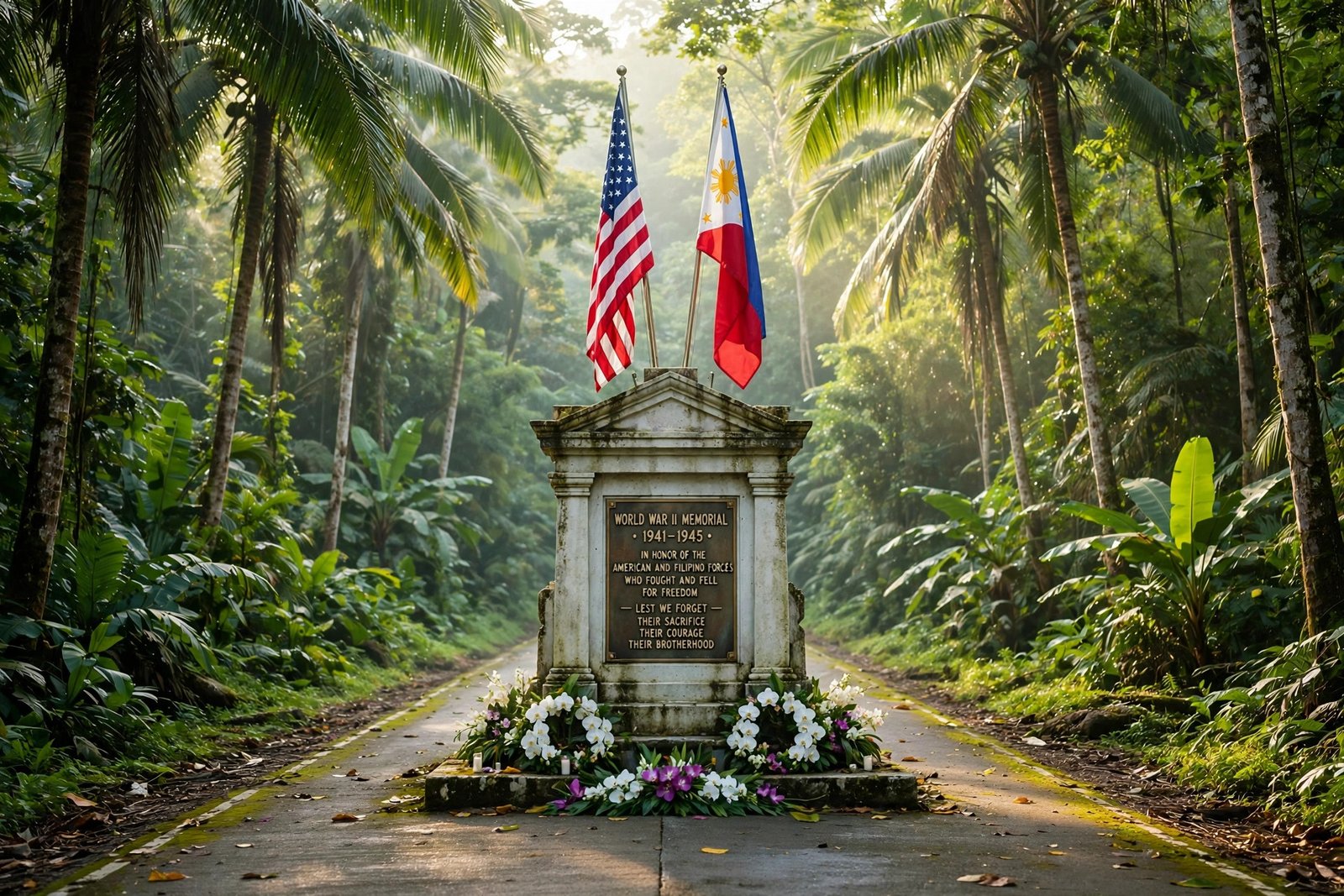
On April 9, 1942, the largest surrender of American-led forces in history took place on a peninsula in the Philippines. After four months of fighting, starvation, and disease, some 76,000 Filipino and American soldiers laid down their arms on Bataan. What followed was one of the most brutal episodes of World War II: a 65-mile forced march in tropical heat, without food or water, in which thousands of men were beaten, bayoneted, and shot — and thousands more died in the prison camp that waited at the end.
Americans call it the Bataan Death March. The men who survived it called it simply “the march.” For decades, many of them did not talk about it at all. This is the story of what happened on Bataan, and of the soldiers who endured it.
The Fall of Bataan
Japan attacked the Philippines on December 8, 1941, hours after Pearl Harbor. The American and Filipino forces under General Douglas MacArthur were outnumbered and outgunned, and by late December they had retreated to the Bataan Peninsula, a jungle-covered thumb of land across Manila Bay from the capital. The plan was to hold out until reinforcements arrived from the United States. The reinforcements never came.
For four months, the defenders of Bataan fought on dwindling rations. By March 1942, the men were living on about 1,000 calories a day — half of what a soldier needs — and malaria, dysentery, and beriberi were sweeping through the ranks. Ammunition ran low. Medicine ran out. MacArthur was ordered to leave for Australia, and command passed to Major General Edward P. King Jr. On April 9, with his men starving and his lines collapsing, King surrendered. It was the largest surrender of American forces since the Civil War, and it included about 12,000 Americans and 64,000 Filipinos.
The March Begins
The Japanese had expected about 25,000 prisoners. They got three times that many, and they were not prepared. The plan was to march the prisoners 65 miles north to Camp O’Donnell, a former Filipino training camp, where they would be held. The march began on April 10, in the dry season, under a tropical sun that pushed temperatures past 100 degrees.
The prisoners were given almost no food and no water. They marched in groups of hundreds, and anyone who fell behind was beaten or killed. Men who stopped to drink from roadside puddles were shot or bayoneted. Filipino civilians who tried to hand food or water to the marchers were beaten, and sometimes killed. The Japanese guards, themselves exhausted and operating under a military culture that despised surrender, treated the prisoners with casual cruelty. Men collapsed from heat, dehydration, and disease. Some were beheaded. Some were run over by trucks. The bodies were left where they fell.
The march took days. The distance was about 65 miles, but the prisoners were held in staging areas along the way, and the journey stretched over a week for many groups. Historians estimate that between 5,000 and 10,000 Filipino soldiers and 600 to 650 Americans died on the march itself, though the exact numbers remain uncertain because the Japanese kept no reliable records. Thousands more died in the weeks that followed.
Camp O’Donnell: The March After the March
The march ended at Camp O’Donnell, but the dying did not stop. The camp was a half-finished training ground with almost no water, no sanitation, and no medical care. Prisoners were packed into barracks built for a fraction of their number. Dysentery spread through the camp within days. Men died at a rate of hundreds per day in the first weeks. By the end of 1942, thousands more had died at O’Donnell and at Cabanatuan, the camp where most of the American prisoners were later moved.
The survivors were sent to work in Japan, in mines and factories, or to other prison camps across the occupied Pacific. Many died on the “hell ships” that carried them — unmarked vessels that Allied submarines sometimes sank, not knowing American prisoners were aboard. Of the roughly 12,000 Americans who surrendered on Bataan, only about 8,000 were alive at the end of the war. The Filipino death toll was far higher, and the exact number will never be known.
The Men Who Came Home
The survivors of Bataan came home to a country that did not know what to do with them. The Army told many of them not to talk about what had happened — the full story of the march was kept quiet during the war to avoid provoking Japan over the treatment of prisoners, and after the war, many men found they simply could not describe it. Some suffered from what we now call post-traumatic stress for the rest of their lives. Some never spoke of Bataan to their families at all.
Justice came slowly. General Masaharu Homma, the Japanese commander in the Philippines, was tried for war crimes and executed in 1946. Other officers responsible for the march were tried and punished, though many escaped justice. The march became a defining symbol of Japanese war crimes, and the phrase “Bataan Death March” entered the language as shorthand for cruelty in war.
In the decades since, the survivors built a community. The American Defenders of Bataan and Corregidor, founded by the survivors themselves, kept the memory alive, fought for recognition and benefits, and pushed for the story to be taught. Every year, the Bataan Memorial Death March is held at White Sands Missile Range in New Mexico, where thousands of marchers — soldiers, veterans, and civilians — walk 26 miles through the desert in honor of the men who marched in 1942. The event has grown into one of the largest memorial marches in the country.
Why Bataan Still Matters
Bataan matters for two reasons. The first is the scale of the suffering: tens of thousands of men, most of them Filipino, died because an army that had surrendered was treated as if it had no rights at all. The march is a reminder that the laws of war exist for a reason, and that what happens after a battle can be as terrible as the battle itself.
The second is the men themselves. The defenders of Bataan held out for four months against overwhelming odds, on starvation rations, with no hope of rescue — and they held because they were ordered to, and because their comrades were holding beside them. The march that followed was an atrocity, but the defense that came before it was an act of endurance that the Army still teaches. The soldiers of Bataan did not lose because they were weak. They lost because they were abandoned, outnumbered, and starved — and they kept fighting anyway.
On April 9, 1942, General King surrendered his army. He knew what he was doing. He told his men, “I am doing this to save you.” He was wrong about what would happen next. But the men he surrendered did not break. They marched, they endured, and those who lived came home and built lives — and made sure America never forgot what happened on the road from Bataan to Camp O’Donnell.
Frequently Asked Questions
What was the Bataan Death March?
The forced march of about 76,000 Filipino and American prisoners of war from Bataan to Camp O’Donnell in the Philippines in April 1942, after the surrender of American-led forces to Japan. Prisoners were marched about 65 miles with almost no food or water, and thousands died from heat, disease, and abuse by guards.
How many people died in the Bataan Death March?
Estimates vary because the Japanese kept no reliable records. Historians generally estimate that 5,000 to 10,000 Filipino soldiers and 600 to 650 Americans died during the march itself, with thousands more dying in the prison camps that followed.
Why did the soldiers surrender at Bataan?
After four months of fighting on starvation rations, with malaria and dysentery sweeping the ranks and no reinforcements coming, Major General Edward P. King Jr. surrendered on April 9, 1942, to save his remaining men from being wiped out.
Who was General Homma?
Lieutenant General Masaharu Homma was the Japanese commander in the Philippines. He was tried for war crimes after the war, including responsibility for the Bataan Death March, and executed in 1946.
What is the Bataan Memorial Death March?
An annual memorial event held at White Sands Missile Range in New Mexico, where thousands of participants march 26 miles through the desert to honor the soldiers who endured the 1942 march. It is one of the largest memorial marches in the United States.
How long was the Bataan Death March?
About 65 miles, from the Bataan Peninsula north to Camp O’Donnell. The journey took several days for most groups, with prisoners held in staging areas along the way.
Related Reading
- Military Working Dogs: America’s Four-Legged Soldiers
- How US Soldiers Celebrate Thanksgiving Far From Home
- Sergeant Alvin York: The WWI Hero From Tennessee
Sources: Wikipedia: Bataan Death March; National Park Service: Bataan Death March