
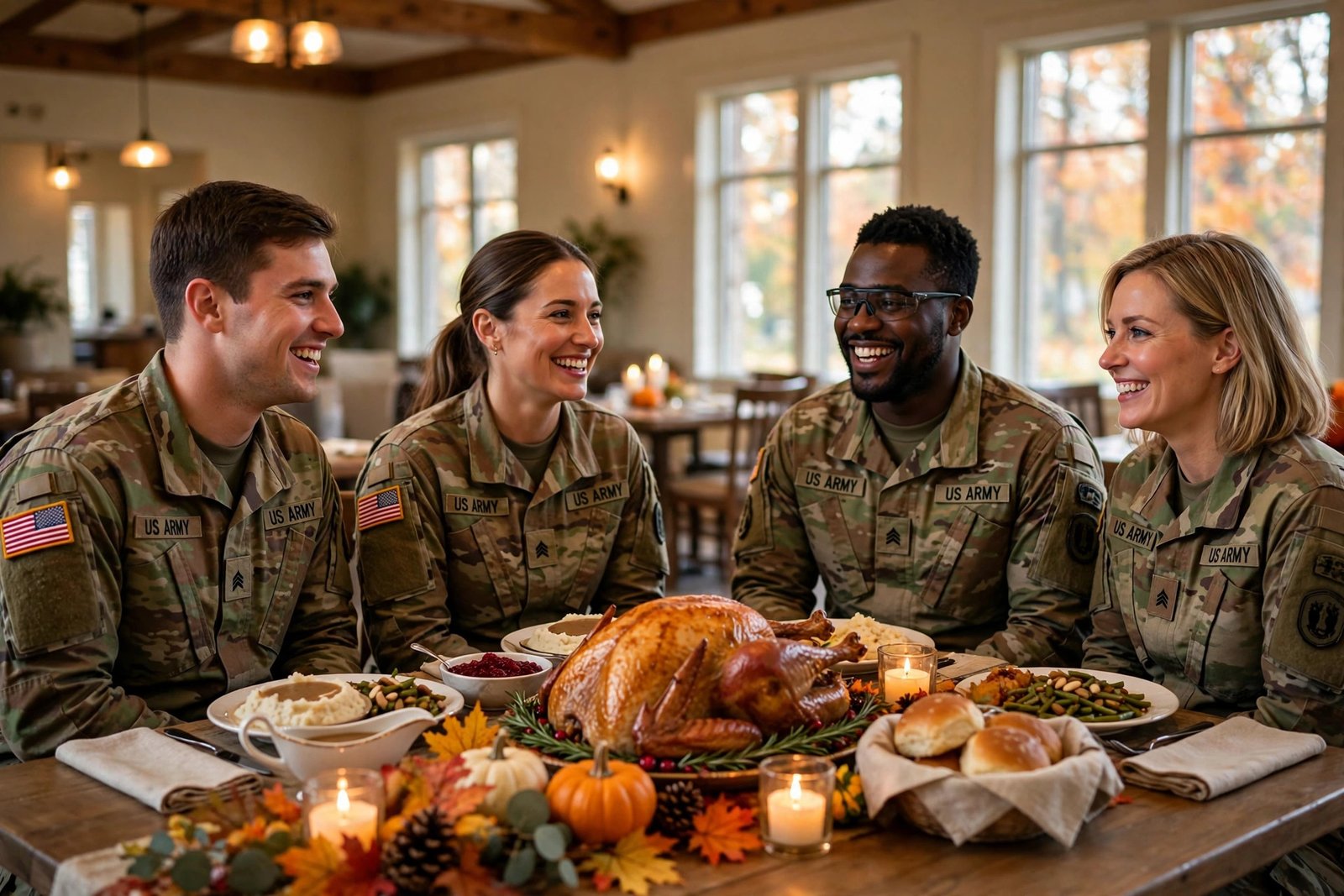
Thanksgiving in America usually means a crowded kitchen, a table full of family, and a turkey that took all day to cook. For thousands of US soldiers, though, the holiday looks very different. They may be in basic training in Missouri, on a base in Germany or South Korea, or deployed to a remote outpost where the nearest familiar face is a fellow soldier in the same unit. There is no drive home for the weekend, no childhood bedroom to sleep in, and no family recipe passed across the table. Yet Thanksgiving still happens — in warrior restaurants, in tents, in USO centres, and over video calls patched through from halfway around the world. It happens because the Army, the USO, and the soldiers themselves work hard to make it happen, and because the holiday, at its heart, is not really about a place. It is about people sitting down together and being grateful for each other.
What follows is a look at how that actually works: the enormous meals cooked in Army dining facilities, the traditions soldiers carry with them and the new ones they invent, the care packages and calls home that bridge the distance, and the quiet moments that make a far-from-home Thanksgiving memorable in its own way. None of it replaces home. But for many soldiers, the Thanksgiving they spend with their unit becomes one of the stories they tell for the rest of their lives.
The Warrior Restaurant: Thanksgiving’s Biggest Kitchen
On most Army posts, the dining facility — now usually called a warrior restaurant — is where Thanksgiving begins. These are not small canteens. At Fort Leonard Wood in Missouri, the Army planned to serve about 12,000 Thanksgiving meals during the lunchtime celebration in 2026, and more than 28,000 meals across the whole day, using thousands of pounds of turkey, prime rib, and shrimp cocktail, with 15 different kinds of cakes and pies. About 850 food-service employees were scheduled to prepare and serve the feast alongside senior leaders. Those numbers, reported by the US Army, give a sense of scale: Thanksgiving in the Army is a logistical operation as much as a meal.
The work starts long before the doors open. At Fort Carson in Colorado, more than 200 facility workers start preparing and cooking the night before, with culinary specialists working through the night to produce the biggest meal of the year. At other posts, cooks are up at three in the morning roasting turkeys while everyone else is still asleep. The menus are deliberately familiar: roast turkey, stuffing, mashed potatoes, gravy, cranberry sauce, sweet potatoes, and pie. Many facilities add prime rib, roasted pig, or shrimp cocktail, and dessert tables groan with cakes and pies made from scratch. The point is not luxury for its own sake. It is recognition — a way of saying to soldiers, many of them far from home for the first time, that this day is different, and that they matter.
There is also friendly competition. Dining facilities compete for the best theme and presentation, from children’s movies to superheroes, with cornucopia displays, ice sculptures, and elaborate decorations. Senior leaders often serve the meal themselves, ladling gravy and carving turkey alongside the cooks, a small gesture that soldiers notice and remember. For trainees in basic training, who cannot go home and who may be eating their first holiday meal in uniform, that dining hall — noisy, decorated, full of people in the same situation — can feel, for an hour or two, a little like a family gathering.
A First Holiday Away From Home
For many young soldiers, Thanksgiving in the Army is the first major holiday they have ever spent away from family, and that fact shapes the whole day. Beverly Leggett, the Installation Food Program manager at Fort Leonard Wood, put it simply when she said that for many soldiers, this may be the first holiday they have ever spent away from family. That is why the dining teams plan festive decorations and a welcoming atmosphere, not just food. A soldier who walks in feeling homesick should walk out feeling looked after, even if only for the length of a meal.
Colonel Jeremy Kerfoot, chief of staff at Fort Leonard Wood’s Maneuver Support Center of Excellence, has spoken about his own first Thanksgiving away from family while deployed, and how spending the time with his platoon became memorable because they shared stories about what they were thankful for and about their own Thanksgiving traditions. That sharing is a quiet tradition in itself. Around a table in a dining facility or a tent, soldiers compare notes: whose grandmother made the best stuffing, whose family watched football all afternoon, whose house always ran out of pie before dessert was over. The stories do two things at once. They keep home alive in memory, and they turn strangers in a unit into people who know something real about each other.
Thanksgiving Downrange: Deployed and Far From Home
Deployed soldiers face a harder version of the same holiday. They may be in a desert outpost, on a ship, or at a small base where a full Thanksgiving dinner has to be flown, driven, or shipped in. The USO, which operates more than 250 centres around the world, works to bring a taste of home to even the most remote locations — a home-cooked Thanksgiving meal in Djibouti, Christmas cookies in Okinawa, or a family-recipe night in Saudi Arabia where deployed service members cook the dishes their families make back home. Those meals are not always fancy. Sometimes they are served in a tent, on paper plates, with plastic cutlery. But the effort behind them is what soldiers remember.
On ships, the challenge is different again. Space is tight, privacy is scarce, and the crew works in shifts around the clock, so Thanksgiving has to fit around the mission. USO centres on Navy ships have included soundproof phone booths so sailors can call home in private — a small thing that makes an enormous difference when you are sharing close quarters with hundreds of shipmates. Aboard ship and on land, chaplains often hold Thanksgiving services, and units organise their own small celebrations: a football game in the dust, a talent show, a shared playlist of songs from home.
The food itself sometimes arrives in surprising ways. Care packages from home, unit funds, and donations from support organisations all play a part. A soldier who opens a box to find a favourite snack, a handwritten note, or a packet of hot chocolate mix has received more than calories. They have received proof that someone, somewhere, was thinking of them on a day when thinking of home hurts a little more than usual. That is why the USO and other groups put so much effort into holiday care packages, with socks, beanies, hand warmers, candy, toiletries, and snacks chosen specifically for deployed troops.
Care Packages, Letters, and Small Comforts
If the warrior restaurant is the centrepiece of Thanksgiving on a big post, the care package is its quiet counterpart downrange. The USO Care Package Program provides service members with snack and toiletry items designed to support them during deployment, packed in canvas bags that can attach to military gear. A special holiday care package may include socks, a beanie, hand warmers, and candy alongside the usual toiletries and energy-boosting snacks. None of these items is expensive. All of them are useful, and all of them say the same thing: you are not forgotten.
Families and friends back home play a central role here, and the advice from support organisations is consistent: send things that travel well and that feel personal. Non-perishable snacks such as jerky, trail mix, nuts, and dried fruit are always welcome. Powdered drink mixes, condiments to liven up field rations, and individually packed protein snacks are practical choices. Toiletries — lip balm, shampoo, lotion, sunscreen, deodorant, hand sanitiser — are genuinely needed in austere places. And, again and again, the organisations stress the power of a handwritten note. A simple thank-you card, a drawing from a child, or a short letter from a spouse can mean more than anything bought in a shop, because it carries a voice and a hand that the soldier knows.
Timing matters, too, and families learn to plan ahead. Mail to deployed troops takes time, and holiday deadlines for military mail fall weeks before Christmas. For Thanksgiving, the lesson is the same: send early, pack carefully, and do not assume a parcel sent in late November will arrive in time. Even if a package misses the holiday itself, support groups note, it is still welcome — the need does not end when the holiday does, and a late box is still a reminder that home is thinking of you.
Staying Connected to Family Back Home
Connection is the thread that runs through every account of a military Thanksgiving. At USO centres around the world, service members can use free Wi-Fi, phones, and computers to call home and speak with family and friends. On ships, those soundproof booths give sailors a private moment on a crowded vessel. The USO notes that being able to make a simple phone call can make all the difference to the morale of forward-deployed troops during the holidays, and it has made keeping military families connected a year-round commitment, not just a seasonal one.
One of the most touching programmes is the USO Reading Program, which helps deployed service members record themselves reading a bedtime story for their child back home. The USO then sends the book and the recording to the family, so a child can hear a parent’s voice at bedtime even when that parent is thousands of miles away. Children can also record themselves reading and send the recording to the deployed service member. As one National Guard captain deployed to Romania described it, being able to read a book over video, where children can see a parent’s face and hear them talk, brings a lot of comfort. It is a small, practical idea with an outsized emotional effect.
Video calls have become a Thanksgiving tradition of their own. Families now routinely set a laptop or phone at the dinner table so a deployed soldier can join the meal virtually — waving at grandparents, watching the turkey being carved, and catching up on family news in real time. Time zones make this tricky, and the connection is not always reliable, but families plan around it, scheduling the call for a moment when the soldier is off duty and the family is gathered. For the soldier, seeing a familiar kitchen, even on a small screen, can be the best part of the day.
New Traditions, Unit Family, and Giving Thanks
Over time, soldiers build their own Thanksgiving traditions, and many of them are now part of Army culture. Units hold turkey trots and flag-football games on Thanksgiving morning. Some hold talent shows or cooking competitions, where soldiers try to recreate a family dish with whatever ingredients they can find. Others volunteer, serving meals to fellow soldiers or to local communities near their post, turning the holiday outward. At Fort Drum in New York, the community has organised a free Thanksgiving dinner for active-duty service members, civilians, retirees, veterans, and their families — a reminder that the military community extends well beyond the uniform.
The phrase soldiers use most often is “unit family,” and Thanksgiving is when it feels most real. A unit is not a family in the ordinary sense — it is a group of people thrown together by assignment, of different ages, backgrounds, and hometowns. But shared hardship, shared meals, and shared holidays have a way of binding people together. A soldier who spends Thanksgiving with their platoon learns who is funny under pressure, who is a surprisingly good cook, who misses their dog more than anything, and who needs a quiet word of encouragement. Those are the bonds that carry a unit through harder days.
There is also a deliberate moment of gratitude built into the day. Chaplains and commanders often invite soldiers to say what they are thankful for — for health, for a safe return home, for a family waiting for them, for the people sitting beside them. It sounds simple, and it is, but in a life where danger and uncertainty are never far away, naming what you are grateful for is a grounding act. Many veterans say that the Thanksgivings they spent in uniform taught them something the comfortable ones at home never did: that gratitude is not about having everything you want, but about noticing what you have, even far from home, and holding on to it.
Frequently Asked Questions
Do soldiers get a Thanksgiving meal while deployed?
Yes, wherever possible. Army dining facilities serve a full holiday meal on major posts, and the USO and unit leaders organise Thanksgiving meals for deployed troops, including home-cooked dinners in remote locations. The menu and setting vary with the mission, but the aim is the same: a familiar holiday meal shared together.
What is a warrior restaurant?
A warrior restaurant is the Army’s name for its dining facilities, where soldiers who live in barracks eat their meals. On Thanksgiving, these restaurants serve a special holiday menu — typically roast turkey with stuffing, mashed potatoes, gravy, and pie — often with decorations, themed displays, and senior leaders serving alongside the cooks.
How can families send Thanksgiving care packages to deployed soldiers?
Families can send non-perishable snacks, toiletries, powdered drink mixes, and handwritten notes through military mail to a service member’s APO or FPO address. Support organisations such as the USO also deliver care packages, and they advise sending early, as holiday mail deadlines fall weeks before the holiday itself.
How do deployed soldiers stay in touch with family on Thanksgiving?
Through free Wi-Fi, phones, and computers at USO centres, soundproof phone booths on Navy ships, and video calls arranged around duty schedules and time zones. Programmes such as the USO Reading Program also let deployed parents record bedtime stories for their children back home.
What do soldiers do for Thanksgiving besides eating?
Many units organise football games, turkey trots, talent shows, and cooking competitions, and some soldiers volunteer to serve meals to others. Chaplains hold services, and soldiers often share stories about their own family traditions — a simple way of keeping home close while building a unit family far from it.
Related reading
To learn more about the soldiers behind the holiday, read The Tomb of the Unknown Soldier: Arlington’s Guards, Sergeant Alvin York: The WWI Hero From Tennessee, and The Army-Navy Game: A Rivalry and Its History. For verified background, see the US Army on Thanksgiving meals at Fort Leonard Wood and warrior restaurants serving Thanksgiving, and the USO on supporting families during the holidays and Operation Celebration.