
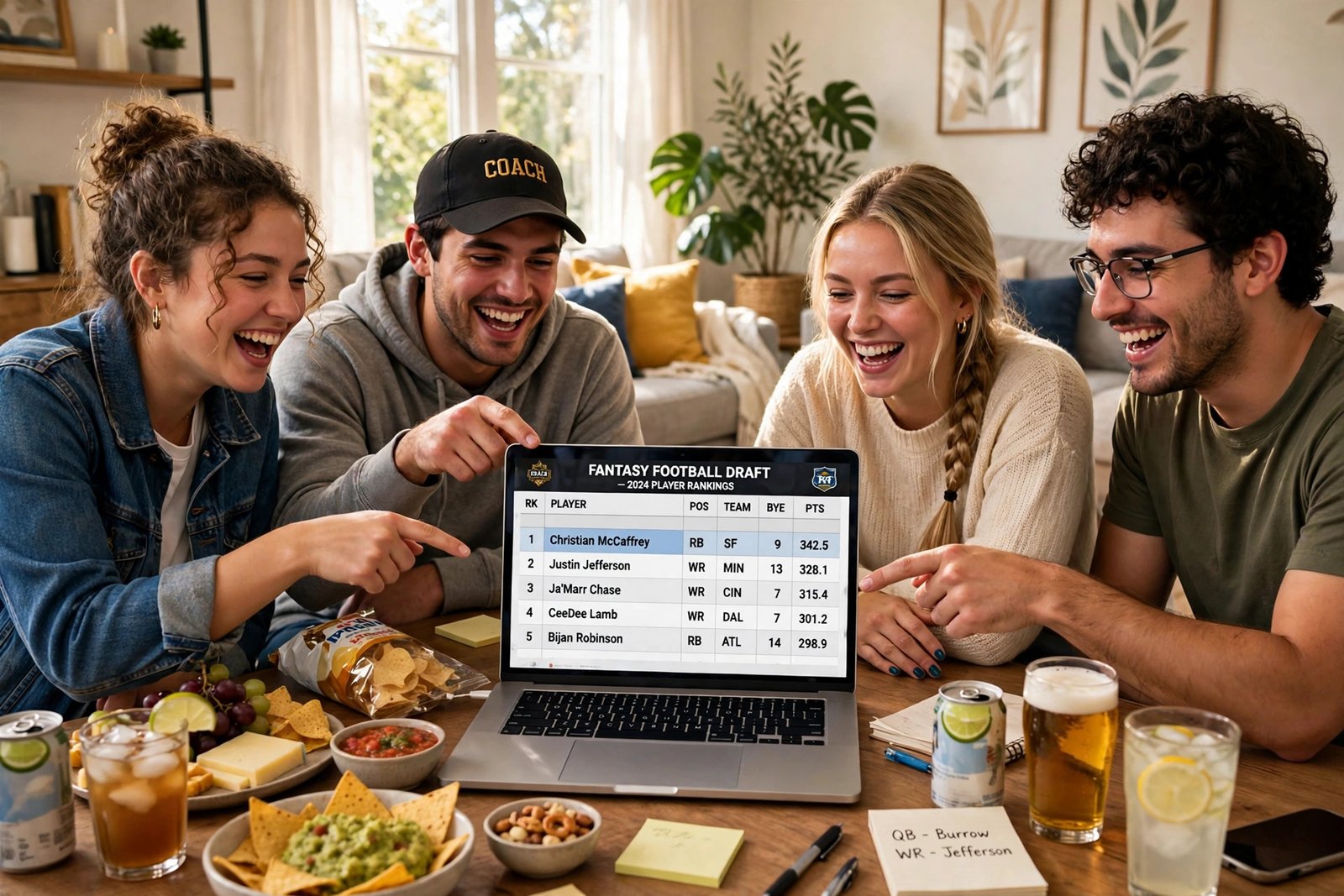
Every autumn, in offices and living rooms and group chats across America, tens of millions of people do something that would have baffled their grandparents: they spend hours each week managing a football team that does not exist. They draft players they have never met, trade them like stocks, agonize over start-or-sit decisions, and celebrate victories that bring them no money and no trophy worth displaying. It is called fantasy football, and it has become one of the most popular pastimes in the United States.
The numbers are staggering. About 40 million Americans play fantasy football each year, according to the Fantasy Sports & Gaming Association, which counted 53 million total fantasy sports players in the United States in 2025. Fantasy football accounts for roughly three-quarters of all fantasy sports activity in the country. The game is so woven into American life that the NFL now schedules its programming around it, sports networks run fantasy segments all week, and the phrase “my fantasy team” is understood by almost everyone.
And it all started in 1962, in a New York hotel room, with eight men and a game invented on a napkin.
The Invention: A Hotel Room in New York, 1962
Fantasy football was born in October 1962, when the Oakland Raiders traveled to New York for a game against the Titans, the team that would later become the Jets. Bill Winkenbach, a successful Oakland businessman who owned a 10 percent stake in the Raiders, was staying at a Manhattan hotel — what is now the Row NYC — with Raiders public relations director Bill Tunnell and Scotty Stirling, who covered the team for the Oakland Tribune.
Winkenbach had already invented a fantasy game based on professional golf, and a fantasy baseball game, in which owners drafted real players and scored points based on their actual performance. Over drinks in the hotel, the three men adapted the idea to football. They created a scoring system — 50 points for a rushing touchdown, 25 for a thrown or caught touchdown, 25 for a field goal, 10 for an extra point, 200 for a kick or interception returned for a touchdown — and a roster format of 20 players per team.
Because the 1962 season had already started, they waited until August 1963 to hold their first draft. It took place in the basement recreation room of Winkenbach’s house in Oakland. Eight men participated, and they called their league the Greater Oakland Professional Pigskin Prognosticators League, or GOPPPL. The first pick in the draft was Houston Oilers quarterback George Blanda, chosen by Andrew Mousalimas. The second pick was Cleveland running back Jim Brown. Each owner paid a $50 entry fee, and the scoring was done entirely by hand, with owners poring over box scores in the Monday newspaper to calculate their totals.
From Paper to the Internet: How Fantasy Football Exploded
For three decades, fantasy football was a niche hobby for die-hard fans. The math was laborious — every point had to be calculated by hand from newspaper statistics — and the game spread mainly by word of mouth among friends and co-workers. By the 1980s, a few hundred thousand people played. The game was fun, but it was work.
Everything changed in the 1990s with the internet. The first online fantasy platforms automated the scoring, the standings, and the waiver wire, removing the drudgery that had limited the game’s appeal. Yahoo launched its free fantasy football game in 1999, and ESPN followed soon after. Suddenly anyone could run a league from a computer, and millions did. By the early 2000s, participation had passed 15 million. By 2023, the Fantasy Sports & Gaming Association estimated more than 70 million people in the United States and Canada played fantasy football.
The NFL noticed. The league had initially been wary of fantasy sports, worried about the association with gambling, but it eventually embraced the game as a driver of fan engagement. Fantasy players watch more games, follow more teams, and care about players they would otherwise ignore. A fan in Chicago with a running back from Jacksonville on their roster will watch a Jaguars game they would never have watched otherwise. The league’s broadcast partners noticed too, and fantasy analysis became a staple of pregame shows.
Why Americans Love It
Fantasy football works because it solves a problem that real football cannot. In real football, you are a spectator. In fantasy football, you are a general manager. You make decisions that matter — at least to your league — and you live with the consequences. The game turns every Sunday into a personal drama, with your players scattered across a dozen real games, each touchdown and each fumble moving your score.
The social element is just as important. Most leagues are made up of friends, family members, or co-workers, and the game gives them a reason to talk every week for five months. The trash talk in the group chat, the trade negotiations, the draft-night arguments — these are the real product. As one fantasy writer put it, the game’s best part has always been the human connection.
There is also the illusion of control. Fantasy football rewards research, preparation, and attention, and it punishes laziness. A player who studies matchups, monitors injuries, and works the waiver wire will usually beat a player who drafts on reputation and forgets to set a lineup. That sense of earned success is addictive, even when the stakes are nothing more than bragging rights and a small entry fee.
The Money and the Law
Fantasy football is also a business, and a big one. The broader fantasy sports market was estimated at $42.37 billion in 2026, and fantasy football generates more than $7 billion a year in economic activity by some estimates. The industry includes the major platforms — ESPN, Yahoo, NFL Fantasy, Sleeper — plus a constellation of advice sites, podcasts, and data services.
The game’s legality was settled by the Unlawful Internet Gambling Enforcement Act of 2006, which exempted fantasy sports from the federal ban on online gambling on the grounds that fantasy is a game of skill rather than chance. That exemption is what allowed daily fantasy companies like DraftKings and FanDuel to grow into the giants they are today, and it is why season-long fantasy football is legal in every state.
Not everyone is comfortable with the money. Critics argue that the line between fantasy sports and gambling has blurred, especially with the rise of daily fantasy contests that pay out cash prizes. Supporters counter that season-long fantasy, played among friends for small stakes, is closer to a board game than a casino. The debate is ongoing, and it is likely to intensify as sports betting spreads across the country.
The Modern Game: Apps, Analytics, and the Waiver Wire
Today’s fantasy football bears little resemblance to the game Winkenbach invented. Modern leagues run on apps that update scores in real time, push injury alerts to your phone, and offer AI-powered lineup advice. The draft, once conducted in a basement with a chalkboard, is now often held online, with players joining from different states and time zones.
The strategy has evolved too. The old approach was to draft running backs early and often. Today’s managers study advanced statistics, track target shares and snap counts, and debate the value of positions with the seriousness of stock analysts. The waiver wire — the weekly scramble to pick up undrafted players who break out — has become a game within the game, and the managers who master it often win their leagues.
And yet the core of the game is unchanged. Eight men in a hotel room in 1962 wanted a reason to care more about football on Sundays. Sixty years later, 40 million Americans want the same thing, and they have built a culture around it — a culture of drafts and trades, of group chats and trophies, of agony and ecstasy, all over a game that does not exist.
Frequently Asked Questions
Who invented fantasy football?
Fantasy football was invented in 1962 by Bill Winkenbach, an Oakland Raiders part-owner, along with Bill Tunnell and Scotty Stirling. The first league, the Greater Oakland Professional Pigskin Prognosticators League (GOPPPL), held its first draft in August 1963 with eight members.
How many people play fantasy football?
About 40 million Americans play fantasy football each year, according to the Fantasy Sports & Gaming Association. The FSGA reported 53 million total fantasy sports players in the United States in 2025, with football accounting for roughly 75 percent of the activity.
Is fantasy football legal?
Yes. The Unlawful Internet Gambling Enforcement Act of 2006 exempts fantasy sports from the federal ban on online gambling because fantasy is considered a game of skill. Season-long fantasy football is legal in every state.
How does fantasy football work?
Each player drafts a team of real NFL players and earns points based on those players’ actual performance in real games — touchdowns, yards, field goals, and more. Teams compete head-to-head each week, and the best records advance to the playoffs.
Who was the first pick in the first fantasy football draft?
Houston Oilers quarterback George Blanda was the first pick in the GOPPPL’s inaugural draft in August 1963. Cleveland running back Jim Brown was picked second.
Sources
- Scoutcast — 40M+ Players: How Many People Play Fantasy Football? (2026), citing FSGA research
- Fantasy Alarm — The History of Fantasy Sports (excerpt from Larry Schechter’s book)
- SportsSurge — Who Invented Fantasy Football? The True Origin Story