
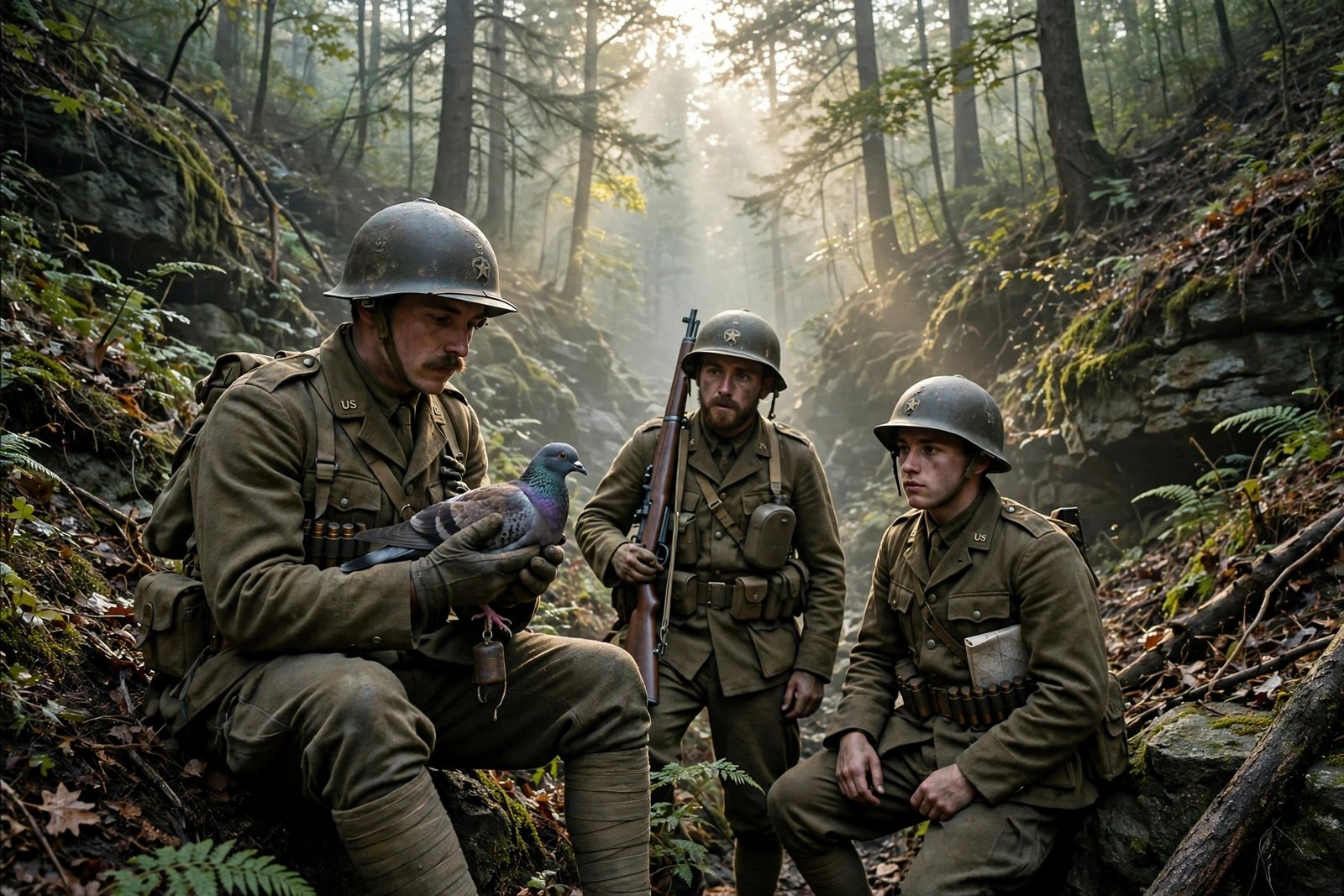
On the morning of October 2, 1918, nine companies of the United States 77th Division — about 554 men, most of them draftees from New York City — advanced into the Argonne Forest in northeastern France. They were part of the Meuse-Argonne Offensive, the largest American military operation of World War I, and their orders were to push through the forest and break the German Hindenburg Line. By nightfall, they were surrounded. The French units that were supposed to protect their left flank had not kept up. The American units on their right had fallen behind. The Germans had closed in around them from three sides.
For the next six days, the men held their ground in a ravine in the forest, cut off from food, water, and reinforcements, under constant attack and even under fire from their own artillery. They became known to the world as the Lost Battalion — although they were not a battalion, and they were never truly lost. Their commanders knew exactly where they were. The problem was reaching them.
Their story is one of the most famous episodes in American military history, and it ended with a wounded pigeon, a message tied to its leg, and 194 men who walked out of the forest under their own power.
The Advance Into the Forest
The Meuse-Argonne Offensive had begun on September 26, 1918, with more than a million American troops attacking fortified German positions. It was the final great push of the war, and the 77th Division, nicknamed the Liberty Division for its Statue of Liberty emblem and the Metropolitans for its New York City roots, was in the thick of it.
On October 1, Major Charles White Whittlesey, a 34-year-old lawyer from New York who had become a battalion commander, received his orders. He was to advance north through the Argonne Forest toward a position known as Hill 198, at the head of the Ravin de Charlevaux. The plan assumed that French forces would protect his left flank and that American units would cover his right. Neither assumption held.
Early on October 2, Whittlesey led his men forward behind an artillery barrage. The advance went well at first — too well. The battalion pushed deeper into the forest than the units on either side, and the Germans, realizing the Americans were overstretched, moved in behind them. By dawn on October 3, roughly 554 Americans were completely encircled in a ravine, with German forces on the high ground around them.
Six Days in the Pocket
The men of the Lost Battalion dug in along the Charlevaux ravine and prepared to hold. They had little food and less water. The Germans attacked repeatedly, and the Americans fought them off with rifles, machine guns, and grenades. German snipers picked off men who exposed themselves. Artillery pounded the ravine day and night.
The worst moment came on October 4, when American artillery, unaware of the battalion’s exact position, began shelling the ravine itself. The men were being killed by their own guns, and they had no way to stop it. Whittlesey’s runners had been killed or captured. His field telephones were dead. His last line of communication was a small flock of carrier pigeons.
Whittlesey wrote a message by hand and attached it to a pigeon named Cher Ami, a black check homing pigeon. The message read, in part: “We are along the road parallel to 276.4. Our own artillery is dropping a barrage directly on us. For heaven’s sake, stop it.” Cher Ami flew 25 miles through German gunfire to reach the 77th Division headquarters, arriving with a bullet wound in the breast, a shattered leg, and one eye blinded. The message got through, and the shelling stopped. Cher Ami survived, was awarded the French Croix de Guerre, and became one of the most decorated animals of the war. The bird’s preserved body is now on display at the Smithsonian.
Meanwhile, the men in the ravine were running out of everything. They had no water except what they could collect from a muddy stream under German fire. They ate what little food remained, then went hungry. The wounded lay in the open, and the dead could not be buried. German loudspeakers called on them to surrender. Whittlesey’s answer, according to his men, was that there would be no retreat and no surrender.
The Rescue
For six days, the rest of the 77th Division fought to break through to the trapped men, and for six days the Germans held them off. Then, on the evening of October 7, American forces finally broke through the encirclement. The relief column found a scene of devastation: men who had not eaten in days, many wounded, all exhausted, standing among the dead of their own companies.
Of the 554 men who had entered the forest, 194 walked out unscathed. The rest had been killed, wounded, missing, or captured. The National Archives’ final casualty count lists 107 killed, 190 wounded, and 63 missing; other accounts put the number killed higher, at around 197. The discrepancy reflects the chaos of the battle and the difficulty of counting the dead in a forest that had been shelled for a week. What is certain is that the battalion had paid a terrible price for holding its ground.
Whittlesey, Captain George McMurtry, and Captain Nelson Holderman each received the Medal of Honor for their actions. Whittlesey was also promoted to lieutenant colonel on the battlefield. The men of the 77th Division returned home as heroes, and the Lost Battalion became a legend.
The Aftermath
The story did not end happily for its hero. Charles Whittlesey never recovered from the experience. He suffered from what would today be recognized as post-traumatic stress, haunted by the men he had lost and by the decisions he had made. In 1921, three years after the war, he disappeared from a ship crossing the Atlantic, in what was concluded to have been a suicide. He left letters to his family, and his body was never found.
His death is a reminder that the cost of the Lost Battalion’s stand was not measured only in the men who died in the forest. The survivors carried the battle with them for the rest of their lives. The 77th Division went on to serve with distinction in World War II in the Pacific, and the division’s history is still taught at West Point as an example of endurance under impossible conditions.
Why the Story Endures
The Lost Battalion has never left the American imagination. A silent film about the battle was released in 1919, while the survivors were still coming home, and a television film starring Rick Schroder as Whittlesey followed in 2001. The story has been told in books, in songs — the Swedish metal band Sabaton recorded a track about the battalion — and in classrooms, where it is used to teach leadership, endurance, and the cost of holding a position when retreat would be easier.
Part of the story’s power is the pigeon. Cher Ami’s flight has become one of the most famous animal stories in military history, and the bird’s preserved body, on display at the Smithsonian’s National Museum of American History, still draws visitors more than a century later. A small bird, wounded and blinded in one eye, flew 25 miles through gunfire and saved nearly 200 men. It is the kind of detail that no novelist would dare invent — and it is true.
The other part is the men themselves. They were not professional soldiers. They were draftees from New York City — clerks, factory workers, immigrants, and sons of immigrants — who had been in uniform for a matter of months. They held a ravine in a foreign forest for six days against a professional army, with no food, no water, and no way out, because their commander told them to hold and because they trusted him. That is why the story is still told.
The Lost Battalion’s stand also mattered to the war itself. The Meuse-Argonne Offensive was the campaign that broke the German army’s will to fight, and it ended with the Armistice on November 11, 1918 — just five weeks after the battalion was rescued. The men who held the ravine did not know that when they were fighting for their lives. They held because they were ordered to hold, and because their commander refused to surrender, and because, in the end, that is what soldiers do.
Frequently Asked Questions
How many men were in the Lost Battalion?
About 554 men from nine companies of the US 77th Division were surrounded in the Argonne Forest in October 1918. Only 194 walked out unscathed. The rest were killed, wounded, missing, or captured.
Why were they called the Lost Battalion?
The name came from newspaper reports during the war. The men were not actually lost — their commanders knew where they were — but they were cut off from the rest of the army and could not be reached for six days.
How did Cher Ami the pigeon save the Lost Battalion?
On October 4, 1918, American artillery was mistakenly shelling the battalion’s own position. Major Whittlesey sent a message by carrier pigeon asking for the barrage to stop. Cher Ami flew 25 miles through gunfire, wounded, and delivered the message. The shelling stopped.
Who commanded the Lost Battalion?
Major Charles White Whittlesey, a New York lawyer, commanded the force. He received the Medal of Honor, as did Captains George McMurtry and Nelson Holderman.
When was the Lost Battalion rescued?
American forces broke through the German encirclement on the evening of October 7, 1918, after six days of fighting. The battalion had been surrounded since October 2.
Sources
- National Archives — The Lost Battalion of World War I
- Wikipedia — Lost Battalion (World War I)
- American Rifleman — “Over There”: The Lost Battalion in the Argonne Forest
- CIB Association — How a Wounded Pigeon Named Cher Ami Saved the Lost Battalion in WWI