
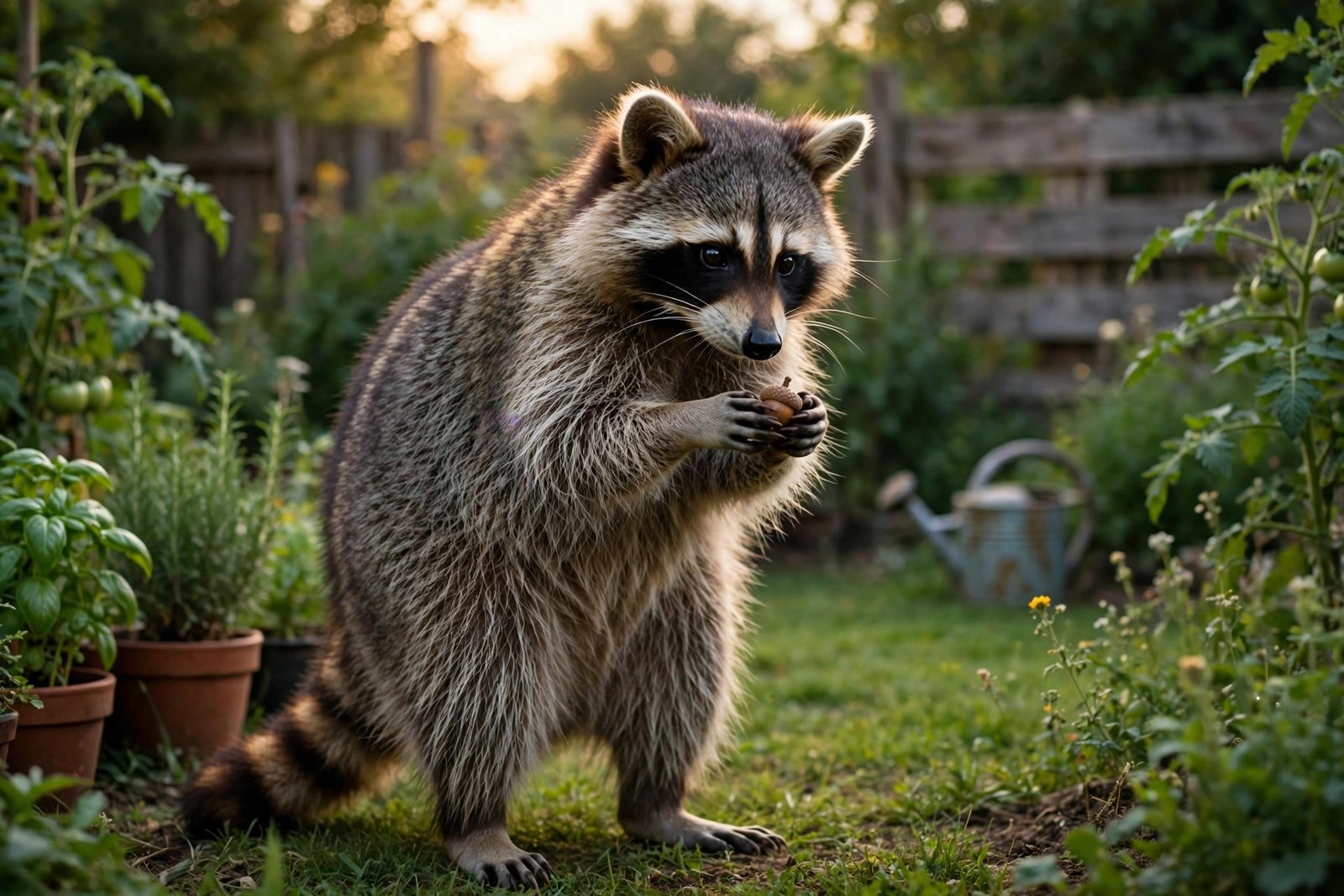
There is a masked bandit working the night shift in nearly every American neighborhood, and chances are you have met it — or at least cleaned up after it. The raccoon tips over trash cans with the confidence of a professional, opens latches that were supposed to be raccoon-proof, and vanishes into the dark before you can even turn on the porch light. It is the animal Americans love to hate and cannot help admiring: a creature so clever, so adaptable, and so stubbornly successful that it has conquered an entire continent and moved into our cities, our suburbs, and our backyards.
The raccoon’s real name is Procyon lotor, and its scientific name contains a joke: lotor means “the washer,” a nod to the famous habit of dunking food in water. But the raccoon is not washing anything. It is doing something stranger and more interesting. It is feeling its food, using front paws so sensitive that they are effectively a second pair of eyes. This is an animal that thinks with its hands, remembers solutions for years, and learns from every encounter with a locked bin, a closed door, or a puzzle it has never seen before.
What’s in a Name?
The common raccoon — also called the North American raccoon or northern raccoon — is Procyon lotor, named by Linnaeus in 1758. It belongs to the family Procyonidae, a group of New World mammals that includes coatis, kinkajous, and ringtails. It is native to North America, ranging from southern Canada all the way down to northern South America, a range that covers almost every habitat on the continent, from forests and wetlands to deserts and, increasingly, cities.
The English word “raccoon” comes from the Powhatan word “aroughcun,” meaning “animal that scratches with its hands.” It is a remarkably accurate name. The raccoon’s hands are the whole story — the feature that defines the animal, drives its behavior, and explains its success. Long before Europeans arrived in North America, the Indigenous peoples of the Americas knew the raccoon well, and it features in Indigenous mythologies across the continent, often as a trickster figure: clever, mischievous, and impossible to outsmart for long.
Hands That Can See
The raccoon’s most distinctive features are its facial mask, its ringed tail, and above all its front paws. Each front paw has five long fingers and no opposable thumb — and yet, in dexterity, those paws rival the hands of many primates. A raccoon can turn a doorknob, unscrew a jar lid, undo a latch, unclip a carabiner, and open a cooler. Anyone who has ever tried to build a raccoon-proof trash can knows the feeling: you design a latch, the raccoon defeats it, you design a better latch, and the raccoon defeats that one too.
The secret is touch. The raccoon’s front paws have roughly four to five times more touch sensors than those of typical mammals, and about two-thirds of the sensory part of the raccoon’s brain is devoted to touch. In a very real sense, raccoons see with their hands. They explore the world by feeling it, and the information they gather through their paws is extraordinarily detailed — the shape of an object, its texture, whether it is food, whether it opens, and how.
The Lock-Picking Experiments
Raccoons have a long history in the science of animal intelligence, and the early results were startling. In the early twentieth century, the ethologist H.B. Davis ran a series of experiments testing raccoons on complex mechanical locks — bolts, hooks, latches, and combinations of them. The raccoons opened 11 of 13 complex locks in under 10 attempts, even when the locks were rearranged or turned upside down. They were not just memorizing a sequence of movements. They were understanding the mechanism.
The intelligence is not just individual — it is situational. Studies have found that urban raccoons solve puzzles that rural raccoons fail, suggesting that city life, with its constant stream of novel problems and food sources, sharpens the animals’ problem-solving skills. GPS-collared city raccoons have even learned to avoid major intersections, reading the urban landscape the way a commuter reads a map. The raccoon is not just surviving in our cities. It is learning them.
City Smarts
The raccoon is one of the great success stories of urban wildlife. Where many species retreat from cities, the raccoon moves in. Cities offer everything a raccoon needs: food in abundance, shelter in attics, chimneys, and storm drains, and few predators. A raccoon in the city eats better than a raccoon in the forest, and it shows — urban raccoons are often heavier than their rural cousins. A typical raccoon weighs 9 to 20 pounds (4 to 9 kilograms), but some urban animals weigh over 15 kilograms, thanks to a steady diet of human food.
The raccoon is built for the night shift. It is usually nocturnal, active after dark when the streets are quiet and the garbage is out. It is a strong swimmer and an agile climber, equally at home in a tree, on a roof, or in a stream. It can run up to 15 miles per hour in a sprint and can leap to the ground from 40 feet without being harmed — a fall that would injure most animals its size. The raccoon is, in short, an athlete, a climber, a swimmer, and a lock-picker, all in one compact, masked package.
What’s on the Menu?
Raccoons are omnivores, and their diet is one of the most flexible in the animal kingdom. Roughly 40 percent of their diet is invertebrates — insects, worms, crayfish, and other small creatures — about 33 percent is plants, including fruits, nuts, and grains, and about 27 percent is vertebrates, such as fish, frogs, and small mammals. Those proportions shift with the seasons and the location. A raccoon in a wetland eats differently from a raccoon in a forest, and a raccoon in a city eats differently from either.
This adaptability is also why raccoons are so hard to keep out of human spaces. A garden, a bird feeder, a pet food bowl left on the porch, a compost pile — all of these are, to a raccoon, an invitation. The animal is not being malicious. It is being a raccoon. The solution, as any wildlife expert will tell you, is not to fight the raccoon but to remove the invitation: secure the trash, bring in the pet food, and make the yard boring.
Life in the Dark
The animal’s senses are tuned for the night. Its eyes are adapted to low light, and its mask — the dark fur around its eyes — may help reduce glare, much like the eye black worn by athletes. Its sense of hearing is sharp, and its sense of touch, as we have seen, is extraordinary. The raccoon is a creature built for darkness, and it moves through the night with a confidence that is easy to mistake for boldness.
The Washing Myth
One of the raccoon’s most famous behaviors is also one of the most misunderstood. Raccoons are often seen dunking food in water before eating it, and for centuries people assumed they were washing their food. The behavior even gave the animal its scientific name: lotor, “the washer.” But the truth is more interesting than the myth.
The dousing behavior is not about cleanliness. It appears to be about touch. Wetting the front paws enhances the sensitivity of the touch receptors, giving the raccoon more information about what it is holding. A raccoon dunking a piece of food in a stream is not washing it. It is feeling it more clearly — checking its texture, its shape, whether it is worth eating.
Trash Pandas and Staying Safe
Raccoons are beloved and cursed in equal measure. They are charming, clever, and endlessly entertaining — and they are also, frankly, a nuisance. They raid trash cans, tear up lawns looking for grubs, nest in attics, and chew through roofs. The nickname “trash panda” captures the contradiction perfectly: an animal that is cute enough to be a mascot and troublesome enough to be a pest.
There is also a serious side to living alongside raccoons. Raccoons are the primary natural carrier of rabies in the United States east of the Mississippi River, and rabies is a fatal disease once symptoms appear. That does not mean every raccoon is rabid — most are not — but it does mean that the sensible approach is admiration from a distance. Never feed a raccoon. Never try to touch one, handle one, or keep one as a pet. Keep trash secured in bins with tight-fitting lids, and bring pet food indoors at night.
Frequently Asked Questions
Are raccoons really that smart? Yes. Studies show raccoons can remember solutions to tasks for at least three years, and in early-20th-century experiments by ethologist H.B. Davis, raccoons opened 11 of 13 complex mechanical locks in under 10 attempts, even rearranged or upside down. Urban raccoons have been shown to solve puzzles that rural raccoons fail.
Do raccoons actually wash their food? No. The famous “washing” behavior — dousing food in water — is not about cleanliness. It appears to enhance tactile sensation from the wet front paws, giving the raccoon more information about what it is holding. The scientific name lotor means “the washer,” but the behavior is really about feeling, not washing.
How long do raccoons live? In the wild, life expectancy is only 1.8 to 3.1 years, because mortality is high from predators, disease, and traffic. In captivity, where those dangers are removed, raccoons can live over 20 years.
Are raccoons dangerous to people? Raccoons are not usually aggressive, but they are the primary natural carrier of rabies in the US east of the Mississippi, so they should always be admired from a distance. Never feed a raccoon or try to touch one, keep trash secured, and contact local animal control if you see a raccoon behaving strangely.