
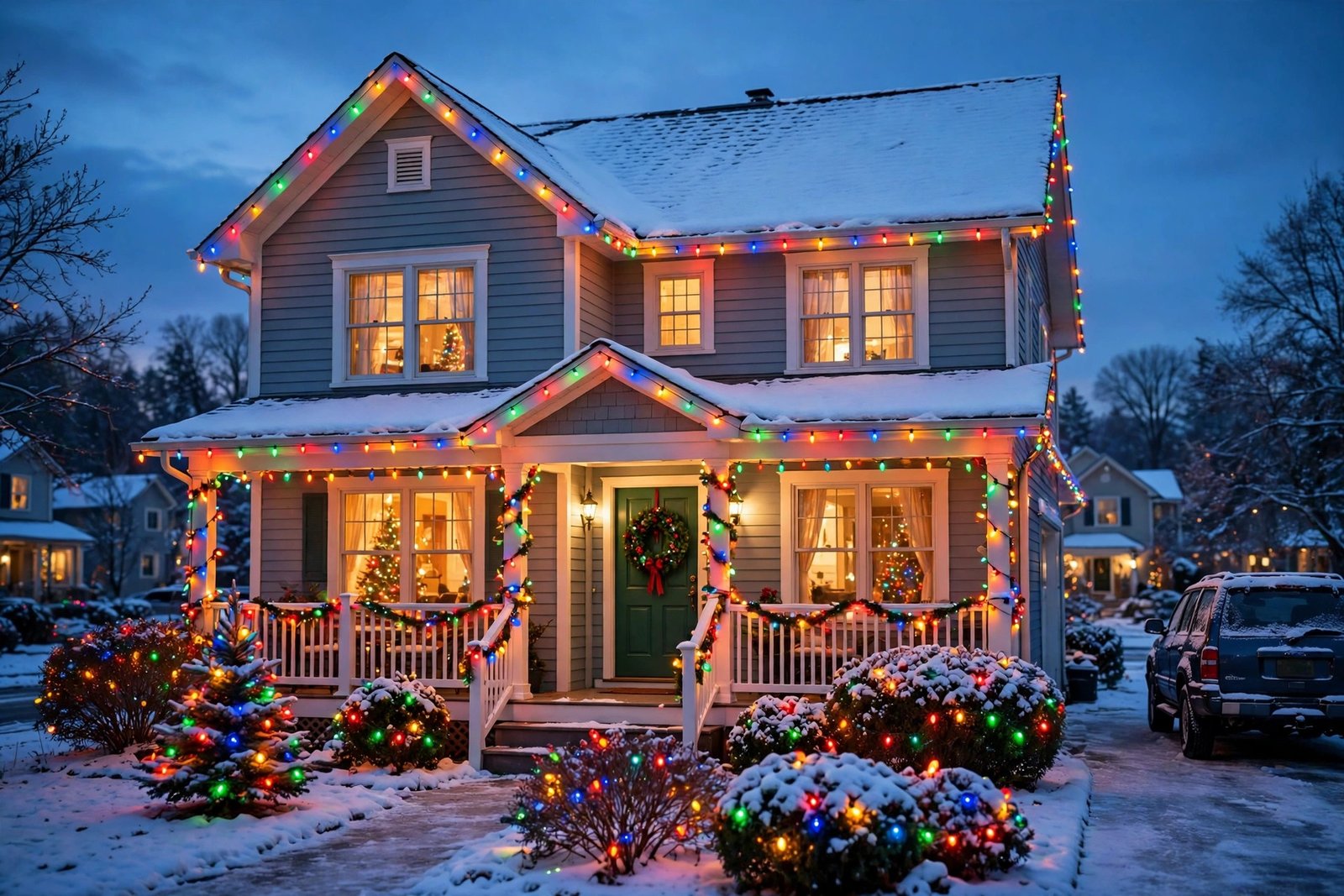
Every December, America glows. Rooflines sparkle, front yards turn into winter scenes, and whole streets seem to compete for the brightest display. It is easy to forget that this tradition is barely more than a century old, and that it began with a single tree, in a single New York townhouse, lit by a man most people have never heard of. The story of Christmas lights is the story of how a dangerous luxury became a beloved national habit, and how a new technology found its most joyful use.
It started with 80 bulbs on a tree in 1882. From there, Christmas lights traveled from the homes of the wealthy to the shelves of five-and-dime stores, from the White House to the smallest front porch, and from fragile glass bulbs that burned hot to LEDs that sip electricity and last for years. This is how America turned December into a light show.
Before the Bulb: Candles on the Tree
Long before electric lights, Americans lit their Christmas trees with candles. The effect was beautiful: small flames flickering among the branches, casting a warm glow across a dark winter room. It was also a real fire hazard. A dry evergreen, a room full of paper decorations, and a dozen open flames were a dangerous combination, and families knew it. Trees were lit only for short periods, watched carefully, and kept away from curtains and other flammable things. The beauty was real, and so was the risk.
The candlelit tree was not an American invention. The custom of decorating a tree came to the United States from Germany, and by the middle of the 1800s it had become a familiar part of an American Christmas. President Franklin Pierce put the first Christmas tree in the White House in 1856, and like every tree of its time, it was lit by candles. The tree was a symbol of celebration, but the light on it was fragile, brief, and genuinely dangerous. Something better was needed, and the answer would come from an inventor in New Jersey.
Edison Lights Up Menlo Park
In 1879, Thomas Edison demonstrated the practical incandescent bulb at Menlo Park, New Jersey. The bulb was the result of years of work, and it changed what electric light could be: not a laboratory curiosity, but something that could be made, sold, and used in ordinary life. Edison understood that a new technology needs a public moment, and he gave the electric light one.
In December 1880, Edison strung electric lights outside the Menlo Park laboratory, creating the first public decorative display of electric light. People came to see it. The lights were a novelty, a wonder, and a demonstration all at once: here was a light that did not flicker, did not smoke, and did not set things on fire. It was the first hint that electric light could be used for celebration as well as for work, and it set the stage for what would happen two years later in New York City.
The 1882 Tree That Started It All
On December 22, 1882, Edward H. Johnson lit the first electrically illuminated Christmas tree. Johnson was an associate of Edison and the vice president of the Edison Electric Light Company, and he understood the new technology as well as anyone alive. In his New York City townhouse at 136 East 36th Street, he hand-wired 80 red, white, and blue bulbs around a Christmas tree and mounted the tree on a revolving platform, so that it turned slowly and the lights moved with it.
It was the first documented use of electric lights on an indoor Christmas tree, and it caused a sensation. The tree was written about in the newspapers, and visitors came to see it. The bulbs were hand-wired, one by one, and the whole display was a rich man’s stunt: far too expensive and too complicated for an ordinary family. But it planted an idea that would not go away. If a tree could be lit with electricity, it could be lit safely, brightly, and for as long as anyone wanted.
Johnson kept improving his display. By 1884, the New York Times counted 120 bulbs on his tree. The number had grown, and so had the attention. Each year the tree got a little brighter, and each year more people heard about it. The electric Christmas tree had arrived, even if it would take decades before most families could afford one.
From a Rich Man’s Stunt to a Store Shelf
The journey from Johnson’s townhouse to the average American living room took time, and it ran through the factory. GE began manufacturing electric Christmas lights around 1890, and in 1903 the company introduced the first pre-wired strings of sockets. That was the turning point. Before pre-wired strings, anyone who wanted electric lights had to wire each bulb by hand, the way Johnson had. After 1903, you could buy a string, hang it on the tree, and plug it in.
Prices fell as manufacturing improved. By 1914, a 16-foot string cost just $1.75. That was still real money in 1914, but it put electric lights within reach of a middle-class family for the first time. The lights were no longer a curiosity for the wealthy. They were a product, sold in stores, and each year more of them found their way onto American trees.
The White House helped the trend along. In 1894, President Grover Cleveland became the first president to put electric lights on the White House tree. The endorsement of the White House mattered: it told the country that electric lights were not a gimmick but a proper way to celebrate. From Pierce’s candlelit tree in 1856 to Cleveland’s electric tree in 1894, the White House had moved with the technology, and the country followed.
NOMA, Mini-Lights, and the Postwar Boom
For much of the early twentieth century, one company dominated the Christmas light business: the NOMA Electric Company. NOMA sold lights to generations of American families and held its leading position until the 1960s. The company understood something important about its product. Christmas lights were not just lights. They were part of the holiday itself, and the company sold them that way, year after year, as families replaced burned-out bulbs and added new strings to the collection.
The lights themselves kept changing. The classic mini-light design arrived in 1970, and it reshaped what a Christmas display could look like. Mini-lights were smaller, cheaper, and easier to use in large numbers, and they opened the door to the outdoor displays that now define the season. Where an earlier generation might have put a single string on the tree, a family with mini-lights could outline the roof, wrap the bushes, and frame the windows. The light show moved outside, and it has been growing ever since.
LEDs Change Everything
The biggest change in Christmas lights since the bulb itself came with the LED. LED Christmas lights use up to 90 percent less energy than incandescent bulbs, and they last 50,000 hours or more. The difference is not subtle. A string of old-fashioned incandescent bulbs burned hot, used real power, and needed replacing often. An LED string stays cool to the touch, costs far less to run, and can last for many seasons.
The change mattered for more than the electric bill. Because LEDs use so little energy and produce so little heat, people could use far more of them. The giant outdoor displays that now draw crowds in neighborhoods across the country are practical in a way they never were with incandescent bulbs. A display that would once have strained a household’s wiring and budget can now run all evening, every evening, for weeks. The technology made the tradition bigger, and it made it safer at the same time.
LEDs also last. A bulb rated for 50,000 hours or more can outlive the string it sits on, and families no longer face the annual ritual of testing every bulb in every string. The frustration of the dead string, the one dark section in an otherwise bright tree, has not vanished entirely, but it has faded. The lights got better, and the holiday got brighter.
Christmas Lights Today
Today, an estimated 150 million light sets are sold in America each year. That number tells the story plainly: Christmas lights are no longer a luxury, a novelty, or a stunt. They are a normal part of December, as expected as the tree itself. They hang in windows, wrap around porches, outline rooftops, and fill front yards with figures, scenes, and color.
And some people take the tradition further than anyone in 1882 could have imagined. The record for lights at one home, lawn included, is 601,736 bulbs. It is a staggering number, and it is also a fitting endpoint for the story: a tradition that began with 80 hand-wired bulbs on a revolving tree now runs to hundreds of thousands of lights on a single property, all of them cool, cheap to run, and bright enough to be seen from down the street.
What has not changed is the reason for the lights. Johnson’s tree was a wonder because it was new. A modern display is a wonder because it is shared: with neighbors, with strangers driving by, with children seeing the glow from the car window. The technology changed completely, from candle flame to incandescent bulb to LED. The impulse behind it never did. In the darkest month of the year, Americans still want to make light, and to share it.
Frequently Asked Questions
Who invented Christmas lights?
Electric Christmas lights trace back to Thomas Edison, who demonstrated the practical incandescent bulb in 1879 and strung decorative lights outside his Menlo Park laboratory in December 1880. The first electric lights on an indoor Christmas tree were put up by his associate Edward H. Johnson in 1882.
When were electric Christmas lights first used on a tree?
On December 22, 1882, Edward H. Johnson hand-wired 80 red, white, and blue bulbs around a Christmas tree in his New York City townhouse at 136 East 36th Street, mounting the tree on a revolving platform. It was the first documented use of electric lights on an indoor Christmas tree.
Why did people switch from candles to electric lights?
Candles on a dry evergreen were a real fire hazard, and trees could only be lit briefly and watched closely. Electric lights were safer, brighter, and could stay on for hours. They also grew cheaper over time: by 1914, a 16-foot string cost just $1.75.
How much energy do LED Christmas lights save?
LEDs use up to 90 percent less energy than incandescent bulbs, and they last 50,000 hours or more. That is why large outdoor displays are practical today in a way they never were with older bulbs.
How many Christmas light sets are sold in America each year?
An estimated 150 million light sets are sold in America each year. The record for lights at one home, lawn included, is 601,736 bulbs.
Sources
- Mental Floss: A Brief History of Christmas Tree Lights
- IEEE Spectrum: The History of Electric Christmas Lights
- Luminii: Untangling the History of Christmas Lights