
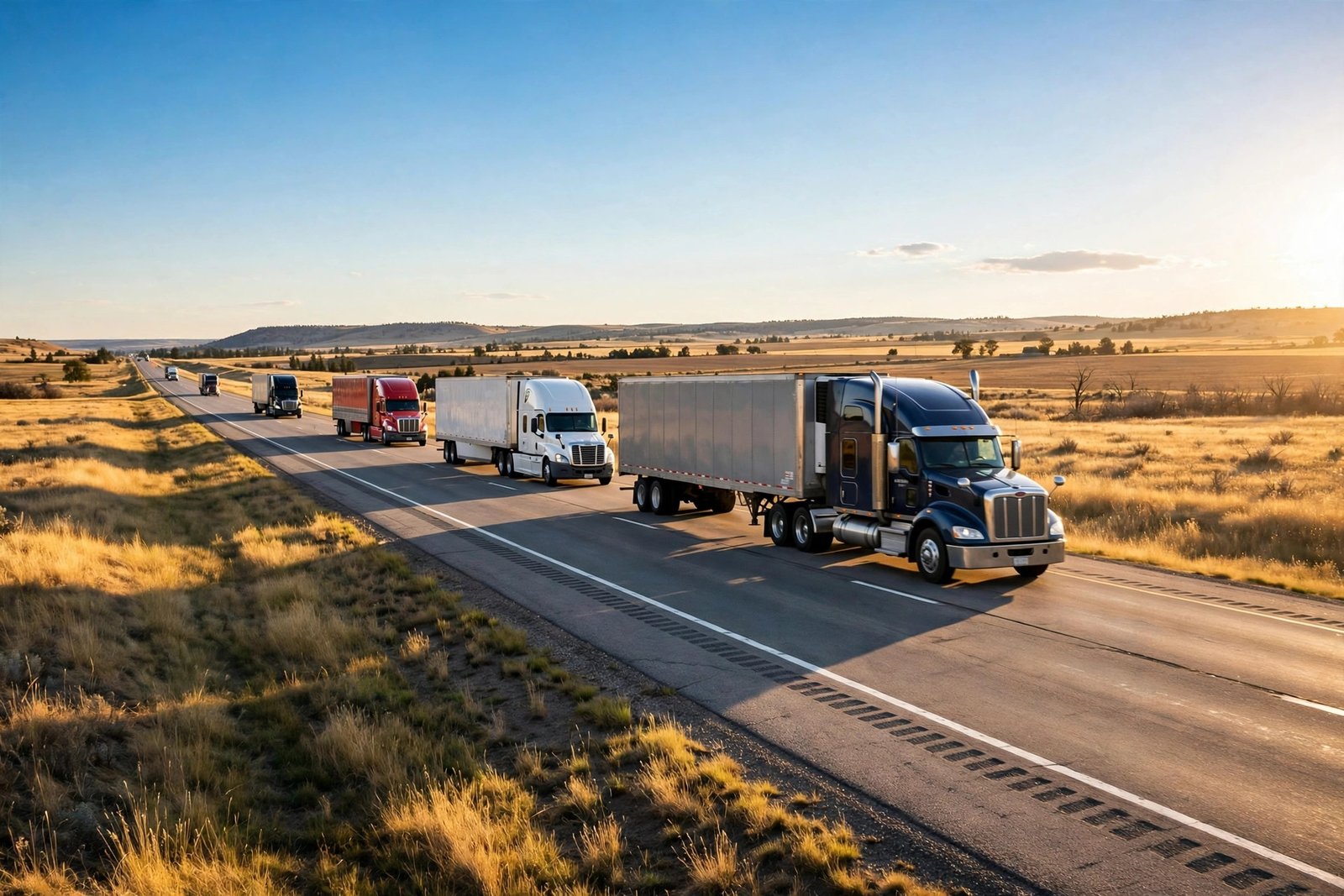
Almost everything in your home arrived by truck. The food in your refrigerator, the clothes in your closet, the phone in your hand, the furniture in your living room: at some point, a truck carried it, often for the final leg of its journey and sometimes for the whole way. It is easy to forget that, because trucks are so ordinary. They are background noise on the highway, a line of trailers in the next lane, a delivery van on your street. But the American economy runs on trucking in a way that few other countries can match, and the numbers behind that ordinary sight are extraordinary.
According to the American Trucking Associations, trucks moved 11.46 billion tons of freight in 2025, up from 11.27 billion tons the previous year, with industry revenues of 936.4 billion dollars. Trucks delivered more than 72 percent of all domestic freight tonnage in the United States, and they carried 68 percent of surface trade between the United States and Canada and 86 percent of goods across the Mexican border. Those figures come from the ATA’s annual American Trucking Trends report, the industry’s most comprehensive data compendium. They describe a system so large that it is hard to picture: billions of tons, hundreds of billions of dollars, and millions of people, all moving on wheels.
Why trucks dominate American freight
Trucks dominate for a simple reason: they go everywhere. Trains are efficient for bulk cargo over long distances, ships are efficient for international trade, and planes are fast for high-value goods, but none of them deliver to a store, a warehouse, a farm, or a home. Trucks do. Economists estimate that 80 percent of American communities receive their goods exclusively by truck, which means that for most towns, the truck is not one option among many. It is the only option. Even goods that travel most of their journey by rail or ship usually finish that journey on a truck, in what the industry calls the last mile, though in rural America that last mile can be a hundred miles or more.
Flexibility is the other advantage. A truck can leave when the cargo is ready, take the most direct route, and adjust to changing demand in a way that a train schedule cannot. That flexibility matters enormously in an economy built on just-in-time delivery, where stores keep smaller inventories and expect frequent restocking. It also matters for agriculture, construction, and manufacturing, where loads are irregular, destinations change, and timing is everything. A truck can pick up a load of produce at dawn and have it in a grocery distribution center by nightfall, a rhythm that the American food system depends on.
Who drives America’s trucks
Behind the tonnage figures are people, and the trucking workforce is one of the largest in the country. The industry employs more than 3.5 million truck drivers, according to ATA figures, and the broader trucking ecosystem includes dispatchers, mechanics, warehouse workers, and the small business owners who run most of the industry. In fact, the industry is strikingly decentralized: 99.3 percent of carriers operate fewer than 100 power units, and 91.5 percent operate 10 or fewer trucks. That means American trucking is not dominated by a handful of giants. It is a nation of small fleets and owner-operators, each running a few trucks, each with a direct stake in the freight they haul.
The work itself is demanding in ways that are easy to underestimate. Long-haul drivers spend days or weeks away from home, sleeping in their cabs, eating on the road, and managing a vehicle that can weigh 80,000 pounds fully loaded. They navigate weather, traffic, construction, and delivery windows that do not always respect either. They also carry enormous responsibility: a single load can be worth hundreds of thousands of dollars, and a single mistake can be dangerous. The best drivers combine the skills of a navigator, a mechanic, a logistics manager, and a diplomat, because they deal with shippers, receivers, dispatchers, and inspectors every day.
The highways that make it possible
American trucking depends on American highways, and the interstate system is the backbone of that network. The interstates were built, in part, for national defense and commerce, and they remain the arteries through which freight flows. A truck traveling from Los Angeles to Chicago, or from Dallas to Atlanta, spends most of its journey on interstates, and the condition of those roads directly affects the cost and reliability of everything Americans buy. Potholes, congestion, and construction delays are not just annoyances for drivers. They are costs that ripple through the supply chain, adding fuel, time, and wear to every load.
That is why infrastructure debates matter so much to trucking, even when they seem abstract. A bridge weight limit, a highway closure, or a port bottleneck can reroute thousands of trucks and delay deliveries across a region. The ATA and other industry groups track these issues closely, because the highway system is, in a real sense, the factory floor of American trucking. When it works, freight moves invisibly and cheaply. When it does not, everyone notices, usually at the grocery store or the gas pump.
Challenges facing the industry
The ATA’s latest report notes that the industry’s gains in tonnage and revenue must be viewed in the context of fierce economic headwinds, as carriers contend with escalating operational costs and uneven freight volumes. Fuel is the most visible cost, and diesel prices swing with global oil markets in ways that small carriers cannot control. Insurance, equipment, maintenance, and labor costs have all risen, while freight rates have not always kept pace. For small fleets operating on thin margins, a bad month can be an existential threat, and the industry has seen waves of small carriers close during downturns.
The driver shortage is another long-running challenge. The job is hard, the lifestyle is demanding, and younger workers have many other options. Carriers have responded with higher pay, better equipment, and more predictable schedules, but the shortage persists, especially in long-haul work. Technology is changing the job too: electronic logging devices, advanced safety systems, and route optimization software are now standard, and autonomous trucking is being tested on some routes, though full automation remains a distant prospect for most freight. For now, and for the foreseeable future, American freight moves because human drivers move it.
What trucking means for everyday life
The next time you open your refrigerator, consider the journey behind it. The milk may have traveled from a dairy farm in Wisconsin, the lettuce from California, the bread from a bakery in your state, and the packaging from somewhere else entirely. Each leg of that journey involved a truck, and each truck involved a driver, a dispatcher, a mechanic, and a highway. The system is so reliable that Americans rarely think about it, which is a testament to how well it works, and also a risk: when supply chains break, as they did during the pandemic, the public discovers quickly how much depends on trucks.
Trucking is, in the end, a story about American scale. The country is vast, its economy is enormous, and its people expect goods to be available everywhere, quickly and cheaply. No other transportation system can deliver that combination of reach, flexibility, and speed across a continent. Trains, ships, and planes all play essential roles, but trucks are the system that touches every town, every store, and every home. They are the reason the American economy feels local even when it is global, and they are, quite literally, what keeps America moving.
Truck stops are a world of their own, and they tell the story of the industry as clearly as any statistic. A large truck stop at night is a small town in itself, with fuel islands, repair bays, showers, restaurants, and a parking lot full of drivers resting between loads. These stops are where drivers swap road information, where dispatchers reach their drivers, and where the rhythms of freight become visible: trucks arriving at all hours, loads being checked, and drivers planning the next leg. For travelers passing through, a truck stop is a reminder that the highway is a workplace, not just a route, and that the people working there keep the shelves stocked in every town they pass.
Sources and further reading
The American Trucking Associations’ annual data is the primary source: ATA Releases Latest Edition of American Trucking Trends. Industry economics, including tonnage and revenue figures, are summarized here: Economics and Industry Data, American Trucking Associations.
Related reading
American Freight Railroads: Powering the Economy · Small Business, Big Power: America’s Economic Engine · Why Washington, D.C. Isn’t a State, Explained
Frequently asked questions
How much freight do American trucks move? Trucks moved 11.46 billion tons of freight in 2025, according to the American Trucking Associations, up from 11.27 billion tons in 2024.
What share of U.S. freight moves by truck? Trucks deliver more than 72 percent of all domestic freight tonnage in the United States.
How many truck drivers are there in America? More than 3.5 million truck drivers, according to ATA figures, plus dispatchers, mechanics, and warehouse workers.
Are most trucking companies large? No. 99.3 percent of carriers operate fewer than 100 trucks, and 91.5 percent operate 10 or fewer. American trucking is dominated by small fleets and owner-operators.
What is the trucking industry’s revenue? Industry revenues were 936.4 billion dollars in 2025, up from 906 billion dollars in 2024.