
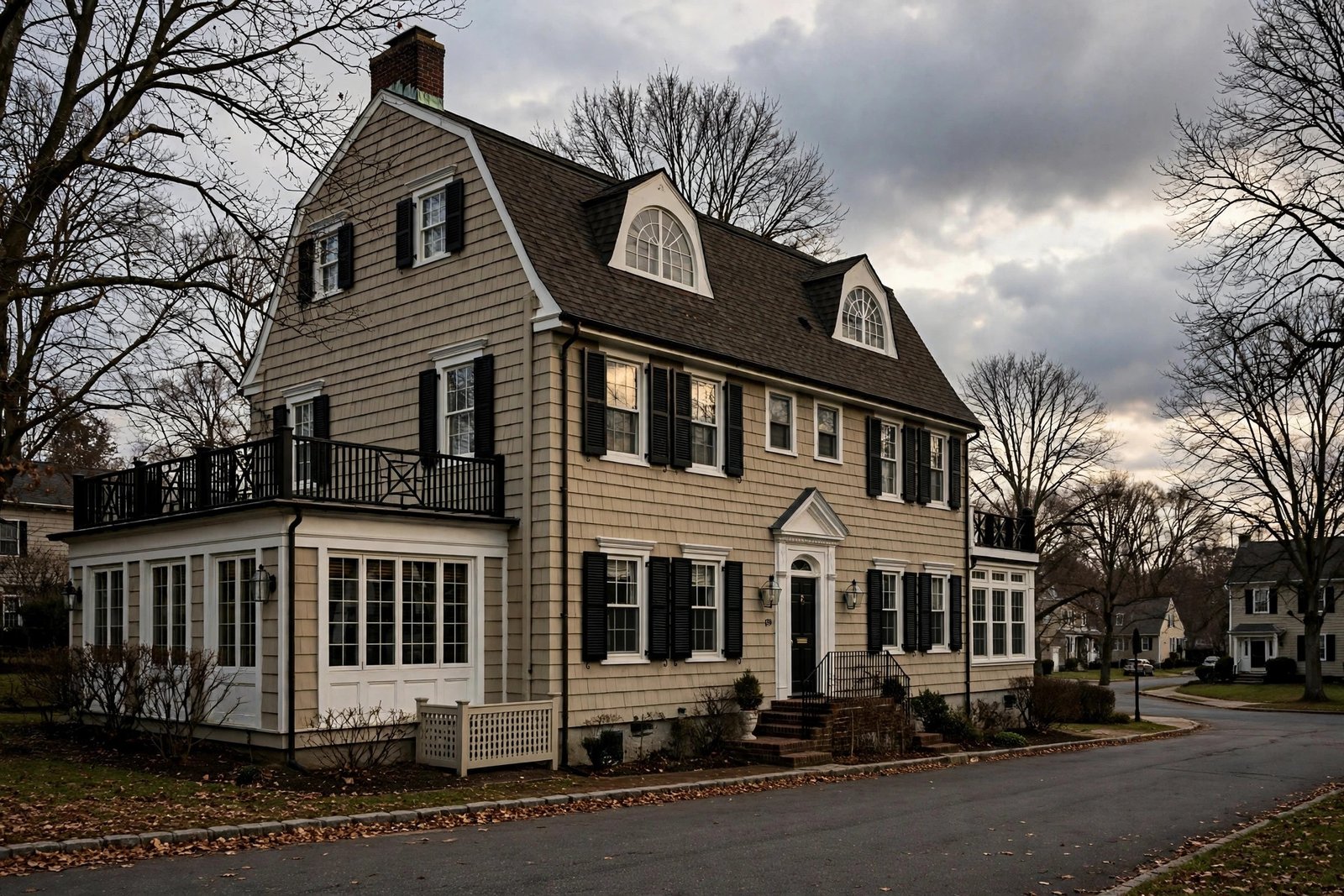
Few addresses in America carry as much weight as 112 Ocean Avenue in Amityville, New York. Say the words Amityville Horror and most people picture the same thing: a large Dutch Colonial house with two round windows on the top floor that look like staring eyes, a family murdered in their beds, and another family driven out after less than a month by something they could not explain. The story has sold millions of books, filled movie theaters, and inspired a franchise that is still going decades later. Yet the real history of the house is stranger and sadder than any ghost story, and it is also more complicated. Some of what happened at 112 Ocean Avenue is a matter of court record. Much of the rest is testimony, publishing, and dispute, and the line between the two has been argued over for fifty years.
This article separates what is confirmed from what is claimed. The murders that took place in the house in 1974 are documented facts, established at trial. The haunting that supposedly followed is a set of claims made by one family, turned into a bestselling book and a hit film, and challenged almost from the moment it reached the public. Understanding the Amityville Horror means holding both parts of the story at once: a genuine American tragedy, and a legend that grew around it until the legend became better known than the truth.
The House on Ocean Avenue
The house at 112 Ocean Avenue is a large Dutch Colonial Revival home in Amityville, a village on the south shore of Long Island, New York. Built in the 1920s, it stands on a canal with a boathouse and a swimming pool, and its most famous feature is a pair of quarter-round windows on the third floor that, in photographs, resemble a pair of watchful eyes. The DeFeo family moved in during 1965, when Ronald DeFeo Sr., a service manager at his father-in-law’s Buick dealership in Brooklyn, brought his wife Louise and their five children to the address. A sign in the yard read High Hopes, a detail that later took on a grim irony.
Nothing in the public record suggests the house had any reputation before November 1974. It was not known as haunted, and no earlier tragedies are attached to it in the historical accounts. That matters, because so much of the legend depends on the idea that something was wrong with the house itself. The documented history tells a different story: the house was an ordinary family home until an act of violence inside it made it famous, and everything that followed, from the book to the films to the tourists, grew out of that single night. The building itself is well constructed and unremarkable as architecture, which is part of why the story attached to it so firmly.
The DeFeo Murders of November 1974
In the early morning hours of November 13, 1974, 23-year-old Ronald DeFeo Jr., known as Butch, shot and killed six members of his family as they lay in their beds. He used a .35-caliber Marlin hunting rifle. The victims were his parents, Ronald DeFeo Sr. and Louise, and his four siblings: Dawn, 18; Allison, 13; Marc, 12; and John, 9. DeFeo later told police that voices in the house had driven him to commit the murders, and his lawyers entered an insanity defense at trial. The jury did not accept it. After a trial lasting seven weeks, DeFeo was convicted in November 1975 of six counts of second-degree murder and sentenced to six consecutive terms of 25 years to life in prison. He was never paroled, and he died in custody in March 2021 at the age of 69.
The murders are the one part of the Amityville story that no serious account disputes. They are a matter of court record, reported at the time and confirmed in every reliable history of the case. The historical record of the house sets out the facts plainly: six people were murdered in a suburban home on Long Island, and the killer was convicted and spent the rest of his life in prison. It is worth keeping that fact separate from everything that followed, because the legend that grew up around the house can make it easy to forget that the real horror at 112 Ocean Avenue was a human act of violence, and that the victims were a real family.
The Lutz Family and Their 28 Days
The house stood empty for 13 months after the murders. Then, in December 1975, George and Kathy Lutz bought the property, including its swimming pool and boathouse, for $80,000, a price widely described as a bargain for a large waterfront home. The couple moved in on December 18, 1975, with Kathy’s three children from a previous marriage and the family dog, Harry. According to the Lutzes, the dream quickly turned into a nightmare. They said the house was plagued by strange smells and sounds, unexplained cold spots, doors slamming on their own, furniture moving, and a gelatinous substance appearing on the carpet. They described swarms of flies in midwinter, a pig-like entity the children called Jodie, and a night when Kathy was supposedly levitated above her bed.
On January 14, 1976, after just 28 days, the Lutzes left 112 Ocean Avenue, taking only the clothes they were wearing and leaving all of their possessions behind. A mover who arrived the next day to collect their belongings reported no paranormal phenomena while inside the house. The events were first publicly reported in Newsday, the local newspaper, on February 14, 1976, and a television report followed on Channel 5. According to the newspaper’s account, some friends of the Lutzes confirmed that they had experienced strange phenomena, while another said the family left because the heating system had failed and they could not afford to repair it. That disagreement, present from the very first public telling, has never really gone away. The Lutzes themselves never wavered in public. George Lutz insisted for the rest of his life that the events were real, saying in a 2000 documentary, It is certainly not a hoax.
The paranormal investigators Ed and Lorraine Warren also became involved, visiting the house and conducting a blessing, and their involvement helped carry the story from local news into the wider world of American ghost lore. But it is important to be clear about what the Warrens and the Lutzes actually established. They offered testimony about experiences, not evidence that could be independently verified. No photographs, recordings, or physical traces from the 28 days have ever been produced that confirm the haunting, and the most dramatic claims, such as levitation and a demonic pig, rest entirely on the word of the people who said they experienced them.
The Book That Made Amityville Famous
The story might have faded into local legend if not for Jay Anson, a writer who turned the Lutzes’ account into a book. The Amityville Horror: A True Story was published in September 1977, and it became a phenomenon. Anson said he based the book on 35 hours of audio recordings given to him by George Lutz, plus about five hours of interviews he conducted to get the timeline right. The book spent months on the New York Times bestseller list, and according to some reports, the publisher ordered 13 printings of the hardcover edition in the first six months. Estimates of total sales run to around 10 million copies.
Two years later, the film adaptation arrived, and it was even bigger. The Amityville Horror, directed by Stuart Rosenberg and starring James Brolin, Margot Kidder, and Rod Steiger, opened in the summer of 1979 and became a major commercial success. Box office records show the film earned about $86.4 million in North America, making it the second-highest-grossing movie of 1979, behind only Superman: The Movie. As one detailed account of the book notes, the author himself would never quite say whether he believed the story was true, telling interviewers that he had no idea whether the book was true or not, but that he was sure the Lutzes believed what they told him to be true.
The Case Against the Haunting
From the start, skeptics pointed to problems with the Lutz account. Some of the book’s specific claims do not match the historical record. The book describes full moons and torrential rains on nights when weather records show neither, and neighbors at the time did not report the storms and disturbances described in the story. The timeline of events also raised questions. The Lutzes said they fled in terror, yet they left their possessions behind in an orderly way and returned the next day with a mover, who found nothing unusual. The family’s financial situation offered another possible explanation: the house had been bought cheaply, but it came with a large mortgage and high running costs, and some accounts suggest the Lutzes realized they had taken on more than they could afford.
The most damaging challenge came from William Weber, the lawyer who had represented Ronald DeFeo Jr. at his murder trial. Weber had met George Lutz during the 28 days the family lived in the house, and he later said the haunting was invented. In the September 17, 1979 issue of People magazine, Weber was quoted as saying, I know this book is a hoax. We created this horror story over many bottles of wine. He said the story had been worked out over drinks with the Lutzes as a way to get DeFeo a new trial, since a house possessed by demons might support a fresh look at the case. Weber’s account has itself been disputed, and the Lutzes denied it, but it was taken seriously enough to matter. In September 1979, a federal judge dismissed the Lutzes’ own legal claims and observed in his ruling that to a large extent the book is a work of fiction, relying in a large part upon the suggestions of Mr. Weber.
The honest position is that neither side has ever been proven right in full. The Lutzes never produced verifiable evidence of the haunting, and they never backed down from their story. What can be said with confidence is that the haunting claims rest on testimony alone, that several specific details in the book contradict the historical record, and that a federal judge concluded the book was largely fiction. Entertainment Weekly’s account of the true story puts it well: the murders were real, and what came next is still up for debate. Readers who want the full picture should keep the two parts of the story separate in their minds, and judge each on its own evidence.
The House Today
After the Lutzes left, the house passed through several owners, none of whom reported anything like the experiences the Lutzes described. Jim and Barbara Cromarty bought the house in 1977, just as the book was coming out, and their lives were quickly disrupted by tourists, pranksters, and curiosity seekers. To reduce the unwanted attention, they had the official address changed from 112 Ocean Avenue to 108 Ocean Avenue. In 1987, Peter and Jeanne O’Neill bought the property and removed the iconic quarter-round windows, replacing them with standard square windows to make the house less recognizable. Later owners continued the remodeling, and the house changed hands again in 1997 and in 2010.
The most recent public sale came in 2017, when the house was sold for about $605,000, after being listed the previous year for $850,000 by the owners who had held it since 2010. Today it remains a private residence at 108 Ocean Avenue, occupied by owners whose identity is kept private, and it is not open to the public. No subsequent owner has publicly reported paranormal activity in the house, and the neighborhood is an ordinary, well-kept Long Island suburb. That quiet fact is, in its own way, the most telling part of the story. For half a century, the house has been lived in by ordinary families who found it an ordinary place to live. The legend endures in books and films, but the building itself has gone back to being what it was before November 1974: a house on a canal, in a suburb, where people live their lives.
FAQ
What happened at the Amityville house in 1974?
On November 13, 1974, Ronald DeFeo Jr., 23, shot and killed six members of his family at 112 Ocean Avenue in Amityville, New York. He was convicted of six counts of second-degree murder in November 1975 and sentenced to six terms of 25 years to life. He died in prison in March 2021. The murders are documented court facts.
How long did the Lutz family live in the house?
George and Kathy Lutz moved into the house on December 18, 1975, with Kathy’s three children and their dog, and left on January 14, 1976, after 28 days. They said they fled because of terrifying paranormal events, and they left their possessions behind.
Was the Amityville Horror a hoax?
That has never been settled to everyone’s satisfaction. The Lutzes always insisted the haunting was real, and they reportedly passed polygraph tests in 1979. But DeFeo’s lawyer, William Weber, said the story was invented over wine, and a federal judge ruled in 1979 that the book was largely a work of fiction. Several details in the book also contradict weather and other historical records.
What is the address of the Amityville house today?
The house is now officially 108 Ocean Avenue, Amityville, New York. The address was changed from 112 Ocean Avenue to discourage tourists and curiosity seekers. The distinctive quarter-round windows were also replaced with square ones. It is a private residence and is not open to visitors.
How successful were the Amityville book and film?
Jay Anson’s book, published in September 1977, spent months on the New York Times bestseller list and has sold an estimated 10 million copies. The 1979 film earned about $86.4 million in North America, making it the second-highest-grossing movie of that year, and it launched a franchise that includes sequels and a 2005 remake.