
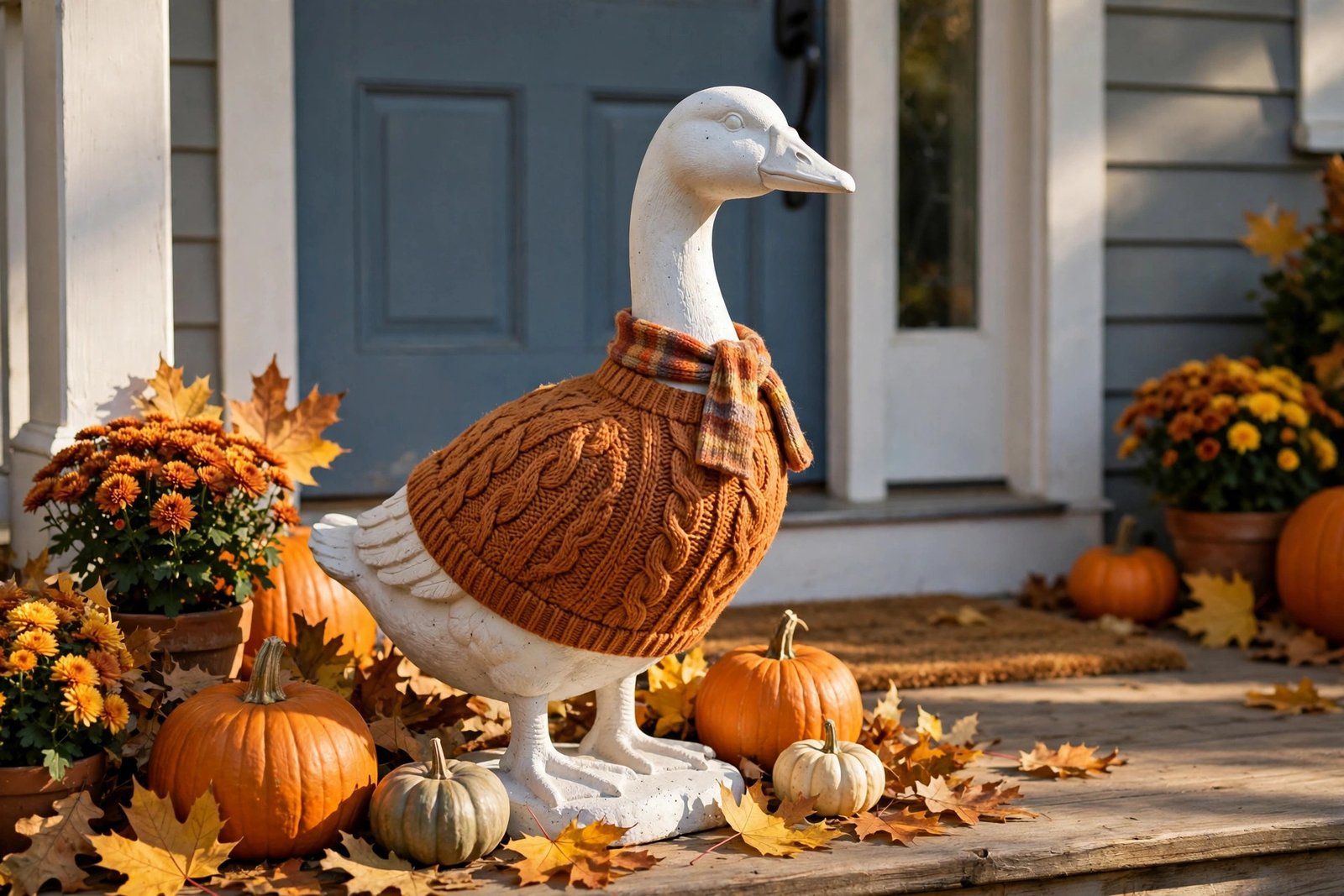
Scroll through TikTok lately and you are bound to meet her sooner or later: a cheerful white goose standing on a front porch, dressed for the occasion. In the spring she might wear a yellow raincoat and a tiny bonnet. By July she is decked out in red, white, and blue for Independence Day. Come October, she is a witch, a ghost, or a Kansas City Chiefs fan. She does not honk and she does not need feeding. She is a porch goose, a plastic lawn statue with a wardrobe bigger than most people’s, and she has become one of the most joyful viral trends in America.
The porch goose is not new. She is older than TikTok, older than the internet, and older than most of the creators now dressing her up for millions of viewers. She spent decades standing quietly on Midwestern porches, a beloved piece of grandma’s garden decor, before social media discovered her and turned her into a star. The hashtag #porchgoose now leads to a flood of outfit changes, unboxings, and craft tutorials, and the humble goose has become shorthand for American warmth: wholesome, funny, a little kitsch, and completely sincere.
What Exactly Is a Porch Goose?
A porch goose is a statue of a goose, usually about 23 inches tall, made to stand by a front door, on a porch, or in a garden. The classic version is a white plastic blow-mold goose sold under names like Gaggleville and Fox Valley Traders. It is hollow inside, so owners fill the base with sand or gravel to keep a stiff breeze from sending their goose tumbling into the neighbor’s yard. The design has barely changed in decades, because it does not need to. The goose is a blank canvas, and the real magic is the wardrobe.
That wardrobe is the whole point. Porch goose owners dress their birds for every season and holiday, some with the seriousness of a fashion stylist. There are raincoats for April showers, Uncle Sam suits for the Fourth of July, Santa outfits for Christmas, Easter bonnets for spring, and spooky costumes for Halloween. Some owners sew their own outfits, some buy them from sellers on Etsy, Amazon, and eBay, and some do both. As Apartment Therapy noted when the trend went viral, the 23-inch Gaggleville goose is designed to wear costumes and welcome house guests in all of its goosely glory, and creators have dressed theirs in everything from a custom Barbie ensemble to a Kansas City Chiefs outfit.
The goose also comes in other sizes now. The classic 23-inch statue remains the most recognizable, but there are 21-inch versions that many Etsy sellers design for, and a 7-inch mini desk goose for a shelf or desk. Metal versions, like a 24-inch goose sold with two outfits, have joined the flock as well. Whatever the size, the idea is the same: a friendly bird, dressed for the day, standing guard over the home.
A Midwestern Original: The Goose’s 1980s Heyday
The porch goose was born in the American Midwest, and its roots run back to the late 1970s and early 1980s. Concrete lawn geese began their migration into mainstream American culture around 1980, and their popularity began in the Upper Ohio River Valley, the region from Pittsburgh, Pennsylvania, toward northern Kentucky. A 1995 Chicago Sun-Times article identified Kentucky as the birthplace of the concrete goose, and the fad of dressing the birds likely began in Indiana, Illinois, or Ohio. Wherever exactly it started, the Midwest was its home.
The timing was perfect. The 1980s and 1990s were the golden age of the country look in home decor, and a cheerful goose fit right in. The originals were made of concrete, heavy and permanent, but plastic blow-mold versions soon followed, lighter and easier to move. By the 1990s, the sale of goose fashions was booming across the Midwest. The Chicago Sun-Times reported on owners who bought entire wardrobes for their statues, including negligees, curlers, leopard-print bikinis, and sunglasses, and one Chicago owner filled three bureau drawers with goose clothing.
By the early 1990s, well-dressed geese had spread across the country, and the goose was a fixture of American front yards. Then tastes changed, contemporary decor pushed the country look aside, and many geese were retired to garages and thrift stores. But they never fully disappeared, especially in the Midwest, where they remained a porch staple.
Grandma’s Porch: Where the Tradition Lived On
Ask almost any porch goose owner where they first saw one, and the answer is almost always the same: grandma’s house. For a generation of Americans, the goose is tangled up with memories of visiting grandparents, of front porches and gardens and holidays marked by a change of outfit on a statue by the door. That nostalgia is the emotional engine of the whole trend. The goose is not just decor; it is a memory you can put on your porch.
At Minot Air Force Base in North Dakota, Joni Favreau’s goose, named Gerty, carries decades of family memories. As a child, Joni helped her grandmother dress a porch goose for every season and holiday. Years later, during a difficult period in her pregnancy, her husband remembered those stories and surprised her with a porch goose of her own. Every time she changes Gerty’s outfit now, she thinks of her grandmother, while creating new memories for the next generation.
Amy Williams of Snow Hill, Maryland, tells a similar story about her goose, Gustar. Her mother proudly displayed a cement porch goose in the 1990s, complete with seasonal outfits, and after her mother died in 2000, the memory stayed with her. When she noticed porch geese making a comeback, she went searching for one like her mother’s and eventually found a traditional cement goose at a farmers market in Delaware. These are stories about grief, love, and the small objects that keep people close after they are gone.
TikTok Discovers the Goose
The goose’s big comeback began the way so many comebacks do now: on TikTok. Creators started posting videos of their geese getting dressed for the seasons, and the format turned out to be perfect for the platform. An outfit change takes seconds to film, the reveal is instantly satisfying, and the goose’s deadpan expression makes every costume funnier. The hashtag #Goosetok gathered the videos together, and soon the algorithm was serving dressed-up geese to millions of people who had never thought about lawn ornaments. Apartment Therapy’s February 2024 feature captured the moment, describing one creator’s Halloween costume change for her gaggle of geese.
The mainstream press followed. In June 2025, the Washington Post published an article by Kate Morgan announcing that the porch goose had made a huge comeback, this time with extensive wardrobes. Three years earlier, Ohioan Erica Gross had bought her first home and remembered the goose that stood watch on her grandmother’s porch. An aunt found one at a garage sale, Gross set out to clothe it, and she went on to found the Porch Goose Club of America in 2022. Today that group has more than 240,000 followers on Facebook, and goose lovers now trade outfits and hunt for rare birds on Pinterest, eBay, Etsy, and Amazon.
Then came the story that made the whole country fall in love. In February 2026, TikToker Emma Lou, known as @emily_jean21, shared how her porch goose had connected her to an elderly couple who lived two blocks away. The couple also had a porch goose, and Emma began leaving little outfits and notes on their doorstep. One day she found a bag outside her door marked Porch Goose Friends, with a note from the couple’s daughter. The goose had originally belonged to the wife, who had requested it as a birthday gift in the early 1990s. After she passed away in 2018, her husband and grandchildren kept the tradition going. As Distractify reported, the video was so touching that it prompted many viewers to go out and find their own porch geese.
The Great Goose Hunt of 2025
With virality came scarcity. As the trend exploded, porch geese started selling out everywhere. Big retailers like Lowe’s, Walmart, and Hobby Lobby stocked them, but inventory moved fast, and entire Facebook groups sprang up dedicated to tracking down where to buy one. Craft blogs warned readers to snag a goose the moment they spotted one, because the birds were gone almost as soon as they arrived. For a lawn ornament that had spent years gathering dust in thrift stores, it was a remarkable reversal.
The sellers adapted quickly. Etsy shops began offering outfits for every imaginable occasion, from bee costumes to bridal gowns, and some sellers reported handmade goose wardrobes selling out within hours of listing. Retailers noticed too. Costco began selling a porch goose set for under 30 dollars, a 24-inch metal goose with two outfits, a yellow raincoat with a matching hat and umbrella, and a barbecue look with a red shirt and apron. The set appeared at select locations in late 2026. Meanwhile, My Evergreen’s Giddy the Goose, a metal goose made to be dressed year-round, released new seasonal outfits including gardener, chef, biker, and floral designs.
The hunt itself became part of the fun. Thrifting for geese, checking stock at garden centers, and trading tips in Facebook groups turned shopping into a community activity. One community site counts more than 360,000 members in the largest porch goose group on Facebook. The goose is no longer a solitary decoration. It is a hobby, a marketplace, and a social network, all built around a bird that never moves.
The Mini Goose and the New Wave
Every viral trend spawns variations, and the porch goose is no exception. The most charming is the mini goose, a 7-inch desk version of the classic statue that brings the trend indoors. Mini geese sit on desks, bookshelves, and entryway tables, dressed in tiny outfits, and they have become a gateway for people without a porch, or who live in apartments. The mini goose proves the trend is not really about porches at all.
The trend has also inspired spin-offs. In the spring of 2026, porch ducks began appearing on TikTok, wooden duck statuettes placed on front stoops and steps, a modern variation that owes an obvious debt to the goose. But the goose remains the original, and its fans are quick to point out the difference: a porch duck is cute, but a porch goose is made to be dressed up. The wardrobe is the point, and no spin-off has matched the depth of the goose’s closet.
What comes next is anyone’s guess, but the signs point to staying power rather than a flash in the pan. The goose has already survived one long fade into obscurity and come back stronger, and this time it has clubs with hundreds of thousands of members, sellers with full product lines, and a new generation of owners behind it. The goose is not a one-season wonder. She is a permanent resident now.
Why a Plastic Goose Makes America Smile
So why does a plastic goose make so many Americans so happy? Part of it is nostalgia. The goose connects younger homeowners to their grandparents’ porches, to a time that feels simpler and warmer, and to a style of decorating that was personal rather than purchased. The grandmillennial trend, the embrace of cottagecore and grandmacore aesthetics, and a broader hunger for handmade, homey things have all fed into the goose’s return. She asks nothing of you except a smile.
Part of it is the humor. There is something inherently funny about a goose in a tuxedo, or a goose dressed as a bee, or a goose wearing a tiny raincoat while it pours outside. The goose never breaks character. She stands there, dignified and absurd at the same time, and the contrast is irresistible. In Franklin County, Alabama, a 911 dispatch office keeps a goose named Dispatch Goose, dressed in dozens of costumes including a police uniform, nurse’s scrubs, a judge’s robe, and a clown suit. After the office started posting the goose on Facebook, its page engagement jumped 118 percent, with 32 new followers in a single week.
But the deepest reason is community. The goose gives strangers something to talk about. Neighbors stop to ask about an outfit. Passersby take photos. People leave costumes on each other’s doorsteps, as Emma Lou did, and friendships form around a shared joke. In a country where so much of daily life happens behind screens, the porch goose is gloriously analog: a real object, in a real yard, that makes real people smile. As Lancaster County Magazine put it, the goose is reclaiming its status at the top of the pecking order of porch accessories, one outfit change at a time.
FAQ
What is a porch goose?
A porch goose is a statue of a goose, usually about 23 inches tall and made of plastic or concrete, that stands on a porch or in a garden. Owners dress it in seasonal outfits for holidays and special occasions, then share photos and videos of the outfit changes on social media, especially TikTok.
Where did the porch goose trend start?
Concrete lawn geese became popular around 1980 in the Upper Ohio River Valley, the region from Pittsburgh toward northern Kentucky. The fad of dressing them likely began in Indiana, Illinois, or Ohio, and the trend flourished across the Midwest through the 1980s and 1990s before fading and then roaring back on TikTok.
Why is the porch goose so popular on TikTok?
Outfit-change videos are short, satisfying, and funny, perfect for TikTok. The hashtag #Goosetok gathers the clips, and creators compete to find the most creative costumes, from sports team outfits to elaborate holiday looks. Nostalgia for grandparents’ porches gives the trend emotional weight that keeps viewers coming back.
Where can I buy a porch goose?
Porch geese are sold at retailers including Walmart, Hobby Lobby, Lowe’s, and Tractor Supply, as well as on Amazon, eBay, and Etsy, though popular sizes frequently sell out. The classic 23-inch plastic goose is the most common, and smaller 7-inch mini geese are available for desks and shelves. Seasonal sets, like the metal goose at Costco, appear at select locations.
How much does a porch goose cost?
Prices vary widely. New plastic geese typically sell for modest prices at big retailers, while vintage concrete geese can cost more at antique shops and flea markets. Costco’s 2026 porch goose set, a metal goose and two outfits, sells for under 30 dollars. Outfits are sold separately, and handmade Etsy costumes range from a few dollars to much more.