
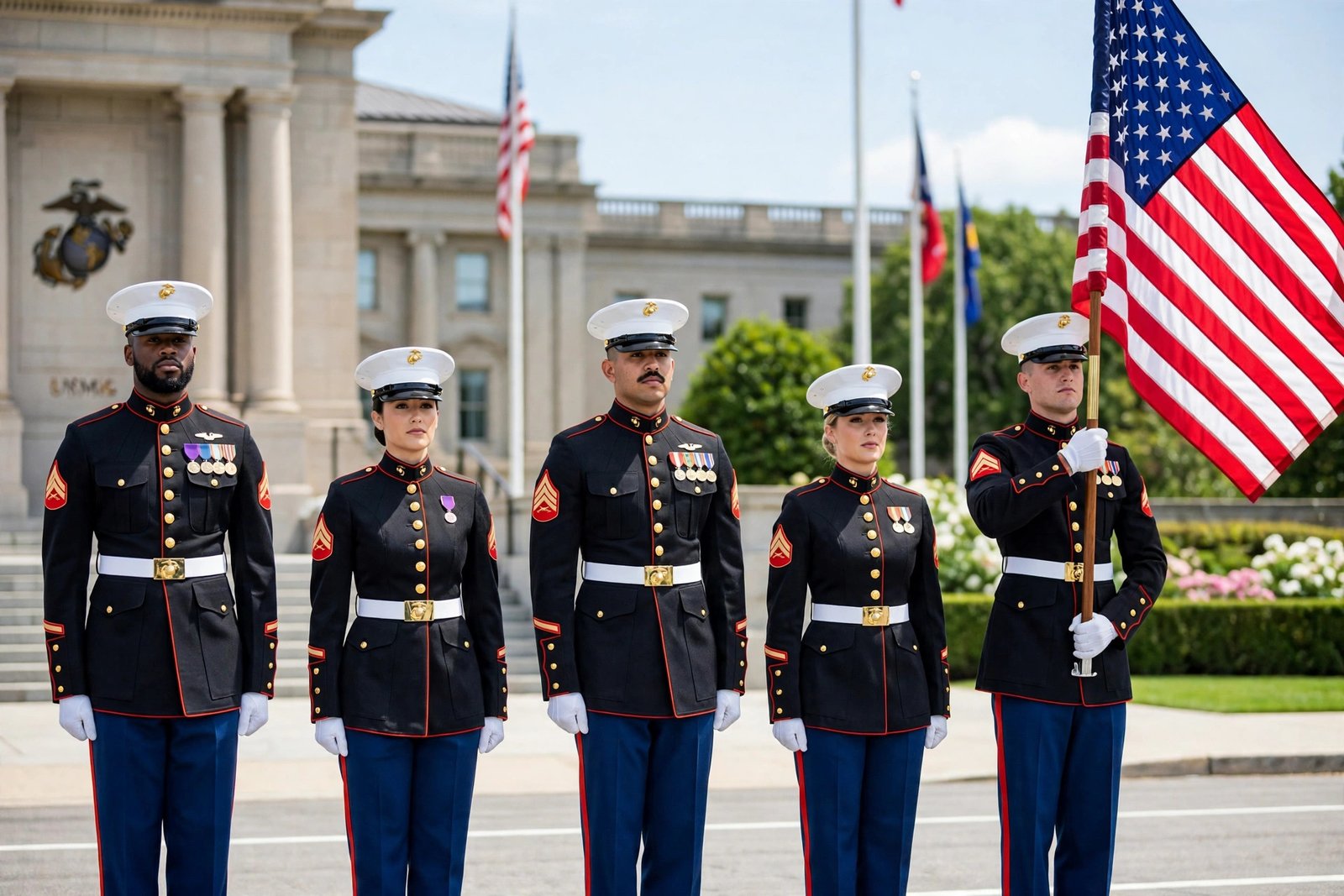
On November 10, Marines around the world will pause, dress in their finest uniforms, and celebrate a birthday that is older than the United States itself. The United States Marine Corps turns 251 in 2026, and its birthday is not just a party. It is a ceremony built around a 1921 order, a cake cut with a sword, and a tradition in which the oldest Marine present hands a piece of cake to the youngest, symbolizing the passing of knowledge from one generation to the next.
For Americans who have never served, the Marine Corps Birthday Ball can seem like a formal mystery: why November 10, why a cake, why a sword, and why does a military service celebrate its birthday with such devotion? The answers reach back to a tavern in Philadelphia, a resolution by the Continental Congress, a period when the Corps ceased to exist, and a commandant who decided, in 1921, that Marines needed a shared birthday to bind them together. This is that history, and why November 10 still matters.
November 10, 1775: Two Battalions of Marines
The story begins before independence, in the autumn of 1775, when the American colonies were already at war with Britain but had not yet declared independence. The Continental Congress needed a naval force, and a naval force needed Marines: soldiers who could fight aboard ships, guard naval installations, and serve as landing forces ashore. On November 10, 1775, the Second Continental Congress resolved that two battalions of Marines be raised.
The resolution, preserved in the Journals of the Continental Congress, specified that the Marines should be good seamen or men acquainted with maritime affairs, and it set the framework for recruiting and organizing the new force. Command of the first Marines fell to Samuel Nicholas, a Philadelphia merchant and tavern keeper’s son, who became the first commandant in all but name. Tradition holds that the first recruiting took place at Tun Tavern in Philadelphia, a popular gathering place for sailors and merchants, and the Marine Corps today regards Tun Tavern as its birthplace, even though historians note that the 1775 resolution itself does not mention the tavern by name.
The distinction matters, because it shows how tradition and documentation interact in Marine history. The date is documented. The tavern is traditional, and the Corps embraces it as a symbol of its origins among ordinary Philadelphians, sailors, and volunteers who stepped forward in a revolutionary moment. A Marine Corps history of the birthday from Twentynine Palms explains that the ball, held on or around November 10 each year, commemorates those traditions and that history for generations of Marines around the globe.
The Continental Marines served through the Revolutionary War, fighting aboard ships and in land battles, but they did not survive the peace that followed. After the Treaty of Paris in 1783 ended the war, the Continental Navy and Marines were disbanded, and for more than a decade, there was no Marine Corps. That gap is essential to understanding the birthday story, because the Corps that exists today is not an unbroken continuation of the 1775 force. It is a re-creation, given a birthday that reaches back to its revolutionary origins.
Rebirth in 1798 and the July Birthday
On July 11, 1798, President John Adams signed a bill re-establishing the Marine Corps, this time as a permanent service under the Secretary of the Navy. The new Corps was created amid tensions with France, the Quasi-War, when the young republic again needed a naval infantry force. For more than a century afterward, Marines celebrated July 11 as their birthday, because that was the date of the law that brought the Corps back into existence.
There is, however, little evidence of elaborate July birthday ceremonies in those years, according to Marine Corps historical accounts. The date was acknowledged, but it did not generate the balls, pageants, and cake ceremonies that define the modern celebration. The Corps was busy building its identity through service: in the Barbary Wars, in the War of 1812, in Mexico, and in the Civil War, where Marines served on both sides. It earned a reputation for discipline and expeditionary readiness, but it did not yet have a birthday ritual that tied every Marine, past and present, to a single founding moment.
That changed after World War I. The Marine Corps had proven itself in France, most famously at Belleau Wood, where Marines earned national fame and the nickname Devil Dogs, though the origin of that nickname is debated. Yet the Corps also faced questions about its future in a peacetime military dominated by the Army and Navy. Its leaders understood that a service needs more than missions. It needs memory, ritual, and a story that every recruit learns on day one.
How November 10 Became the Birthday
The shift from July to November came from a small group of Marine historians and a commandant willing to act. In 1921, Major Edwin McClellan, officer in charge of the Historical Section at Headquarters Marine Corps, sent a memorandum to Major General John A. Lejeune, the commandant, suggesting that November 10, 1775, the date the Continental Congress resolved to raise two battalions of Marines, be declared a Marine Corps holiday.
Lejeune agreed. On November 1, 1921, he issued Marine Corps Order No. 47, Series 1921, summarizing the history, mission, and tradition of the Corps and directing that his message be read to every command on November 10 each year. The order begins with the sentence every Marine knows: On November 10, 1775, a Corps of Marines was created by a resolution of Continental Congress. That reading remains part of the birthday ceremony today, more than a century later, followed by a message from the current commandant.
Lejeune’s order did more than change a date. It gave the Corps a founding story that predated the Constitution, tied modern Marines to Continental Marines, and created an annual moment when the entire service, from the newest private to the commandant, heard the same words on the same day. In a service that prizes tradition, that shared moment became a powerful tool for cohesion. As a Military.com account of Lejeune’s decision notes, the general inherited a Corps that had proven itself at Belleau Wood but faced serious questions about its future, and the birthday helped link current Marines to their Continental predecessors.
The first event called a Birthday Ball was probably held in 1925 in Philadelphia, according to Marine Corps history, with the unveiling of a tablet at the site of Tun Tavern. Early celebrations varied widely: dances, mock battles, musical performances, pageants, and sporting events all appeared in different places and years. There was no single template yet, only a growing sense that November 10 deserved a celebration worthy of the Corps.
The Cake Ceremony and the Mameluke Sword
The most recognizable part of the modern birthday is the cake ceremony, and its history is more recent than many assume. The earliest instance noted by Headquarters Marine Corps was at Quantico, Virginia, in 1935, and a better-documented ceremony took place at Marine Barracks Washington in 1937. It was not until 1952 that Commandant General Lemuel C. Shepherd Jr. directed that the birthday observance be formalized throughout the Corps, with an outline of the cake ceremony included in the Drill Manual approved in 1956.
The ceremony follows a precise order that Marines learn by heart. The birthday cake is cut with a Mameluke sword, a curved blade whose own history reaches back to Lieutenant Presley O’Bannon’s assault on Derna, Tripoli, in 1805, during the Barbary Wars, when he was reportedly presented with such a sword. The first piece of cake goes to the guest of honor. The second piece goes to the oldest Marine present, who then hands it to the youngest Marine present. That handoff is the emotional center of the ceremony: experience passing knowledge to youth, tradition passing to the future, in a single, simple gesture.
Other elements complete the ritual. The reading of Marine Corps Order No. 47, the commandant’s message, the playing of the Marines’ Hymn, and, at formal balls, a pageant that recounts the Corps’ history through its uniforms and battles. The Hymn itself, with its opening line From the Halls of Montezuma, was authorized as the official Marine Corps Hymn by Lejeune in 1929, adding another layer of tradition to the birthday season. Together, these elements turn a dinner dance into a history lesson, a reunion, and a reaffirmation of identity.
For Marines deployed far from home, the birthday can be simpler and more moving: a cake shared in a combat zone, a toast raised quietly, a message read in a tent or aboard a ship. A Marine Corps account from Miramar notes that celebrations range from elaborate balls to a simple shared cake delivered into a combat zone, or just quietly raising glasses in a toast. That range is the point. The birthday is not about the venue. It is about Marines, wherever they are, marking the same day together.
What Marines Have Done Since 1775
A birthday is also a moment to recall why the Corps exists, and Marine history offers no shortage of material. From the shores of Tripoli to the Halls of Montezuma, from Belleau Wood to Iwo Jima, from Korea and Vietnam to Iraq and Afghanistan, Marines have served as the nation’s expeditionary force, ready to deploy quickly, fight in austere conditions, and operate from the sea.
That history includes moments of extraordinary sacrifice that Americans know by image even if they do not know the details: the flag raising on Mount Suribachi at Iwo Jima, the frozen fighting at the Chosin Reservoir in Korea, the long campaigns in the Pacific in World War II. It also includes quieter service: embassy security, disaster relief, training allied forces, and the daily work of maintaining readiness in garrisons around the world. The birthday ceremony honors both kinds of service, because both are part of what it means to be a Marine.
The Corps has also changed over time, admitting women, integrating units, and adapting to new forms of warfare, from amphibious assault to cyber and space operations. The birthday tradition has adapted with it, while keeping its core elements intact. The oldest Marine and the youngest Marine at a 2026 ball may have little in common in age, background, or military specialty, but the cake ceremony links them in a chain that stretches back to 1775, and that link is intentional.
For civilians, the best way to honor the birthday is simple: learn the history, thank a Marine you know, and understand that November 10 is not Veterans Day, which falls the next day, on November 11. The two observances are close on the calendar but different in purpose. Veterans Day honors all who served. The Marine Corps birthday honors one service’s founding and traditions. Many Marines observe both, often with the birthday ball on or near November 10 and Veterans Day ceremonies the following day.
How to Mark November 10 This Year
If you are not a Marine, you can still mark the day meaningfully. Visit a local Marine Corps League event, a museum exhibit, or a veterans’ ceremony in your community. Read the text of Marine Corps Order No. 47, which is widely published and short enough to read in a few minutes. Learn about Tun Tavern, Samuel Nicholas, and the 1775 resolution, and share that history with young people who may know the Marines only from movies or recruitment ads.
If you know a Marine, a simple happy birthday on November 10 will be appreciated, and it will likely prompt a story. Marines love to talk about their birthday balls, their first cake ceremony, and the oldest Marine they met at a particular celebration. Those stories are part of the tradition too, passed along informally alongside the formal ceremony, and they keep the history alive in a way that official accounts alone cannot.
For families of Marines, the birthday is also a moment of pride and, sometimes, of worry, especially when a loved one is deployed. A message, a care package, or a phone call on November 10 can mean a great deal, and many family groups organize birthday greetings for units far from home. The Corps’ own history, as told in a Marine Corps story on birthday traditions, emphasizes that Marines celebrate yearly with new messages from the commandant and a cake ceremony that commemorates the passing of wisdom from one generation to the next. That passing is not abstract. It happens in families, in units, and in communities every November.
As the Corps turns 251, its birthday remains what Lejeune intended it to be: a day to remember where Marines came from, to honor those who served, and to remind current Marines that they are part of something larger than themselves. The cake will be cut with a sword. The oldest Marine will hand a piece to the youngest. The order from 1921 will be read again. And for one more year, a resolution passed in Philadelphia in 1775 will bring Marines together around the world.
FAQ
When is the U.S. Marine Corps birthday?
The Marine Corps birthday is November 10. On November 10, 1775, the Second Continental Congress resolved that two battalions of Marines be raised, and the Corps has celebrated that date as its birthday since 1921.
Why did the birthday change from July 11 to November 10?
From 1798 until 1921, the Corps marked July 11, the date President John Adams signed the bill re-establishing the Corps. In 1921, Major General John A. Lejeune issued Marine Corps Order No. 47, directing that November 10, 1775, be observed as the birthday instead, to honor the original Continental Marines.
What happens at the Marine Corps Birthday Ball?
Celebrations include the reading of Marine Corps Order No. 47, a message from the commandant, a pageant or ceremony, and the cake-cutting ceremony, in which the cake is cut with a Mameluke sword and the oldest Marine present hands a piece to the youngest Marine present.
Is the Marine Corps birthday the same as Veterans Day?
No. The Marine Corps birthday is November 10 and honors the founding of the Marine Corps. Veterans Day is November 11 and honors all American veterans. Many Marines observe both, often on consecutive days.
Related reading
WASP Women Pilots of World War II: History
Hello Girls: World War I Telephone Operators of the Army Signal Corps
Tomb of the Unknown Soldier: Arlington’s Guards