
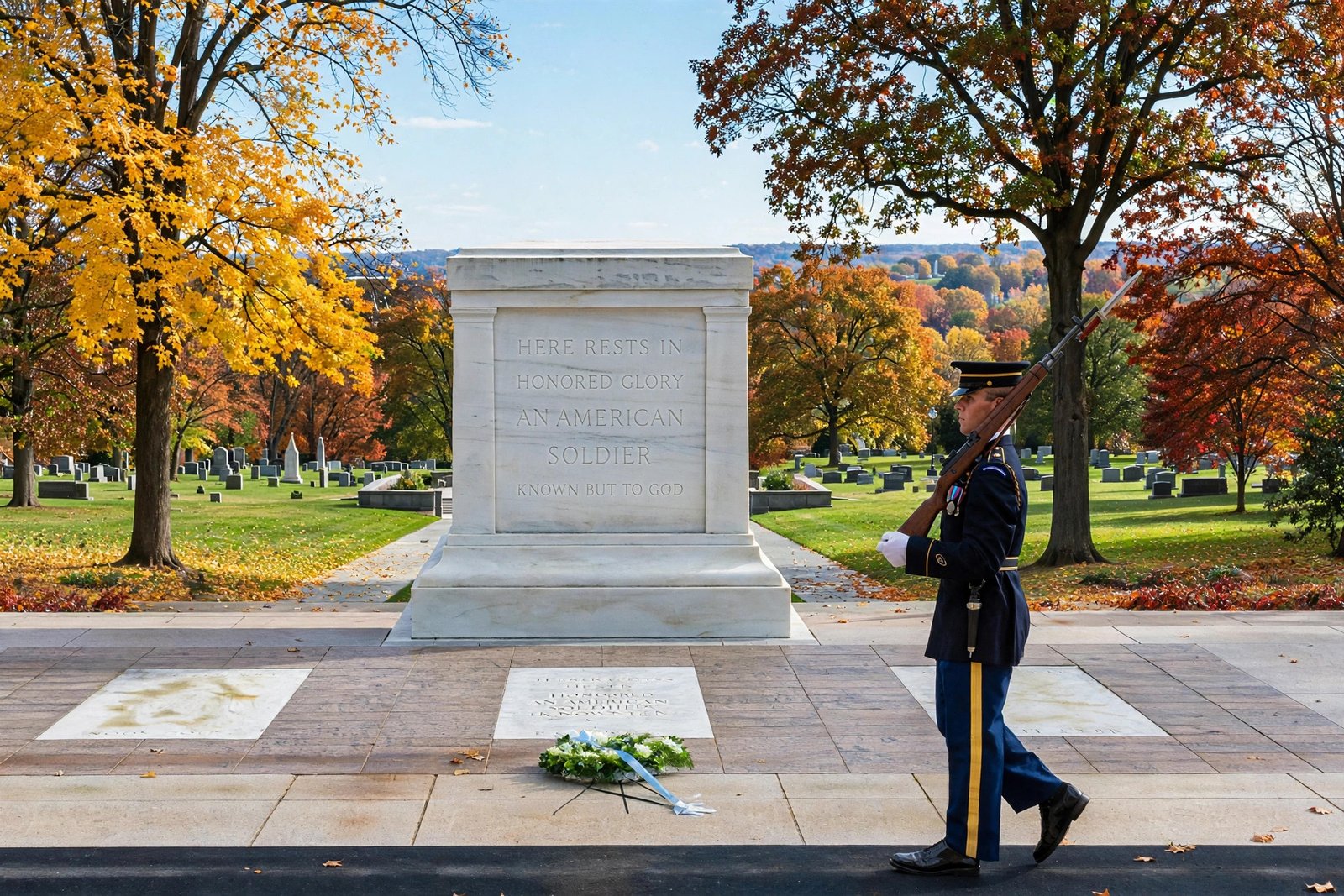
Every hour of every day, in heat, cold, rain, and snow, a soldier walks a precise path in front of a white marble sarcophagus at Arlington National Cemetery. Twenty-one steps, a turn, a pause of 21 seconds facing the tomb, a turn, 21 seconds more, and 21 steps back. The number 21 is no accident: it echoes the 21-gun salute, the highest military honor. The soldier is a Sentinel of the Tomb of the Unknown Soldier, and the watch has not stopped since 1937. Ahead of Veterans Day on November 11, there is no better American story to tell than the story of the tomb, the unknowns it honors, and the guards who never leave their post.
The Tomb of the Unknown Soldier is Arlington National Cemetery’s most iconic memorial. Since 1921, it has provided a final resting place for one of America’s unidentified World War I service members, and unknowns from later wars were added in 1958 and 1984. The white marble sarcophagus that visitors see today, completed in 1932, sits above the World War I unknown’s grave, with the graves of the World War II and Korean War unknowns in the plaza before it. The inscription on the back reads, Here rests in honored glory an American soldier known but to God. It is a sentence that stops visitors in their tracks, because it names exactly what the tomb is for: honoring those whose names were lost along with their lives.
How the tomb began
The idea came from Britain and France, which had already honored their unknown dead after World War I. Congress approved a resolution for an unknown and unidentified American soldier from World War I to be buried at Arlington, and the debate over where to place him was real: some favored the Capitol, at least one person favored Central Park, but Congress settled on Arlington, in the Memorial Amphitheater area. On Memorial Day 1921, four unidentified American soldiers were placed side by side in identical caskets, and Sergeant Edward Younger, himself a decorated veteran, was asked to choose one at random. He chose the third casket from the left.
The chosen unknown was transported from the Capitol to Arlington on November 11, 1921, by horse-drawn caisson, and buried in a ceremony that drew a nation still grieving the Great War. The grave was first marked with a simple marble tomb, intended as the base for a more elaborate structure. Congress later approved funding for the detailed sarcophagus, and after a design competition, the winning design by Lorimer Rich and Thomas Hudson Jones was completed and dedicated in 1932. The tomb Americans visit today is that structure: 11 feet tall, white marble, carved with figures representing Peace, Victory, and Valor on its sides.
But the tomb most people picture is not only the World War I tomb. America had an earlier tomb of unknowns, too: the Tomb of the Civil War Unknowns, dedicated in September 1866, a massive vault containing the remains of more than 2,000 unidentified soldiers from Civil War battlefields, built under Quartermaster General Montgomery C. Meigs. It was America’s first major monument to those whose names were lost in battle, and it stands elsewhere at Arlington. The Tomb of the Unknown Soldier continues that tradition for the wars that followed.
When the guard began
The iconic guards were not part of the tomb from the start. When the tomb was new, visitors treated it casually — families in the early 1920s sometimes mistook the area for a picnic ground, and people climbed or stepped on the tomb. Arlington posted a civilian guard in 1925 to stop that, and in March 1926, soldiers from nearby Fort Myer were first assigned to guard the tomb during daylight hours. The following morning, the first American soldiers to stand vigil at the tomb took their post, and the guard has evolved ever since.
In 1937, the guard became a 24-hour presence, standing watch at all times, and it has remained so ever since, in all but the most extreme weather, such as intense lightning or a hurricane that threatens the sentinel’s safety. The Old Guard, the 3rd U.S. Infantry Regiment, based at what is now Joint Base Myer-Henderson Hall, became the permanent provider of tomb guards in 1948, when it was designated the Army’s official ceremonial unit on April 6 of that year. Since then, every sentinel has come from that regiment, and the assignment is considered one of the highest honors in the Army.
The changing of the guard is the ceremony visitors come to see. It takes place every half hour from April through September and hourly from October through March, so a November visit means an hourly ceremony. The relief commander appears on the plaza, asks spectators to stand and remain silent, inspects the incoming sentinel in detail, and then the outgoing and incoming sentinels meet at the center of the mat, where all three salute the unknowns. The exchange of orders is spoken in a set form, simple words passed between soldiers to confirm that the post and its responsibilities remain exactly as they were.
What it takes to be a sentinel
Becoming a sentinel is one of the most selective assignments in the American military. All sentinels are volunteers, and they must meet strict standards: height between 5 feet 10 inches and 6 feet 4 inches, with proportionate weight and build, and a record that qualifies them for the duty. Fewer than 20 percent of volunteers are accepted for training, and of those, only a fraction pass to become full-fledged tomb guards. The Tomb Guard Identification Badge is among the least-awarded qualification badges in the Army, with fewer than 900 awarded in total, including some later revoked.
The training is famously rigorous. Sentinels memorize pages of information about Arlington National Cemetery and the tomb, including the locations of nearly 300 graves and who is buried in each one, and they must be able to recite the cemetery’s history word for word. They spend an average of six hours preparing their uniform for the next day’s watch — heavy wool, regardless of the season — and they follow a demanding rotation: 24 hours on, 24 hours off, for five days, followed by four days off, with physical training, tomb guard training, and regimental duties filling the off-watch hours. Guards do not wear rank while on duty, so that they never outrank the soldiers laid in the tomb.
The discipline shows in the walk itself. Twenty-one steps across the mat, a turn to face the tomb for 21 seconds, an about-face, a shift of the rifle, another 21 seconds, and 21 steps back. The rifle is carried on the shoulder away from the tomb, as a sign of respect. Every movement is precise, and the precision is the point: it is a visible, unbroken act of respect, repeated without variation, so that the honor paid to the unknowns never depends on the mood of the day.
The unknowns from later wars
The tomb grew as America’s wars grew. After World War II, Congress approved adding an unknown from that war, but the Korean War delayed the plans. Ultimately, unknown soldiers from World War II and the Korean War were awarded the Medal of Honor and interred in the plaza of the tomb simultaneously on May 30, 1958. A Vietnam War unknown was interred on Memorial Day 1984, but the story of that unknown took a different turn: advances in DNA testing led to his exhumation in 1998 and his identification as Air Force First Lieutenant Michael Joseph Blassie. The crypt that held him was rededicated to honor missing service members from all wars, and the Defense POW/MIA Accounting Agency continues the work of recovering and identifying the missing.
That arc — from unknown to identified — is part of what makes the tomb a living memorial rather than a static one. The tomb honors the unknown, but it also stands for the effort to make the unknown known, to bring every missing service member home when science and determination allow. Visitors who know Blassie’s story see the empty crypt differently: it is not a failure of the memorial, but a fulfillment of its purpose, because the soldier it held was finally given his name back.
Visiting the tomb
The tomb is open to visitors during Arlington National Cemetery’s hours, and the changing of the guard is free to watch. Arrive early for a good viewing spot, especially on weekends and around Veterans Day, when crowds grow. The cemetery asks visitors to stand and remain silent during the ceremony, and to stay behind the barriers. Photography is allowed, but the atmosphere is one of quiet respect, and visitors generally match it without being asked.
November is a fitting time to visit. Veterans Day, November 11, marks the anniversary of the World War I unknown’s burial in 1921, and the cemetery holds ceremonies for the day. Wreath-laying ceremonies take place daily, with guest organizations laying wreaths before the tomb in special ceremonies. If you cannot visit in person, the Army and the cemetery publish information about the tomb and its guards, and the ceremony has been filmed many times — but no film quite captures the silence of the plaza when the sentinel turns and the crowd holds its breath.
The tomb endures because the idea behind it endures: that a nation should honor, by name or without one, every person who gave everything for it. The sentinel’s walk, repeated hour after hour, year after year, is the visible form of that promise. Twenty-one steps, 21 seconds, and a watch that does not end.
Frequently asked questions
When did the Tomb of the Unknown Soldier get a 24-hour guard?
Continuous guard duty began in 1937. Soldiers were first assigned to guard the tomb during daylight hours in March 1926, after a civilian guard was posted in 1925.
Who guards the Tomb of the Unknown Soldier?
Sentinels from the 3rd U.S. Infantry Regiment, known as The Old Guard, who have guarded the tomb since April 6, 1948. All sentinels are volunteers who pass a famously rigorous selection and training process.
Why 21 steps and 21 seconds?
The number 21 echoes the 21-gun salute, the highest military honor. The sentinel walks 21 steps, pauses 21 seconds facing the tomb, and repeats the pattern.
Are there still unknown soldiers in the tomb?
Yes. The tomb holds the World War I unknown, and the plaza holds the World War II and Korean War unknowns. The Vietnam War unknown was identified in 1998 as Air Force First Lieutenant Michael Joseph Blassie, and his crypt was rededicated to missing service members.
Related reading
For more Army stories, read about Sergeant Alvin York, the World War I hero from Tennessee, the Coast Guard’s Pendleton rescue of 1952, and the Tuskegee Airmen and the Red Tails’ World War II record.
Sources for this article include Arlington National Cemetery’s Tomb of the Unknown Soldier page, the American Battlefield Trust’s history of the tomb, and VeteranLife’s history of the tomb and its guards.