
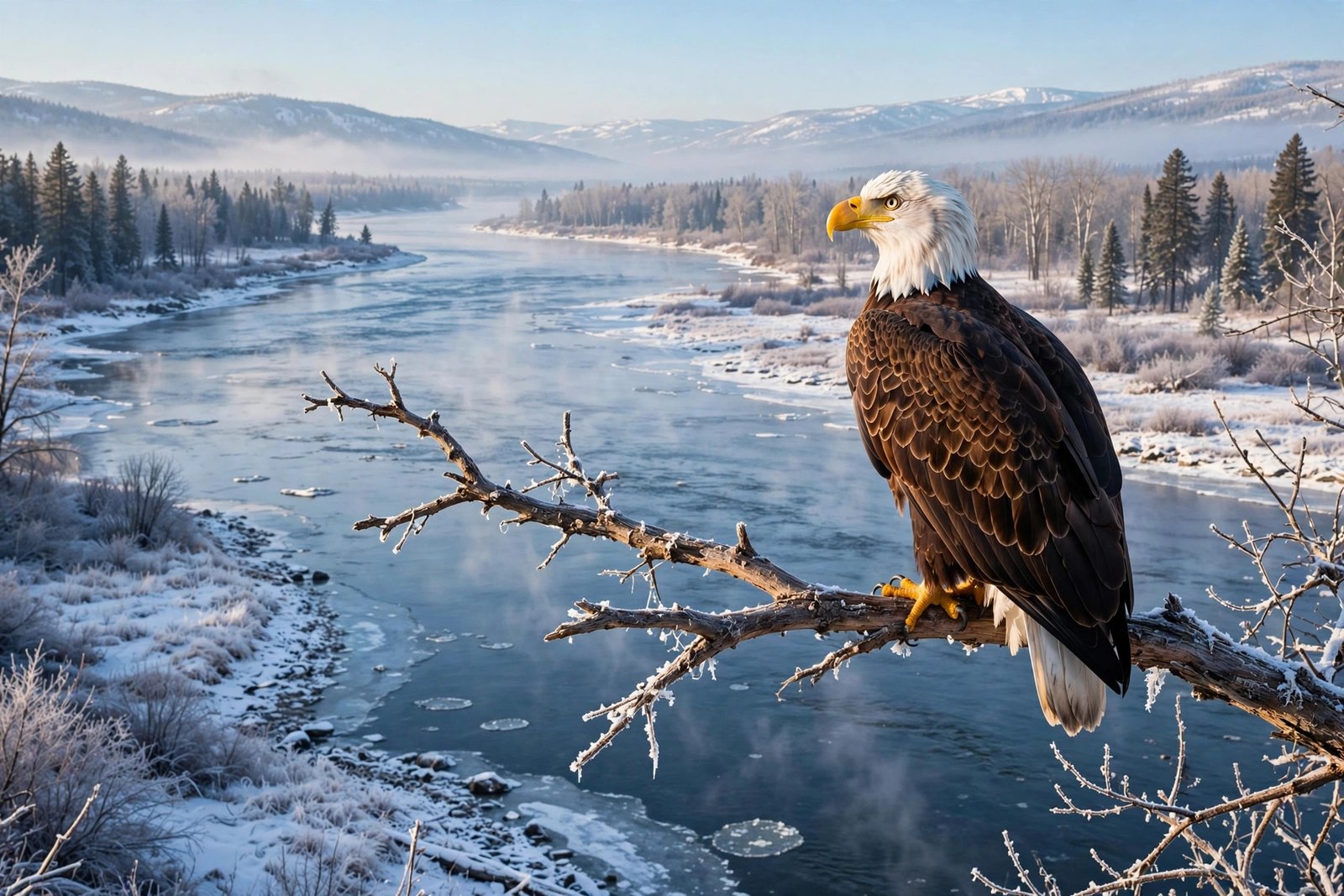
Every winter, one of America’s greatest wildlife spectacles unfolds along its rivers and lakes, and it costs nothing to watch. Bald eagles, the nation’s bird, gather where the water stays open and the fish stay accessible, and their numbers peak from November through March across the lower 48 states. January is even designated National Bald Eagle Watch Month, but the season starts now: northern eagles from Alaska and Canada begin moving south as lakes and rivers freeze, and southern eagles begin nesting. If you have ever wanted to see a bald eagle in the wild, winter is your best chance, and this guide covers where to go, when to go, and how to watch without disturbing the birds.
The bald eagle’s recovery is one of the great conservation stories in American history. The species was removed from the endangered species list in 2007, after decades of protection, habitat recovery, and the banning of the pesticide DDT, which had thinned eggshells and crashed populations. In 2021, the U.S. Fish and Wildlife Service published new estimates for the lower 48 states totaling about 316,700 individuals, including about 71,467 breeding pairs. Today, bald eagles are seen in every state except Hawaii in winter, and their populations continue to grow. Winter watching is possible because the recovery worked.
Why winter is eagle season
Bald eagles are fish-eaters, always near water, and winter concentrates them. In the deep of winter, northern eagles migrate south as lakes and rivers freeze over in their territories, seeking open water where fish remain accessible. They gather along unfrozen rivers, below dams where turbines stun fish, and around lakes that hold out against the ice. In warmer areas, such as Florida, eagles may stay year-round, and some begin laying eggs as early as October, with the nesting season running into spring.
The result is a predictable pattern: January through March is the best window in the lower 48, with November and December offering the first arrivals and the start of the southern nesting season. Eagles are most active in the morning, especially before 11 a.m., when they hunt and feed. They perch in tall trees near water, often in groups, and they are large enough — with wingspans over six feet — to spot with the naked eye once you know what to look for: a dark body, a white head and tail in adults, and a massive yellow bill. Young eagles, by contrast, are mottled brown for their first four to five years, and beginners often mistake them for golden eagles or large hawks.
The best places to see bald eagles in winter
The Upper Mississippi River is the classic winter eagle destination. From December through February, eagles crowd below the locks and dams, where open water and stunned fish create easy feeding, and state parks along the river in Wisconsin, Iowa, Illinois, and Minnesota offer viewing platforms and ranger programs. Nelson Dewey State Park in Cassville, Wisconsin, is a well-known winter hotspot, and the Two Rivers National Wildlife Refuge near Brussels, Illinois, hosts some of the largest wintering concentrations in the lower 48, with more than 500 eagles counted near the river confluence.
The Pacific Northwest offers a different spectacle. The Skagit and Nooksack Rivers in Washington host one of the largest concentrations of bald eagles in the contiguous United States each winter, as eagles follow the chum and coho salmon runs south. In a typical year, more than a thousand eagles migrate to the Upper Skagit alone, with numbers peaking in late December and early January. Eagle watcher sites with spotting scopes are set up along the Skagit during the peak, at Howard Miller Steelhead Park, the Milepost 100 rest stop on Highway 20, and the Marblemount Fish Hatchery, and the Skagit River Bald Eagle Interpretive Center in Rockport is a good first stop.
Other reliable hotspots span the country. The Klamath Basin, on the California-Oregon border, hosts the largest concentration of wintering bald eagles in the lower 48, with as many as 1,000 eagles in peak months of January and February, visible from the Lower Klamath and Tule Lake auto tours. Conowingo Dam in Maryland draws eagles in winter below its turbines. Dale Hollow Lake, on the Tennessee-Kentucky border, supports the second largest wintering bald eagle population in those two states, and its annual Eagle Watch Tours, run by the Army Corps of Engineers since the 1990s, carry visitors by open-air barge to view wintering eagles. Loess Bluffs National Wildlife Refuge in Missouri has recorded more than 300 eagles at peak, with a record 662 counted in 2020. The Karl E. Mundt National Wildlife Refuge in South Dakota supports 100 to 300 wintering eagles at a critical roost. And the Columbia River Gorge, near The Dalles Dam, gathers migrating eagles from Alaska and Canada each winter.
How to watch eagles well
Binoculars transform eagle watching, and a spotting scope transforms it again. Eagles often perch far across a river or reservoir, and the difference between a distant dark speck and a crisp white head is magnification. If you do not own binoculars, many refuges and eagle festivals lend them, and a basic pair is a worthwhile investment for any wildlife trip. Dress for standing still in winter: warm layers, a windproof outer layer, gloves that still allow you to work binoculars, and waterproof boots, because the best viewing spots are often muddy or icy.
Watch for behavior, not just birds. Eagles soar on thermals in the late morning, perch and preen in the afternoon, and squabble over fish with surprising noise and drama. A perched eagle may sit motionless for an hour, then explode into flight when a fish surfaces or a rival approaches. Scan the treetops along the water’s edge systematically, looking for the white head among bare branches, and scan the sky for the broad, flat wings and short, fanned tail that distinguish an eagle’s soar from a hawk’s. Patience is the skill: eagle watching rewards the watcher who stays in one good spot for an hour over the watcher who drives between five spots.
Respect the birds, and the law. Bald eagles are protected by federal law, and active nests are protected within a buffer — the commonly cited guidance is to stay at least 660 feet from an active nest. Do not approach a perched eagle closely, do not use drones near eagles, and do not play recorded calls to attract them. If an eagle flushes because of you, you were too close. The best viewing platforms and refuge auto tours exist precisely so that people can watch without pressuring the birds, so use them.
Eagle festivals and ranger programs
Winter eagle festivals make first-time watching easy. The Upper Skagit Bald Eagle Festival, held on a January weekend in Concrete, Washington, pairs river trips with interpretive programs. Dale Hollow Lake’s Eagle Watch Tours, held on January Saturdays, offer barge-based viewing with naturalists aboard. The Columbia Gorge’s annual Eagle Watch event, hosted by the Army Corps of Engineers and the Columbia Gorge Discovery Center, offers a January day of viewing and education. National wildlife refuges across the Mississippi flyway run winter eagle programs, and state parks along the Upper Mississippi schedule eagle days with ranger talks and spotting scopes.
These programs are worth seeking out even for experienced birders, because rangers know where the eagles were yesterday, which matters more than any guidebook. Eagle locations shift with ice, fish, and weather, and a ranger’s morning report can save hours of searching. Check refuge and park websites before you go, since tour dates, reservation requirements, and road conditions change with the season.
The eagle’s comeback, in one view
There is a reason eagle watching feels emotional in a way that other birding does not. Within living memory, the bald eagle was headed for extinction in the lower 48, and its recovery — from a few hundred nesting pairs in the 1960s to tens of thousands today — is a visible proof that conservation works. When you watch a hundred eagles along a winter river, you are watching a policy success with wings. That is worth a cold morning.
Start close to home. Check your nearest national wildlife refuge, state park, or river dam for winter eagle programs, and pick a January or February morning with clear skies. Bring binoculars, dress warmly, and give yourself time. The eagles will be there, perched above the open water, white heads bright against the winter trees, waiting for the fish to rise.
Frequently asked questions
When is the best time to see bald eagles?
January through March is the best window in the lower 48 states, when northern eagles winter in the south and gather along open water. November and December bring the first arrivals, and southern eagles begin nesting in late fall.
Where is the best place to see bald eagles in winter?
The Upper Mississippi River, the Skagit River in Washington, the Klamath Basin on the California-Oregon border, Conowingo Dam in Maryland, and Dale Hollow Lake in Tennessee and Kentucky are among the most reliable winter hotspots.
Do I need binoculars to see bald eagles?
Eagles are large enough to spot with the naked eye, but binoculars make a huge difference, since eagles often perch far across a river or reservoir. Many refuges and festivals lend binoculars and spotting scopes.
How close can I get to a bald eagle?
Stay back and use viewing platforms and auto tours. Federal guidance protects active nests within about 660 feet, and if an eagle flushes because of you, you were too close. Never use drones near eagles.
Related reading
For more wildlife watching, read where to hear bugling elk during the autumn rut, the wild ponies of Assateague and Chincoteague, and where to see Florida manatees in winter.
Sources for this article include the U.S. Fish and Wildlife Service’s Dale Hollow Lake eagle watch report, the national parks guide to winter eagle watching, and the Skagit River eagle migration guide.