
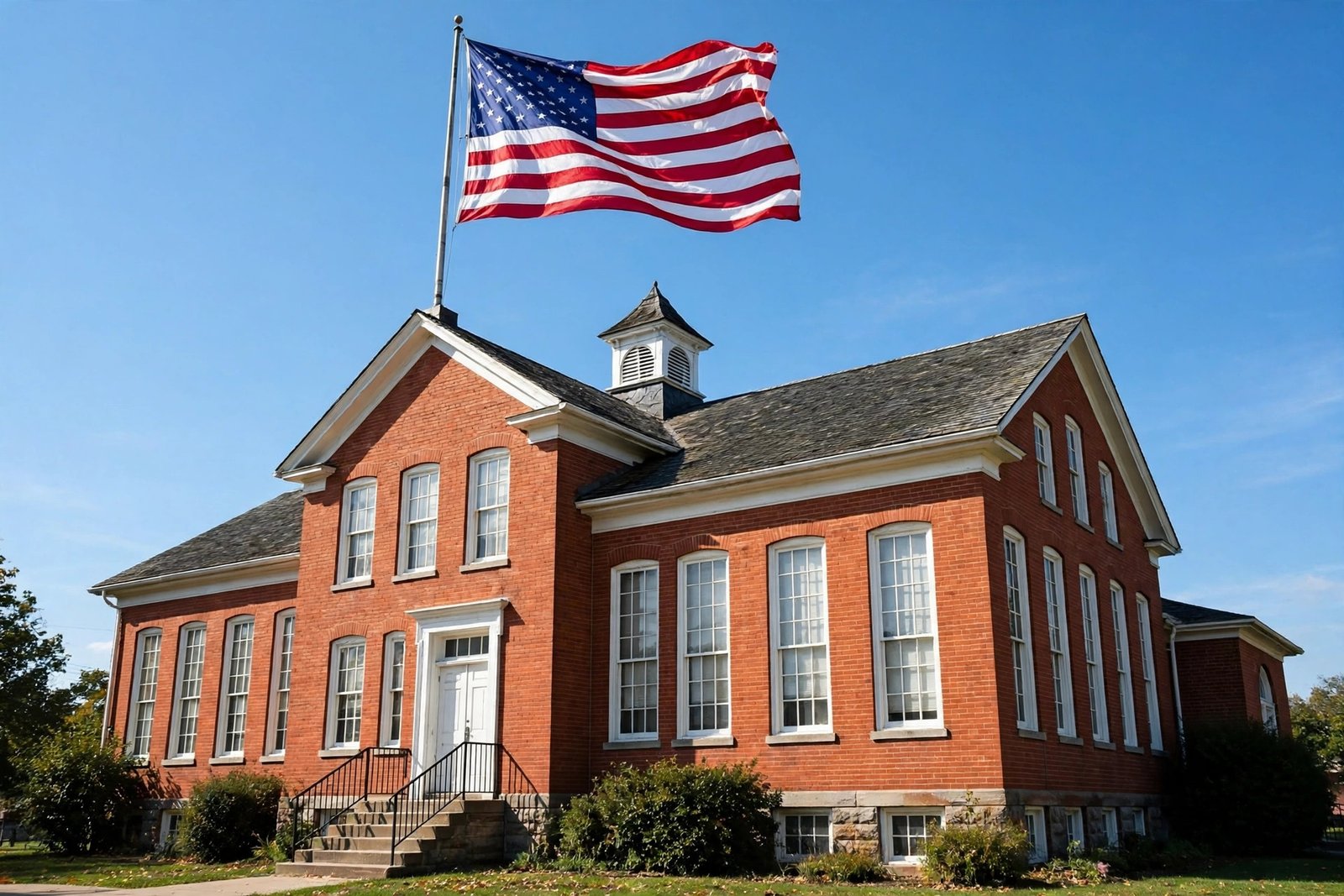
Every school morning, millions of American children stand, face the flag, and recite 31 words they mostly know by heart. The Pledge of Allegiance feels timeless, as if it has always been part of American life. In truth, it is younger than the light bulb’s widespread use, younger than the telephone network, and it was born not in a hall of government but in the offices of a children’s magazine running a marketing campaign. The story of the Pledge, from 1892 to today, is a story about how America invents its traditions, argues over them, and keeps them anyway.
The Pledge has been rewritten, re-saluted, taken to the Supreme Court, and amended by Congress. It began as a 23-word classroom exercise tied to a flag sale, and it became one of the most recognized oaths in the world. Along the way, it picked up the words ‘of the United States of America,’ lost an awkward salute, gained the phrase ‘under God,’ and survived court challenges that tested the meaning of freedom itself.
A Magazine, a Flag Sale, and a Columbus Day Celebration
The story starts in Boston, at The Youth’s Companion, a popular children’s magazine. In the early 1890s, the magazine was running a clever promotion: readers who sold subscriptions could earn an American flag for their school. The campaign’s goal was to put a flag in every public school, and it was working. But the magazine’s staff wanted something more, a ceremony to go with the flag.
The occasion was the 400th anniversary of Christopher Columbus’s arrival in the Americas. The magazine planned a National Public-School Celebration of Columbus Day, with a program that schools across the country could follow. The centerpiece would be a flag-raising and a short pledge of loyalty, something students could recite together.
Francis Bellamy, a Baptist minister who worked on the magazine’s staff, was given the job of writing the pledge. Bellamy was a man of strong convictions, including socialist ideas that had already cost him a pulpit. He wrote quickly, reportedly in a couple of hours, but the words were the product of months of thinking about patriotism, public education, and national unity. His draft read: ‘I pledge allegiance to my Flag and to the Republic for which it stands, one nation, indivisible, with liberty and justice for all.’
The Pledge was published on September 8, 1892, in The Youth’s Companion. A month later, on October 21, 1892, schoolchildren across the country rose to their feet, faced their newly installed flags, and recited it for the first time as part of the Columbus Day celebration. The tradition was born in classrooms, not in Congress, and it spread because teachers and students embraced it.
The Words Change, Little by Little
The Pledge we say today is not the one Bellamy wrote, and the changes tell their own story about America. The first version said ‘my Flag,’ which worked fine when every child was pledging to the same flag in the same country. But as immigration grew, educators worried that children from other countries might be thinking of a different flag. In 1923, a National Flag Conference changed ‘my Flag’ to ‘the Flag of the United States,’ and the next year the wording became ‘the Flag of the United States of America.’
Each change made the Pledge more specific, more American, and less universal. Bellamy’s original was deliberately simple, a pledge any republic’s citizens might make. The revised version was unmistakably about this country, this flag, and this republic. The core promise stayed the same, but the words grew more precise with each generation.
For decades, the Pledge lived in a kind of unofficial status. Schools recited it, civic groups promoted it, and everyone assumed it was official. But Congress did not formally adopt it until 1942, fifty years after Bellamy wrote it. That year, as America entered World War II, Congress recognized the Pledge as part of an official flag code, giving the classroom ritual the force of federal law for the first time.
The Salute That Had to Go
The Pledge’s most uncomfortable chapter involves not its words but its gestures. When Bellamy wrote the Pledge, he also described a salute to accompany it. Students would extend their right arm toward the flag, palm up, in what became known as the Bellamy salute. It started with the hand at the chest and ended with the arm outstretched.
For fifty years, that salute seemed harmless. Then, in the 1930s and early 1940s, the world changed. Fascist regimes in Europe adopted salutes that looked disturbingly similar, with an outstretched arm. Suddenly, American schoolchildren performing the Bellamy salute looked, to outside eyes, like they were mimicking the very regimes America was preparing to fight.
Congress acted. On December 22, 1942, when it amended the Flag Code, Congress replaced the Bellamy salute with the hand-over-the-heart gesture that Americans use today. The change was practical and symbolic at once: it removed any visual confusion about which side of the war America was on, and it gave the Pledge a gesture that felt personal rather than militaristic. The hand over the heart has been the civilian salute ever since.
The Supreme Court Steps In: You Cannot Be Forced to Say It
The Pledge’s history is also a history of religious freedom, and its most important court case involved children who refused to say it. Beginning in the 1930s, members of the Jehovah’s Witnesses challenged school rules requiring the flag salute, arguing that saluting a flag violated their religious beliefs against worshipping graven images.
In 1940, the Supreme Court ruled against them in Minersville School District v. Gobitis, holding that schools could compel students to recite the Pledge. The decision was controversial, and it did not last. Just three years later, in 1943, the Court reversed itself in West Virginia State Board of Education v. Barnette, ruling that students could not be forced to salute the flag or say the Pledge.
The Barnette decision is one of the great statements of American freedom. The Court held that the government cannot compel citizens to confess their loyalty, and that freedom of speech includes the freedom not to speak. The ruling means that no public school student can be punished for sitting quietly during the Pledge. The words are an invitation, not a requirement, and that distinction is part of what makes the Pledge meaningful. A promise means more when it is freely given.
1954: ‘Under God’ Joins the Pledge
The last change to the Pledge’s wording came in the middle of the Cold War. In 1954, Congress added the words ‘under God’ to the Pledge, so that it read ‘one Nation under God, indivisible.’ President Dwight D. Eisenhower signed the change into law on Flag Day, June 14, 1954.
The addition was driven by several forces. The Knights of Columbus, a Catholic fraternal organization, had lobbied for it. Presbyterian minister George MacPherson Docherty had preached in favor of it. And the political moment mattered: in the Cold War, adding ‘under God’ was a way to distinguish the United States from what was described as godless Communism. The phrase gave the Pledge a religious dimension it had never had before.
The change brought the Pledge to its current 31 words: ‘I pledge allegiance to the Flag of the United States of America, and to the Republic for which it stands, one Nation under God, indivisible, with liberty and justice for all.’ It also sparked decades of legal challenges, with critics arguing that ‘under God’ violates the separation of church and state, and supporters arguing that it is a traditional expression of the nation’s heritage. Courts have wrestled with the question ever since, and in 2004 the Supreme Court sidestepped a major challenge on procedural grounds, leaving the phrase in place.
The Pledge Today
Today, the Pledge occupies a unique place in American life. Most states require public schools to set aside time for it, though under Barnette no student can be forced to participate. It is recited at naturalization ceremonies, where new citizens pledge their loyalty to their adopted country, often with deep emotion. It opens sessions of Congress and meetings of civic groups. It is one of the few texts that nearly every American can recite from memory.
The Pledge also remains a lightning rod, and that is part of its power. Athletes, students, and public figures have used the moment of the Pledge to protest, to reflect, or to affirm their beliefs. The debates over ‘under God,’ over compulsory recitation, and over what patriotism means are really debates about America itself, and the Pledge sits at the center of them because it is short enough to memorize and big enough to argue about.
What is remarkable, more than 130 years after Bellamy wrote it, is how durable the Pledge has proven. A marketing gimmick from a children’s magazine became a national ritual. A 23-word classroom exercise grew into a 31-word oath. And a promise written for a Columbus Day celebration in 1892 is still being spoken by children who have never heard of The Youth’s Companion, in schools Bellamy never imagined, in a country he would barely recognize. The words changed, the salute changed, and the law around it changed. The promise, somehow, stayed.
Learn more from the Smithsonian on the Pledge’s origins, Smithsonian Magazine on how the Pledge went from PR gimmick to patriotic vow, and Encyclopedia.com on the Pledge’s history.
Frequently Asked Questions
Who wrote the Pledge of Allegiance? Francis Bellamy, a Baptist minister on the staff of The Youth’s Companion magazine, wrote the Pledge in 1892. Research teams from the U.S. Flag Association in 1939 and the Library of Congress in 1957 credited Bellamy as the author.
When was the Pledge first published? The Pledge was published on September 8, 1892, in The Youth’s Companion, and first recited by schoolchildren on October 21, 1892, as part of a Columbus Day celebration.
Why was the original salute replaced? The original Bellamy salute, with an outstretched arm, resembled the salutes used by fascist regimes in Europe. Congress replaced it with the hand-over-the-heart gesture on December 22, 1942.
When was ‘under God’ added? Congress added ‘under God’ to the Pledge in 1954, and President Dwight D. Eisenhower signed it into law on Flag Day, June 14, 1954.
Can students be forced to say the Pledge? No. In West Virginia State Board of Education v. Barnette (1943), the Supreme Court ruled that public school students cannot be forced to salute the flag or recite the Pledge.
What are the exact words of the Pledge today? ‘I pledge allegiance to the Flag of the United States of America, and to the Republic for which it stands, one Nation under God, indivisible, with liberty and justice for all.’