
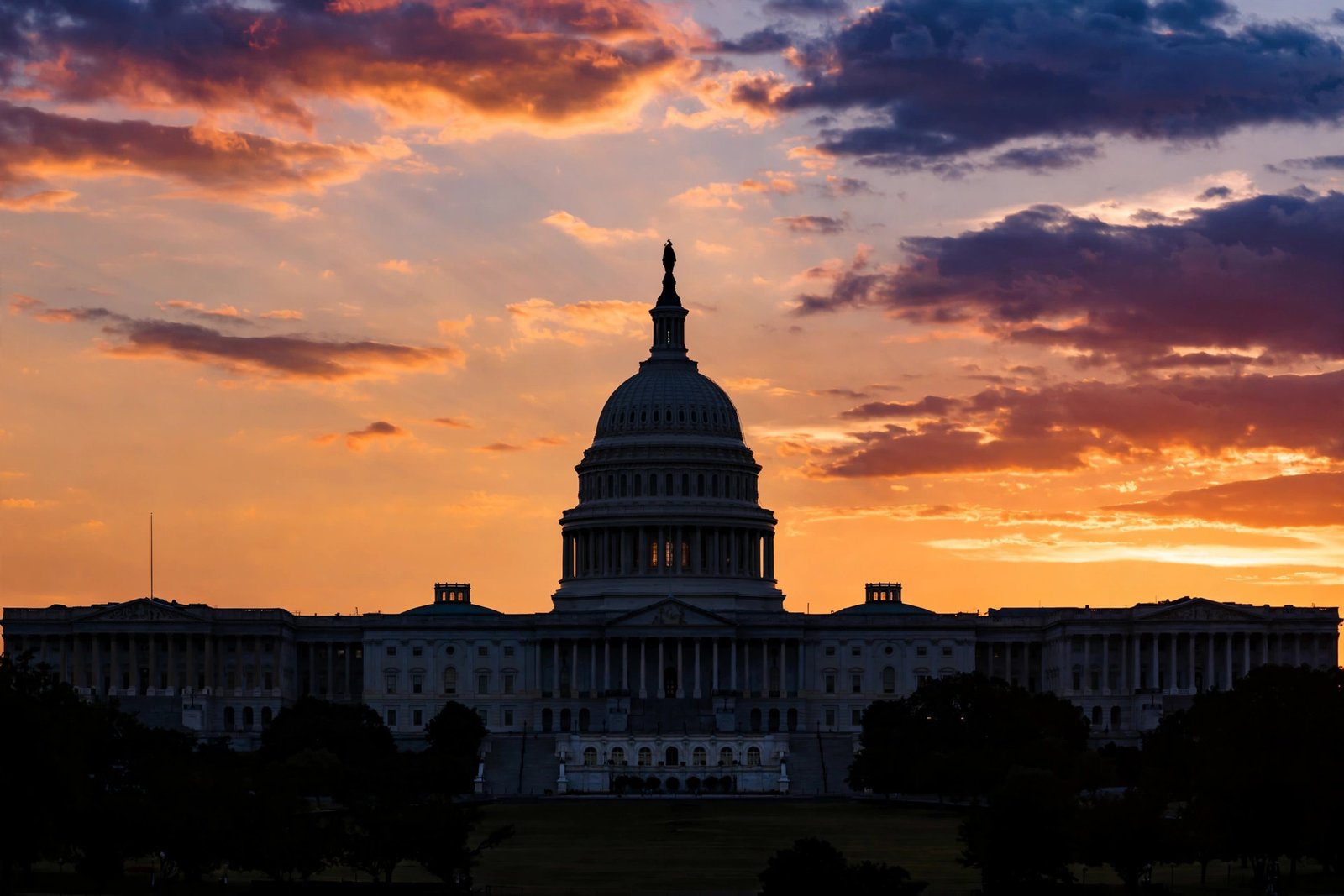
Every American recognizes the silhouette. The white dome rising over Washington, D.C. is probably the most photographed government building on Earth, the backdrop to inaugurations, protests, state funerals and a million tourist selfies. But the United States Capitol is more than a symbol. It is a strange, sprawling, endlessly rebuilt machine of a building, stuffed with quirks that most visitors walk right past: an empty tomb waiting for a president who never came, a private subway most citizens never ride, and a pair of marble bathtubs hiding in the basement.
The best way to understand the Capitol is the way its own stewards do — in numbers. So let’s count our way through the hidden stories of the building where Congress has met for more than two centuries.
The Building by the Numbers
Start with the basics, as documented by the Architect of the Capitol, the federal office that maintains the building. The Capitol stands 288 feet tall, measured from the base line on the east front to the very top of the Statue of Freedom. It stretches 751 feet 4 inches from north to south and 350 feet at its widest, approaches included. Inside, there are roughly 540 rooms, about 658 windows (108 of them in the dome alone) and around 850 doorways spread across a floor area of about 16.5 acres.
From the basement floor to the top of the dome, the climb is 365 steps — one for every day of the year, a coincidence tour guides have enjoyed pointing out for generations. The great cast-iron dome itself, completed during the Civil War, weighs 8,909,200 pounds. President Abraham Lincoln insisted construction continue even as the nation tore itself apart, reasoning that if people saw the Capitol going up, it would be a sign the Union would go on too.
The building’s age explains its odd shape. The cornerstone was laid by George Washington in 1793. British troops burned the Capitol in 1814. The House and Senate wings were added in the 1850s as the country grew, and the current dome replaced a smaller wooden one that no longer fit the enlarged building. The east front was extended again in the late 1950s and early 1960s. The Capitol is less a single design than an argument carried on in stone and iron for over 230 years.
The Statue of Freedom: 19 Feet 6 Inches of Bronze
Crowning it all is a woman most Americans have seen but few can name. The Statue of Freedom, designed by sculptor Thomas Crawford, stands 19 feet 6 inches tall — nearly three feet taller than the original specification, which forced architect Thomas U. Walter to adjust his dome design — and weighs about 15,000 pounds. She wears a helmet ringed with stars and topped with an eagle’s head and feathers, holds a sheathed sword and a laurel wreath, and rests one hand on the shield of the United States.
Freedom was cast in bronze at Clark Mills’s foundry just outside Washington. Her story carries one of the Capitol’s most important hidden chapters: historians credit Philip Reid, an enslaved laborer in the foundry, with solving the problem of how to take apart Crawford’s plaster model for casting — skilled work that helped bring the statue into being. Reid later gained his freedom during the Civil War era, and in recent decades the Capitol has worked to give his contribution the recognition it long lacked. The full-size plaster model he helped handle now stands in Emancipation Hall at the Capitol Visitor Center, where visitors can see Freedom’s details up close.
The finished statue was raised to the top of the dome in 1863, in the middle of the Civil War. In 1993 she came down again — lifted off by helicopter for a full restoration, in one of the most remarkable photo opportunities in the building’s history — before returning to her perch above the city.
The Crypt: An Empty Tomb at the Center of the Capital
Two floors below the Rotunda sits a round, columned chamber called the Crypt, and at its exact center, set into the floor, is a white marble compass star. That star marks the point where Washington’s four quadrants — Northwest, Northeast, Southwest, Southeast — divide. It also marks a plan that never happened.
The Crypt was built as a tomb. Congress intended George Washington’s remains to rest directly beneath the Rotunda, in a purpose-built burial chamber at the physical and symbolic heart of the republic. Washington’s family declined. The first president had asked to be buried at Mount Vernon, and there he stayed. The tomb chamber has sat empty ever since — a magnificent, echoing vacancy.
The Crypt is not entirely unused, though. It displays statues and exhibits, and it holds the Lincoln catafalque: the simple wooden platform, built in 1865, on which Abraham Lincoln’s coffin rested in the Rotunda — and which has since supported the coffins of other honored Americans who have lain in state. Thirteen presidents have lain in state in the Rotunda above, but the tomb below remains, as it has always been, waiting for a tenant who declined the honor.
A Private Subway Under Capitol Hill
Here is a number most tourists never learn: three. That is how many subway lines run beneath the Capitol complex, a private transit system operated by the Architect of the Capitol to shuttle members of Congress between their office buildings and the Capitol in time for votes.
The first line opened on March 7, 1909, linking the Russell Senate Office Building to the Capitol. The original cars were built by the Studebaker Company — yes, the carmaker — and were essentially electric carriages on rails. A monorail replaced them in 1912. The system kept growing: an operator-driven monorail for the Dirksen Senate Office Building arrived in 1960, a two-car line connecting the Rayburn House Office Building opened in 1965, and the Dirksen line, extended to the Hart Senate Office Building in 1982, was replaced by an automated train in 1993.
Today the Senate side has two lines — a crewed system with open-topped cars serving Russell, and a computer-controlled system with enclosed three-car trains running on a 90-second schedule between Hart, Dirksen and the Capitol. The House and Senate systems end in different spots under the building, connected by a labyrinth of tunnels. Members and staff ride free; visitors, sadly, cannot — the little trains are one of Washington’s most charming sights reserved almost entirely for the people who work there.
The Senators’ Marble Baths: Myth vs. Fact
Now for the bathtubs, where the Capitol’s best myth meets an almost equally good truth.
The myth: In popular retellings, the Capitol’s basement baths become a decadent Roman spa, a luxurious perk where pampered senators soaked away the stresses of legislating in marble splendor, perhaps with attendants and refreshments close at hand. Some versions imply the baths were a scandalous indulgence, or that they still operate in secret.
The fact: The Senate baths were entirely real — and entirely practical. In the mid-1800s, most members of Congress lived in boardinghouses and hotels, many without indoor plumbing, and Washington was a famously muddy, swampy town. A wash before a Senate session was not luxury; it was hygiene. The Capitol’s baths were a spa-like facility by the standards of the day, with several marble tubs where members and their guests could bathe before modern plumbing reached the rest of the city.
As plumbing spread through Washington, the baths lost their purpose and the facility was dismantled. What survives today is wonderfully modest: two marble bathtubs, sitting in a basement utility room, all that remains of the once-elaborate Senate baths. Not a secret spa. Not a scandal. Just two old tubs — and a reminder that the most famous building in America was once, among other things, the best place in town to get clean.
The Rotunda and Statuary Hall: More Numbers Worth Knowing
Directly above the Crypt lies the Rotunda, the Capitol’s ceremonial heart, and it rewards counters too. Look straight up: the great fresco inside the dome’s canopy, The Apotheosis of Washington, painted by Constantino Brumidi in 1865, covers 4,664 square feet and floats 180 feet above the Rotunda floor. Brumidi, an Italian immigrant artist, spent years working on scaffolds throughout the Capitol and is still remembered as the ‘Michelangelo of the Capitol.’ Around the Rotunda’s walls runs a frieze of American history and a ring of enormous paintings, several of them by John Trumbull, depicting the founding moments of the republic at near-life scale.
Next door, the National Statuary Hall Collection adds a puzzle in arithmetic every schoolchild can try: 100 statues, two donated by each of the 50 states, honoring everyone from George Washington and Sam Houston to King Kamehameha of Hawaii and Po’pay of New Mexico. The collection grew so heavy — some statues weigh thousands of pounds — that it outgrew its original hall; many pieces now stand in the Capitol Visitor Center and throughout the building. One bronze, Hawaii’s 15,000-pound Kamehameha, reportedly raised concerns about crashing through the floor and was relocated to the Visitor Center’s Emancipation Hall.
Even the acoustics join the act. In the old House chamber, now Statuary Hall, a famous ‘whispering spot’ is said to let a whisper on one side of the room be heard clearly on the other — a quirk guides attribute to the room’s curved ceiling, and which legend ties to John Quincy Adams, who supposedly listened in on colleagues from his desk. Physicists will tell you the effect is real but finicky; guides will tell you it works every time. Either way, it is one more number-free marvel in a building that usually gives up its secrets in digits.
Why the Numbers Matter
There is one more number worth knowing: four acres. That is the ground area the Capitol covers, a footprint that has housed the legislative branch since November 17, 1800, when the 6th Congress first convened in the unfinished building. Since then the Capitol has been burned, rebuilt, extended, restored and reimagined by nearly every generation of Americans — and almost every change left a number behind: 288 feet of height, 19 and a half feet of Freedom, 540 rooms, three subway lines, two bathtubs, and one empty tomb.
Next time you see that dome on the news, remember: behind the symbol is a building with a basement, a plumbing history and a train set. America’s most serious address has always had a wonderfully human side — you just have to count it.