
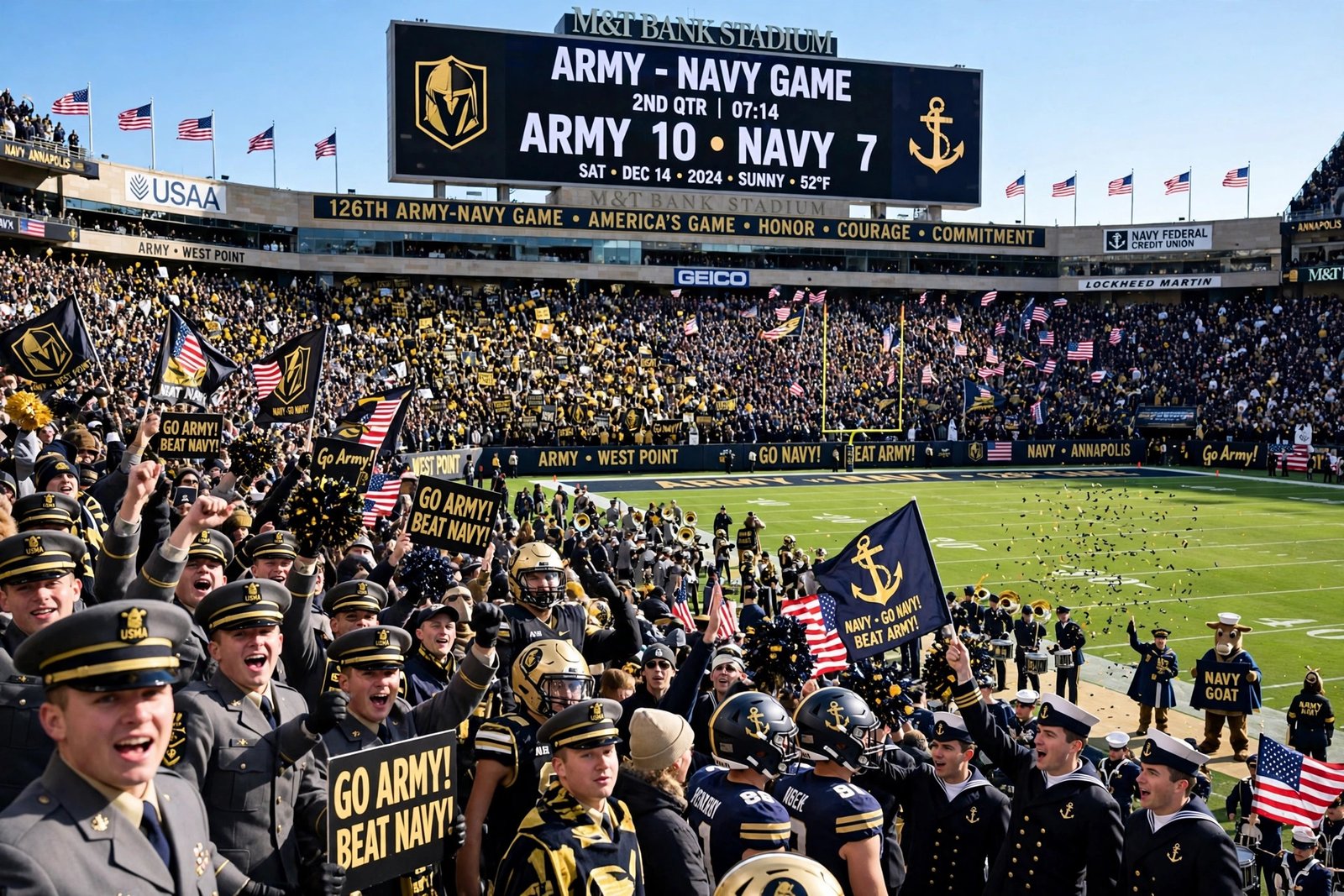
There is no game quite like Army-Navy. Long before kickoff, the stadium fills with cadets and midshipmen in dress uniforms, bands play fight songs that generations have memorized, and families who have served in both branches take their seats knowing that, for one afternoon, loyalty is divided in the friendliest and fiercest way possible. Then the ball is kicked, and two teams made up entirely of future officers play as hard as any teams in America.
What makes this rivalry different is not only its age. It is the fact that the players on both sidelines will soon serve together. They may deploy together, lead troops and sailors together, and depend on one another in ways no ordinary college rivalry can match. That is why the game ends the way it does, with both teams singing together, and why so many Americans who have never attended either academy still stop to watch it every December.
The Army-Navy game is often called America’s Game, and the nickname fits. It began before modern college football looked anything like it does today, survived wars, suspensions and changing times, and grew into a national event that still belongs, first and foremost, to the cadets and midshipmen who march onto the field. This is the story of how it began, how its traditions took shape, and why it still matters.
The First Game on the Plain at West Point
Football came to the Naval Academy before it came to West Point in organized form. According to the Naval Academy’s own archives, Navy played its first intercollegiate-style game in December 1879, a scoreless tie against players from the Baltimore Athletic Club. Over the following decade, football took hold in Annapolis, while West Point was slower to build a team of its own.
The breakthrough came in 1890. Navy asked for a game, and Cadet Dennis Mahan Michie persuaded West Point leaders to form a team so the academies could meet. On November 29, 1890, the teams played on the Plain, the parade ground at West Point. Navy won that first meeting, 24-0, and a rivalry was born. The Naval Academy’s archives record the celebration that followed, including a salute of guns fired by the Corps of Cadets to mark the victory.
One of the most charming details from that first game is how it was paid for. The 271 members of the Corps of Cadets each contributed 52 cents to cover half of Navy’s travel costs, a small act of hospitality that already hinted at the mutual respect underneath the competition. About a thousand spectators watched, a modest crowd by today’s standards, but the foundation was laid for something much larger.
The return game came the next year in Annapolis, and this time Army won, 32-16. The early series alternated between the two campuses, with Navy winning three of the first four meetings. From the start, the game was not treated as just another date on the schedule. It was a meeting between two institutions that trained the nation’s future military leaders, and it carried a weight that ordinary games did not.
Why the Game Moved to Philadelphia
After a gap in the mid-1890s, when no games were played between 1894 and 1898, the rivalry resumed with a new idea: play at a neutral site roughly halfway between West Point and Annapolis. Philadelphia became that home. In 1899, Franklin Field in Philadelphia hosted the game, and the city would go on to host it more than any other place.
The logic was practical as well as symbolic. Neither campus stadium was large enough for the crowds the game began to draw, and Philadelphia offered a big venue in a city with deep military and patriotic history. According to the U.S. Army, Philadelphia had hosted 88 of the first 125 Army-Navy games by the time of the 2025 game, a remarkable share that explains why so many fans still associate the rivalry with that city.
Over the decades, the game has also been played in Baltimore, Washington, New York, and other northeastern cities, and only rarely on campus. The Army notes that the game has been played at West Point or Annapolis only seven times since 1890. That neutral-site tradition keeps the game feeling like a national event rather than a home game for one side, and it allows tens of thousands of graduates, families and fans to gather in one place.
Philadelphia’s long run as host also helped build the game’s pageantry. Marches through the city, alumni gatherings, pep rallies and service events grew up around the weekend, turning a football game into a reunion for two proud communities. Even when the game travels elsewhere, that sense of a shared weekend remains.
Mascots, March-Ons and the Prisoner Exchange
Ask a fan what they remember most about Army-Navy and they may not mention a touchdown at all. They may mention the march-on, when the entire Corps of Cadets and the Brigade of Midshipmen march into the stadium in formation before kickoff, a display of discipline and unity that no other college game can match. Thousands of young men and women in uniform, moving as one, set a tone that is impossible to forget.
Then there are the mascots. Navy’s goat, Bill the Goat, traces its story to the earliest days of the rivalry, with legends linking the first goat to a ship’s mascot or to a goat borrowed for good luck. Army’s mule tradition dates to 1899, when a quartermaster officer chose a white mule used to pull an ice wagon to counter the Navy goat. The first official mule, a former Army pack mule named Mr. Jackson, arrived at West Point in 1936. Since then, Army mules have become beloved figures in their own right, and the sight of a mule and a goat on opposite sidelines is part of the game’s charm.
Another beloved tradition is the prisoner exchange. Before kickoff, a small group of cadets and midshipmen who spent a semester at the other academy march to midfield and are formally returned to their home school. It is a lighthearted ceremony with a serious point: these students have lived in each other’s world, and the exchange reminds everyone that rivalry and respect can live side by side.
Uniforms add another layer. In recent years, each team has worn special uniforms honoring a particular unit, battle or chapter of service history, turning the game into a living history lesson. Fans look forward to the uniform reveal almost as much as the game itself, because each design tells a story about soldiers and sailors who came before.
The Years the Game Paused, and Why It Returned
The rivalry has not been played every single year without interruption, and those pauses are part of its history too. After the early campus games, the series stopped from 1894 to 1898. Later, disagreements over player eligibility led to another break, with no game in 1928 after the academies could not agree on eligibility rules. There were other interruptions and tensions over the decades, often reflecting larger debates about the role of athletics at military academies.
Each time, the game came back, because the demand for it never really went away. Graduates wanted it, the academies valued it, and the public embraced it. The return to Philadelphia and the growth of the neutral-site tradition gave the rivalry stability, and by the middle of the twentieth century it was firmly established as the traditional finale of the college football regular season.
The game also grew up alongside America itself. It was played through world wars and peacetime, during eras when the academies themselves were changing, including the admission of women and the broadening of who could serve as an officer. Through all of that, the core idea stayed the same: two schools that train leaders for the same nation, meeting once a year to test themselves against each other.
That continuity is one reason older fans speak about the game with such feeling. A grandfather who watched in the 1950s, a parent who watched in the 1990s, and a cadet watching today are all watching the same rivalry, with many of the same songs, marches and rituals. Few sporting events in America can claim that kind of unbroken thread.
Sing Second: The Ending That Defines the Game
If you watch only one moment of Army-Navy, watch the ending. When the clock runs out, both teams gather on the field. First, they stand together facing the losing team’s student section and sing that school’s alma mater. Then they turn and walk to the winning team’s section to sing the winner’s alma mater. The winning team, in other words, sings second.
The U.S. Army explains the tradition plainly: the goal of the game is to sing second. The losing team sings first, with the winners standing behind them out of respect, and then the winners celebrate by singing their own song last. It is a simple ritual, but it captures everything the rivalry is supposed to mean. Victory is celebrated, defeat is honored, and both sides end the day together.
For seniors, that final singing carries extra weight. It is their last time singing as players, and many are visibly moved, whether they sang first or second. Coaches, families and graduates in the stands often sing along, and the stadium, which was loud and divided minutes earlier, becomes one crowd again. It is a reminder that after graduation, these rivals will wear the same flag on their shoulders.
That ending is also why the game resonates far beyond football fans. In a country where sports rivalries can sometimes turn bitter, Army-Navy offers a different model: compete with everything you have, then stand together and sing. It is a lesson in sportsmanship that feels especially powerful coming from young people who have chosen a life of service.
What the Game Means Today
Today, the Army-Navy game is a national television event, watched by service members around the world and by millions of Americans at home. Troops deployed overseas have long been shown on broadcasts, cheering from far away, a reminder that the game belongs to the entire military community, not just the two academies.
For the players, the game is the peak of a demanding life. Cadets and midshipmen balance a full academic load, military training and physical demands that leave little free time, yet they still compete at a high level. Win or lose, simply playing in the game is an honor that stays with them for life, and many graduates say it was one of the defining experiences of their academy years.
For fans, the game offers something increasingly rare: a rivalry built on respect rather than contempt. Army fans chant Beat Navy, Navy fans chant Beat Army, and both sides mean it, but the chants are part of a shared tradition, not an expression of hostility. The same families often include graduates of both schools, and the same towns send young people to both academies.
As December approaches each year, the anticipation builds in a familiar way. Uniforms are revealed, songs are rehearsed, travel plans are made, and old graduates tell new cadets and midshipmen what to expect. Then, on game day, two teams take the field, two student bodies march in, and America watches a rivalry that has lasted for more than a century and shows no sign of fading.
FAQ
When was the first Army-Navy game played?
The first Army-Navy game was played on November 29, 1890, on the Plain at West Point. Navy won that game, 24-0, and Army won the return game in Annapolis the following year.
Why is the game usually played in Philadelphia?
Philadelphia is roughly midway between West Point and Annapolis and has large stadiums that can hold the huge crowds the game draws. The city has hosted the game more than any other, including 88 of the first 125 meetings, according to the U.S. Army.
What does sing second mean?
After the game, both teams sing the losing team’s alma mater first, then the winning team’s alma mater. The team that sings second is the winning team, so singing second has become shorthand for winning the game.
What is the prisoner exchange?
Before kickoff, cadets and midshipmen who spent a semester at the other academy march to midfield and are formally returned to their home academy. It is a lighthearted ceremony that highlights the respect and shared experience between the two schools.
Related reading
Explore more American history on Eng Post Now: The Pledge of Allegiance, from 1892 to today, The Tomb of the Unknown Soldier and its guards at Arlington, and The Gettysburg Address of November 19, 1863.
Learn more from official sources: the U.S. Naval Academy archives on the first Army-Navy game, the U.S. Army’s guide to the Army-Navy game, and the USO’s history of the rivalry.