
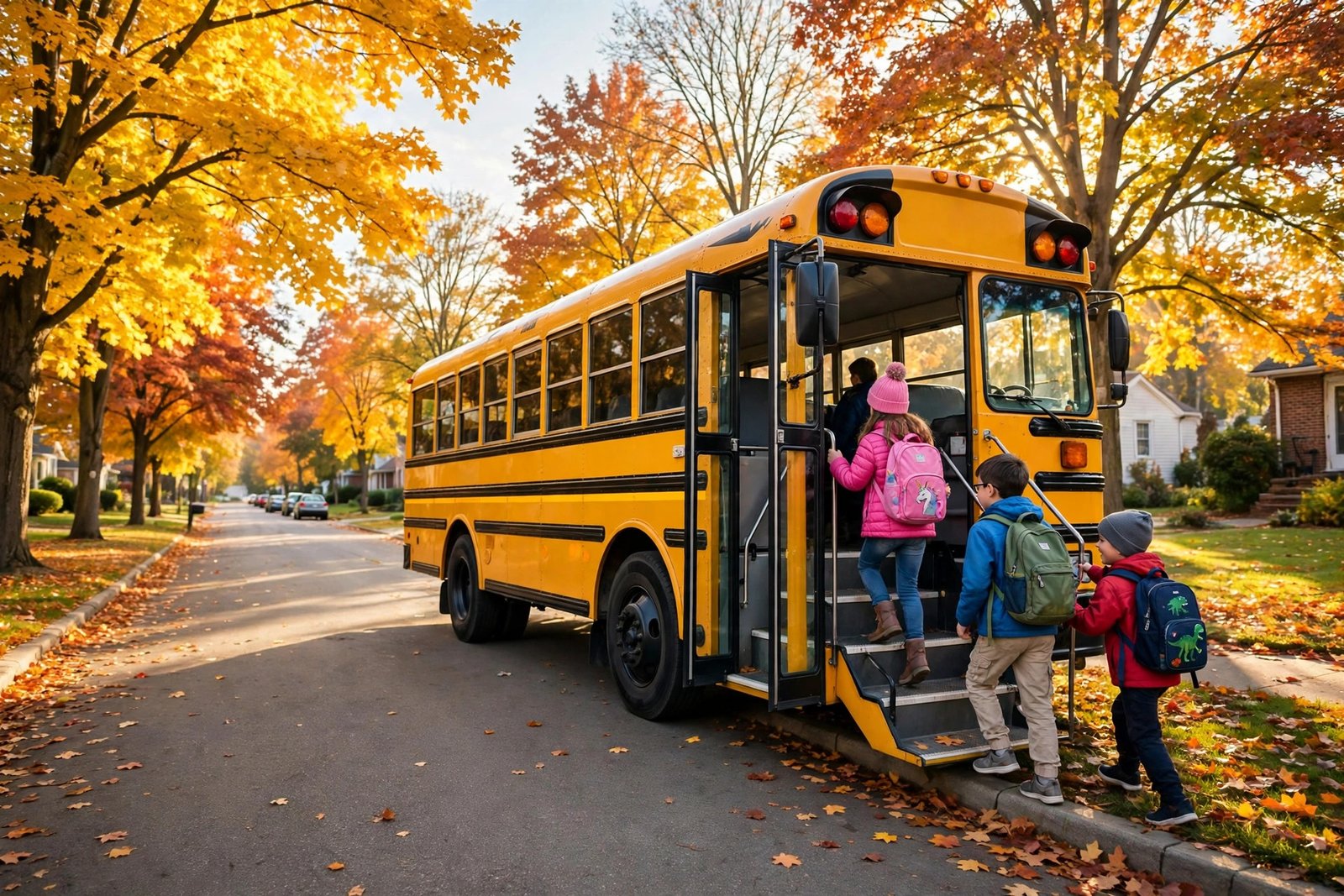
Every weekday morning across America, the same scene plays out on streets and country roads: a big yellow bus pulls up to the curb, its red lights flashing, its stop arm swinging out, and children climb aboard. The color is so familiar that most of us never stop to ask why it exists. School buses are not yellow by accident, and they are not yellow because someone simply liked the color. The yellow of an American school bus is one of the most carefully chosen colors in the world, the product of a landmark 1939 conference, a study of how the human eye works, and more than eighty years of safety engineering. It is a color with a job to do, and it does that job every single school day.
The shade has a formal name: National School Bus Glossy Yellow. It is registered as Color 13432 in the Federal Standard 595 collection, and it is the same color on every school bus in the United States, from Maine to Hawaii. The color was chosen because it is the easiest color for the human eye to spot, especially in the low light of early morning and late afternoon, when school buses are on the road, and especially out of the corner of the eye, where a driver might notice a bus pulling out from a side street or stopping ahead. The story of how that color was chosen begins in the 1930s, with a professor who traveled the country and did not like what he saw.
Before 1939: A Mess of Colors and Makeshift Buses
In the early twentieth century, getting children to school was a chaotic affair. Rural school districts used whatever vehicles they could find: trucks with wooden benches, horse-drawn wagons, repurposed cars, and early buses that varied wildly from one district to the next. There was no standard for what a school bus should look like, how it should be built, or even what color it should be. Some districts painted their buses yellow, some painted them red or blue or green, and some did not paint them at all. The vehicles themselves differed in size, shape, and safety features, and there was no shared idea of what a school bus even was.
The problem was not just cosmetic. Without standards, manufacturers built buses to different specifications, which made them more expensive and harder to maintain, and safety features were inconsistent or absent. Children rode in vehicles that had not been designed with their safety in mind, on roads that were often unpaved, in all kinds of weather. Parents worried, teachers worried, and the companies that built the vehicles wanted standardization so they could manufacture buses efficiently and profitably. The situation called for someone to bring order to it, and that someone turned out to be a rural education professor named Frank W. Cyr.
Cyr, a professor at Teachers College, Columbia University, had grown up in rural Nebraska and knew the world of country schools firsthand. In the 1930s, he traveled the country surveying pupil transportation, studying how children got to school and what went wrong along the way. What he found troubled him: a patchwork of unsafe, inconsistent vehicles, with no national standards at all. He became convinced that the country needed a single set of standards for school buses, covering everything from the height of the passenger compartment to the color of the paint. In 1939, he got his chance to create them.
The 1939 Conference That Changed Everything
In April 1939, Frank Cyr organized a conference at Teachers College, Columbia University, in Manhattan. Funded by a $5,000 grant from the Rockefeller Foundation’s General Education Board, the conference brought together school transportation officials from all 48 states that then made up the Union, along with engineers, school bus manufacturers, and paint experts from companies like Ford and DuPont. They met in the Grace Dodge Room at Teachers College, and over the course of seven days they hammered out a set of national standards for school bus construction and safety. The result was 44 standards, published in a booklet with a yellow cover, covering everything from body length and aisle width to axles, batteries, and emergency brakes.
One of those 44 standards was the color. To choose it, Cyr hung some fifty strips of paint along the wall of the conference room, ranging from pale lemon yellow to deep orange-red. The delegates debated the shades, narrowed the field down to a small handful of near-identical hues, and settled on a distinctive orangish-yellow. The color was originally called National School Bus Chrome, named for the lead-chromate pigment used in the original paint formulation. It was chosen, quite simply, because it was the easiest color to see. The delegates wanted a color that would stand out at a distance, that other drivers would notice immediately, and that would be identified with a school bus the moment anyone saw it, so that drivers would think of the children on board and slow down.
The conference also made practical sense for manufacturers. By standardizing aspects like the paint color, the body dimensions, and the mechanical parts, manufacturers could build buses more cheaply and in larger numbers, and school districts could buy safer buses at prices they could afford. Cyr’s work earned him the nickname the father of the yellow school bus, and the standards he helped create became the foundation of school bus safety in the United States. The conference’s 44 standards were not a federal mandate; states and school districts adopted them voluntarily, because they worked. Within a short time, 35 states had switched to painting their school buses the new yellow, and by 1974, every state in the country used it. The last holdout was Minnesota, which had painted its buses a shade called Minnesota Golden Orange before finally making the change.
The Science: Why Yellow Is the Easiest Color to See
The delegates in 1939 chose yellow on instinct and observation, but modern science has confirmed that they made the right call. The reason lies in how the human eye works. Color vision relies on cone cells in the retina, and two types matter most here: the cones that respond to green light and the cones that respond to red light. Research has shown that green cones peak in sensitivity near 530 nanometers and red cones near 560 nanometers. School bus yellow reflects light at about 583 nanometers, a wavelength that falls in the overlap where both cone types still respond strongly. As Ivan Schwab, a clinical spokesperson for the American Academy of Ophthalmology, explained to Smithsonian magazine, the shade sits right in the middle of that overlap, producing a stronger combined signal to the brain than a color that stimulates only one cone type.
The practical effect is most obvious in peripheral vision, the ability to see things out of the corner of your eye without turning your head. Scientific research cited by the Children’s Museum of Indianapolis found that lateral peripheral vision for detecting yellow is 1.24 times greater than for red. In plain terms, a driver is significantly more likely to notice a yellow bus in the corner of their vision than a red one, which matters enormously on the road. A driver does not always look directly at a school bus; often the bus appears at the edge of their vision, pulling out from a side street, stopping ahead in traffic, or waiting at an intersection. Yellow is the color most likely to catch that sideways glance.
Yellow also performs best in the light conditions when school buses are actually on the road. Buses run in the early morning and the late afternoon, in the dim light of dawn and dusk, when visibility is at its worst. Yellow stands out in that semi-darkness better than other colors, and it cuts through rain and fog more effectively than darker shades. The bold black lettering on the side of the bus, spelling out SCHOOL BUS, is easy to read against the yellow background, which is part of the design: the color draws the eye, and the lettering tells the driver exactly what they are looking at. Together, they make the bus impossible to confuse with any other vehicle on the road.
From Chrome to Glossy Yellow: How the Color Evolved
The color chosen in 1939 was originally called National School Bus Chrome, a name that reflected the lead-chromate pigment in the original paint. For decades, that was the official name, and the paint formula stayed largely the same. But as the dangers of lead paint became better understood, and the federal government moved away from lead-based paints, the formulation had to change. The color itself stayed the same, but the paint was reformulated without lead chromate, and the name was updated to match. The United States General Services Administration now calls the color National School Bus Glossy Yellow, registered as Color 13432 in the Federal Standard 595 collection, and it is also recorded with the National Highway Traffic Safety Administration and the National Institute of Standards and Technology.
The name change is a reminder that the yellow of a school bus is not just a paint color but a specification. Manufacturers must match it exactly, so that a bus built in one state looks identical to a bus built in another. The formula is precise, and the result is a distinctive orangish-yellow that many people perceive as slightly orange, especially in bright sunlight or as the paint ages. That orange tint is no accident: it comes from the original choice among those fifty shades on the wall in 1939, a shade that leaned toward orange rather than lemon yellow, because it was the most visible of all. The next time you see a school bus and think it looks a little orange, you are seeing the color exactly as it was designed.
The standardization did not stop with the paint. The 1939 conference’s work grew into the modern system of school bus safety standards, and today’s school buses are among the safest vehicles on the road. They are built with reinforced sides, high seat backs, flashing warning lights, stop arms, crossing control arms, and emergency exits, all governed by federal and state standards that trace back to Cyr’s conference. The yellow paint is the most visible part of that system, but it is only one piece of a much larger safety design. The color gets the driver’s attention; the rest of the bus keeps the children safe.
Why the Color Still Matters Today
More than eighty years after the 1939 conference, the yellow school bus remains one of the most recognizable sights in America, and the reasons for the color are as relevant as ever. School buses carry millions of children every school day, and the greatest danger to those children is not the ride itself but the loading and unloading zone, where children cross the street in front of traffic. That is why the law in every state requires drivers to stop when a school bus has its red lights flashing and its stop arm extended. The yellow color is the first warning, visible from a distance and out of the corner of the eye, that a bus is ahead and children may be nearby.
The color has also become a cultural symbol. The yellow school bus appears in movies, television shows, children’s books, and songs as shorthand for childhood itself. It is one of the few colors in American life that belongs to a single thing: when you see that shade of yellow on a vehicle, you know instantly what it is, without reading a word. That instant recognition is exactly what Frank Cyr and the delegates in 1939 were aiming for.
Other countries have noticed too. Canada uses the same National School Bus Glossy Yellow, and many countries around the world have adopted yellow for their school transport, inspired by the American example. The color has become a global standard for child safety on the road, which is a remarkable legacy for a decision made in a single week in 1939, by a group of educators and engineers staring at fifty strips of paint on a wall. Frank Cyr died in 1995 at the age of 95, but every yellow bus on the road is a reminder of his work.
Frequently Asked Questions
Why are American school buses yellow?
School buses are yellow because the color is the easiest for the human eye to spot, especially in peripheral vision and in the low light of early morning and late afternoon, when buses operate. The shade was chosen at a 1939 conference to make buses instantly recognizable so drivers would slow down around children.
Who decided school buses should be yellow?
Frank W. Cyr, a professor at Teachers College, Columbia University, organized a 1939 conference that set the first national school bus standards, including the color. Delegates from all 48 states chose the shade from about fifty paint samples hung on the conference room wall.
What is the official name of school bus yellow?
The color was originally called National School Bus Chrome, named for the lead-chromate pigment in the original paint. It is now officially called National School Bus Glossy Yellow, registered as Color 13432 in the Federal Standard 595 collection.
When did all school buses become yellow?
Thirty-five states adopted the standard color soon after the 1939 conference. By 1974, all states used National School Bus Glossy Yellow. Minnesota was the last holdout, having previously painted its buses a shade called Minnesota Golden Orange.
Is yellow really more visible than red?
Research cited by the Children’s Museum of Indianapolis found that lateral peripheral vision for detecting yellow is 1.24 times greater than for red. Yellow also stimulates two types of cone cells in the eye at once, producing a stronger visual signal than colors that stimulate only one.
Related reading
Explore more American history and everyday mysteries with ENG Post Now: Why American Money Is Green: The History of the Dollar Bill, Why Americans Drive on the Right Side of the Road, and The Pledge of Allegiance: History from 1892 to Today. For the story of the 1939 conference, see Columbia University Teachers College on Frank Cyr and the yellow school bus, and for the science of the color, see Mental Floss on why school buses are yellow and SlashGear on the science behind school bus yellow.