
Every American driver does it without thinking: keep to the right. But visitors from Britain, Australia, India, or Japan often experience a small jolt the first time they get behind the wheel in the United States, because in their home countries traffic keeps to the left. The United States is part of the large majority of the world that drives on the right, yet it was once a British colony, and Britain drives on the left. So why did America go the other way? The answer is older than the automobile, older than the interstate, and older than the country itself. It begins with horses, wagons, and a practical problem that colonial Americans solved differently from the British.
The Federal Highway Administration, which has researched this question for decades, reports that the evidence points in one direction: right-hand travel predominated in colonial America from the time of the earliest settlements. Albert C. Rose, who served as the unofficial historian of the U.S. Bureau of Public Roads for much of his career from 1919 to 1950, investigated the question and concluded that colonial travelers, whether on horseback, on foot, or driving teams of animals, generally kept to the right. That was true long before anyone wrote a traffic law, and it stayed true as wagons, turnpikes, and eventually cars transformed American roads.
The horseback explanation
The oldest explanation involves how people traveled before roads were paved or even graded. In medieval England, riders on horseback are often said to have kept to the left so that their right hand, the sword hand for most people, stayed free and closest to an oncoming stranger. If that stranger turned out to be a threat, the rider could react quickly. It is a vivid story, and it may explain part of Britain’s left-hand tradition, though historians note that medieval travelers often simply rode in the middle of the road or on whichever side was in the best condition, since traffic was light.
In colonial America, the logic ran differently. Rose found that travelers carrying handguns carried their weapons in the hollows of their left arms and traveled to the right, better prepared if an oncoming stranger proved dangerous. The details differ from the English story, but the principle is the same: people kept to the side that left their dominant hand free and gave them the best view of what was coming. On narrow colonial paths, where two riders or walkers might meet unexpectedly, a consistent side mattered, and the side Americans settled on was the right.
The wagon that locked it in
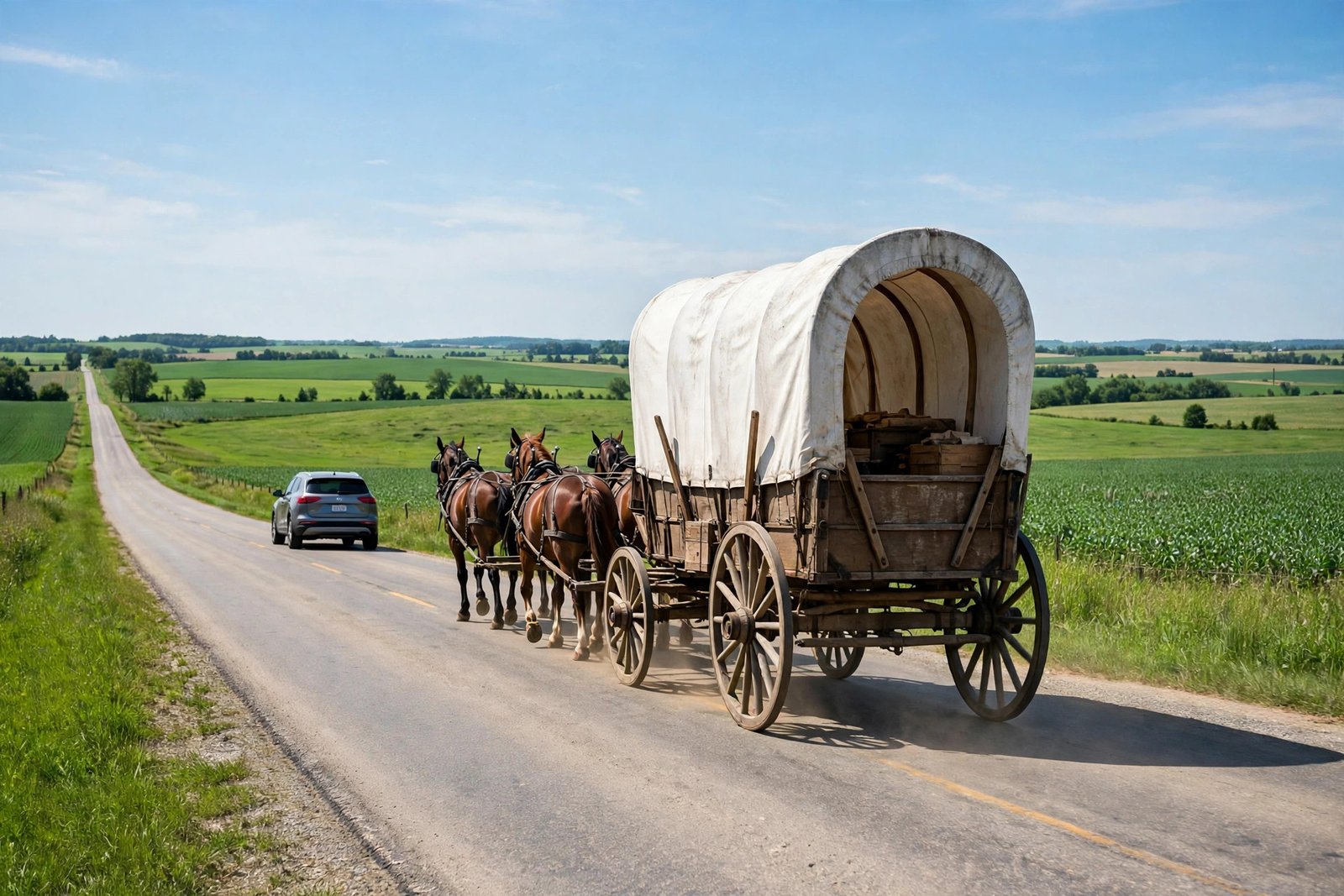
The decisive influence, according to Rose and later historians, was the freight wagon, above all the heavy Conestoga wagon introduced around 1750 near Lancaster, Pennsylvania. These wagons hauled goods across rough terrain, pulled by teams of two, four, or six horses, and they had no driver’s seat in the modern sense. The driver rode the left rear horse, known as the wheel horse, in postilion fashion, or rode a board on the left side of the wagon called a lazy board, or simply walked along the left side of the horses. The driver held the reins or jerk line with the left hand and the long black-snake whip with the right.
That seating position made right-hand travel the practical choice. A driver sitting on the left side of the wagon could best judge clearance with oncoming traffic if the wagon kept to the right, putting the driver closest to the center of the road and giving a clear view of the passing gap. Australian historian M. G. Lay agreed with Rose that the Conestoga wagon provided a major impetus for right-hand driving in the United States. The wagon’s design also explains a related American habit: drivers eventually sat on the left side of vehicles, a position that carried over into automobiles and remains standard in the United States today.
There was also a cultural current running beneath the practical one. Rose noted a smoldering opposition to customs of the Old World among colonists, many of whom had left England to escape persecution or to build something different. Other European countries had established widely separated settlements in America, each observing its own customs, so there was no single Old World rule to transplant. When the new country began to formalize its road rules, it formalized the habit Americans already had, not the habit Britain had kept.
From habit to law
No formal rule of the road was adopted by the new country or by any state until 1792, when Pennsylvania adopted legislation establishing a turnpike from Lancaster to Philadelphia. The charter legislation provided that travel would be on the right-hand side of the turnpike. New York followed in 1804, becoming the first state to prescribe right-hand travel on all public highways. Other states followed, and by the Civil War, right-hand travel was followed in every state. The process was gradual and practical rather than dramatic: a habit became a turnpike rule, the turnpike rule became a state law, and the state laws became a national norm.
Early American cars complicated the picture briefly. Some early automobiles had steering wheels on the right, following the older buggy tradition in which drivers sat on the right to avoid roadside ditches. But when Henry Ford introduced the Model T in 1908 with the steering wheel on the left, the pattern locked in. Getting in from the curb was easier, driving on the right made more sense with a left-side driver, and the rest of the industry followed. Within a few years, the left-side driver’s seat and right-side driving were the American standard, and they have remained so for more than a century.
Why other countries still drive on the left
About a third of the world’s countries still drive on the left, including Britain and many of its former colonies, such as Australia, India, Pakistan, Jamaica, and South Africa. Britain made left-hand travel a legal requirement with the Highway Act of 1835, and the empire exported the rule across its territories. France took the opposite path: before the French Revolution, aristocrats traveled on the left while everyone else was pushed to the right, but after the revolution, the old hierarchy collapsed, and traveling on the right became the norm, a rule Napoleon later spread across much of continental Europe. That is why most of Europe drives on the right today, and why about three-quarters of the world does.
Switching sides is rare because it is enormously expensive and disruptive. Sweden managed it in September 1967, in a carefully planned overnight change known as Dagen H, but for most countries the cost of changing road markings, signs, intersections, and vehicles outweighs any benefit. Once a country settles on a side, it tends to stay there, which is why a decision made by wagon drivers in the 1700s still shapes American highways in the 2020s.
What this means for visitors today
For American drivers traveling abroad, the lesson is to practice before you need to merge into fast traffic. Roundabouts, turns, and intersections are where the habit is hardest to break, because muscle memory pulls you toward the side you know. For visitors driving in the United States, the same advice applies in reverse: the rules of the road are the same in spirit, but the side is mirrored, and the driver’s seat will be on the opposite side of the car from what you expect. Rental cars, road signs, and lane markings all assume right-hand travel, so the safest approach is to start on quiet roads, follow the car ahead at first, and let the pattern settle in before tackling a busy highway.
The next time you merge onto an interstate without a second thought, remember that you are following a rule older than the republic. It was set by riders with weapons in their left arms, locked in by wagon drivers riding the left wheel horse, written into law by Pennsylvania and New York, and sealed by the Model T. America drives on the right because, for the people who built its roads, the right was simply the side that worked.
Sources and further reading
The Federal Highway Administration’s history of the question is the primary source: On The Right Side of the Road, Federal Highway Administration. A fuller account of the wagon history is available from AAA: Why Do Different Countries Drive on Different Sides of the Road?
Related reading
Why Washington, D.C. Isn’t a State, Explained · American Freight Railroads: Powering the Economy · The U.S. Capitol Building: Hidden Stories and Numbers
Frequently asked questions
Why does America drive on the right? Right-hand travel predominated in colonial America from the earliest settlements, and the Conestoga wagon, whose driver sat on the left, made keeping right the practical choice. The habit was later written into law.
Which state first required driving on the right? Pennsylvania’s 1792 Lancaster-to-Philadelphia turnpike charter required travel on the right, and New York in 1804 became the first state to prescribe right-hand travel on all public highways.
Why does Britain drive on the left? Britain’s left-hand tradition dates to horseback travel and was made law by the Highway Act of 1835. The empire exported the rule to many colonies.
What role did the Model T play? The Model T, introduced in 1908, placed the steering wheel on the left, which matched right-hand driving and helped make left-side seating the industry standard.
How much of the world drives on the right? About three-quarters of the world’s countries drive on the right, while about a third drive on the left, mostly former British territories.