
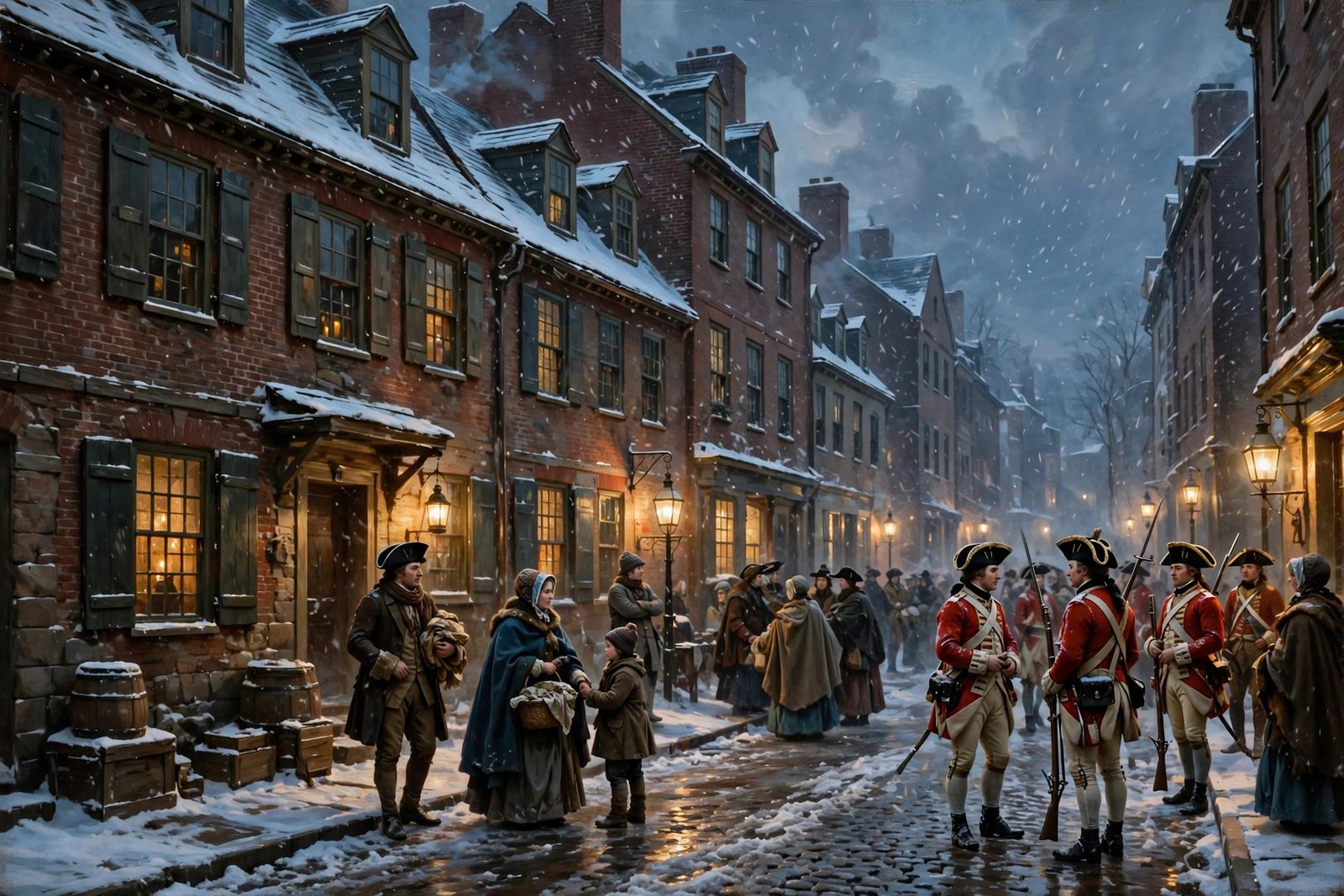
On a cold, snowy evening in Boston, a street confrontation turned into gunfire, and five men fell dead on King Street. Within weeks, the whole of America knew about it — not because news travelled fast in 1770, but because one powerful engraving, one furious funeral procession, and one unforgettable name for the event made sure nobody could look away. The Boston Massacre of March 5, 1770, did not start the American Revolution by itself. Yet it changed how ordinary colonists saw British soldiers, how Patriots talked about liberty, and how a local tragedy became a shared American story. More than 250 years later, it still stands as one of the most argued-over nights in American history — a night when fear, anger, snowballs, muskets, and politics collided in a few terrible minutes.
Boston on Edge Before March 5, 1770
By the winter of 1770, Boston was a city living under strain. British troops had been stationed in the town since 1768, sent to enforce customs laws and keep order after protests against new taxes. For many Bostonians, the sight of red-coated soldiers on their streets felt like an occupation, not protection. Jobs were scarce, and soldiers often took part-time work on the docks and in workshops, which put them in direct competition with local labourers, sailors, and apprentices. Resentment built day by day, in taverns, workshops, and on the waterfront, where insults and scuffles between soldiers and townspeople were becoming routine.
The taxes were at the heart of the anger. Parliament had imposed duties on goods such as tea, glass, paper, and paint under the Townshend Acts, and many colonists believed taxation without representation in Parliament was unjust. Boycotts of British goods had hurt Boston merchants and made tempers shorter. At the same time, customs officials were widely distrusted, seen as men who seized ships and cargoes and profited from enforcement. When an 11-year-old boy named Christopher Seider was killed in February 1770 after a confrontation involving a customs official, the city was already grieving and furious before March arrived. The National Park Service notes that tensions had been rising for months, and that the killing of Seider deepened the sense that ordinary people were not safe.
What Happened on King Street That Night
The evening of March 5, 1770, began with a small incident that grew out of control. A British sentry, Private Hugh White, was on duty outside the Custom House on King Street, near the Town House. A group of young men began taunting him, throwing snowballs and insults, and the confrontation drew a crowd. Church bells rang, which many Bostonians took as a fire alarm, and more people hurried into the street. Within a short time, a crowd of several dozen — some accounts say several hundred — had gathered around the sentry, pressing closer, shouting, and throwing snow, ice, and sticks.
Captain Thomas Preston, who had been watching from nearby, marched with seven soldiers to rescue the sentry. The soldiers formed a line with their muskets, their bayonets fixed, facing a crowd that refused to back away. The exact sequence of the next minute remains disputed to this day, and that dispute mattered enormously at the trials that followed. Some witnesses said a soldier was struck by a club or a thrown object and fired in response. Others said no order to fire was ever given. What is not disputed, according to the National Park Service, is the outcome: British soldiers fired into the crowd, killing five people and wounding six more. The dead were Crispus Attucks, Samuel Gray, James Caldwell, Samuel Maverick, and Patrick Carr.
Crispus Attucks, a sailor of mixed African and Indigenous ancestry, was among the first to fall, struck by two musket balls. Samuel Gray and James Caldwell died that night as well, Samuel Maverick died the next morning, and Patrick Carr lingered for nearly two weeks before dying from his wounds. The wounded included men who would carry the scars and the story for the rest of their lives. Within hours, Captain Preston and the soldiers were arrested. Governor Thomas Hutchinson, facing a furious town, agreed to remove the troops from the centre of Boston to Castle William in the harbour, a concession that showed just how completely the night had shifted the balance of power in the city.
Crispus Attucks: The First to Fall
Of the five men killed, Crispus Attucks has become the most remembered, and his story carries a weight that goes far beyond that one night. Attucks was a sailor and rope-maker, a working man of African and Indigenous descent who had spent years at sea. Much of his early life is not well documented, and historians are careful about what can be said with certainty — some records suggest he may have escaped enslavement years earlier and lived under another name. What is clear is that on March 5, witnesses placed him near the front of the crowd, leaning on a cordwood club, and that he was among the first to be shot.
In the years that followed, Attucks became a symbol. For Patriots, he was proof that the cause of liberty belonged to all Americans, not only to wealthy merchants and lawyers. In the 1800s, abolitionists in Boston, led by William Cooper Nell, held up Attucks as the first martyr of the American Revolution, a Black man who died for a freedom that America had not yet extended to all its people. That reclaiming of his story matters, because for a long time the most famous image of the night — Paul Revere’s engraving — showed the victims as white men, erasing Attucks’s identity from the picture most Americans saw.
Paul Revere’s Engraving and the Power of Propaganda
Within weeks of the killings, an image began circulating through the colonies that fixed the Boston Massacre in the American imagination: Paul Revere’s engraving, titled “The Bloody Massacre Perpetrated in King Street Boston on March 5th 1770 by a Party of the 29th Regt.” The print showed British soldiers standing in a neat line, firing a coordinated volley into a peaceful crowd on the direct order of Captain Preston, who stands behind them with his sword raised. It was dramatic, clear, and deeply misleading — and it worked exactly as its makers intended.
Historians now know that Revere’s engraving was closely based on a design by Henry Pelham, another Boston engraver, and that it simplified and sharpened the scene for political effect. There was no snow on the ground in the image, though the street that night was icy. The soldiers were shown firing together on command, though the trial evidence suggested the first shot may have been fired without an order and the rest followed in confusion. And, as noted above, the victims were depicted as white, though Crispus Attucks was a man of colour. None of that stopped the print from being copied, sold, and displayed in homes and taverns across the colonies, where it turned a confusing street clash into a simple moral story: innocent Americans murdered by a tyrannical army.
Samuel Adams understood this power perfectly. As chairman of the town committee investigating the event, he helped produce “A Short Narrative of the Horrid Massacre in Boston,” a pamphlet that presented the Patriot version of events and was sent to other colonies and to London. On March 8, a huge funeral procession for the first four victims wound through Boston, with thousands of mourners following the coffins to the Granary Burying Ground. The National Park Service records that witnesses suggested around 10,000 people attended — a remarkable share of the town’s population. The funeral was grief, but it was also theatre: a public demonstration that Boston would not forget, and would not forgive, what had happened on King Street.
John Adams Defends the Soldiers
One of the most surprising chapters of the Boston Massacre story is what happened in court. When Captain Preston and eight soldiers were charged with murder, they struggled to find a lawyer willing to defend them. In a town boiling with anger, taking the case was a risk to any attorney’s reputation and livelihood. John Adams, a 34-year-old lawyer, a committed Patriot, and a vocal opponent of British taxation, agreed to do it anyway — alongside Josiah Quincy Jr. — because he believed that every accused person deserved a fair trial, and that the integrity of colonial justice would be judged by how it treated even its enemies.
The trials were held separately. Captain Preston’s trial began on October 24, 1770, and lasted six days, ending in his acquittal on October 30. The soldiers’ trial began on November 27, with Adams delivering his closing argument on December 3 and 4. Adams argued that the soldiers had been provoked, surrounded, and frightened, and that the crowd’s violence had created a situation in which the men feared for their lives. He famously described the crowd in harsh terms, calling them a “motley rabble,” a line that has troubled readers ever since, because it was part of a defence strategy that blamed the victims, including Attucks, for the confrontation.
The verdicts, delivered on December 5, 1770, reflected the jury’s careful weighing of the evidence. Six of the soldiers were acquitted. Two — Matthew Kilroy and Hugh Montgomery — were found guilty of manslaughter rather than murder. They were given reduced sentences and branded on the thumb with the letter “M” for manslaughter, a punishment that marked them but allowed them to go free. Adams later wrote that the defence of the soldiers was one of the most honourable acts of his life, and that a fair trial in the midst of passion was itself a victory for the rule of law. It is a striking reminder that the American Revolution was fought not only in the streets, but in courtrooms, where principles were tested under the hardest conditions.
Why the Massacre Sparked a Revolution
The Boston Massacre did not cause the Revolution on its own, and the war itself would not begin for another five years, at Lexington and Concord in April 1775. But the massacre changed the argument. Before March 1770, many colonists still hoped for reconciliation with Britain, believing that Parliament might repeal the taxes and restore the old relationship. After the massacre, that hope grew harder to sustain. If British troops would fire on civilians in Boston, Patriots asked, what would stop them elsewhere? The event gave Samuel Adams and other organisers a story they could carry to every colony: a concrete, human example of British tyranny, with names, faces, and a funeral that thousands had witnessed.
The massacre also sharpened the language of the Revolution. The word “massacre” itself was a choice — a deliberate piece of naming by Samuel Adams and his allies, who understood that the label would stick in a way that “unfortunate incident” never could. Annual commemorations of March 5 were held in Boston in the years that followed, with orations that kept the memory alive and reminded each new audience what had been lost. Those commemorations helped turn a local tragedy into a shared anniversary, one that linked Boston’s grief to the wider colonial cause.
Visiting the Site Today
Today, the Boston Massacre site is marked by a circle of cobblestones beneath the balcony of the Old State House, on the Freedom Trail in downtown Boston. Standing there, it is hard to imagine the chaos of that night — the street is now busy with tourists, office workers, and school groups, and the Old State House itself is a museum. But the marker is deliberately modest: a ring of stones in the pavement, easy to miss if you are hurrying past, and all the more powerful for it. Nearby, the Granary Burying Ground holds the shared grave of the victims, and Boston Common holds a monument to the five men.
For visitors, the site works best as part of a wider walk through Revolutionary Boston. The Old State House, Faneuil Hall, the Paul Revere House, and the Old South Meeting House are all within a short walk, and together they tell the story of a city that argued, organised, and eventually rebelled. The National Park Service, which cares for Boston National Historical Park, offers ranger programmes and exhibits that present the evidence from both sides, including the trial records and the competing engravings. It is worth taking the time to look at Revere’s print and Pelham’s original side by side, and to ask yourself which details each artist chose to keep, change, or leave out — and why.
Frequently Asked Questions
When did the Boston Massacre happen?
The Boston Massacre took place on the evening of March 5, 1770, on King Street in Boston, outside the Custom House. Five colonists were killed and six were wounded after British soldiers fired into a crowd.
Who were the five people killed in the Boston Massacre?
The five victims were Crispus Attucks, Samuel Gray, James Caldwell, Samuel Maverick, and Patrick Carr. Attucks, Gray, and Caldwell died on the night itself, Maverick died the next morning, and Carr died from his wounds nearly two weeks later, on March 14.
Did John Adams really defend the British soldiers?
Yes. John Adams, a Patriot lawyer who later became the second President of the United States, defended Captain Thomas Preston and eight soldiers at their trials in the autumn of 1770. Preston was acquitted, six soldiers were acquitted, and two were convicted of manslaughter and branded on the thumb.
Was Paul Revere’s engraving accurate?
Not entirely. Revere’s famous engraving, based on a design by Henry Pelham, showed the soldiers firing a coordinated volley on Captain Preston’s order at a peaceful crowd. Trial evidence suggested the firing was more confused, with no clear order given, and the print also depicted the victims as white, omitting Crispus Attucks’s identity as a man of African and Indigenous descent.
Why is the Boston Massacre important to American history?
It turned colonial anger at British taxation and military occupation into a vivid, shareable story of civilians killed by soldiers, helped unite the colonies behind the Patriot cause, and raised lasting questions about justice, propaganda, and who counts as an American — questions that were still being debated long after the Revolution itself.
Related reading
If this story caught your interest, keep exploring American history with us: read The Gettysburg Address: November 19, 1863, discover The Pledge of Allegiance: History From 1892 to Today, and explore The US Capitol Building: Hidden Stories and Numbers. For verified background, see the National Park Service pages on the Boston Massacre, Crispus Attucks, and the Boston Massacre Trial, plus the primary account at Teaching American History.