
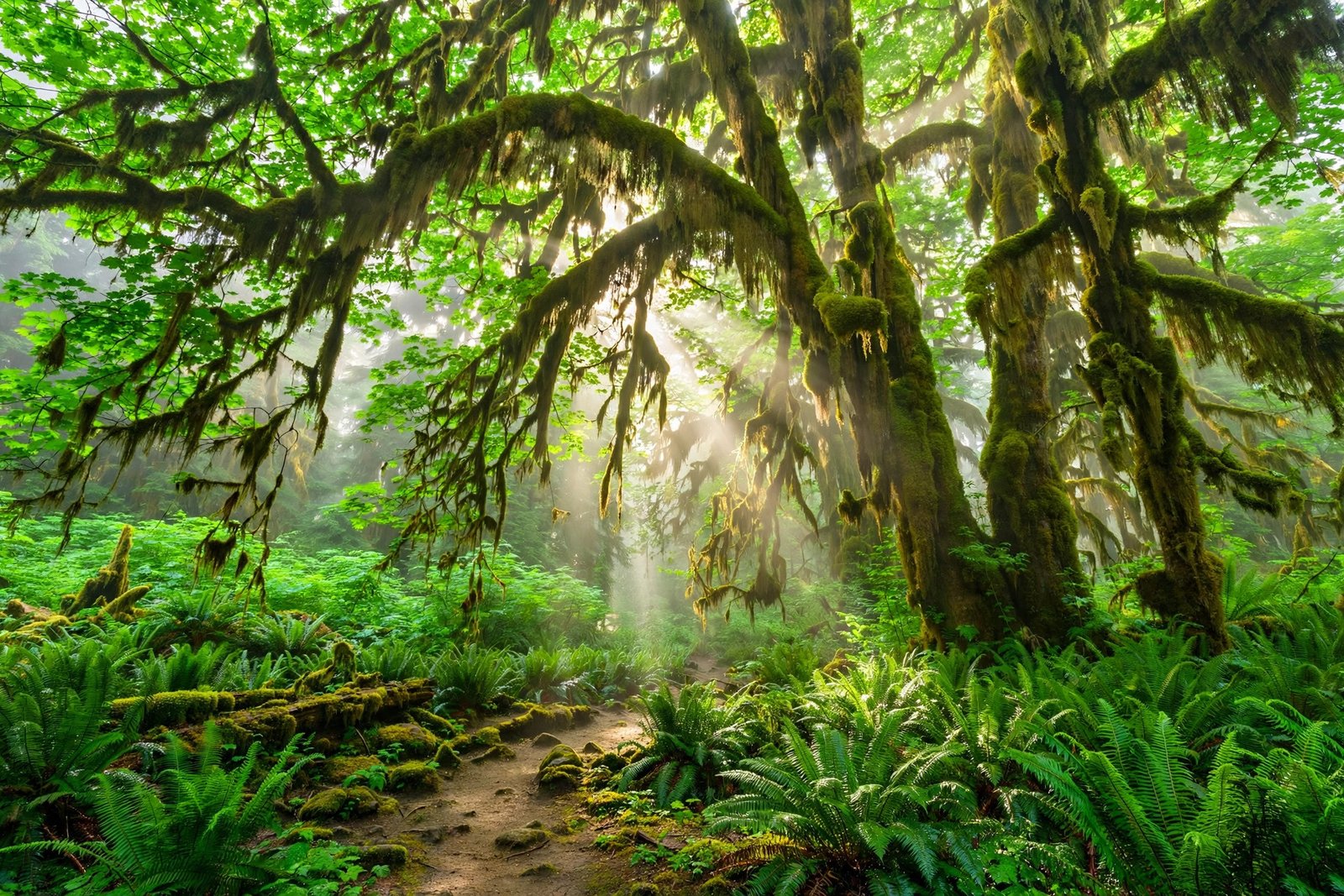
There is a rainforest in the United States where the trees wear coats of moss, the air smells of rain and earth, and the light falls green through a canopy so thick that the forest floor stays dim even at noon. It is not in Hawaii or Puerto Rico. It is on the Olympic Peninsula in Washington State, and it is called the Hoh Rainforest, one of the few temperate rainforests in the world and one of the most magical places in the entire national park system.
The Hoh sits inside Olympic National Park, about a three-hour drive from Seattle, and it feels like a different planet from the moment you step onto the trail. Giant Sitka spruce and western hemlock rise more than 200 feet overhead, draped in club moss that hangs in long green curtains. Ferns grow taller than a person. Elk move silently through the mist. The Hoh River runs cold and milky-blue beside the trail, fed by glaciers on Mount Olympus.
What makes the Hoh special is not just its beauty. It is one of the quietest and wettest places in the country, a living example of an ecosystem that exists in only a handful of places on Earth. Here is how to understand it, and how to visit it.
What Is a Temperate Rainforest?
Most people picture rainforests as tropical places near the equator, full of parrots and monkeys. Temperate rainforests are different. They grow in the cool, wet coastal regions of the mid-latitudes, and the Hoh is one of the finest examples anywhere on the planet. Only a small number of temperate rainforests exist, mostly along the Pacific coast of North America, in parts of Chile, New Zealand, and Tasmania.
The Hoh earns its rainforest title the honest way: with rain. The valley receives roughly 12 to 14 feet of rainfall a year, most of it falling between October and April. That is among the highest rainfall totals anywhere in the continental United States. The rain does not fall in dramatic tropical downpours. It falls as a steady, patient drizzle that soaks everything for days at a time, and the forest is built to drink it.
The result is a landscape of almost overwhelming green. Moss covers the trunks, the branches, and the ground. Ferns, including the sword fern and the delicate lady fern, carpet the forest floor. Fallen trees, called nurse logs, sprout new seedlings from their decaying trunks, so the forest literally grows out of itself. It is a cycle of growth and decay that has been running for thousands of years.
The Hall of Mosses and the Spruce Nature Trail
Most visitors to the Hoh start at the Hoh Rain Forest Visitor Center, a small building at the end of a winding road through the park. From there, two short trails introduce the forest, and both are easy enough for almost anyone.
The Hall of Mosses Trail is a loop of less than a mile, and it is the single most popular walk in the rainforest. The trail winds through a grove of bigleaf maple trees so heavily draped in moss that they look like something from a fairy tale. The moss hangs in curtains and beards, swaying gently in the damp air, and the light filters through in soft green shafts. It is one of the most photographed spots in Olympic National Park, and it is easy to see why.
The Spruce Nature Trail is a slightly longer loop, about 1.2 miles, that passes through old-growth Sitka spruce and along the banks of the Hoh River. It is a good place to look for Roosevelt elk, the large subspecies of elk that lives on the Olympic Peninsula. Elk are most often seen in the early morning or late afternoon, grazing in the meadows near the river or moving quietly through the trees.
For visitors who want more, the Hoh River Trail runs 17 miles into the backcountry, climbing gradually toward the glaciers of Mount Olympus. Most day hikers walk the first few miles, where the trail passes waterfalls, side streams, and enormous trees, then turn back. The full trail is a multi-day backpacking trip that requires a permit.
The Wildlife of the Hoh
The Hoh is home to wildlife that is hard to find anywhere else in the United States. The Roosevelt elk is the largest elk subspecies in North America, and the Hoh Valley holds one of the densest populations. The animals are most visible in the open meadows along the river, especially in the fall during the rut, when the bulls bugle through the mist.
Black bears live in the valley too, though they are shy and most often seen from a distance. River otters play in the Hoh River and its side streams. The birdlife includes the varied thrush, with its haunting whistle, the winter wren, whose song fills the forest in spring, and the northern spotted owl, a rare and protected species that depends on old-growth forest for its survival.
One of the most remarkable residents is also one of the smallest. The banana slug, a bright yellow mollusk that can grow several inches long, is a familiar sight on the forest floor after rain. It is harmless, slow, and oddly charming, and it plays an important role in the ecosystem by breaking down dead leaves and returning nutrients to the soil.
When to Visit and What to Expect
The Hoh is beautiful in every season, but the experience changes dramatically with the weather. Summer, from June through September, brings the driest and warmest conditions, with daytime temperatures often in the 60s and 70s. The trails are at their most accessible, the visitor center is fully staffed, and the forest is lush and green. This is also the busiest season, and the parking lot can fill up by mid-morning on summer weekends.
Fall brings the rain back in earnest, and with it, the forest at its most atmospheric. The moss glows, the river runs high, and the elk rut fills the valley with sound. It is also the quietest time to visit, with far fewer people on the trails. Winter is the wettest season, when the Hoh receives the bulk of its annual rainfall and the forest drips constantly. The visitor center keeps shorter hours, but the trails remain open, and the solitude is profound.
Spring, from March through May, is a time of renewal, with wildflowers blooming on the forest floor and the river running high with snowmelt. Whatever the season, visitors should come prepared for rain. Waterproof jackets, sturdy shoes, and layers are essential, and the park service recommends carrying water and snacks, since there are no food services at the Hoh beyond the visitor center.
The drive to the Hoh is part of the experience. The road winds through the small town of Forks, made famous by the Twilight books and films, and then into the park along the Hoh River. Cell service fades quickly, and the forest closes in. By the time you reach the visitor center, the modern world feels very far away.
Why the Hoh Matters
The Hoh Rainforest is more than a beautiful place to hike. It is one of the last intact temperate rainforests in the United States, and its old-growth trees are centuries old. Some of the Sitka spruce in the valley are more than 500 years old and tower over 300 feet tall. The forest stores enormous amounts of carbon, shelters rare species, and provides a living laboratory for scientists studying how forests respond to climate change.
Olympic National Park was established in 1938, and the Hoh Valley has been protected within it ever since. The park is also a UNESCO World Heritage Site and an International Biosphere Reserve, designations that recognize its global importance. The Hoh is one of the park’s three rainforest valleys, along with the Quinault and the Queets, but it is the most accessible and the most visited.
For many visitors, the Hoh is a reminder of what the Pacific Northwest looked like before logging and development changed it. Standing beneath a moss-draped maple, listening to the rain fall through the canopy, it is easy to understand why people travel from around the world to see it. It is a place that slows you down, quiets your mind, and makes you feel small in the best possible way.
Frequently Asked Questions
Where is the Hoh Rainforest?
The Hoh Rainforest is in Olympic National Park on the Olympic Peninsula in Washington State, about 90 miles west of Seattle. It is reached by driving through the town of Forks and into the park along the Hoh River.
How much rain does the Hoh Rainforest get?
The Hoh Valley receives roughly 12 to 14 feet of rain per year, most of it between October and April. That is among the highest rainfall totals in the continental United States.
What is the best trail for first-time visitors?
The Hall of Mosses Trail, a loop of less than a mile, is the best introduction to the rainforest. It passes through a grove of moss-draped maple trees and is easy enough for most visitors, including families with children.
Can you see elk in the Hoh Rainforest?
Yes. Roosevelt elk are common in the Hoh Valley, especially in the meadows along the Hoh River. The best times to see them are early morning and late afternoon, and during the fall rut.
When is the best time to visit the Hoh Rainforest?
Summer offers the driest weather and full visitor services, while fall and winter offer the most atmospheric rainforest experience with far fewer crowds. The forest is worth visiting in any season, but always come prepared for rain.
Do you need a permit to hike in the Hoh?
Day hikes on the Hall of Mosses, Spruce Nature Trail, and the first miles of the Hoh River Trail do not require a permit. Overnight backpacking in the backcountry requires a wilderness permit from Olympic National Park.