
Here is a number worth pausing on: in 2024, visitors to America’s national parks spent an estimated $29 billion in the communities near those parks — and that spending rippled outward into $56.3 billion in total economic output for the U.S. economy, supporting about 340,100 jobs. Those are not tourism-industry estimates. They come from the National Park Service’s own annual economic analysis, and they describe something Americans rarely think about when they plan a road trip: the national park system is not just a collection of beautiful places. It is one of the most productive economic engines the country owns.
This is the story of how scenery became payroll — how gateway towns from Wyoming to Tennessee run on park visitors, where the money actually goes, and why the health of small-town America is now tied, in measurable dollars, to the health of its parks.
The headline numbers
The National Park Service publishes its visitor spending analysis every year in a report called National Park Visitor Spending Effects. The latest edition, covering 2024 and released in September 2025, reads like an earnings report for America’s best idea:
- 331.9 million recreation visits to the National Park System in 2024 — a record, up about 2 percent from 2023.
- $29.0 billion spent by visitors in “gateway regions” — the local economies within roughly 60 miles of park boundaries — up about 10 percent from 2023.
- $56.3 billion in total economic output generated for the national economy, also a record.
- 340,100 jobs supported by that spending.
- $18.8 billion in labor income — wages, salaries and benefits — and $33.7 billion in value added to U.S. GDP.
- 433 units in the National Park System, with 404 of them reporting visitation in 2024 — and every reporting unit contributed spending to its surrounding communities.
The full data, broken down by park, state and industry sector, is published in the NPS 2024 Visitor Spending Effects report and in the agency’s interactive tool at nps.gov, where anyone can look up what a single park means to its neighbors. As coverage of the report’s release noted, adjusted for inflation, 2024 visitor spending was the highest in more than a decade.
Where the money goes
Park visitors do not spend their money inside park boundaries, for the most part — they spend it in town. The Park Service tracks eight spending categories, and the ranking tells you exactly what a park trip looks like on the ground:
- Lodging is king: about $11.1 billion in direct economic output nationally — hotels, motels, lodges, vacation rentals and bed-and-breakfasts in gateway towns capture the largest share, with camping fees adding hundreds of millions more.
- Restaurants are next: about $5.7 billion in direct output, from diners and coffee shops to brewery patios full of hikers.
- The rest of the trip economy: groceries and convenience stores, gasoline and local transportation, outfitters and guided recreation, and retail — each of those categories lands in the $2.2–2.6 billion range in visitor spending.
Then comes the multiplier. Roughly 44 percent of the total output is direct — the visitor’s dollar at the register. The rest, more than half, is secondary: the hotel housekeeper spending her paycheck at the local grocery, the rafting company buying trucks and insurance in town, the diner’s owner paying a local contractor. That is why $29 billion in spending becomes $56.3 billion in output. In gateway communities, a park visitor’s dollar does not get spent once; it gets spent all summer.
Gateway towns: main streets that run on scenery
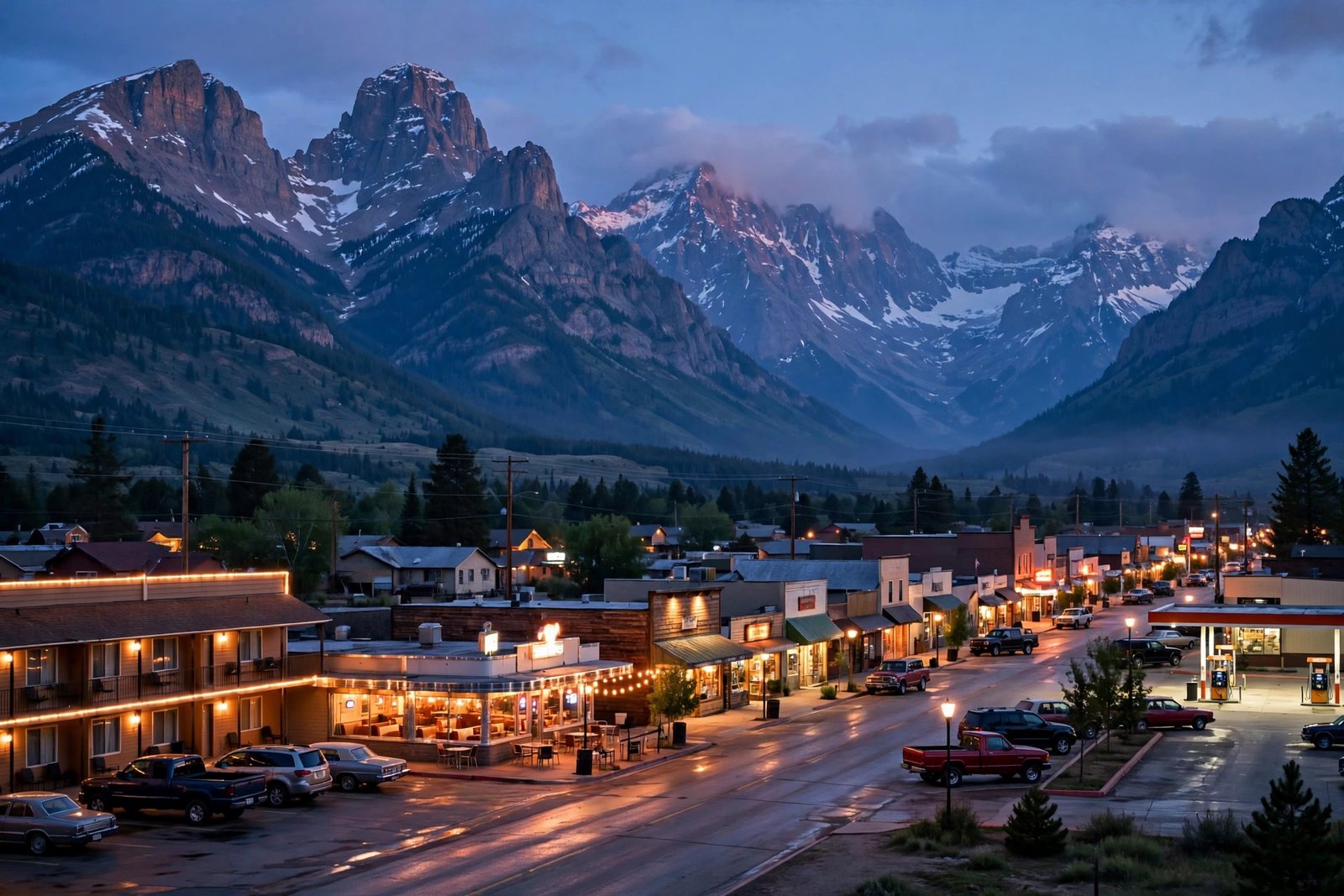
The “gateway community” is the Park Service’s term for the towns within about 60 miles of a park — and for hundreds of them, the park is not one attraction among many. It is the economy.
Consider the pattern, repeated across the map. Towns like Gatlinburg and Townsend, Tennessee, sit at the entrances to Great Smoky Mountains National Park, the most visited national park in the country, and their main streets are built entirely around the flow of park traffic. Jackson, Wyoming, and Gardiner and West Yellowstone, Montana, orient their whole year around Yellowstone and Grand Teton seasons. Moab, Utah, transformed from a quiet mining town into a recreation hub on the strength of Arches and Canyonlands. Page, Arizona; Springdale, Utah, at the mouth of Zion; Bar Harbor, Maine, serving Acadia; Mariposa and Oakhurst on the road to Yosemite — the list runs for pages, and the economics rhyme: lodging taxes fund local services, seasonal jobs draw young workers from around the world, and a single busy summer can make a small town’s entire year.
The biggest individual parks post city-sized numbers. Grand Canyon National Park alone contributed roughly $1.1 billion in economic impact in 2024, including about $905 million in direct visitor spending in its gateway region — for a park whose “industry” is, essentially, a very large and beautiful hole in the ground that charges no one to look at it (entrance passes aside).
There is a flip side, and honest reporting requires it. Gateway prosperity comes with gateway strain: housing prices that push park employees and service workers far from their jobs, main streets crowded to gridlock in peak season, water and infrastructure stretched thin, and businesses hostage to anything that interrupts the visitor flow — a wildfire, a flood, a federal shutdown. Recent analysis of gateway businesses highlights exactly these risks: when your town’s economy is a funnel pointed at a park entrance, changes in park policy, congestion management or the climate itself land on local doorsteps first. The engine is powerful, but it is not evenly distributed, and it is not guaranteed.
Why the engine keeps growing
Several forces have pushed park economics to record levels:
- Record visitation: 331.9 million visits in 2024 set an all-time high, continuing a rebound that blew past pre-pandemic levels. (Visitation eased somewhat in 2025, to roughly 323 million by preliminary counts — still the second-highest era in the system’s history.)
- The outdoor boom: the pandemic-era surge in outdoor recreation did not fully recede; national parks became the default American vacation for a new generation of travelers.
- International draw: parks are among America’s top global tourism brands, pulling high-spending international visitors into rural counties that would otherwise see few of them.
- New parks, new gateways: the system keeps adding units — most recently including Chiricahua in Arizona, signed into law in October 2026 as America’s newest national park — and each designation redirects visitor spending toward a new set of small towns. Local leaders there explicitly cite the per-park average impact (on the order of $88 million in output per park unit in 2024) when they make the case.
- It is cheap to run, relatively: the entire National Park Service operates on a budget that is a small fraction of the economic output its parks generate — a return on public investment few federal programs can match.
Not just the famous parks: the long tail pays too
It is tempting to assume the money belongs to Yellowstone and the Grand Canyon, but the Park Service’s state-by-state data shows the engine running everywhere — including at small historic sites most Americans have never heard of. In New York, for example, the state’s 24 Park Service units generated roughly $877 million in visitor-driven economic impact, more than half of it spent on lodging and restaurants. Within that total, Saratoga National Historical Park — a Revolutionary War battlefield, not a wilderness icon — drew more than 116,000 visitors who spent about $8.2 million in the surrounding communities. Multiply that pattern by hundreds of battlefields, historic homes, recreation areas, seashores and parkways, and you get the system’s secret strength: the dollars are spread across all 50 states and deep into rural and small-town America, not concentrated in a handful of postcard destinations.
That spread is also why park economics command rare bipartisan affection. Gateway counties lean every political direction, but their representatives tend to agree on the local math: visitors arrive on their own, spend freely, require relatively little public infrastructure in return, and leave the asset — the landscape — intact for next season. It is an export industry where the factory is a canyon and the product never ships.
The catch: success is wearing the parks out
There is one more economic fact that belongs in any honest accounting: the parks are generating record value while carrying a maintenance backlog the Park Service has estimated at more than $20 billion — crumbling roads, aging water systems, worn trails and historic structures in need of repair. Congress responded in 2020 with the Great American Outdoors Act, which created a Legacy Restoration Fund drawing on federal energy revenues to attack the backlog, and the resulting construction projects have themselves become a secondary economic engine in gateway regions, employing local contractors and tradespeople. Park advocates argue the logic is circular and self-evident: the better the parks are maintained, the better the visitor experience; the better the experience, the stronger the gateway economies that depend on it. Record spending numbers, in other words, are not just a celebration. They are the strongest available argument for reinvestment.
More than money
It is worth ending where the Park Service begins: none of this economic machinery is the point of the parks. The point is the preservation of the Grand Canyon’s silence, Yellowstone’s geysers, the Smokies’ blue haze — places Congress began setting aside, starting with Yellowstone in 1872, “for the benefit and enjoyment of the people.” The economics are best understood as the dividend, not the mission.
But dividends matter. In a country where rural communities often struggle to hold onto jobs and young people, the national park system quietly functions as one of the largest rural economic development programs in existence — one that pays out not in subsidies but in motel bookings, raft trips, diner breakfasts and gas-station coffee, 332 million visits a year. Protecting the parks, it turns out, is not in tension with prospering from them. The prosperity exists precisely because the protection came first.
So the next time you crest a hill in a gateway town and see the “Vacancy” signs lit up, the outfitters racking boats and the diner line out the door, remember what you are looking at: America’s best idea, running at full economic throttle.