
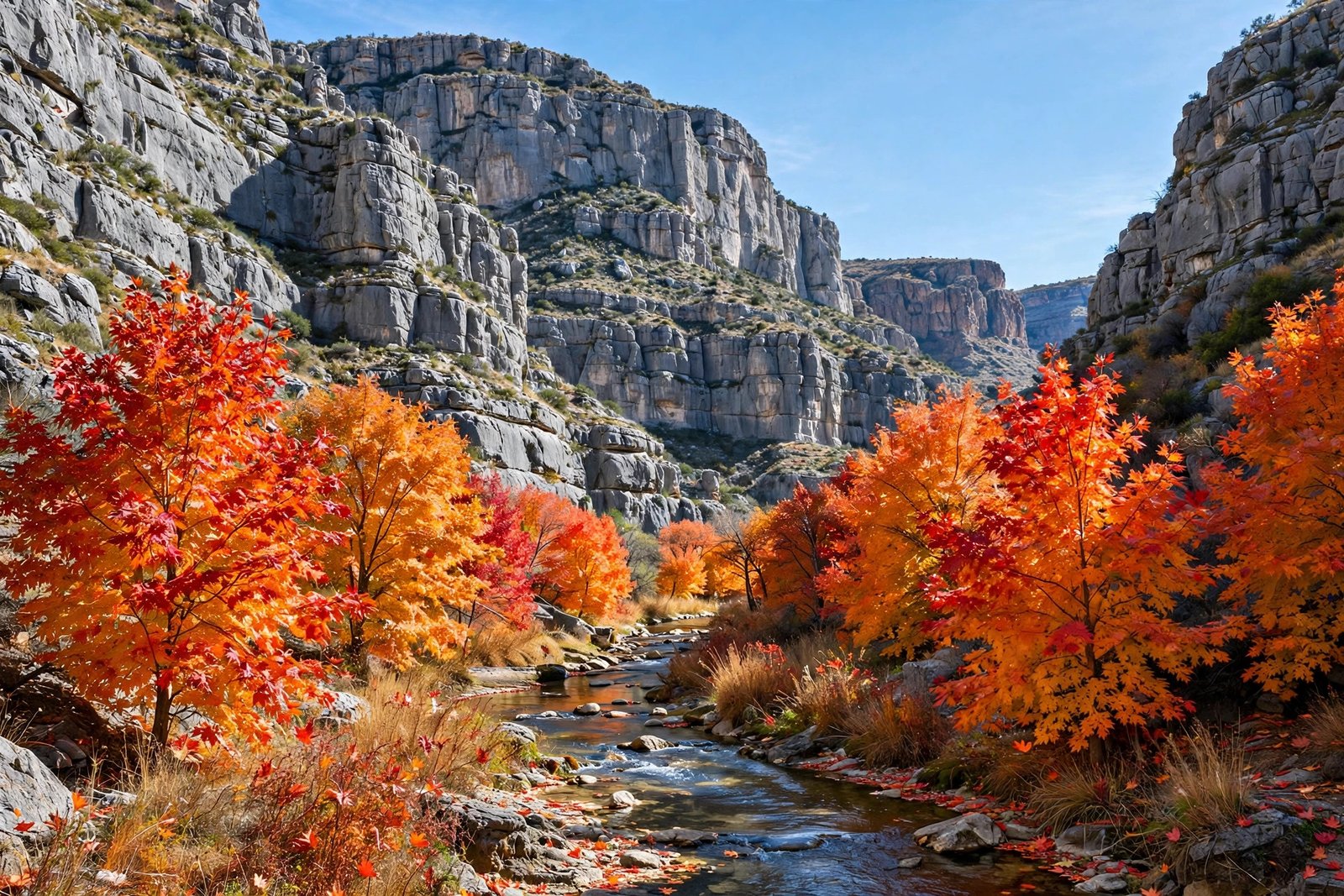
Texas is not the first state most people think of for fall foliage, and that is exactly why Guadalupe Mountains National Park is such a rewarding surprise. Tucked into the far western corner of the state, about 110 miles east of El Paso and near the New Mexico border, the park protects a rugged range of limestone peaks rising out of the Chihuahuan Desert. For most of the year it is a land of desert light, cactus, and big sky. But for a few weeks each autumn, one canyon inside the park turns a brilliant red, orange, and gold, and the contrast between desert and forest is so striking that visitors describe it as the most beautiful place in Texas. That canyon is McKittrick Canyon, and late October through the first week of November is its moment.
The National Park Service says bright fall colors are not common in the Southwest, but elevation and environment combine in the Guadalupe Mountains to produce a seasonally striking display, usually from mid-October to mid-November. The best viewing window is generally the last week of October and the first week of November, though the exact peak varies from year to year depending on precipitation and weather. That timing makes right now, in early November, the tail end of peak season: still worth the trip, but with a reason to go soon rather than later. If you miss it this year, the canyon will be there next autumn, and the planning lessons below will still apply.
Why a desert park has fall color at all
The Guadalupe Mountains are the exposed remains of an ancient Permian-era reef that grew beneath a tropical sea hundreds of millions of years ago. Over geologic time, erosion carved the reef into cliffs, canyons, and peaks, including Guadalupe Peak, the highest point in Texas at 8,751 feet. The park covers more than 86,000 acres of desert lowlands, forested highlands, and wilderness, and it holds more than 80 miles of trails. What makes fall color possible here is elevation. As you climb from the desert floor into the mountains, temperatures drop, moisture collects, and the habitat changes. Desert plants give way to oak, juniper, and pine, and in the sheltered canyons, bigtooth maples, Texas madrones, walnuts, ash, and oaks thrive along seasonal streams.
McKittrick Canyon is the best expression of that change. The canyon is a day-use area, and the trail follows a wooded drainage where maples grow beneath gray limestone cliffs and green conifers. The result is a layered landscape: red and gold leaves in the foreground, dark green pines behind them, and pale rock rising above it all. Elsewhere in the park, fall color is more scattered. Hikers heading to the Bowl, a high forested basin, may catch occasional bursts of red maple against green pine, while the Guadalupe Peak Trail itself shows little fall color. McKittrick Canyon is where the color concentrates, and that is why it draws the park’s biggest autumn crowds.
The McKittrick Canyon Trail, step by step
The hike into McKittrick Canyon is a there-and-back trail, and the color improves the farther you go. The trailhead sits in a desert landscape, and the first stretch is open and dry. As the canyon narrows and the walls rise, the vegetation thickens, and the first maples appear. About two and a half miles in, the display becomes serious, and it continues to the Grotto picnic area and beyond. The historic Pratt Cabin, the stone cabin of Wallace Pratt, the petroleum geologist who donated the land that became the park’s core, sits along the way and makes a natural resting point. The Park Service notes that fall colors can be seen from the porch of the Pratt Cabin, though the best views require the longer hike to the Notch or all the way to McKittrick Ridge.
Distances matter for planning. The full hike to the Grotto and back is a solid half-day walk, and the longer options to the Notch or the Ridge are considerably more demanding. There is no shuttle and no shortcut: all significant fall color displays in the park require hiking in and out. Bring more water than you think you need, even in November, because the desert air is dry and the return hike is uphill in places. Wear sturdy shoes, carry sun protection, and start early. McKittrick Canyon is a day-use area, and access closes at 5 p.m. Mountain Time, so you must be completely out before the gate closes. The park operates on Mountain Time, which catches some Texas visitors off guard, since most of the state runs on Central Time.
Timing, crowds, and parking
Fall foliage season brings some of the park’s largest crowds, and McKittrick Canyon parking is limited. On peak fall weekends, the lot can fill and the park may manage access. The Park Service recommends weekday visits when possible, and that advice is worth taking seriously. A Tuesday or Wednesday hike in early November can feel like a different park from a Saturday in late October: quieter trail, easier parking, and more room to enjoy the canyon without a crowd. If a weekend is your only option, arrive as early as you can and have a backup plan. Frijole Ranch, Devil’s Hall, and Smith Spring can offer autumn color and desert beauty without focusing exclusively on McKittrick Canyon, and the Pine Springs area gives access to the Guadalupe Peak Trail for those who want a summit rather than a canyon.
Weather is the other planning factor. November through March is the park’s windy season, and gusts can be strong, especially on exposed ridges. High winds can make hiking on ridges genuinely unpleasant and sometimes unsafe, so check the forecast and the park’s current conditions before you drive out. Snow and ice are possible at elevation, even while the desert floor stays mild. Temperatures can swing widely between day and night, so layers are essential: a warm jacket for the morning, sun protection for midday, and something windproof for the ridges. There is no gas available for many miles in either direction from the visitor center, so fill up before you arrive, and carry food and water, since services inside the park are limited.
Beyond the canyon: what else to see
Guadalupe Mountains rewards visitors who stay more than a day. Guadalupe Peak, the highest point in Texas, is an 8.4-mile round-trip hike with about 3,000 feet of elevation gain, and the summit offers views across the desert to El Capitan, the pale limestone prow that guards the southern end of the range. El Capitan itself has no formal trail to its summit and is best appreciated from the roadside pullout on US-62/180. Frijole Ranch preserves a piece of ranching history, and the park’s desert trails cross gypsum sand dunes, springs, and historic sites. The park is also a designated International Dark Sky Park, which means the night sky here is exceptionally dark. On a clear November night, after the day’s hikers have left, the Milky Way and the winter constellations put on a second show.
The park’s history is part of the experience too. The idea of preserving the Guadalupe Mountains was raised in the early twentieth century, but it only came to fruition when Wallace Pratt donated more than 5,000 acres, including McKittrick Canyon, to the National Park Service in 1959. Congress authorized the park in 1966, and it was officially established in 1972. That relatively recent history means the park still feels wild and uncrowded compared with older, more famous parks. In 2021 it drew a record 243,000 recreational visits, a number that would be a quiet month at some better-known parks. For travelers who like their national parks without traffic jams, that is a selling point, not a drawback.
Planning a McKittrick Canyon trip
A practical itinerary starts the night before in a nearby town such as Carlsbad, New Mexico, about 56 miles away, or Van Horn, Texas, about 62 miles away. Drive to the park early, stop at the Pine Springs Visitor Center for current conditions, and then head to McKittrick Canyon. The entrance fee is 10 dollars per person aged 16 and over, valid for up to seven consecutive days. Pack lunch, water, and layers, and plan to be out of the canyon well before the 5 p.m. gate closure. If you want a second day, hike Guadalupe Peak in the morning and explore Frijole Ranch in the afternoon, or simply return to the canyon at a different time of day, when the light changes the color completely. Morning light makes the maples glow; afternoon light deepens the reds against the cliffs.
Leave-no-trace habits matter here more than usual. The canyon’s ecosystem is fragile, the water is seasonal, and the park’s wilderness character depends on visitors staying on trails, packing out trash, and leaving rocks, plants, and historic structures untouched. Dogs are severely limited by the rugged terrain and extreme temperatures, so check the park’s pet rules before bringing one. And remember the simplest rule of all: check conditions on the Park Service website before you go, because trail closures, wind advisories, and water availability can change quickly in the desert mountains.
McKittrick Canyon will not stay red for long. The maples will drop their leaves, the canyon will settle back into its desert quiet, and the park will return to its winter rhythm of wind and clear skies. That fleeting quality is part of what makes the trip special. Go soon, go early, go on a weekday if you can, and let a desert canyon surprise you with autumn.
Sources and further reading
The National Park Service’s fall color guide for the park is the authoritative planning source: Hike to Fall Colors, Guadalupe Mountains National Park. A detailed visitor guide with trail and fee information is available here: Hiking Guadalupe Mountains National Park: Trails, Fees, Camping.
Related reading
Valley of Fire: Nevada’s Oldest State Park Guide · November 2026 Night Sky: Beaver Supermoon and Leonids · Wild Turkeys in November: America’s Comeback Bird
Frequently asked questions
When is the best time to see fall color in McKittrick Canyon? Generally the last week of October and the first week of November, though the peak varies from year to year with precipitation and weather.
How far do I have to hike to see the color? Color improves with distance. The best views start about two and a half miles in and continue to the Grotto, with longer options to the Notch or McKittrick Ridge.
What time does McKittrick Canyon close? It is a day-use area and access closes at 5 p.m. Mountain Time. Visitors must be out before the gate closes.
What is the highest point in Texas? Guadalupe Peak, at 8,751 feet, inside Guadalupe Mountains National Park.
Is Guadalupe Mountains National Park crowded in fall? Fall foliage season brings some of the park’s largest crowds and McKittrick Canyon parking is limited, so weekday visits are recommended.