
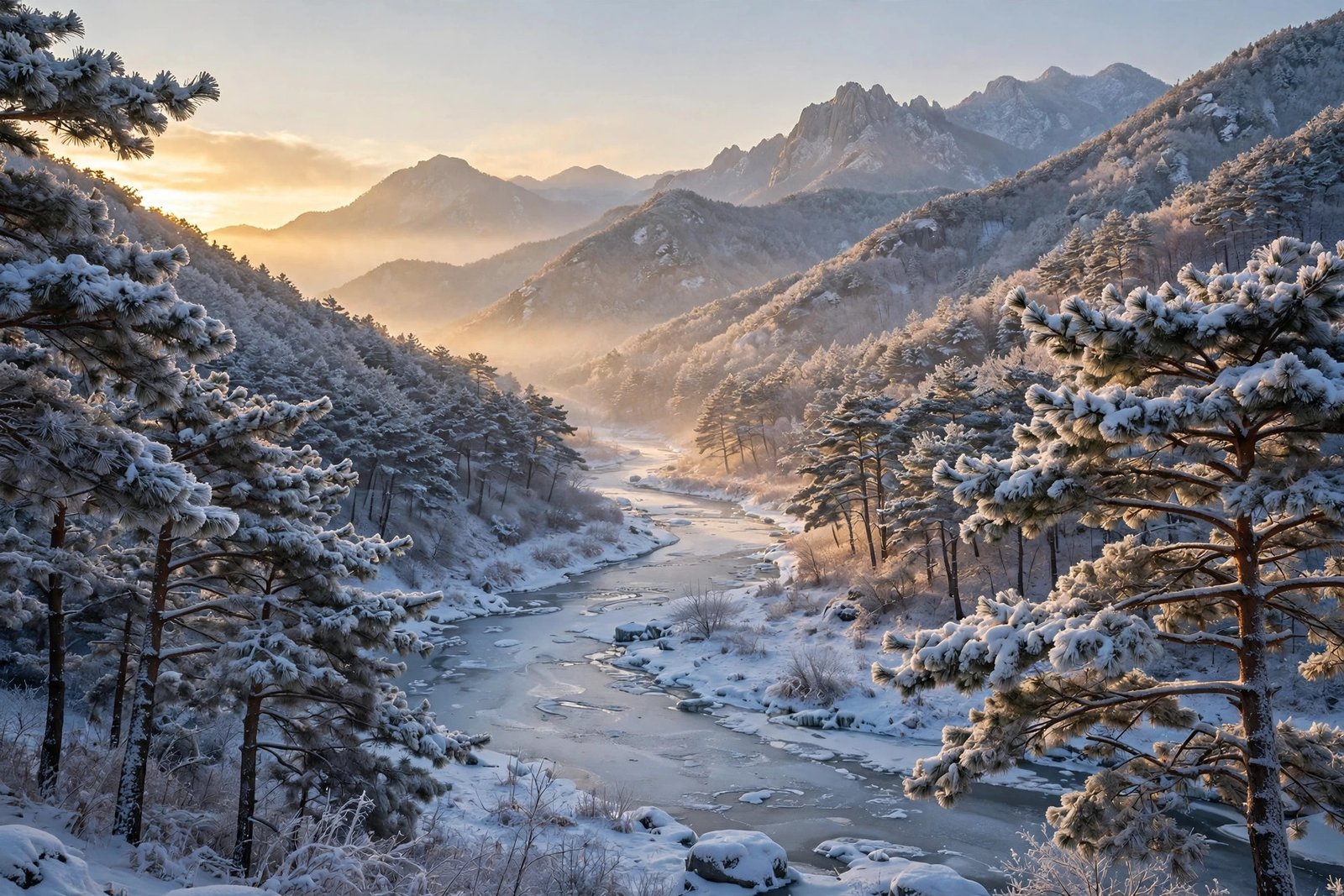
In December 1950, in the frozen mountains of North Korea, one of the most extraordinary battles in American military history took place. Around 30,000 United Nations troops, most of them US Marines, found themselves surrounded by more than 100,000 Chinese soldiers in temperatures that dropped to 30 degrees below zero. Their weapons froze. Their rations froze. Their blood froze on their wounds. And over 17 days, they fought their way out, carrying their dead and wounded with them, in what the Marine Corps still calls one of its proudest moments.
The place was the Chosin Reservoir, a man-made lake in the rugged mountains of northeastern Korea. The battle that bears its name is remembered for the cold, for the courage, and for a line that has become part of Marine Corps legend. When a reporter asked the commander of the 1st Marine Division whether his men were retreating, Major General Oliver P. Smith replied: “Retreat, hell! We’re not retreating, we’re just advancing in a different direction.”
This is the story of Chosin Reservoir, and of the Marines who refused to be beaten by an enemy, or by the cold.
How the Marines Got to Chosin
The Korean War began in June 1950, when North Korea invaded South Korea. The United States, acting under the authority of the United Nations, sent troops to defend the South, and by the fall of 1950 the war seemed to be going well. General Douglas MacArthur’s forces had landed at Inchon, recaptured Seoul, and pushed north across the 38th parallel into North Korea. MacArthur believed the war would be over by Christmas, and his troops would be home for the holidays.
It was a dangerous assumption. China had warned that it would intervene if American troops approached its border, and in late October and November 1950, Chinese forces crossed the Yalu River into Korea in massive numbers. The Chinese army, calling itself the People’s Volunteer Army, moved at night, avoided detection, and struck with overwhelming force.
The 1st Marine Division, under General Smith, had advanced to the Chosin Reservoir area in northeastern Korea, a remote region of steep mountains and narrow roads. The division was spread out along a single mountain road that ran 78 miles from the port of Hungnam on the coast to the town of Yudam-ni near the reservoir. It was the only route in or out, and it was vulnerable at every point.
On the night of November 27, 1950, the Chinese attacked. They hit the Marines at multiple points along the road, cutting the division into isolated pockets and surrounding the main force at Yudam-ni and Hagaru-ri. The Marines were outnumbered, cut off, and facing an enemy that seemed to come out of the darkness in endless waves.
The Coldest Battle
The cold at Chosin was not just uncomfortable. It was a weapon, and it killed as surely as bullets did. Temperatures dropped to minus 30 degrees Fahrenheit at night, and the wind chill was far worse. Weapons froze and would not fire until they were thawed. Mortar shells froze in their tubes. Blood plasma froze solid in its bottles. Food froze before it could be eaten, and the Marines survived on frozen rations they thawed in their mouths.
Frostbite was everywhere. Men lost toes, fingers, and feet to the cold, and the medical tents filled with casualties who had never been shot. The Marines learned to sleep in shifts, huddled together for warmth, and to keep their weapons inside their sleeping bags so they would fire in the morning. They wrapped their feet in anything they could find, and they shared body heat in foxholes dug into the frozen ground.
The cold also affected the Chinese. Their troops, many of them dressed in thin cotton uniforms and canvas shoes, suffered terribly from frostbite and exposure. But they kept coming, attacking in waves through the night, blowing bugles and whistles, and trying to overwhelm the Marine positions by sheer numbers.
The fighting was close and brutal. At Yudam-ni, the Marines of the 5th and 7th Regiments held their positions against repeated attacks, fighting hand to hand in the dark. At Hagaru-ri, the division headquarters and a small garrison held an airstrip that became the lifeline for the entire force. The airstrip, built on frozen ground in a matter of days, allowed planes to bring in supplies and fly out the wounded, and it was defended at enormous cost.
The Breakout
By early December, General Smith had made his decision. The division would not stay and be destroyed. It would fight its way out, moving south along the mountain road to the port of Hungnam, 78 miles away, carrying its wounded and its dead with it. The order was given on December 6, and the breakout began.
The breakout was a slow, grinding fight. The Marines moved in a column, with infantry on the ridges above the road and engineers clearing the way below. The Chinese held the high ground at key points, and every pass and bridge became a battle. At one point, the road crossed a deep gorge on a bridge that the Chinese had blown up. The Marines called in an airdrop of bridge sections, which were parachuted in, assembled under fire, and laid across the gap so the column could cross.
The column moved at a pace of a few miles a day, fighting all the way. The wounded were carried on stretchers, in trucks, and on the backs of their comrades. The dead were brought out too, because the Marines do not leave their dead behind. The cold never let up, and the attacks never stopped, but the column kept moving.
On December 11, the lead elements of the division reached Hungnam. The breakout was complete. The Marines had fought their way 78 miles through enemy territory, in the worst cold of the war, and they had brought their wounded and their dead with them.
The Cost and the Meaning
The cost of Chosin was enormous. The 1st Marine Division suffered thousands of casualties, including hundreds killed and thousands wounded, and frostbite cases numbered in the thousands more. The Chinese forces suffered far worse, with tens of thousands of casualties from combat and the cold. Exact figures are still debated by historians, and the numbers vary by source, but no one disputes that the battle was one of the bloodiest of the Korean War.
What the Marines accomplished at Chosin has been debated too. The battle was a tactical withdrawal, and the United Nations forces gave up the territory they had held in northeastern Korea. But the division was not destroyed, and its survival was a remarkable achievement. The Chinese had intended to annihilate the Marines at Chosin, and they failed. The Marines fought their way out as a coherent, combat-ready force, and that fact became a point of pride for the Corps.
The battle also became a defining moment for the Marine Corps. The 1st Marine Division received a Presidential Unit Citation for its actions at Chosin, and the battle is still studied in military schools around the world. The Marines who fought there called themselves the Chosin Few, and they held reunions for decades after the war. Their motto, drawn from the battle, was simple: “Retreat, hell.”
Chosin is also remembered for what it revealed about the war. The Chinese intervention changed the course of the Korean War, turning what had seemed like a quick victory into a long and costly stalemate. The war would drag on for two and a half more years, ending in an armistice in July 1953, with Korea still divided. The Marines at Chosin were among the first to feel the full weight of that change.
Why Chosin Still Matters
The Battle of Chosin Reservoir is remembered today for reasons that go beyond military history. It is a story about endurance, about what people can do when they refuse to give up, and about the bonds between soldiers who depend on each other for survival. The Marines at Chosin were cold, hungry, exhausted, and outnumbered, and they kept fighting anyway.
It is also a story that is still being told. Veterans of the battle spoke about it for the rest of their lives, and their stories have been passed down through books, films, and the Marine Corps itself. Every year, on the anniversary of the battle, Marines gather to remember Chosin, and the phrase “the Chosin Few” still carries weight in the Corps.
For the rest of us, Chosin is a reminder of the cost of war, and of the extraordinary things ordinary people can do when they are asked to do the impossible. The Marines who fought their way out of the frozen mountains of Korea did not set out to become legends. They set out to survive, and to bring their friends home with them. That they did both is why we still remember them.
Frequently Asked Questions
When was the Battle of Chosin Reservoir?
The battle took place from late November to mid-December 1950, during the Korean War. The main fighting ran from November 27 to December 13, with the breakout from the reservoir area beginning on December 6.
Who fought at Chosin Reservoir?
The battle pitted the US 1st Marine Division and other United Nations troops, around 30,000 men, against Chinese forces numbering more than 100,000. US Army units, British Royal Marines, and South Korean troops also fought in the battle.
How cold was it at Chosin Reservoir?
Temperatures dropped to around minus 30 degrees Fahrenheit at night, with wind chill far lower. The cold froze weapons, rations, and medical supplies, and caused thousands of frostbite casualties on both sides.
Did the Marines retreat at Chosin?
The Marines fought their way out of an encirclement in what is often called a breakout rather than a retreat. When asked if his men were retreating, General Oliver P. Smith famously said, “Retreat, hell! We are just advancing in a different direction.”
How many casualties were there at Chosin?
Casualty figures are debated by historians, but the 1st Marine Division suffered thousands of casualties, including hundreds killed, thousands wounded, and thousands of frostbite cases. Chinese casualties were far higher, numbering in the tens of thousands.
What is the Chosin Few?
The Chosin Few is the name adopted by the veterans of the battle. They formed an association that held reunions for decades after the Korean War, and the name is still used today by Marines to honor those who fought at the reservoir.