
At 5:29 in the morning on July 16, 1945, a light brighter than a thousand suns lit up the New Mexico desert. The men watching from ten miles away felt the heat on their faces before they heard the sound, and when the sound came it rolled across the desert like a long, slow thunder. A tower of fire and dust rose eight miles into the sky. J. Robert Oppenheimer, the scientist who had led the effort, later recalled a line from the Hindu scripture the Bhagavad Gita: “Now I am become Death, the destroyer of worlds.”
The test was called Trinity, and it was the first explosion of an atomic bomb in human history. It was the climax of the Manhattan Project, the most secret and ambitious scientific effort ever undertaken, a program that employed more than 130,000 people, cost roughly 2 billion dollars, and in less than three years built a weapon that changed the world forever.
This is the story of how America built the first atomic bomb.
The Letter That Started It All
The Manhattan Project began with a letter. In August 1939, the physicist Albert Einstein wrote to President Franklin D. Roosevelt, warning that scientists in Nazi Germany might be working on a weapon based on nuclear fission, the splitting of the atom. Einstein’s letter, drafted with the help of the physicist Leo Szilard, urged the president to support American research into what was then called uranium, before Germany could build such a weapon first.
Roosevelt took the warning seriously, but the American effort moved slowly at first. It was not until December 1941, after the Japanese attack on Pearl Harbor brought the United States into World War II, that the project became a national priority. In 1942, the US Army Corps of Engineers took charge of the effort under the command of General Leslie Groves, a blunt, driven officer who had overseen the construction of the Pentagon. Groves chose the physicist J. Robert Oppenheimer to lead the scientific work.
The project took its name from the Manhattan Engineer District, the Army office in New York that administered it. The name was deliberately unremarkable, a bureaucratic cover for one of the largest undertakings in American history.
The Secret Cities
Building an atomic bomb required two things that did not yet exist at scale: enriched uranium and plutonium. Producing them required enormous industrial facilities, and those facilities had to be built in secret, in places where thousands of workers could live and work without attracting attention.
The government built three secret cities. Oak Ridge, Tennessee, was the largest, a sprawling industrial complex where uranium was enriched in giant plants that covered acres. At its peak, Oak Ridge employed around 75,000 people, and most of them had no idea what they were making. Workers were told only what they needed to know, and the town itself did not appear on maps.
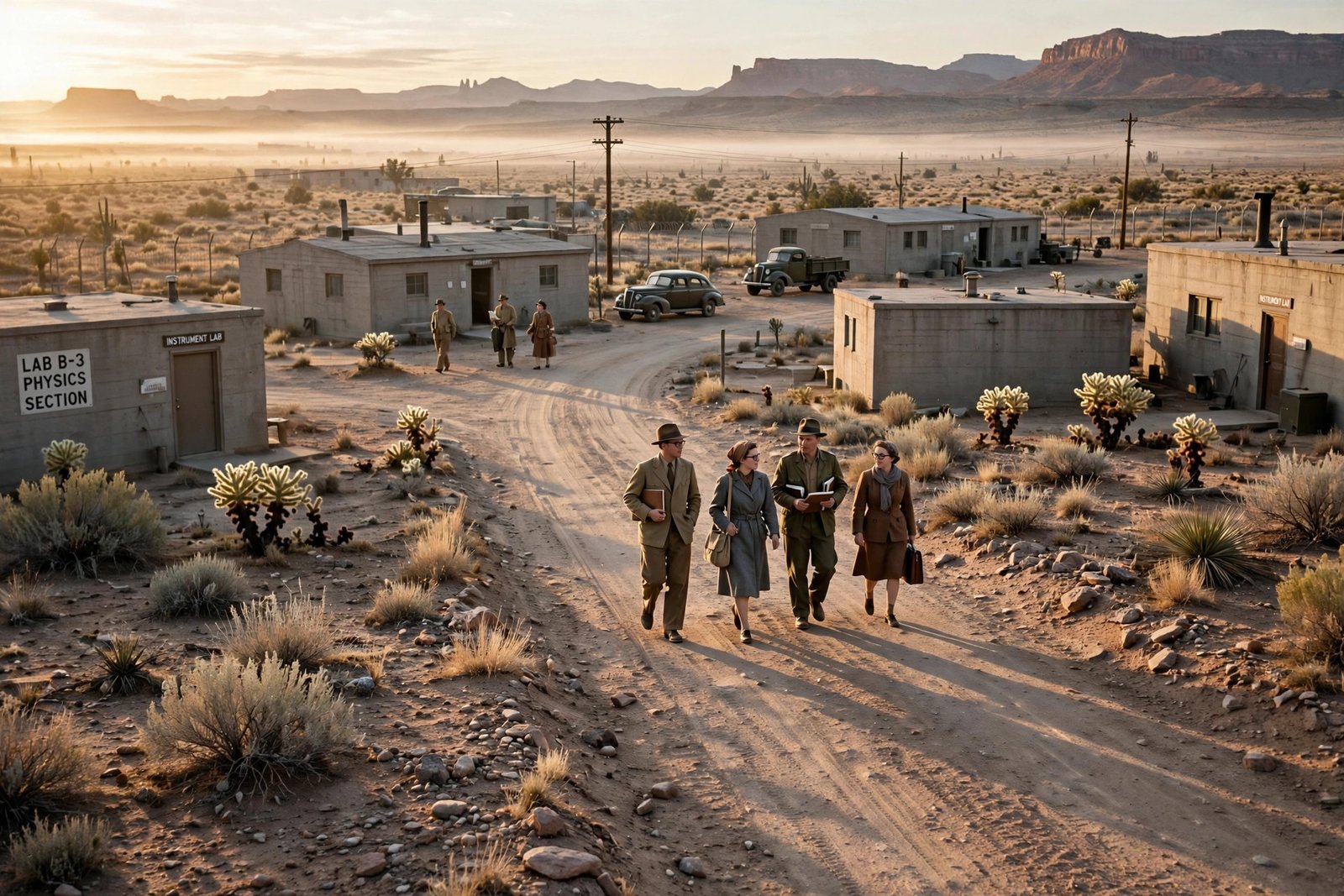
Hanford, Washington, was the second city, built on a remote stretch of the Columbia River. Its reactors produced plutonium, the material that would fuel the second bomb. Los Alamos, New Mexico, was the third, a laboratory town built on a mesa in the high desert, where Oppenheimer and his team of scientists designed the bomb itself. Los Alamos was the smallest of the three, with a population of a few thousand, but it was the heart of the project.
The secrecy was extraordinary. Workers at Oak Ridge wore badges that identified them only by number. Mail was censored. The towns were fenced and guarded. Families lived in hastily built houses with no idea what their spouses did all day. It was, in the words of one historian, the largest secret ever kept in American history.
The Science and the Race
The science behind the bomb was both simple and terrifying. When a uranium or plutonium atom splits, it releases an enormous amount of energy, and it also releases neutrons that can split other atoms, creating a chain reaction. If that chain reaction is uncontrolled, the energy is released in a fraction of a second, in an explosion far more powerful than any conventional weapon.
Turning that principle into a working bomb was enormously difficult. The scientists at Los Alamos had to solve problems that had never been solved before: how to bring enough nuclear material together fast enough to sustain a chain reaction, how to trigger the explosion at precisely the right moment, and how to build a device that could be delivered by aircraft. The work was done by some of the greatest scientific minds of the century, including the physicists Richard Feynman, Enrico Fermi, and Edward Teller, alongside a generation of young scientists who had been recruited from universities across the country.
There was also a race. The scientists knew that Germany had a nuclear program, and they feared that German scientists might reach the bomb first. In fact, the German program was far behind the American effort, hampered by limited resources, scientific errors, and the disruption of the war. But the Americans did not know that at the time, and the fear of a German bomb drove the project forward with relentless urgency.
Trinity: The First Test
By the summer of 1945, the scientists at Los Alamos had built a test device, a plutonium bomb nicknamed the Gadget. It was assembled in a tower at a remote site in the New Mexico desert called the Jornada del Muerto, the Journey of Death, and the test was scheduled for the early morning of July 16.
The scientists were not sure it would work. Some worried that the bomb might not explode at all. A few, in moments of dark humor, wondered whether it might ignite the atmosphere and destroy the world. Fermi, the great Italian physicist, took bets on the size of the explosion. Oppenheimer watched from a bunker ten miles away, holding onto a post to steady himself.
When the Gadget detonated, it produced an explosion equivalent to about 21,000 tons of TNT, far larger than anyone had predicted. The tower vaporized. The desert sand fused into green glass. A mushroom cloud rose eight miles into the sky, and the light was visible for hundreds of miles. The test had worked, and the world had changed.
Hiroshima and Nagasaki
Less than a month after Trinity, the United States used the bomb in war. On August 6, 1945, a B-29 bomber called the Enola Gay dropped a uranium bomb, nicknamed Little Boy, on the Japanese city of Hiroshima. The explosion killed tens of thousands of people instantly, and tens of thousands more died in the following weeks and months from injuries and radiation. Three days later, on August 9, a second bomb, a plutonium weapon nicknamed Fat Man, was dropped on Nagasaki, killing tens of thousands more.
Japan announced its surrender on August 15, and World War II ended. The role of the atomic bombs in ending the war has been debated ever since. Supporters of the decision argue that the bombs saved lives by making an invasion of Japan unnecessary, an invasion that military planners expected would cost hundreds of thousands of casualties. Critics argue that Japan was already close to surrender, that the Soviet declaration of war on Japan was the decisive factor, and that the civilian death toll was unjustifiable.
Historians continue to argue about it, and the debate is unlikely to be settled. What is not in dispute is the scale of what happened. The two bombs killed more than 100,000 people, most of them civilians, and left two cities in ruins. They also demonstrated to the world, in the most terrible way possible, that humanity now possessed the power to destroy itself.
The Legacy of the Manhattan Project
The Manhattan Project did not end with the war. Its facilities became the foundation of the American nuclear weapons program, and its scientists went on to shape the postwar world. Oppenheimer became a national hero and then, within a decade, a controversial figure, stripped of his security clearance during the anti-communist investigations of the 1950s. Groves retired from the Army and became a corporate executive. Many of the young scientists who had worked at Los Alamos became leaders of American science.
The project also left a complicated legacy of environmental damage. The Hanford site in Washington became one of the most contaminated places in the country, and the cleanup effort there is still going on today, decades later, at a cost of billions of dollars. The test site in New Mexico and the production facilities at Oak Ridge also required extensive cleanup.
Today, the Manhattan Project is remembered at the Manhattan Project National Historical Park, which preserves sites at Los Alamos, Oak Ridge, and Hanford. Visitors can tour the facilities where the bomb was built, see the laboratories where the science was done, and stand in the places where history was made. The park’s mission is not to celebrate the bomb but to help visitors understand it, and to reflect on what it means that humanity built such a weapon.
The Manhattan Project remains one of the most extraordinary achievements in American history, and one of the most troubling. It showed what the country could accomplish when it mobilized its scientists, its engineers, and its industry behind a single goal. It also showed what happens when that power is turned toward destruction. Both lessons are worth remembering.
Frequently Asked Questions
What was the Manhattan Project?
The Manhattan Project was the top-secret American program during World War II that developed the first atomic bombs. It employed more than 130,000 people at facilities in Oak Ridge, Tennessee, Hanford, Washington, and Los Alamos, New Mexico.
When was the first atomic bomb tested?
The first atomic bomb was tested on July 16, 1945, at the Trinity site in the New Mexico desert. The test, codenamed Trinity, produced an explosion equivalent to about 21,000 tons of TNT.
Who led the Manhattan Project?
General Leslie Groves of the US Army Corps of Engineers directed the project, and physicist J. Robert Oppenheimer led the scientific work at Los Alamos. Albert Einstein’s 1939 letter to President Roosevelt helped start the American effort.
What were the names of the two bombs dropped on Japan?
The bomb dropped on Hiroshima on August 6, 1945, was called Little Boy, a uranium weapon. The bomb dropped on Nagasaki on August 9, 1945, was called Fat Man, a plutonium weapon.
How much did the Manhattan Project cost?
The project cost roughly 2 billion dollars in 1940s money, which would be tens of billions in today’s dollars. It was one of the most expensive scientific undertakings in history.
Can you visit Manhattan Project sites today?
Yes. The Manhattan Project National Historical Park preserves sites at Los Alamos, Oak Ridge, and Hanford, and offers tours and exhibits at all three locations.
Sources and Further Reading
- National Park Service: Manhattan Project National Historical Park
- Atomic Heritage Foundation
- Los Alamos National Laboratory