
In southeastern Massachusetts, there is a patch of land about 200 square miles in size where, according to local legend, strange things happen. Ghost lights flicker over a swamp. Giant birds with enormous wingspans are seen in the sky. Ghostly figures walk the roads at night. Mysterious creatures, some of them drawn from Native American folklore, are said to live in the woods. The area has a name, and it has been famous, or infamous, for decades: the Bridgewater Triangle.
The Triangle is bounded by three towns, Abington, Rehoboth, and Freetown, with the city of Bridgewater at its center. Inside its borders are the Hockomock Swamp, a vast wetland that has been called one of the most haunted places in America, and the Freetown-Fall River State Forest, where hikers have reported strange encounters for generations.
Is any of it real? The answer depends on who you ask. What is certain is that the Bridgewater Triangle has one of the richest collections of strange stories in the United States, and that people have been telling those stories for a very long time.
How the Triangle Got Its Name
The term “Bridgewater Triangle” was coined in the 1970s by the cryptozoologist Loren Coleman, a researcher who studied reports of unknown animals and unexplained phenomena. Coleman noticed that a cluster of strange reports seemed to concentrate in a triangular area of southeastern Massachusetts, and he gave the region its now-famous name, deliberately echoing the Bermuda Triangle.
Coleman later wrote a book about the area with the researcher Jeff Belanger, documenting decades of reports from the region. The book collected stories of UFO sightings, ghost encounters, mysterious animals, and other unexplained events, and it helped turn the Triangle from a local curiosity into a nationally known legend.
The name stuck, and the Triangle became a staple of paranormal television, podcasts, and books. It has been featured on shows about ghosts, cryptids, and unsolved mysteries, and it draws visitors from around the country who come hoping to see something strange for themselves.
The Hockomock Swamp
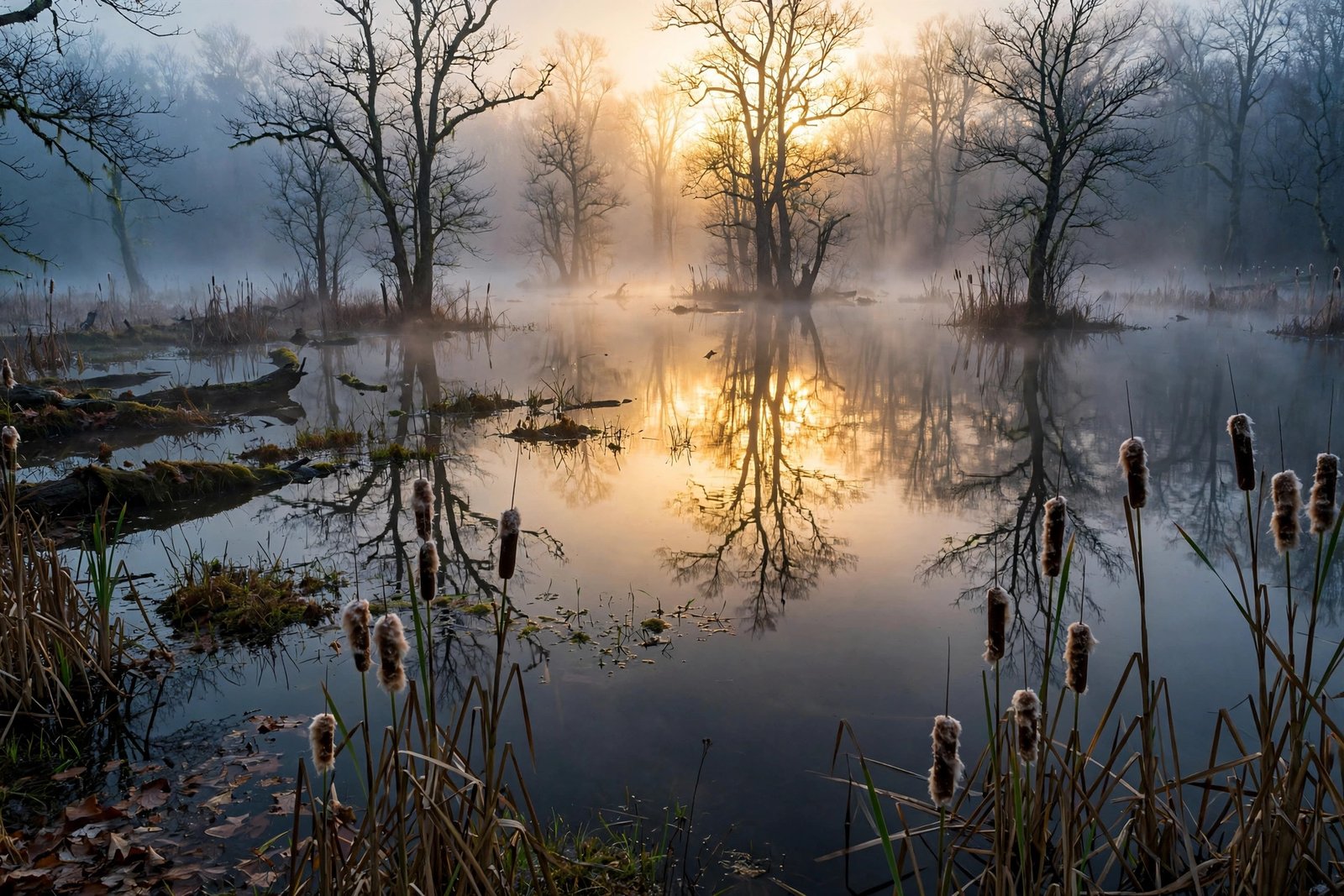
At the heart of the Triangle is the Hockomock Swamp, a wetland of more than 16,000 acres that stretches across several towns. The name comes from a Native American word meaning “place where spirits dwell,” and the Wampanoag people who lived in the area long before European settlers arrived regarded the swamp with respect and caution.
The swamp is a wild, difficult place. It is dense with vegetation, crossed by blackwater streams, and home to a rich variety of wildlife, including beavers, otters, herons, and turtles. It is also, according to legend, home to things that are harder to explain.
Over the years, people have reported seeing ghostly lights over the swamp, hearing unexplained sounds, and encountering strange figures in the mist. Some of the stories involve the Pukwudgie, a creature from Wampanoag folklore described as a small, human-like being with a large nose and ears, who is said to lure travelers into the swamp and then vanish. The Pukwudgie is one of the oldest legends in the region, and it predates the Bridgewater Triangle by centuries.
Other stories involve more modern phenomena. The swamp has been the site of reported UFO sightings, including lights that move in ways that seem to defy explanation. Skeptics point out that the swamp is near a major highway and an airport, and that many of the lights can be explained by cars, planes, and atmospheric conditions. Believers say that not all of them can.
The Giant Birds and the Thunderbird
One of the most persistent legends of the Bridgewater Triangle involves giant birds. Over the years, witnesses have reported seeing enormous birds, with wingspans of eight feet or more, flying over the swamp and the surrounding forests. Some have described them as looking like prehistoric pterodactyls, while others have compared them to the Thunderbird, a creature from Native American tradition that is said to create thunder with the beating of its wings.
The most famous of these reports dates to the 1970s, when a man reported seeing a large bird with a wingspan of eight to twelve feet near the swamp. Other witnesses came forward with similar stories, and the reports continued into the following decades. In 1978, a police officer reported seeing a large birdlike creature in the area, a report that was taken seriously enough to be documented.
Ornithologists and skeptics have suggested that the giant birds are most likely large herons, eagles, or other birds seen at a distance and in poor light, and that the human mind tends to exaggerate the size of unfamiliar objects in the sky. That is almost certainly true in many cases. But the persistence of the reports, over decades and from multiple witnesses, is part of what keeps the legend alive.
Ghosts, Cults, and the Darker Stories
The Bridgewater Triangle is also known for darker stories. The Freetown-Fall River State Forest, a large wooded area inside the Triangle, has been the site of reported ghost sightings, strange sounds, and unexplained activity. Hikers have reported hearing voices in the woods, seeing figures that vanish when approached, and feeling a sense of being watched.
The forest also has a grim history that has nothing to do with the paranormal. In the 1970s and 1980s, the forest was the site of criminal activity, including animal sacrifices and other occult practices, and several murders were committed in or near the area. These real crimes have become tangled up with the legends of the Triangle, and it can be hard to separate the documented history from the folklore.
The town of Bridgewater itself has its own ghost stories, including reports of hauntings at the Bridgewater State University campus and in the older homes of the town. The university, founded in 1840, has been the subject of ghost stories for generations, with students and staff reporting unexplained sounds, moving objects, and apparitions in the older buildings.
What to Make of the Triangle
The Bridgewater Triangle is a useful case study in how legends grow. The area has a real history of strange reports, going back to Native American traditions and continuing through the present day. It also has a real landscape, a vast swamp, dense forests, and isolated roads, that is perfectly suited to mystery. When you combine an atmospheric place with a long history of stories, the legend takes on a life of its own.
Skeptics are right to point out that many of the reports can be explained by natural causes, misidentification, and the power of suggestion. A light over a swamp can be swamp gas, or a car headlight, or a planet low on the horizon. A large bird can be a heron. A strange sound in the woods can be an animal, or the wind, or the imagination of a person who is already expecting to hear something strange.
But the skeptics also miss something important. The legends of the Bridgewater Triangle are not just a collection of ghost stories. They are a record of how people in a particular place have tried to make sense of a landscape that is wild, beautiful, and sometimes frightening. The Pukwudgie, the ghost lights, the giant birds, and the haunted forest are all ways of talking about a place that has always felt a little bit outside the ordinary.
Whether or not you believe in the paranormal, the Bridgewater Triangle is worth a visit. The Hockomock Swamp is a remarkable natural area, the forests are beautiful, and the towns of southeastern Massachusetts are full of history. Go during the day, bring a friend, and keep an open mind. You may not see a ghost. But you will understand why people have been telling stories about this place for so long.
Frequently Asked Questions
Where is the Bridgewater Triangle?
The Bridgewater Triangle is a roughly 200-square-mile area in southeastern Massachusetts, bounded by the towns of Abington, Rehoboth, and Freetown, with the city of Bridgewater at its center.
Who named the Bridgewater Triangle?
The cryptozoologist Loren Coleman coined the term in the 1970s, after noticing that strange reports seemed to cluster in a triangular area of southeastern Massachusetts. He later wrote a book about the region with Jeff Belanger.
What is the Hockomock Swamp?
The Hockomock Swamp is a wetland of more than 16,000 acres at the heart of the Triangle. Its name comes from a Native American word meaning “place where spirits dwell,” and it is the source of many of the area’s legends, including stories of ghost lights and the Pukwudgie.
What is a Pukwudgie?
A Pukwudgie is a creature from Wampanoag folklore, described as a small, human-like being with a large nose and ears. According to legend, Pukwudgies live in the forests and swamps of the region and are known to lure travelers astray.
Are the Bridgewater Triangle stories true?
Many of the reports have natural explanations, such as misidentified birds, atmospheric phenomena, and the power of suggestion. But the legends are based on real reports from real people, collected over decades, and the area’s long history of strange stories is well documented.
Can you visit the Bridgewater Triangle?
Yes. The Hockomock Swamp and the Freetown-Fall River State Forest are open to the public, and the towns of the Triangle are full of history. Visitors should explore during the day, stay on marked trails, and respect private property.