
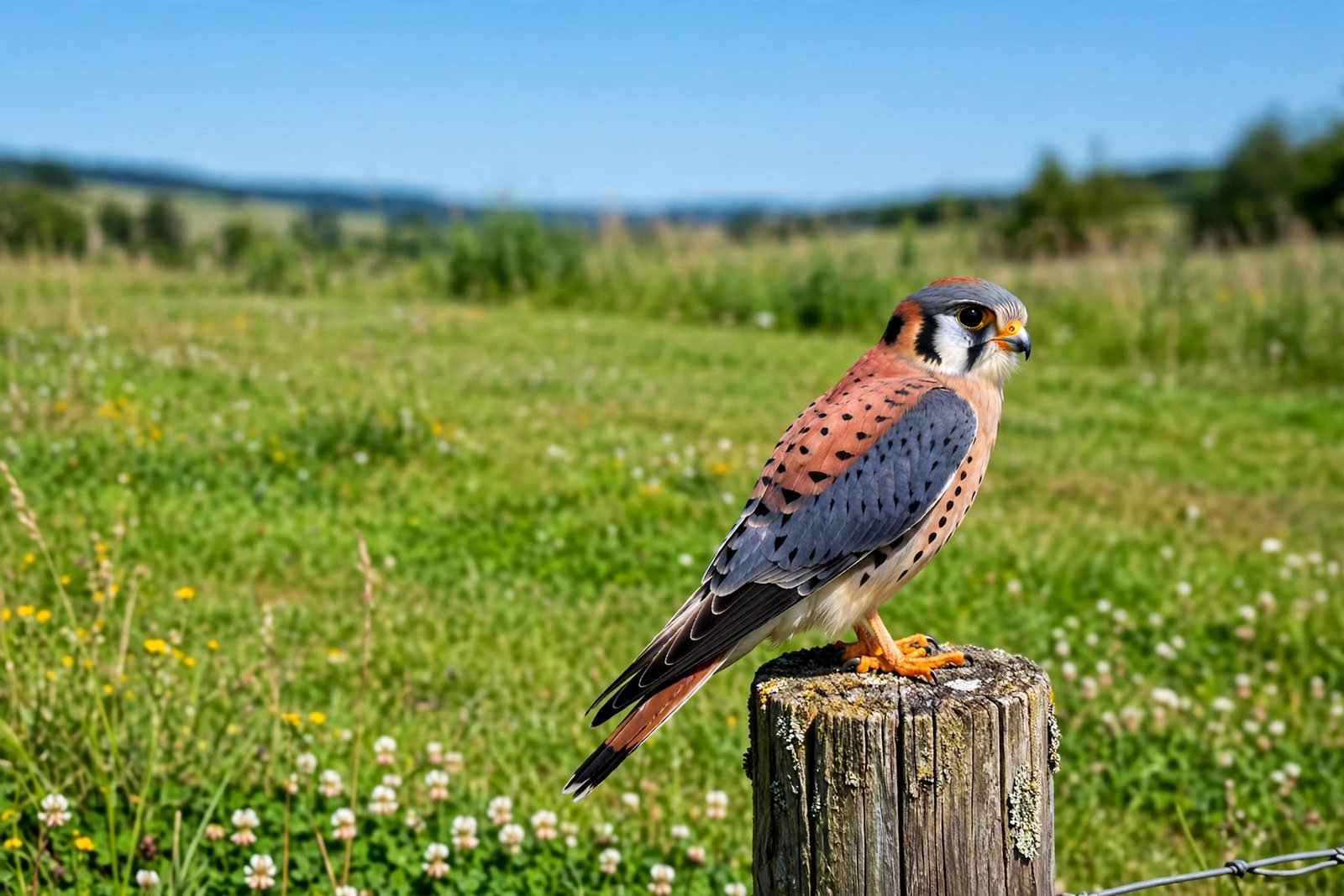
It weighs about as much as a robin, it is smaller than a blue jay, and it can hover in mid-air like a helicopter, staring down at a grasshopper in the field below. It is the American kestrel, the smallest falcon in North America, and it is one of the most colorful and charismatic birds on the continent.
For such a small bird, the kestrel is easy to recognize once you know what to look for. The male has a slate-blue head and wings, a rusty-red back and tail, and a white face marked with two black stripes that look like a mustache. The female is more rusty all over, with fine black barring on her back. Both have a fierce, falcon stare that seems far too intense for a bird that weighs about four ounces.
Kestrels are found across the entire United States, from Alaska to Florida, and they are one of the most common birds of prey in North America. But their numbers have been falling for decades, and scientists are working to understand why. Here is the story of this remarkable little falcon.
A Falcon the Size of a Robin
The American kestrel is a falcon, a member of the same family as the peregrine falcon and the merlin, but it is much smaller than its relatives. A kestrel measures about 9 to 12 inches long, with a wingspan of about 20 to 24 inches, and weighs between 3 and 6 ounces. The female is slightly larger than the male, as is the case with most birds of prey.
Despite its size, the kestrel is a true falcon in every way that matters. It has the sharp, hooked beak of a bird of prey, the powerful talons, and the speed and agility to hunt on the wing. Kestrels are capable of hovering, a rare ability among birds of prey, and they use it to scan the ground for prey before diving.
The kestrel’s hunting style is a pleasure to watch. The bird will perch on a wire, a fence post, or a tree branch, scanning the ground below with its sharp eyesight. When it spots a grasshopper, a mouse, or a lizard, it will either dive directly onto the prey or hover above it, beating its wings rapidly to stay in one place, before dropping in a steep dive. Kestrels can also catch insects in the air, snatching dragonflies and grasshoppers out of the sky with their talons.
What Kestrels Eat
The American kestrel is a generalist hunter, which means it eats a wide variety of prey. Insects make up a large part of its diet, especially grasshoppers, crickets, dragonflies, and beetles. In the summer, a kestrel may eat dozens of insects in a single day. Small mammals, including voles, mice, and shrews, are also important, especially in the winter when insects are scarce. Kestrels also eat small birds, lizards, and occasionally snakes and frogs.
The kestrel’s diet varies with the season and the habitat. In open grasslands, insects and small mammals dominate. In suburban areas, kestrels may hunt sparrows and other small birds at feeders. In the desert Southwest, lizards are a common prey item. This flexibility is one of the reasons kestrels are so widespread, and it is also one of the reasons they are so interesting to study.
Kestrels hunt during the day, which makes them one of the easiest birds of prey to observe. They are often seen perched on power lines along rural roads, bobbing their tails up and down, a distinctive behavior that helps identify them from a distance. In the fall, kestrels migrate, and they are a common sight at hawk-watching sites along the East Coast, where thousands of them pass through each year.
How Kestrels Raise Their Young
American kestrels are cavity nesters, which means they nest in holes in trees, in old woodpecker nests, or in rock crevices. They do not build their own nests. Instead, they rely on existing cavities, and in many areas, they have adapted to using nest boxes put up by people.
The breeding season begins in the spring, when the male performs a courtship display that includes aerial acrobatics and the offering of food to the female. Once a pair has chosen a nest site, the female lays four to five eggs, which she incubates for about a month. The male brings food to the nest during incubation, and both parents feed the chicks after they hatch.
The chicks grow quickly, and they leave the nest after about a month. The parents continue to feed them for a few more weeks while the young birds learn to hunt. By the end of the summer, the young kestrels are independent, and many of them will migrate south for the winter.
Kestrels are one of the few falcons that can raise two broods in a single season in the warmer parts of their range, and they are known to return to the same nest site year after year. Their fidelity to a nest site makes them good candidates for nest box programs, which have become an important tool for kestrel conservation.
The Kestrel Decline
Despite their wide range and adaptability, American kestrel populations have been declining for decades. Breeding bird surveys and migration counts both show a long-term downward trend, and the decline is steepest in the northeastern United States. Scientists are still working to understand the causes, but several factors are likely involved.
One factor is habitat loss. Kestrels need open grasslands and meadows for hunting, and those habitats have been shrinking as farmland is converted to development and as grasslands are replaced by forests. Another factor is the loss of nesting cavities. As dead trees are removed from the landscape, kestrels have fewer places to nest, and competition for the remaining cavities from starlings and other birds is intense.
Pesticides may also play a role. Kestrels eat insects, and the widespread use of pesticides reduces the insect prey available to them. Some pesticides may also affect kestrels directly, either through poisoning or by reducing their reproductive success. Researchers are studying this question, but the evidence is still developing.
There is also a mystery. The decline is not uniform across the country, and it is not fully explained by any single factor. Some researchers have suggested that changes in the timing of migration, or in the availability of prey during the winter, may be involved. The American Kestrel Partnership, a research program run by the Peregrine Fund, is studying the decline with the help of citizen scientists across the country, and its work is gradually filling in the picture.
How Nest Boxes Are Helping
One of the most successful conservation efforts for kestrels is also one of the simplest: nest boxes. Because kestrels nest in cavities and do not build their own nests, they are limited by the availability of suitable holes. Nest boxes, which are simple wooden boxes with an entrance hole, provide a safe place for kestrels to nest, and they have been shown to increase local kestrel populations.
Nest box programs exist across the country, run by conservation groups, state wildlife agencies, and individual volunteers. The American Kestrel Partnership coordinates many of these efforts and collects data from nest box monitors, who record how many kestrels use the boxes, how many eggs are laid, and how many chicks survive. This data helps scientists understand the kestrel decline and track the effectiveness of conservation efforts.
Anyone with a suitable location can put up a kestrel nest box. The boxes should be mounted on a pole or a tree in open habitat, facing away from prevailing winds, and they should be cleaned out each year after the breeding season. The Peregrine Fund and other organizations provide instructions for building and installing nest boxes, and many local Audubon chapters run nest box programs.
The nest box effort is a reminder that conservation does not always require large-scale interventions. Sometimes, a simple wooden box, put up in the right place, is enough to make a difference for a species that needs help.
How to Spot an American Kestrel
Spotting a kestrel is easier than you might think, once you know where to look. The best places are open areas with scattered perches, such as grasslands, meadows, farmland, and the edges of suburban developments. Look for a small bird perched on a power line, a fence post, or a dead tree, bobbing its tail up and down.
The kestrel’s coloration is distinctive. The male’s blue-gray wings and rusty back are unmistakable, and the female’s barred back and streaked breast are also easy to recognize. Both sexes have the black “mustache” marks on their white faces, and both have a small black spot on the back of their heads that looks like an eye, a feature that may confuse predators.
Binoculars help, but they are not essential. Kestrels are often approachable, and they will tolerate a quiet observer at a reasonable distance. The best time to look for them is in the morning or late afternoon, when they are most active, and the best seasons are spring and fall, when they are breeding and migrating.
If you see a kestrel, take a moment to watch it. You will be watching one of the most remarkable small predators in North America, a bird that weighs less than a can of soda and hunts with the skill and ferocity of a falcon ten times its size.
Frequently Asked Questions
How big is an American kestrel?
American kestrels are about 9 to 12 inches long, with a wingspan of 20 to 24 inches, and they weigh between 3 and 6 ounces. They are the smallest falcon in North America.
What do American kestrels eat?
Kestrels eat insects, including grasshoppers, crickets, and dragonflies, as well as small mammals like voles and mice, small birds, lizards, and occasionally snakes and frogs.
Can American kestrels hover?
Yes. Kestrels are one of the few birds of prey that can hover in place, beating their wings rapidly while scanning the ground for prey. It is one of their most distinctive hunting behaviors.
Why are American kestrel numbers declining?
Kestrel populations have been falling for decades, likely due to a combination of habitat loss, fewer nesting cavities, pesticide use, and other factors that scientists are still studying.
How can I help American kestrels?
Putting up a kestrel nest box in suitable open habitat is one of the most effective things you can do. You can also support conservation groups like the Peregrine Fund and the National Audubon Society, and report kestrel sightings to citizen science programs.
Where can I see an American kestrel?
Kestrels are found across the entire United States. Look for them perched on power lines, fence posts, and tree branches in open grasslands, farmland, and meadows, especially in the morning and late afternoon.
Sources and Further Reading
- Cornell Lab of Ornithology: American Kestrel
- National Audubon Society
- U.S. Fish and Wildlife Service