
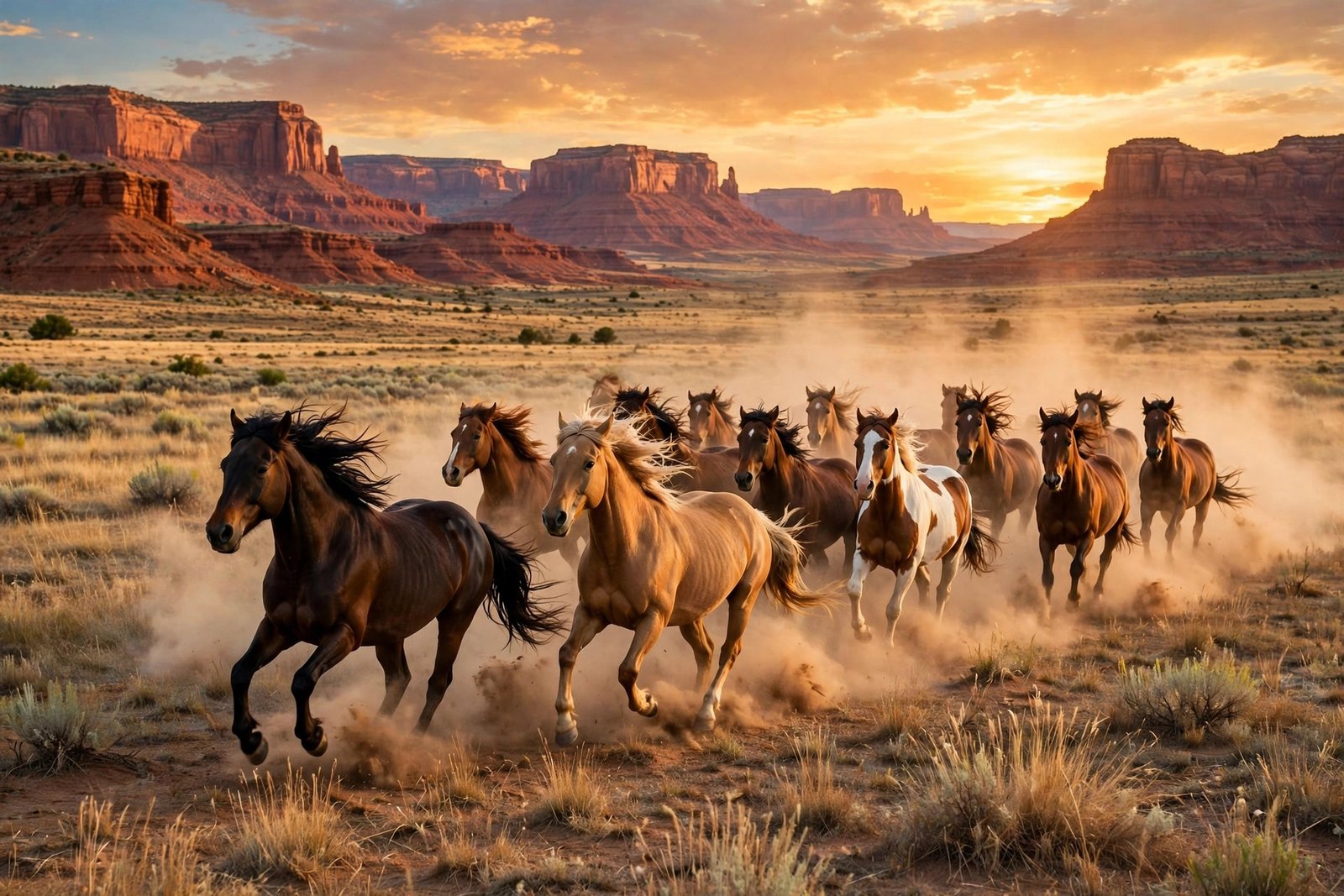
There is a sound that has echoed across the American West for centuries, and it is not an engine or a train whistle. It is the sound of hooves on dry ground, a band of wild horses moving across a Nevada valley at dawn, dust rising behind them in the first light. The mustang is the living symbol of the American West, as much a part of the landscape as the red rock and the sagebrush. But in 2026, the mustang’s story is more complicated than the postcards suggest, because there are now more wild horses on the range than the land is meant to hold, and more in government holding pens than on the open range itself.
I have always been drawn to the mustang, not just for the romance of it, but for what it represents: an animal that belongs to no one and to everyone, protected by federal law, shaped by four hundred years of American history. This is the story of where America’s wild horses came from, how many there really are, and the debate over what should happen to them next.
Where mustangs came from
Mustangs are not native to North America in the way bison or elk are. They are descendants of Spanish horses brought to the Americas in the sixteenth century by explorers and settlers. Some escaped, some were released, some were traded to Native American tribes, and over generations they became wild, adapting to the deserts, mountains, and grasslands of the West. Later, ranch horses, cavalry mounts, and draft horses mixed into the herds, which is why mustangs today come in nearly every color and build, from small and sturdy to tall and long-legged.
By the early twentieth century, wild horses were being rounded up in huge numbers for meat, for the military, and to clear the range for cattle. Their numbers fell sharply, and by the 1950s a Nevada schoolteacher named Velma Johnston, known as Wild Horse Annie, began a campaign to protect them. Her work led to the Wild Free-Roaming Horses and Burros Act of 1971, signed into law by President Richard Nixon, which declared wild horses and burros to be living symbols of the historic and pioneer spirit of the West and gave them federal protection.
The 1971 law covers all unbranded and unclaimed horses and burros on public lands, and it put the Bureau of Land Management, or BLM, in charge of managing them. That responsibility, more than fifty years later, is at the center of one of the most passionate debates in American wildlife management.
How many wild horses are there in 2026?
The Bureau of Land Management estimated that 61,523 wild horses and 23,943 burros were on the lands it manages as of March 1, 2026, a total of 85,466 animals. That is up from 73,130 a year earlier, an increase of more than 12,000 animals in a single year. Nevada holds nearly half of them: 37,426 horses and 5,146 burros, for a total of 42,572. Wyoming has the next most horses with 7,165, followed by Oregon with 5,994. Arizona is burro country, with 13,546 of its 13,814 animals being burros.
Those numbers are only part of the picture. As of May 2026, another 58,025 wild horses and burros were in off-range holding facilities: 20,350 in corrals, 36,459 in off-range pastures, and 1,216 in public off-range pastures. Put the on-range estimate and the holding figure together, and the BLM was responsible for about 143,000 wild horses and burros this year, with roughly two in five of them living in holding rather than on the open range.
The agency manages these animals across 175 herd management areas in ten western states, and each herd is different, with its own history, coloring, and temperament. The horses can live for decades, and without natural predators, herds can grow by ten to twenty percent a year, doubling in size in just four to five years if left unmanaged. That growth rate is the engine of the whole debate.
The carrying capacity problem
The BLM sets an Appropriate Management Level for each herd area, the number of animals the land can support alongside its other uses, including wildlife, livestock grazing, and recreation. Across the country, those levels add up to a maximum of 25,592 animals. The herds were at more than three times that level in March 2026.
The agency argues that when herds grow too large, they degrade the range itself. Horses eat the grasses and shrubs that other wildlife depends on, trample streams and springs, and in a drought year can face starvation as the land runs out of forage and water. The BLM says the choice is not between managing horses and leaving them alone, but between managing them now or watching the range, and the horses, suffer later.
Wild horse advocates push back hard on that argument. They point out that cattle vastly outnumber wild horses on western public lands, and that livestock grazing takes a far larger share of the forage. They argue that the Appropriate Management Levels are set too low, that roundups are stressful and sometimes deadly for the horses, and that the real problem is not too many horses but too little room given to them. In 2026, that argument has grown sharper, because the administration’s fiscal year 2026 budget proposal would cut funding for the Wild Horse and Burro Program by about twenty-five percent and remove long-standing protections against horse slaughter, raising fears about the fate of tens of thousands of animals in holding.
Roundups, adoptions, and the cost of holding
When the BLM decides a herd is over its management level, it conducts a gather, rounding up horses, often with helicopters, and removing a set number from the range. In 2026, the agency planned to remove nearly 14,000 horses and burros, including 245 of the 505 horses in Colorado’s Sand Wash Basin, a herd that has become a symbol of the roundup debate. The images from these gathers, horses running before helicopters toward capture pens, are powerful, and they are the reason the issue draws so much public attention.
Removed horses go into the adoption and sale system. In 2025, 4,330 wild horses and burros were adopted, the lowest number since 2018, while 3,718 were sold, the highest annual figure on record and more than double the number sold in 2024. In the first eight months of 2026, more than 3,000 mustangs and burros were sold, according to BLM records. The standard adoption fee is 125 dollars, and adopters must show they can provide proper care, fencing, and shelter. Many adopted mustangs go on to become trail horses, ranch horses, and even competition horses, and their owners often say the bond with a mustang is unlike any other.
But adoption cannot keep pace with removals. Holding the animals costs taxpayers more than 100 million dollars a year. In fiscal year 2024, off-range holding cost over 100 million dollars, representing about sixty-six percent of the Wild Horse and Burro Program’s entire budget. One estimate puts the lifetime cost of holding a single horse at around 48,000 dollars. Removing 1,111 mustangs from a single Colorado herd area and holding them for life would cost an estimated 53 million dollars. The total capacity of all BLM off-range holding facilities is 78,526 animals, and the system is filling up.
Where to see wild horses
For travelers, the good news is that wild horses are still visible across the West, and seeing them is one of the great American wildlife experiences. Nevada’s Virginia Range, near Reno, is home to one of the most accessible herds, and the horses there are often seen near roads at dawn and dusk. The Pryor Mountains on the Montana-Wyoming border are famous for their small, hardy horses with Spanish markings. Assateague Island, on the Maryland-Virginia coast, has its own wild ponies, which swim across the channel each summer in a tradition that draws crowds from around the country.
If you go looking for them, the rules are simple and important: keep your distance, never feed them, and never approach a band with foals. Wild horses are protected by federal law, and it is a federal crime to harass or kill them. Bring binoculars, go early or late in the day when horses are most active, and remember that a horse that looks calm from a hundred yards away can cover ground very fast.
What happens next?
The future of America’s wild horses will be decided by a mix of science, politics, and public pressure, and 2026 is a turning point. Fertility control vaccines offer one path: treating mares on the range to slow herd growth without roundups. Advocates say it is humane and cheaper than holding horses for life. The BLM says it is useful but cannot bring herds that are already three times over their management levels back down on its own.
Others argue for more adoptions, better marketing of mustangs, and more funding for training programs that turn wild horses into riding horses. Still others say the real answer is to give horses more land, not less, and to reduce livestock grazing on the herd areas instead.
What is clear is that the mustang is not going anywhere, because Americans will not let it. The horse that carried explorers, cowboys, and Native warriors across this continent has become something larger than a species: it is a test of whether a country can keep a promise it made in 1971, to protect a living symbol of its own history. The herds are bigger than ever, the debate is louder than ever, and the horses, out on the range at dawn, do not seem to care about any of it. They just keep running.
FAQ
How many wild horses are in the USA in 2026?
The Bureau of Land Management estimated 61,523 wild horses and 23,943 burros on the lands it manages as of March 1, 2026, a total of 85,466 animals. Another 58,025 were in off-range holding facilities in May 2026.
Where do most wild horses live?
Nevada holds nearly half of America’s wild horses and burros, with 42,572 animals as of March 2026. Wyoming, Oregon, California, and Arizona hold most of the rest, across 175 herd management areas in ten western states.
Are mustangs protected by law?
Yes. The Wild Free-Roaming Horses and Burros Act of 1971 protects unbranded, unclaimed horses and burros on public lands, and the Bureau of Land Management is responsible for managing them. It is a federal crime to kill or harass them.
Can you adopt a wild mustang?
Yes, through the Bureau of Land Management’s Wild Horse and Burro Program. The standard adoption fee is 125 dollars, and adopters must show they can provide proper fencing, shelter, and care. In 2025, 4,330 wild horses and burros were adopted.
Why does the BLM round up wild horses?
The BLM says herds grow faster than the range can support, and that excess horses must be removed under the 1971 act when they exceed the Appropriate Management Level, which totals about 25,592 animals nationwide. Advocates dispute the levels and argue for fertility control and more adoptions instead.
Sources
- Bureau of Land Management, Wild Horse and Burro Program Data
- Equine Info Exchange, Mustang Horses: America’s Wild Horses, Herds and Adoption
- Animals Around the Globe, Wild Horses Roaming the American West
- The Times, From Freedom to the Kill Pen: The Fate of America’s Vanishing Wild Horses