
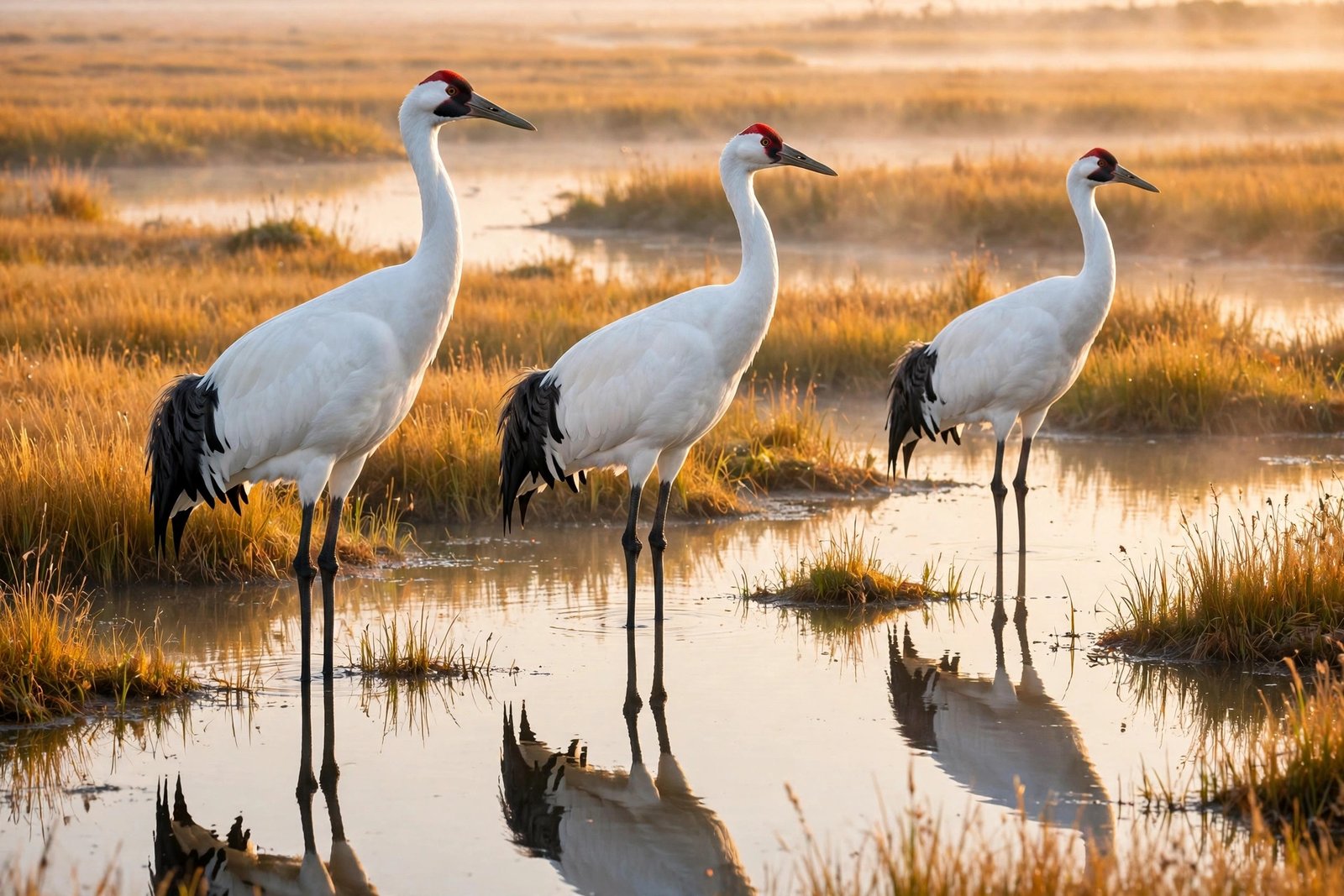
Stand on a Texas marsh at dawn in January and you might hear it before you see it: a loud, rolling bugle that carries for miles across the water. Then a flash of white rises over the cordgrass, wings spread wide, black wingtips catching the light. It is a whooping crane, the tallest bird in North America, and seeing one in the wild is something that almost never happened again.
Not long ago, this bird was nearly gone. In 1941, biologists counted only 14 adults and two juveniles in the wild at Aransas, on the Texas Gulf Coast. Every whooping crane alive today descends from that tiny remnant. The species had been hunted for its feathers and meat, its wetlands drained and plowed, and its nesting grounds in the far north disturbed until there was almost nothing left to save. For a while, extinction looked less like a warning and more like a schedule.
And yet the whooping crane is still here. The U.S. Fish and Wildlife Service estimated that about 540 birds from the main migratory flock wintered around Aransas National Wildlife Refuge in the 2025-2026 season, the ninth straight year that flock has stayed above 500. Counting the reintroduced flocks and the birds in captivity, the total population is now roughly 830 birds. That is not a finished success story. The species is still listed as endangered, and every winter still depends on healthy marshes, clean water, and people willing to give a very tall, very loud bird room to live. But it is one of the great comebacks in American conservation, and it is worth understanding how it happened, one migration at a time.
Meet the Tallest Bird in North America
A whooping crane is hard to mistake for anything else. Adults stand nearly five feet tall, with a wingspan of seven to eight feet, white plumage, black wingtips, a red crown, and long black legs that trail behind in flight. They weigh only about 14 to 16 pounds, which makes that height all the more surprising: most of it is neck and legs, built for wading through shallow marsh water and scanning for food. Their call, the whoop that gives them their name, is amplified by a windpipe that coils inside the breastbone like a French horn, and it can be heard from a long way off.
Whooping cranes are built for a life of movement and patience. They eat blue crabs, clams, shrimp, small fish, frogs, snakes, insects, berries, and plant material, picking through shallow water with slow, deliberate steps. They mate for life, usually returning to the same nesting territory year after year, and they are famously wary of people. A flock that feels crowded will simply move on, which is why the quiet, protected marshes of Aransas matter so much. This is not a bird that adapts easily to noise, boats, and crowds. It needs space, and in the modern world, space is the hardest thing to protect.
How a Bird That Tall Nearly Disappeared
Before European settlement, whooping cranes ranged widely across North America, from the prairies of the Midwest to the Gulf Coast. They were never as numerous as some other waterbirds, and they reproduce slowly, usually raising at most one chick per pair per year. That slow pace made them vulnerable when the pressures arrived all at once. Market hunters shot them for meat and for the plume trade. Settlers drained wetlands for farms and towns. Egg collectors and disturbance at nesting sites finished what hunting had started.
By the time anyone thought to count carefully, the numbers were shocking. The U.S. Fish and Wildlife Service notes that in 1941 only 14 adults and two juveniles were counted in the wild at Aransas, and another account from the same era puts the total wild population at just 21 birds. Either way, the species was down to roughly fifteen birds, give or take a few, in the early 1940s. It was one of the closest calls in the history of American wildlife, and it happened before the modern Endangered Species Act even existed.
What saved them was not a single rescue but a stubborn decision to protect the last flock where it spent the winter. Aransas National Wildlife Refuge, established in 1937 on the Texas coast, became the winter home of the last wild flock, and the birds’ remote summer nesting grounds in what is now Wood Buffalo National Park in Canada were eventually found and protected too. When whooping cranes were listed as endangered in 1967, only around 50 birds remained. From that low point, the long, slow climb began, at an average growth rate of a little over four percent a year since 1938, according to the Fish and Wildlife Service. Slow growth, year after year, is how you rebuild a species that raises one chick at a time.
The 2,500-Mile Migration That Defines the Species
The main flock of whooping cranes, known as the Aransas-Wood Buffalo population, makes one of the great migrations in North America. Each spring the birds leave the Texas coast and fly more than 2,500 miles north through the Great Plains and the Canadian prairies to their breeding grounds in and around Wood Buffalo National Park, on the border of Alberta and the Northwest Territories. In the fall they make the same journey in reverse, arriving in Texas in October and November to spend the winter in the estuarine marshes around Aransas.
The migration takes weeks, and the birds travel in family groups, stopping at wetlands, shallow lakes, and river sandbars along the way to rest and feed. They fly by day, often riding thermals, and they are strong, steady fliers despite their size. Along the Central Flyway, a network of wetlands, refuges, and private ranchlands provides the stepping stones that make the journey possible. Lose too many of those stopover wetlands to draining or development, and the migration itself becomes harder and more dangerous.
Winter at Aransas National Wildlife Refuge
Aransas National Wildlife Refuge, on the Texas Gulf Coast, is the heart of the whooping crane story. Established in 1937 for migratory waterfowl, the refuge now covers more than 115,000 acres of marsh, prairie, oak woodland, and shoreline along the Gulf. It is best known, in the Fish and Wildlife Service’s own words, as the wintering home of the last wild flock of endangered whooping cranes. More than 400 species of birds have been recorded there, but in winter the whoopers are the stars.
Winter is the season when the cranes rebuild their strength. In the marshes they hunt blue crabs, one of their favorite foods, along with wolfberries, clams, and other wetland fare. Each family group defends a winter territory, and the birds spend their days wading, feeding, preening, and calling. Refuge staff help by managing the habitat: prescribed burns open up the coastal prairie and improve foraging, and crews work to control invasive plants like Chinese tallow and salt cedar that crowd out the native marsh plants the cranes depend on. During the 2024-2025 winter season, staff carried out prescribed burns on about 3,575 acres and treated invasive plants in refuge wetlands.
Captive Breeding and the Second and Third Flocks
Protecting the main flock was essential, but conservationists knew that one flock, however well guarded, was still a gamble. A single hurricane, disease outbreak, or oil spill on the Texas coast could have wiped out the species in one season. So over the decades, biologists built backup populations, and the story of how they did it is one of the most creative chapters in wildlife conservation.
It began with eggs. Starting in 1967, biologists collected eggs from nests in Wood Buffalo National Park and brought them to captive breeding centers, including the Patuxent Wildlife Research Center in Maryland and later the International Crane Foundation in Baraboo, Wisconsin. Because whooping cranes often lay two eggs but usually raise only one chick, taking one egg from a nest gave the captive program a start without dooming the wild pair’s season. In captivity, biologists pioneered techniques for raising cranes without letting them imprint on humans, including feeding chicks with crane-shaped puppets and, later, guiding young birds on their first migration behind ultralight aircraft flown by pilots in crane costumes.
Those efforts produced two reintroduced flocks that exist today. The eastern migratory population, which breeds mainly in Wisconsin and winters in the southeastern United States, numbered about 64 birds in the International Crane Foundation’s September 2026 update, with 18 of them hatched in the wild. A non-migratory flock in Louisiana, reintroduced at White Lake Wetlands Conservation Area, is rebuilding the population that once lived there year-round. A previous non-migratory flock in Florida, started in 1993, did not take hold and has dwindled to a handful of birds, a reminder that reintroduction is hard and not every attempt works. Together with the birds in captivity, about 138 cranes under human care at the end of 2025, the total population now stands at roughly 830 birds, according to the International Crane Foundation. That is a long way from sixteen, but it is still a small number for a species, and the work is far from over.
What Still Threatens the Comeback
The whooping crane’s recovery is real, and it is also fragile. The species remains listed as endangered, and the threats that nearly wiped it out have changed shape rather than disappeared. Habitat loss is still the biggest one. Coastal marshes around Aransas face pressure from development, and the freshwater inflows that keep those marshes brackish and productive depend on rivers that are also used by cities, farms, and industry upstream. When drought reduces freshwater flow, the marshes get saltier, blue crab numbers drop, and the cranes have less to eat.
Power lines are another danger. Whooping cranes fly low on their migration and at dawn and dusk, when visibility is poor, and collisions with power lines are a leading cause of death for the reintroduced eastern flock. Disease is a growing concern as well: the 2025-2026 survey season brought the first documented cases of mortality from highly pathogenic avian influenza in this population, a reminder that a single outbreak can hit a small, concentrated flock hard. Climate change adds a slower pressure, shifting the timing of migration, changing wetland conditions, and increasing the odds of severe storms on the Gulf Coast, where a hurricane can reshape a marsh in a night.
How Americans Can See a Whooping Crane and Help It Survive
If you want to see a whooping crane, winter on the Texas coast is the best bet. Aransas National Wildlife Refuge is open to visitors, and the town of Rockport, nearby, is a friendly base with boat tours that take watchers out to the marshes where the cranes feed. The cranes are usually in Texas from late October or November through March or April, and the best viewing is early in the morning, when the birds are actively feeding. Bring binoculars or a spotting scope, dress for wind off the Gulf, and keep your distance. The refuge and the tour operators know where the birds are and how close is too close, so follow their lead.
If Texas is too far, the eastern migratory flock offers chances in Wisconsin in summer and in the Southeast in winter, and the International Crane Foundation in Baraboo, Wisconsin, is a wonderful place to learn about cranes of all kinds, including whooping cranes in its care. Wherever you go, report what you see. Sightings reported through eBird, iNaturalist, and Texas Whooper Watch help biologists track the flock’s movements and find birds outside the survey areas, and that information feeds directly into the annual population estimates.
Frequently Asked Questions
How many whooping cranes are left?
The total population is roughly 830 birds as of 2025, according to the International Crane Foundation. The main wild flock, the Aransas-Wood Buffalo population, was estimated at about 540 birds wintering around Aransas National Wildlife Refuge in the 2025-2026 season, and it has stayed above 500 for nine consecutive years. The eastern migratory flock numbered about 64 birds in September 2026, and about 138 cranes were in captivity at the end of 2025.
Why are whooping cranes endangered?
They were hunted for meat and feathers, lost wetland habitat to draining and development, and reproduce slowly, raising at most one chick per pair per year. By 1941 only 14 adults and two juveniles were counted in the wild. They remain endangered today because the population is still small, concentrated in a few places, and dependent on wetlands that face pressure from development, drought, and climate change.
Where do whooping cranes migrate?
The main flock breeds in and around Wood Buffalo National Park in Canada and migrates more than 2,500 miles south to winter on the Texas Gulf Coast, centered on Aransas National Wildlife Refuge. The eastern migratory flock breeds mainly in Wisconsin and winters in the southeastern United States, while a non-migratory flock lives year-round in Louisiana.
What is the best place to see a whooping crane?
Aransas National Wildlife Refuge on the Texas coast, from late fall through early spring, is the most reliable place, with boat tours from nearby Rockport offering good views from a respectful distance. The International Crane Foundation in Baraboo, Wisconsin, is also a great place to learn about the species and see cranes in its care.
How tall is a whooping crane?
Whooping cranes stand nearly five feet tall, with a wingspan of seven to eight feet, making them the tallest bird in North America. Despite their height, they weigh only about 14 to 16 pounds, since most of that height is neck and legs.
Related reading
If you enjoyed learning about the whooping crane, keep exploring American wildlife with us: read about the wild turkey’s own remarkable comeback, find out where to see Florida manatees this winter, and learn how black bears prepare for winter denning.
Sources: U.S. Fish and Wildlife Service, Service Estimates 540 Whooping Cranes Wintered on Texas Coast in 2025-2026; Aransas National Wildlife Refuge, U.S. Fish and Wildlife Service; International Crane Foundation, Whooping Crane Population Holds Steady at 540.