
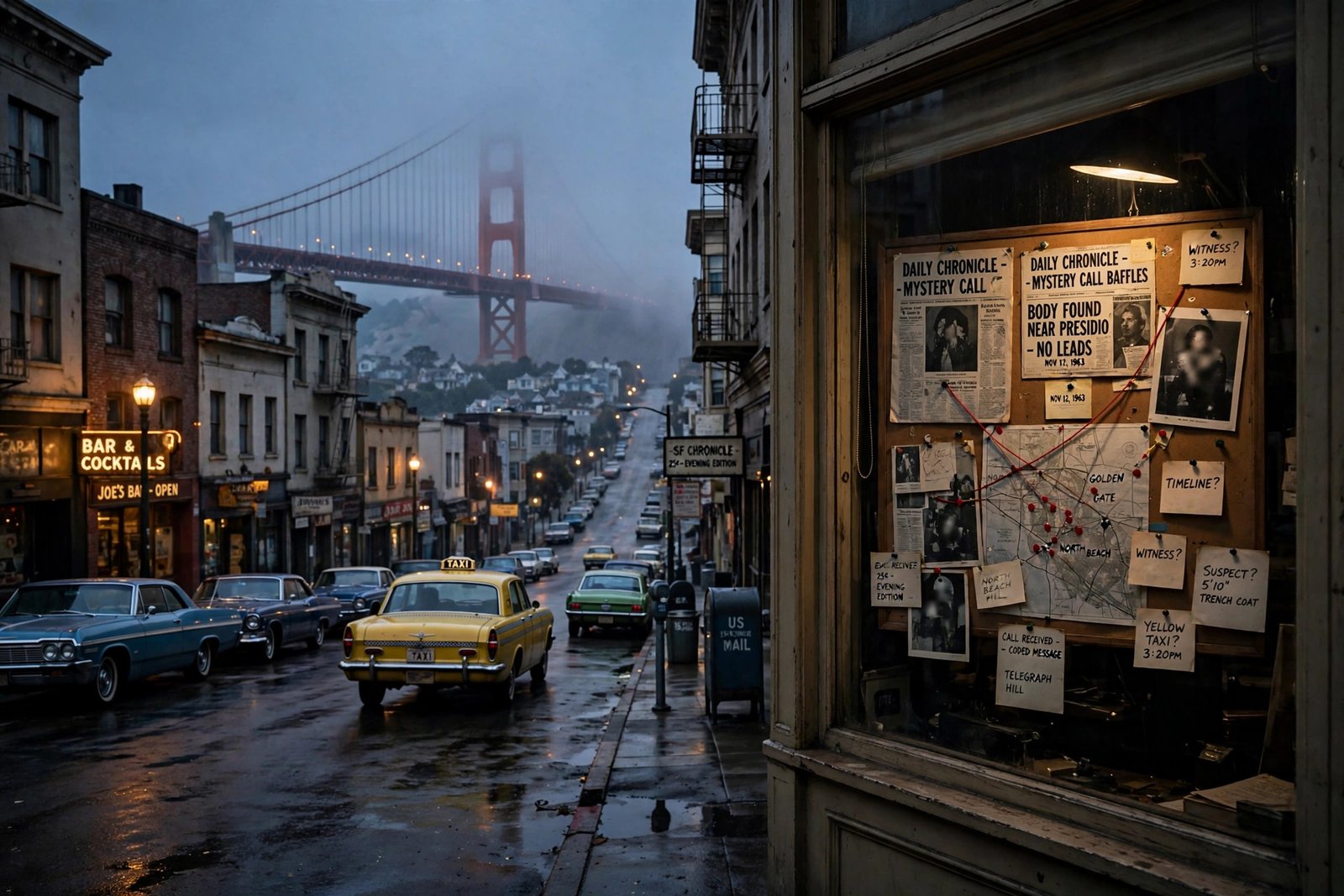
On the night of December 20, 1968, two teenagers were shot dead on a lonely road outside Vallejo, California. It was a terrible crime, but at first it looked like a random act of violence — the kind of tragedy that fills a police blotter and fades from the news. Nobody knew that the killer would write letters, invent a name for himself, and become the most famous unsolved murderer in American history.
He called himself the Zodiac. Over the next year, he killed at least five people, taunted the police and the newspapers with coded messages, and claimed — in his own letters — to have killed 37. He was never caught. More than half a century later, his identity remains one of the great mysteries of American crime, and his ciphers have challenged codebreakers for generations.
This is the story of what is known, what is claimed, and what is still unanswered about the Zodiac Killer.
The Murders: Five Confirmed Victims
The Zodiac’s confirmed crimes began on Lake Herman Road, near Vallejo, on December 20, 1968. David Faraday, 17, and Betty Lou Jensen, 16, were parked in Faraday’s car when a gunman approached and shot them both. Jensen tried to run and was shot in the back. Faraday died at the scene. There was no robbery, no apparent motive, and no suspect.
The second attack came on July 4, 1969, at Blue Rock Springs Park, also near Vallejo. Darlene Ferrin, 22, and Michael Mageau, 19, were sitting in Ferrin’s car when a man pulled up behind them, got out, and fired into the vehicle with a 9mm pistol. Ferrin was killed. Mageau survived, despite being shot several times, and was able to describe the attacker. Within the hour, a man called the Vallejo police department from a pay phone and reported the shooting, giving the location and claiming responsibility. The call was the first sign that the killer wanted an audience.
The third attack, on September 27, 1969, was the most brazen. At Lake Berryessa, a popular recreation area north of San Francisco, a hooded man approached Bryan Hartnell, 20, and Cecelia Shepard, 22, who were picnicking by the water. The man wore a black hood with a white crosshair symbol on the chest — the symbol that would become the Zodiac’s signature — and carried a gun and a knife. He tied the couple up, then stabbed them both repeatedly. Shepard died two days later. Hartnell survived and gave police a detailed description.
The final confirmed murder came on October 11, 1969, in San Francisco. Paul Stine, a 29-year-old cab driver, picked up a passenger in the Presidio Heights neighborhood. The passenger shot him in the head, took his wallet and keys, and tore a piece of his bloodstained shirt. Teenagers across the street watched and called the police. Officers arrived within minutes, and one patrol car actually passed a man matching the description — but the radio dispatch had described a Black suspect, and the officers let the white man walk away. It was the closest the police ever came to catching the Zodiac.
The Letters: A Killer Who Wanted Fame
What made the Zodiac different from other killers was his hunger for attention. Beginning in August 1969, he sent letters to the San Francisco Chronicle, the San Francisco Examiner, and the Vallejo Times-Herald, signing them with the crosshair symbol and the name Zodiac. The letters claimed responsibility for the murders, threatened more killings, and demanded to be published on the front page.
The letters included ciphers — coded messages written in symbols that the killer challenged the public to solve. The first, a 408-character cipher sent in three parts to three newspapers, was cracked within days by a Salinas schoolteacher and his wife, Donald and Bettye Harden. It contained a chilling message in which the killer said he was collecting slaves for the afterlife. The second cipher, the famous 340-character Z340, resisted every attempt to solve it for 51 years.
The letters also contained the Zodiac’s claim that he had killed 37 people. That number has never been verified. Investigators have linked the Zodiac definitively to five murders and two attempted murders. Several other unsolved killings from the period have been proposed as Zodiac crimes, most notably the 1966 murder of Cheri Jo Bates in Riverside, California, but none has been proven. The 37 figure comes only from the killer’s own letters, and it should be treated as his claim, not as a fact.
The Cipher That Took 51 Years to Crack
Of all the Zodiac’s puzzles, the Z340 was the most famous. Sent to the San Francisco Chronicle in November 1969, the 340-character cipher defied codebreakers for more than half a century. The FBI, the NSA, and amateur cryptographers around the world tried to solve it. None succeeded — until December 2020, when a team of three civilian codebreakers, David Oranchak, Sam Blake, and Jarl Van Eycke, finally cracked it.
The solution was a disappointment in one sense and a revelation in another. The message read, in part: “I hope you are having lots of fun in trying to catch me… I am not afraid of the gas chamber because it will send me to paradice all the sooner.” It contained no name, no confession of specific crimes, and no clue to the killer’s identity. It was, like so much of the Zodiac case, a taunt — a message designed to prove that the killer was smarter than everyone trying to catch him.
Two shorter ciphers, known as the Z13 and the Z32, remain unsolved. The Z13 is believed to contain the killer’s name, but with only 13 characters, it may never be cracked.
The Suspects and the Dead Ends
Over the decades, the Zodiac case has generated thousands of suspects and theories. The most famous was Arthur Leigh Allen, a convicted child molester who lived in Vallejo and was the focus of the investigation for years. Allen matched several details: he owned the same type of shoes that left prints at one crime scene, he had a watch with the Zodiac’s crosshair symbol, and he had made statements that sounded like confessions. But the physical evidence did not match. His fingerprints did not match the prints found at the Stine crime scene, his handwriting did not match the letters, and DNA testing on the envelopes excluded him. Allen died in 1992, still insisting he was innocent.
Other suspects have come and gone. In 2021, a group of former law enforcement officers and investigators calling themselves the Case Breakers announced that they had identified the killer as a man named Gary Francis Poste, who died in 2018. The FBI responded that the case remained open and unsolved, and that there was no new information to report. The claim has not been accepted by investigators.
In recent years, the investigation has turned to DNA. The San Francisco Police Department and the FBI have attempted to build a genetic profile from the DNA on the Zodiac’s letters, using the same kind of forensic genealogy that caught the Golden State Killer in 2018. So far, the samples have been too degraded or too contaminated to produce a usable profile. The case remains open in San Francisco, Vallejo, and Napa County.
Why the Zodiac Still Haunts America
The Zodiac case endures for several reasons. The first is the killer’s own doing: he turned murder into a public performance, and the letters, the ciphers, and the crosshair symbol made him a character in the American imagination. The second is the failure to catch him, which stands in stark contrast to the image of modern forensic science. The third is the timing: the murders came at the end of the 1960s, in the San Francisco Bay Area, at the moment when the optimism of the decade was curdling into fear.
The case has inspired books, films, and television series, most famously David Fincher’s 2007 film Zodiac, which dramatized the investigation by the Chronicle cartoonist Robert Graysmith. Graysmith’s books helped keep the case in the public eye, although some of his theories have been disputed by investigators.
For the families of the victims, the case is not a mystery to be solved for entertainment. It is an open wound. David Faraday and Betty Lou Jensen were 17 and 16. Darlene Ferrin was 22. Cecelia Shepard was 22. Paul Stine was 29. Their lives were cut short by a man who wanted to be famous, and who succeeded. The best tribute to them is the truth — and the truth, more than 55 years later, is still incomplete.
Frequently Asked Questions
How many people did the Zodiac Killer murder?
Five murders are definitively linked to the Zodiac: David Faraday and Betty Lou Jensen (December 1968), Darlene Ferrin (July 1969), Cecelia Shepard (September 1969), and Paul Stine (October 1969). The killer claimed 37 victims in his letters, but that number has never been verified.
Was the Zodiac Killer ever caught?
No. The Zodiac Killer was never identified or arrested. The case remains open in San Francisco, Vallejo, and Napa County, and the FBI has said there is no new information that solves it.
What was the Zodiac’s 340 cipher?
The Z340 was a 340-character coded message sent to the San Francisco Chronicle in November 1969. It resisted all attempts to solve it for 51 years until a team of three codebreakers cracked it in December 2020. The message contained no name and no clue to the killer’s identity.
Who was Arthur Leigh Allen?
Arthur Leigh Allen was the leading suspect in the Zodiac case for many years. He matched several circumstantial details, but fingerprints, handwriting, and DNA evidence excluded him. He died in 1992.
What is the Zodiac’s crosshair symbol?
The Zodiac signed his letters with a circle crossed by vertical and horizontal lines, resembling a gunsight. The symbol appeared on the hood worn by the attacker at Lake Berryessa and became the killer’s signature.
Sources
- Federal Bureau of Investigation — Seeking Information: Zodiac Killer
- San Francisco Chronicle — The Zodiac Killer case archive
- Smithsonian Magazine — Codebreakers Crack the Zodiac Killer’s 340-Character Cipher