
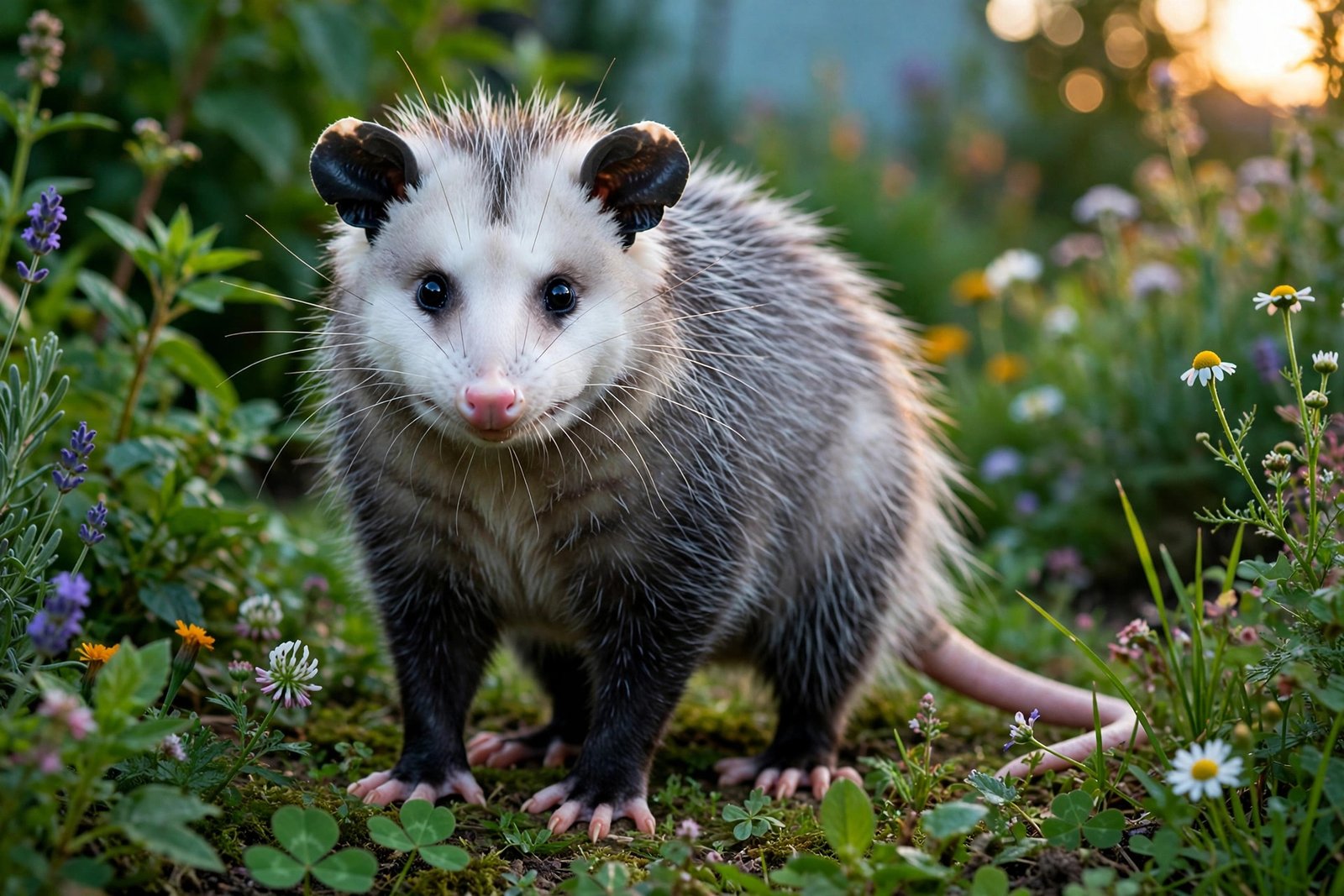
If you have ever seen a small, gray, sharp-faced animal waddling across your yard at night, you have met one of North America’s most misunderstood creatures. It has a pointed white face, a naked pink tail, and a habit of freezing, baring fifty teeth, or collapsing into a convincing imitation of a corpse when startled. It is the Virginia opossum, and it is the only marsupial native to the United States.
Marsupials are the pouched mammals — kangaroos, koalas, wombats — and almost all of them live in Australia. The Virginia opossum is the exception. Its ancestors came from South America, migrating north when the two continents joined at Panama millions of years ago, and it is now found across the eastern and central United States, and increasingly in the West. It is a living fossil, a creature whose lineage predates most of the mammals it shares the continent with — and it is also one of the most useful animals in an American backyard.
Here is what makes the opossum unique, why its most famous trick is not a trick at all, and which of the things you have heard about it are actually true.
America’s Only Marsupial
The Virginia opossum (Didelphis virginiana) is the only marsupial found north of Mexico. Like all marsupials, it gives birth to young that are born extremely underdeveloped and finish growing inside the mother’s pouch. An opossum baby is born after just 12 to 13 days of gestation, no bigger than a honeybee, blind and hairless. It crawls to the pouch, attaches to a nipple, and stays there for two to three months before emerging to ride on its mother’s back.
A female opossum can have as many as three litters a year, and the young stay with her for about three months after leaving the pouch. The species is remarkably successful. Opossums have expanded their range steadily northward over the past century, moving into New England and the upper Midwest, and westward into the Pacific Northwest, helped by the shelter and food that human settlements provide.
Despite their success, opossums live fast and die young. In the wild, most live only one to three years. They are medium-sized animals, weighing 4 to 13 pounds as adults, and their short lives are packed with activity: foraging, breeding, and raising young in a cycle that repeats as quickly as the seasons allow.
Fifty Teeth and a Prehensile Tail
The opossum’s most distinctive feature, after the pouch, is its mouth. Virginia opossums have 50 teeth — more than any other North American land mammal. The dental formula includes 10 upper incisors, a number no other mammal on the continent shares. When threatened, an opossum will gape its mouth wide, revealing all 50 teeth in a display that looks ferocious. It is almost entirely bluff. Opossums are non-aggressive animals that would much rather run away than fight, and actual aggression toward people or pets is rare.
The opossum’s tail is another marvel. It is long, scaly, and prehensile, meaning it can grip branches like a fifth hand. Young opossums use their tails to hang from branches, and adults use them for balance and for carrying nesting material. The hind feet have opposable, clawless thumbs — another feature that sets the opossum apart from almost every other North American mammal.
The animal’s brain is famously small for its body size — roughly one-fifth the size of a raccoon’s brain, and one of the smallest of all marsupials. But what the opossum lacks in brainpower it makes up for in resilience. Its low body temperature makes it a poor host for the rabies virus, and documented rabies cases in opossums are extremely rare. It is also resistant to snake venom, including that of pit vipers, and will eat venomous snakes without apparent harm.
Playing Possum: Not Pretending at All
The opossum’s most famous behavior is playing dead, and the phrase “playing possum” has entered the language as a synonym for pretending. The truth is stranger than the saying. When an opossum is extremely frightened and cannot escape, it does not pretend to be dead. It goes into an involuntary catatonic state, triggered by hormones in the brain, in which it collapses, goes limp, opens its mouth, sticks out its tongue, drools, and emits a foul-smelling liquid from its anal glands. The animal is essentially unconscious, and the state can last from a few minutes to as long as four hours.
The display is remarkably convincing. The opossum’s eyes stay open and glassy, its body goes stiff, and the smell of decay is real. Predators that prefer live prey are often fooled into losing interest. When the threat passes, the opossum eventually rights itself and walks away, apparently unharmed.
According to the Smithsonian’s National Zoo, the behavior is especially common in young opossums, while adults are more likely to hiss, bare their teeth, or flee. The first line of defense is always escape. Playing dead is the last resort, used only when the animal believes it has no other choice.
The Tick Myth — and What Opossums Really Eat
For years, a popular claim circulated that a single opossum could eat thousands of ticks a week, making it a hero in the fight against Lyme disease. The claim came from a 2009 laboratory study in which captive opossums were found to groom off and eat most of the ticks placed on them. It was repeated in countless articles, nature guides, and social media posts.
It does not hold up. In 2021, researchers at the University of Illinois examined the stomach contents of 32 wild opossums from central Illinois and found no ticks or tick parts at all. The lab result, it turned out, did not reflect what wild opossums actually do. The researchers concluded that opossums are not the tick-eating machines they were made out to be, and the claim should be retired.
What opossums do eat is almost everything. They are true omnivores and opportunistic scavengers, eating fruit, insects, worms, mice, frogs, carrion, eggs, and garbage. They will eat slugs and snails that damage gardens, and they clean up fallen fruit and dead animals. In that sense, they are the cleanup crew of the American backyard — unglamorous, unappreciated, and quietly useful.
How to Live With Opossums
Opossums are not dangerous to people, and they do not carry rabies in any meaningful numbers. They can, however, be a nuisance. They raid garbage cans, eat pet food left outside, and den under sheds, decks, and porches. The best way to discourage them is to remove the food: secure trash cans, bring pet food indoors at night, and seal gaps under decks and outbuildings.
If you find an opossum in your yard, the best response is to leave it alone. It is almost certainly passing through, and it will move on by morning. If you find a baby opossum that appears orphaned, do not handle it yourself — contact a local wildlife rehabilitator. Baby opossums that are alone are often still dependent on their mothers, and well-meaning rescue attempts can do more harm than good.
The opossum’s range is still expanding, and as winters warm, it is likely to push further north. That means more Americans will meet this strange, ancient animal in the years to come. It is worth knowing what it is: not a rat, not a pest, but a marsupial — a reminder that North America was once connected to a southern continent, and that the wild world is stranger and older than it looks from a kitchen window.
Frequently Asked Questions
Is the Virginia opossum really America’s only marsupial?
Yes. The Virginia opossum is the only marsupial native to the United States and Canada, and the only marsupial found north of Mexico. Its ancestors migrated from South America when the continents joined at Panama.
Why do opossums play dead?
Playing dead, or thanatosis, is an involuntary response to extreme fear. The opossum collapses, goes limp, and emits a foul odor, which can fool predators into losing interest. The state can last from minutes to four hours, and the animal is not pretending — it is essentially unconscious.
How many teeth does an opossum have?
Fifty — more than any other North American land mammal. The opossum has 10 upper incisors, a feature no other mammal on the continent shares.
Do opossums eat ticks?
Probably not in any meaningful numbers. A 2009 lab study suggested they did, but a 2021 study of wild opossums found no ticks in their stomach contents. The tick-eating claim has been debunked by field research.
Are opossums dangerous?
No. Opossums are non-aggressive and rarely carry rabies, thanks to their low body temperature. They may hiss and bare their teeth when cornered, but they almost always prefer to flee or play dead rather than fight.
Sources
- University of Florida IFAS Extension — Wildlife of Florida Factsheet: Virginia Opossum
- Alabama Cooperative Extension System — Virginia Opossum: Our Only Native Marsupial
- Susquehannock Wildlife Society — Virginia Opossum: North America’s Jack of All Trades
- Secrets of the Green Garden — Virginia Opossum Facts (on the tick study and Smithsonian guidance)