
Some soldiers are remembered for a single battle. Roy Benavidez is remembered for a single morning — six hours of it, in fact — during which he did things that should not have been survivable, and then lived another thirty years to tell about them. Wounded roughly 37 times by bullets, shrapnel, and a bayonet, with a broken jaw and blood loss that would have killed most men several times over, he refused to quit until every living man on his team was out. When the medics finally reached him, they thought he was already dead. They were wrong.
This is the story of a Green Beret from Cuero, Texas, who volunteered for a mission no one ordered him to take, fought his way into an ambush that had already swallowed a twelve-man team, and walked — or rather, crawled and bled — his way out with eight men alive because of him. It is also the story of a medal that took thirteen years to arrive, delayed by paperwork, missing witnesses, and a secret war in a country where American troops were not supposed to be fighting at all.
A Texas Childhood
Roy Perez Benavidez was born Raul Perez Benavidez on August 5, 1935, in Cuero, Texas, a small town in DeWitt County. He grew up in a hardscrabble Texas childhood in the years of the Great Depression and its aftermath, in a Mexican-American family that knew the value of work and the weight of loss. His father died when Roy was young, and his mother died not long after, leaving him an orphan while still a boy. He was raised by relatives and learned early that nobody was coming to do the hard things for him.
Benavidez joined the Army and served in the 82nd Airborne Division, the storied paratrooper unit that had jumped into Normandy on D-Day and fought through some of the hardest battles of the Second World War. The 82nd was a demanding assignment, and it suited him. Paratroopers are trained to fight surrounded, outnumbered, and cut off from support — a description that would turn out to fit the morning of May 2, 1968, with terrible precision.
From the 82nd Airborne to the Green Berets
In 1965, Benavidez was in Vietnam as a military adviser to the Vietnamese Army. The American war in Vietnam was still in its early stages then, and advisers worked alongside South Vietnamese units, training them, fighting beside them, and learning the country and its war the hard way. It was during this tour that Benavidez began the path that would define the rest of his military career.
He later joined the Special Forces — the Green Berets — serving with Detachment B-56 of the 5th Special Forces Group. The Green Berets were a different kind of soldier: small teams, operating deep in hostile territory, working with indigenous forces, and doing the jobs that conventional units could not. In Benavidez’s case, that meant working with Montagnard tribesmen, the indigenous people of Vietnam’s Central Highlands, who served as scouts, fighters, and reconnaissance troops alongside American Special Forces teams. The bond between Green Berets and their Montagnard partners was famously close, built on shared danger and mutual respect, and it mattered enormously on the day Benavidez’s legend was made.
The Morning of May 2, 1968
On the morning of May 2, 1968, Benavidez was at Loc Ninh, a base near the Vietnam-Cambodia border. A radio call came in that stopped everyone cold. A twelve-man Special Forces reconnaissance team — three Green Berets and nine Montagnard tribesmen — had been ambushed by North Vietnamese troops a few miles inside Cambodia and was trapped. The team was outnumbered nearly 100-to-one. Three helicopters had already tried to extract the men and failed. The situation was desperate, and it was getting worse by the minute.
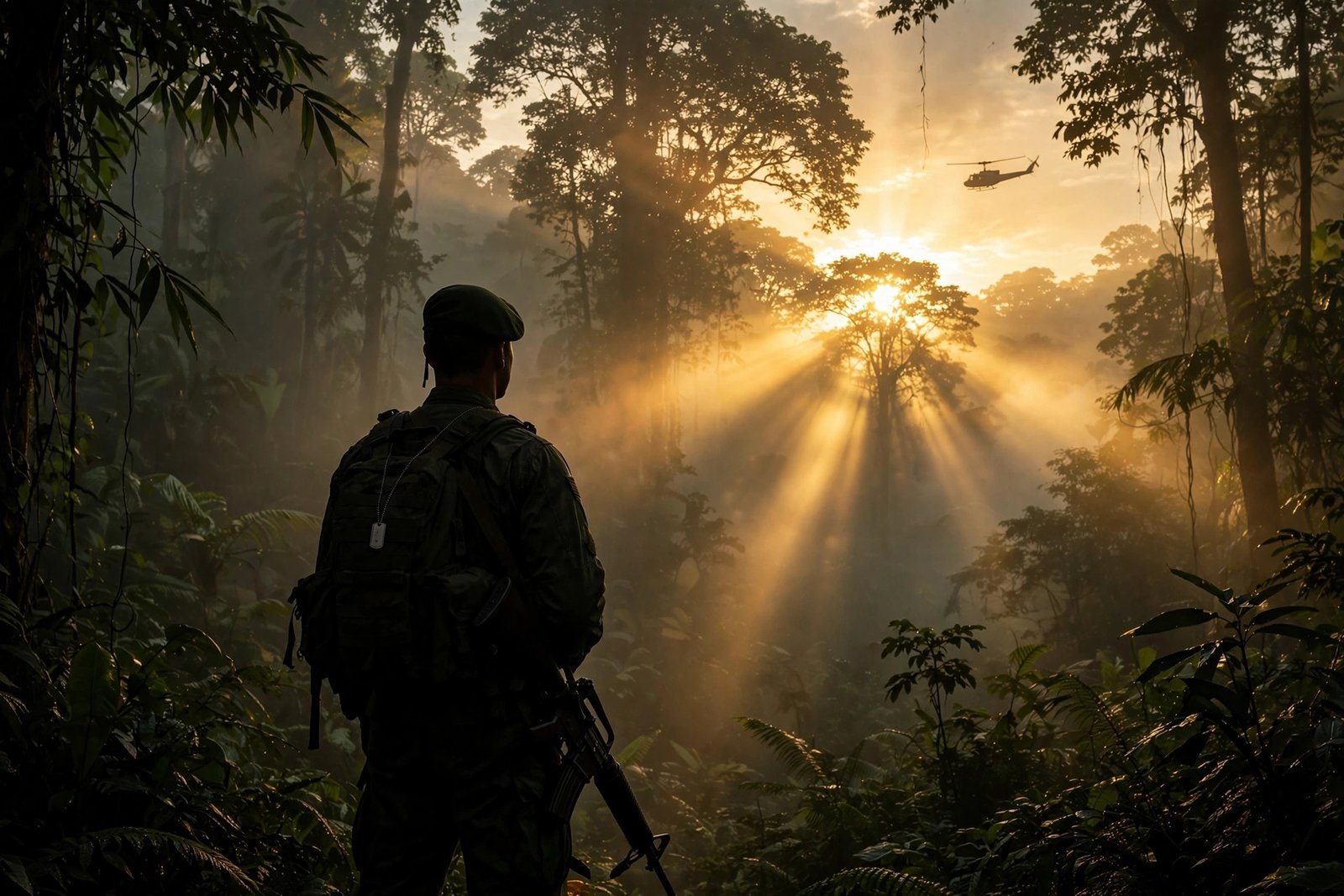
Benavidez did not wait for orders. He volunteered. Armed with only a knife and a medical bag, he boarded a rescue helicopter and flew toward the ambush. There was no plan beyond getting to the men and getting them out, and there was no time to make one. The helicopter could not land — the landing zone was too hot, the enemy fire too intense — so Benavidez jumped out of the aircraft and ran about 75 to 80 yards through withering fire to reach the trapped team. He was wounded in the right leg, the face, and the head before he even got there.
Six Hours in Hell
What followed lasted six hours. Benavidez later called it “six hours in hell,” and the phrase has stuck to his story ever since, because no better description exists. Over those six hours, he did the work of a medic, a radio operator, a forward air controller, and a rifleman, all while bleeding from wounds that kept accumulating.
He organized the survivors, pulling together the men who could still fight and giving them a plan. He tended the wounded, moving from man to man under fire, doing what he could with the contents of a medical bag. He called in air strikes, directing American aircraft onto the enemy positions that were closing in around them. And he recovered classified documents from the dead — including his friend Sergeant First Class Leroy Wright, who had saved Benavidez’s life a month earlier. The documents mattered: in the hands of the enemy, they would have compromised other teams and other missions. Benavidez would not leave them behind.
The wounds kept coming. He was shot in the stomach and in the thigh. He was hit in the back by grenade fragments. In the middle of the fight, an enemy soldier attacked him with a bayonet. Benavidez was stabbed in the arm — and then, in one of the most extraordinary moments of the entire battle, he pulled the blade from his own arm and killed the man with his own knife. It was hand-to-hand combat in the middle of a firefight, fought by a man who was already wounded in half a dozen places.
Then came the extraction attempt. A helicopter came in to take the men out, but as it tried to take off, its pilot was killed, and the helicopter crashed and burned. Benavidez got the troops out anyway, dragging and carrying men to safety, refusing to leave anyone behind. When the rescue was finally over, he had sustained roughly 37 bullet, shrapnel, and bayonet wounds, plus a broken jaw. He had saved the lives of at least eight men.
The Body Bag
When the rescue was over, Benavidez was so badly hurt that the medics who reached him believed he was dead. They placed him in a body bag. As a doctor was zipping it up, Benavidez spat — a small, reflexive act, the last flicker of a man who had refused to die all morning — and the doctor said words to the effect of “I think this one will survive.”
The Long Road to the Medal of Honor
The Medal of Honor was delayed for several reasons, and each one says something about the war Benavidez fought in. Few eyewitnesses to the battle survived, which made it hard to document what had happened. The recommendation for the award missed its deadline. And the action had taken place in Cambodia, where American troops were not supposed to be fighting — the war across the border was secret, and acknowledging it in an award citation raised problems that nobody in the chain of command wanted to deal with.
So the medal waited. Years passed. Benavidez went on with his life, carrying his wounds and his memories, while the paperwork sat and the witnesses scattered. It took an act of Congress — a one-time exemption — to clear the way. Only then, on February 24, 1981, did President Ronald Reagan present Roy Benavidez with the Medal of Honor, thirteen years after the morning in Cambodia.
A Life After the War
Benavidez did not fade away after the medal. He wrote an autobiography, Medal of Honor: A Vietnam Warrior’s Story, published in 1995, telling his story in his own words. He spoke to young people, to soldiers, to anyone who would listen, about service, sacrifice, and duty. He became a voice for veterans, and for the Montagnard tribesmen who had fought alongside American troops and been left behind when the war ended.
He died on November 29, 1998, at Brooke Army Medical Center in San Antonio, Texas. He was 63 years old. He was buried with honors, and his name lives on in the places and institutions that bear it, in the stories told about him in Army training, and in the memory of the men he saved.
Frequently Asked Questions
Who was Roy Benavidez? Roy Perez Benavidez was a United States Army Special Forces soldier — a Green Beret — born Raul Perez Benavidez on August 5, 1935, in Cuero, Texas. He served in the 82nd Airborne Division and later with Detachment B-56 of the 5th Special Forces Group in Vietnam, where he earned the Medal of Honor for his actions on May 2, 1968.
What happened on May 2, 1968? A twelve-man Special Forces reconnaissance team — three Green Berets and nine Montagnard tribesmen — was ambushed by North Vietnamese troops a few miles inside Cambodia and trapped, outnumbered nearly 100-to-one. Benavidez volunteered to join the rescue, jumped from a helicopter, and fought for six hours, saving at least eight men despite sustaining roughly 37 wounds.
What does “six hours in hell” mean? It is Benavidez’s own description of the six-hour battle on May 2, 1968. During those hours he organized the survivors, treated the wounded, called in air strikes, recovered classified documents, and fought hand-to-hand — all while being shot, hit by grenade fragments, and bayoneted.
Why did the Medal of Honor take so long? The award was delayed because few eyewitnesses survived, the recommendation missed its deadline, and the action took place in Cambodia, where US troops were not supposed to be fighting. Congress granted a one-time exemption, and President Ronald Reagan presented the medal on February 24, 1981.
Was Benavidez really placed in a body bag? Yes. When the rescue ended, medics believed he was dead and placed him in a body bag. As a doctor was zipping it up, Benavidez spat, and the doctor said words to the effect of “I think this one will survive.” He went on to recover and received the Distinguished Service Cross and four Purple Hearts before the Medal of Honor.
Sources
- Texas State Historical Association — Roy Perez Benavidez
- EBSCO Research Starters — Roy Benavidez
- All That’s Interesting — Roy Benavidez