
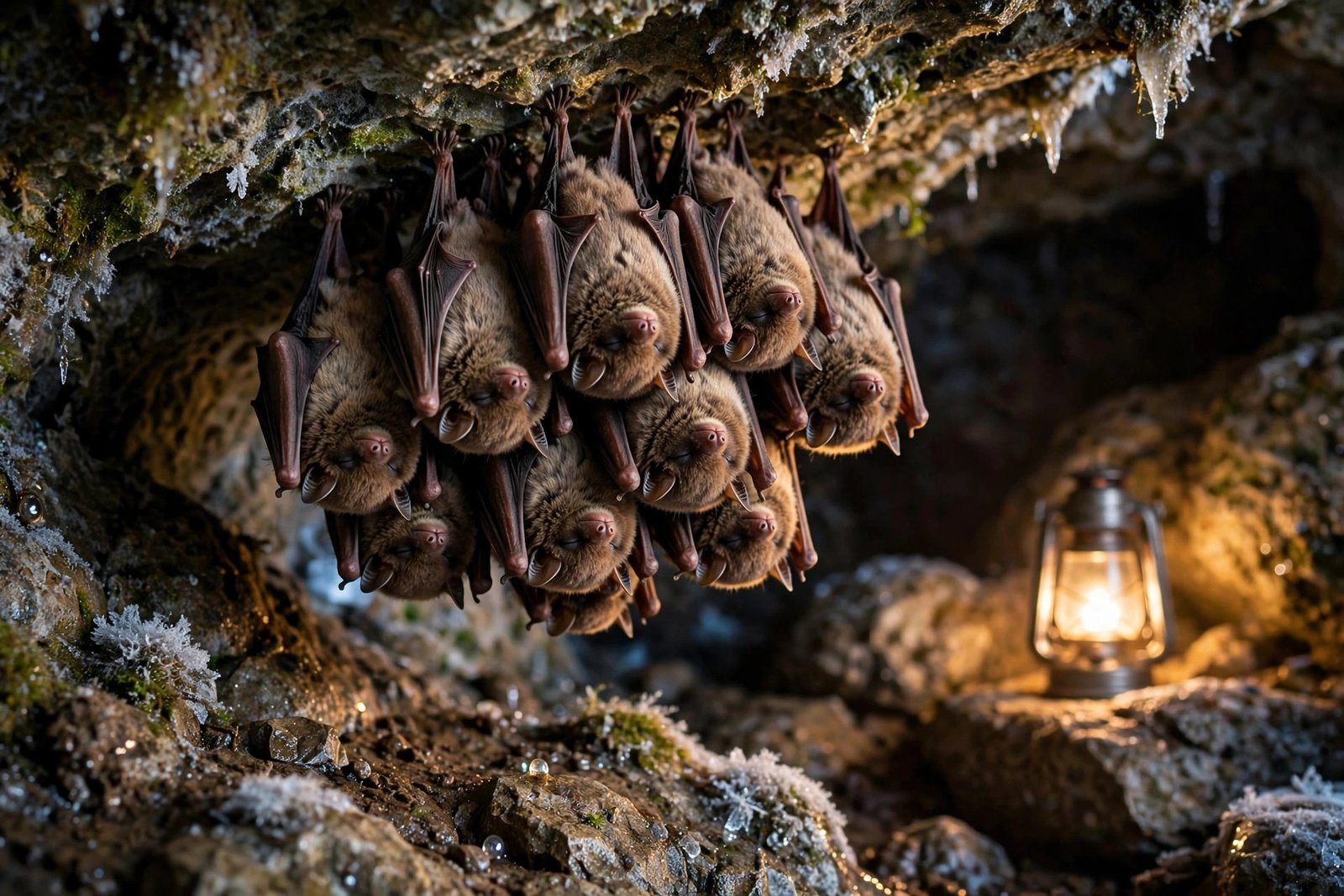
On a cold November evening, while most of us are settling in for winter, a small drama is unfolding in caves, mines, rock crevices and old barns across America. Bats, the only mammals that truly fly, are tucking themselves away for months, slowing their bodies to a near standstill and living off fat they stored during the summer and fall. It is one of nature’s most remarkable survival strategies, and also one of its most fragile.
American bats are often misunderstood. They are associated with Halloween and spooky stories, but in real life they are quiet, hardworking neighbors. Most bats in the United States eat insects, catching moths, beetles, flies and mosquitoes on the wing at night. Some pollinate desert plants. All of them play a part in keeping ecosystems balanced, and their winter survival matters far more to our farms, forests and backyards than most people realize.
This is also a difficult season for bats. A fungal disease called white-nose syndrome has killed millions of bats in North America since it was first documented in New York in the mid-2000s, and it strikes hardest during hibernation, exactly when bats are most vulnerable. Understanding how bats survive winter, what white-nose syndrome does, and how ordinary people can help, without disturbing a hibernating bat, is the best way to appreciate these animals honestly, challenges and all.
Not Every Bat Hibernates the Same Way
When people picture a bat in winter, they usually picture a bat hanging upside down in a cave, asleep for months. That image is true for many species, but not for all of them. More than half of the bat species in the United States and Canada rely on hibernation to get through winter, when insects are scarce, according to research summaries of the disease. Other bats migrate to warmer places, and some in the southern United States stay active through much of the winter, feeding whenever the weather allows.
That variety is important because it means there is no single bat winter story. A little brown bat in New England faces a very different winter from a Mexican free-tailed bat in Texas, and a bat in Arizona may behave differently again. What they share is a basic problem: insects, their main food, largely disappear in cold weather, so each species has evolved a strategy to cope with months of scarcity.
Hibernating bats choose places called hibernacula, sheltered spots with stable, cool temperatures and high humidity, such as caves, abandoned mines, rock crevices and sometimes old buildings. Those conditions matter. Too warm, and a bat burns fat too quickly. Too cold, and it risks freezing. Too dry, and it loses water. A good hibernaculum is like a natural refrigerator that stays steady all winter, and bats may return to the same sites year after year.
Some bats hibernate alone, tucked into a crack where they are hard to spot. Others cluster together in groups, sometimes in large numbers, sharing the stable conditions of a cave. Clustering can help with temperature and humidity, but it also has a downside when disease is present, because close contact makes it easier for a fungus to spread from bat to bat.
How Hibernation Actually Works
Hibernation is not simply a long sleep. It is a controlled slowing of the whole body. A hibernating bat drops its body temperature to near the temperature of its surroundings, slows its heart rate dramatically, and breathes only occasionally. In that state, it uses very little energy, stretching its stored fat across months when it cannot feed.
That fat is the key to survival. During late summer and fall, bats feed heavily, building up fat reserves that will carry them through winter. Think of it as packing a lunch that has to last until spring, with no chance to refill it. Every time a bat wakes up during hibernation, it burns a portion of that fat, so waking too often is dangerous.
Bats do wake up naturally during winter, a few times, to drink, urinate, and give their immune systems a chance to function. Those brief arousals are normal and necessary, but they are costly. A bat that wakes too often, or stays awake too long, can run out of fat before insects return in spring, and starve or die of dehydration or exposure.
This is why disturbance is so harmful. A person entering a cave, shining a light, making noise, or handling a bat can wake animals that cannot afford to wake. Even a single disturbance in midwinter can cost a bat precious energy it cannot replace. That is why wildlife agencies ask people to stay out of caves and mines where bats hibernate, and to leave any bat they find alone.
White-Nose Syndrome, Explained Honestly
White-nose syndrome is a disease caused by the fungus Pseudogymnoascus destructans, a cold-loving fungus that grows in the cool, damp places where bats hibernate. It gets its name from the white, fuzzy growth often seen on the noses, wings and ears of infected bats, although not every infected bat shows obvious white fuzz, and the fungus can be present without visible signs.
The fungus damages the delicate skin of the wings, which bats use not only for flight but also to regulate water and temperature. Infected bats wake up more frequently during hibernation, burning through their fat reserves faster than normal. Many die from starvation, dehydration or exposure before spring arrives, when insects would finally be available again. The National Park Service describes it plainly: the disease disrupts hibernation, causing dehydration and starvation.
The disease was first documented in New York in the mid-2000s and has since spread across much of North America, killing millions of bats. In some hibernating colonies, declines have been extremely severe, with research summaries reporting losses of around 90 percent or more in some northeastern populations of certain species. Other populations have shown signs of stabilization, suggesting that some individuals may be developing resistance or tolerance, but scientists are careful to say the picture is mixed and still unfolding.
It is equally important to be honest about what white-nose syndrome does not do. According to the National Park Service, it does not cause illness in humans. People cannot catch white-nose syndrome from bats. Humans can, however, carry the fungus on clothing, gear and equipment after visiting caves, which is another reason to follow decontamination guidance and to avoid entering hibernation sites. The disease is a bat conservation crisis, not a human health crisis, and that distinction matters for how we respond.
Why Bats Matter So Much
Bats are the top predators of night-flying insects in North America. Most bats in the United States are insectivorous, eating moths, beetles, flies and mosquitoes, and a single bat can eat thousands of insects in a single night, according to the U.S. Fish and Wildlife Service. That appetite has real value for people.
For farmers, bats help control crop and forest pests that would otherwise damage plants and require more pesticide use. The U.S. Fish and Wildlife Service notes that bats contribute at least 3 billion dollars per year to the American agricultural economy through pest control and pollination, and other federal estimates put the value even higher, depending on what is counted. Whatever the exact figure, the direction is clear: losing bats would mean more pests, more pesticide costs, and more pressure on crops and forests.
In the Southwest and other warm regions, some bats also pollinate plants, including agaves and columnar cacti, and help disperse seeds. Those roles connect bats to desert ecosystems, to the plants that depend on night pollinators, and to the animals that depend on those plants in turn. Even in places where bats are mainly insect eaters, their nightly hunting helps keep mosquito and garden pest populations in check, a benefit backyard gardeners notice even if they never see the bats doing it.
Bats also matter as indicators of ecosystem health. Because they depend on healthy insect populations, clean water, roosting habitat and undisturbed hibernation sites, declines in bats can signal broader problems in the landscape. Protecting bats, in other words, often means protecting the forests, wetlands and caves that many other species need too.
The Species Hit Hardest
White-nose syndrome has affected several species, including the little brown bat, the northern long-eared bat, the tri-colored bat, the big brown bat, the eastern small-footed bat, the gray bat and the Indiana bat, among others. Some of these species were already facing pressure from habitat loss and disturbance before the disease arrived, and the fungus made a difficult situation worse.
The northern long-eared bat and the Indiana bat are examples of species that now receive protection under the Endangered Species Act, with white-nose syndrome identified as a major threat. Listing does not solve the disease, but it brings attention, research funding and habitat protections that can help remaining populations hold on while scientists search for longer-term solutions.
Not every species has been hit equally. Some bats that hibernate in different kinds of sites, or that migrate rather than hibernate in caves, have been less affected. Big brown bats, for example, often hibernate in buildings and other sites where conditions differ from caves, and their experience with the disease has been different from that of cave-hibernating species. Those differences are part of why researchers study each species separately, rather than treating all bats as one group.
There are also glimmers of hope that scientists describe cautiously. Some colonies that crashed after the disease arrived have stabilized or even shown signs of recovery, and researchers are studying whether surviving bats carry traits that help them tolerate the fungus. That research takes time, and no one can promise a quick fix, but it is a reason not to give up on bat conservation, even after years of bad news.
What Scientists Are Doing
The response to white-nose syndrome is led in the United States by the U.S. Fish and Wildlife Service, working with more than 150 partner agencies, organizations and institutions under a national plan. That work includes monitoring bat populations, testing for the fungus, studying how it spreads, and trying treatments and management strategies that might help bats survive hibernation.
Monitoring is painstaking work. Biologists count bats in caves in winter, sample for the fungus, track population trends over years, and share data across states and countries. That long-term counting is how we know the scale of the losses, and also how we can spot stabilization when it happens. Without that baseline, it would be impossible to tell whether a colony was recovering or still declining.
Research into treatments is ongoing, including work on probiotics, antifungal treatments, and habitat management that might give bats a better chance during hibernation. Some approaches show promise in laboratory or small field trials, but scientists are careful not to overpromise. A treatment that works in a lab does not automatically work in a wild cave, and any intervention must be safe for bats and for the cave ecosystem as a whole.
Public awareness is part of the response too. Programs like Bat Week, held in late October, aim to dispel myths about bats and explain their value, while cave closures and advisories aim to reduce human disturbance during the most vulnerable months. The message is consistent: bats need space in winter, and the best help most people can offer is to give it to them.
How You Can Help Bats This Winter
The most important thing you can do this winter is also the simplest: do not disturb hibernating bats. Stay out of caves and mines where bats may be hibernating, do not shine lights on roosting bats, and do not handle a bat you find. If you find a bat in your home during winter, do not try to release it outdoors in freezing weather, and do not handle it with bare hands. Contact your state wildlife agency or a local wildlife rehabilitator for advice, and keep pets and children away.
If you find a dead or dying bat, wildlife agencies ask that you report it rather than disposing of it quietly, because it may provide important information about disease in your area. Your state wildlife agency or nearest Fish and Wildlife Service field office can tell you how to report it safely. Reporting helps scientists track the spread of white-nose syndrome and understand which populations are affected.
In warmer months, you can help bats by supporting the insects they eat and the places they roost. Planting native plants that support night-flying insects, reducing pesticide use in your yard, and leaving dead trees standing where it is safe to do so can all help. Installing a bat house, placed correctly and away from bright lights, can provide summer roosting habitat, although a bat house is not a substitute for protecting natural caves and forests.
Finally, you can help by sharing accurate information. Bats are not blind in the way myths suggest, they are not out to tangle in hair, and they are not all carriers of disease in the way fear suggests. They are wild animals that deserve respect and distance, especially in winter, when a quiet cave may be the difference between survival and starvation.
FAQ
Do all American bats hibernate?
No. More than half of bat species in the United States and Canada rely on hibernation, but others migrate to warmer areas, and some in southern states stay active through much of winter when weather allows. Hibernation is one strategy among several for coping with a lack of insects.
What is white-nose syndrome?
It is a disease caused by the fungus Pseudogymnoascus destructans, which grows on hibernating bats in cool, damp caves and mines. It damages wing skin, causes bats to wake too often, and leads many to die from starvation or dehydration before spring.
Can people catch white-nose syndrome?
No, according to the National Park Service, white-nose syndrome does not cause illness in humans. People can, however, carry the fungus on clothing and gear, so cavers are asked to follow decontamination guidance and avoid hibernation sites.
What should I do if I find a bat in winter?
Do not handle it with bare hands and do not release it outdoors in freezing weather. Keep pets and children away, and contact your state wildlife agency or a local wildlife rehabilitator for advice. If you find a dead or dying bat, report it to wildlife authorities.
Related reading
Explore more wildlife on Eng Post Now: Snowshoe hares and their winter white coats, Black bears and their November winter denning guide, and Wild turkeys, America’s comeback bird.
Learn more from official sources: the National Park Service on white-nose syndrome, the U.S. Fish and Wildlife Service on identifying bats, and the U.S. Geological Survey on why bats are important.