
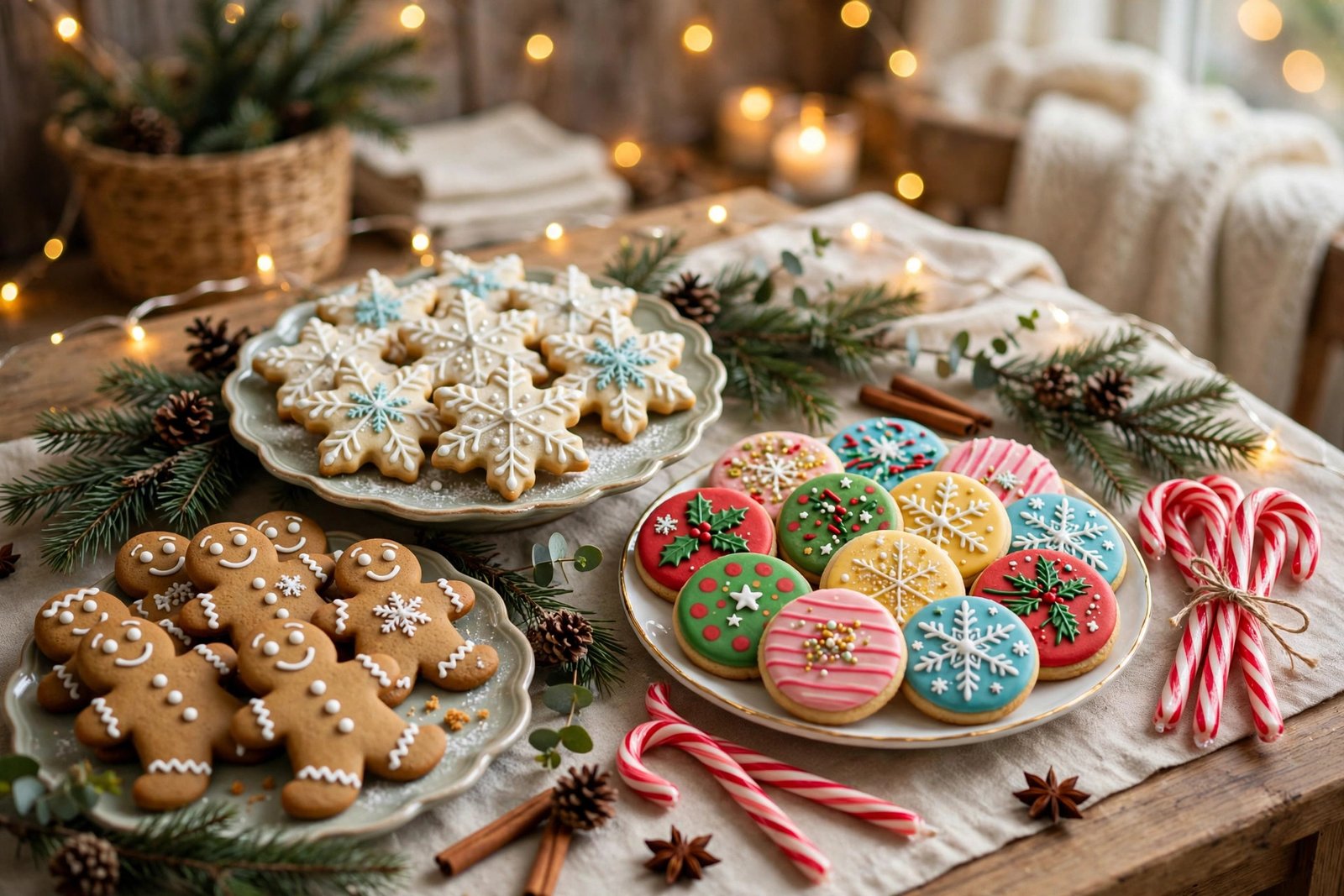
There is a particular kind of December magic that starts with the smell of butter, cinnamon, and vanilla drifting from a kitchen, and ends with a table covered in tins, boxes, and plates of cookies you did not bake yourself. That is the Christmas cookie exchange — also called a cookie swap — and for many American families, it is as much a part of the holidays as the tree, the lights, and the stockings. The idea is beautifully simple: each person bakes a big batch of one kind of cookie, everyone gathers, and everyone goes home with a little bit of everything. You do the work of one recipe and come home with a dozen different treats, a stack of new recipes, and an afternoon of laughter with people you love.
It sounds like a small thing, a party built around biscuits. But a cookie exchange is really about something larger: community, generosity, and the way food carries memory. The cookies on the table are never just cookies. They are a grandmother’s gingerbread, a neighbour’s snickerdoodles, a friend’s attempt at her mother’s sugar cookies, a new recipe someone found online and was brave enough to try. Each plate tells a story, and the exchange is a way of sharing those stories without needing a formal occasion. This guide covers where the tradition came from, how to host one of your own, which classic American Christmas cookies belong on the table, and the etiquette that keeps everyone happy — including the bakers who take their cookies very seriously indeed.
Where Did the Cookie Exchange Come From?
Pinpointing the exact first cookie exchange is impossible, because the tradition grew gradually out of older customs rather than being invented on a single day. Its roots run deep in Europe, particularly in Germany, Scandinavia, Hungary, Austria, and Eastern Europe, where families baked large batches of Linzers, spritz, and pfeffernusse specially for the holidays. Cookies were a way to celebrate abundance, share blessings, and sweeten the darkest time of year. Those traditions and recipes arrived in the United States with immigration, carried in suitcases and recipe boxes by families who kept baking the way their mothers and grandmothers had.
In America, the Christmas cookie itself has a long history. Dutch settlers brought cookie recipes to the early colonies in the 17th century, and German and Dutch settlers introduced cookie cutters and decorative moulds. The first American cookbook, published in 1796, included a recipe its author called Christmas Cookery. Sugar cookies, perfected in their American form by Moravian settlers in Nazareth, Pennsylvania, in the mid-1700s, became a holiday staple, and shaped, decorated Christmas cookies became popular in the United States at the end of the 19th century, when cookie cutters became widely available. Leaving cookies and milk out for Santa Claus, a tradition that dates to the 1930s in America, gave Christmas cookies a new job: they were no longer just a treat, but part of the magic of Christmas Eve itself.
The exchange as a social event took its modern shape after the Second World War. In the 1950s and 1960s, as neighbourhoods flourished and holiday entertaining became a centrepiece of community life, women’s clubs, church groups, parent-teacher organisations, and neighbours began gathering to swap cookies. Magazines such as Ladies’ Home Journal and Good Housekeeping printed holiday cookie exchange guides, turning a neighbourhood habit into a national tradition. Instead of each family baking a dozen different varieties, every guest would prepare one or two favourite recipes in large batches, and everyone would go home with an impressive assortment. It was practical, it was festive, and it was a way of showing pride in domestic arts without needing a formal dinner party. Seventy years on, the format has barely changed — which may be the best proof that it works.
How a Cookie Exchange Works
If you have never been to one, the format is easy to grasp. Each participant bakes a large batch of a single type of cookie — that is the key rule, and the one that makes the whole thing efficient. You bake one recipe well, in quantity, instead of baking a little of everything. Commonly, every baker brings between two and four dozen cookies and walks away with the same amount, chosen from everyone else’s plates. Guests usually bring their cookies unwrapped, on a platter, or in a reusable container, and take their share home in boxes, tins, or bags provided by the host or brought from home.
The gathering itself is usually relaxed: an afternoon or early evening in December, with Christmas music, hot cocoa or coffee, and plenty of time to taste, talk, and compare notes. The host sets out a table where each baker displays their cookies, often with a small card naming the cookie and listing its ingredients — essential for guests with allergies. Everyone samples, everyone chats, and then the swapping begins. Some exchanges are free-for-all, with guests moving around the table and filling their boxes. Others are more structured, with guests taking turns or drawing numbers. Either way, the spirit is the same: generosity first, competition never.
How to Host Your Own Cookie Exchange
Hosting a cookie exchange is a low-lift tradition to start, and a little planning goes a long way. Choose your date first: any time after December 1 works, but aim for a date well before Christmas travel begins, and late morning or afternoon is ideal, since you will not be expected to serve a full meal and the natural light is good for photos. A group of six to twelve guests is usually just right for a home gathering — enough variety without leaving everyone with more cookies than they can possibly enjoy. For a community space, a larger group works, but at home, a baker’s dozen is a sensible cap.
Send invitations three weeks in advance, by mail, email, or a group message, and be specific about what you need guests to know. Tell them how many cookies to bring — typically two to three dozen, plus a few extra for tasting at the party. Tell them whether cookies should be homemade, which is the usual expectation, and whether there are any dietary restrictions to be aware of, such as nut allergies or gluten-free needs. Ask each guest to tell you in advance which cookie they plan to bring, so you do not end up with six plates of chocolate chip cookies and nothing else. A simple shared list, even just a group text, prevents duplicates and builds excitement as the recipes roll in.
On the day, set up a display table with plenty of space, small plates or platters, and labels for each cookie. Provide takeaway boxes or bags, tissue paper, ribbons, and gift tags, so guests can package their treats beautifully. Put on Christmas music, make a pot of coffee and a batch of hot cocoa, and put out a few savoury snacks — cheese, crackers, fruit — so guests are not running on sugar alone. Then step back and enjoy it. The best hosts, experienced swappers say, are the ones who bake one good batch themselves, keep the rules clear and light, and let the conversation do the rest. If a cookie crumbles or a batch does not look perfect, nobody minds. A cookie exchange is not a competition; it is a celebration of trying.
Classic American Christmas Cookies to Bake
Every cookie exchange needs a strong line-up, and American Christmas baking offers plenty to choose from. Start with the decorated sugar cookie, the undisputed star of the season. Traced back to the Moravian settlers of Nazareth, Pennsylvania, in the 1700s, the sugar cookie is a blank canvas: rolled, cut into trees, stars, candy canes, and reindeer, and decorated with icing and sprinkles. It is the cookie children love to help make, and the one that looks most like Christmas on a plate.
Gingerbread men are the second classic, with a history stretching back to the 16th century, when gingerbread was already a holiday treat in Europe. The warm spices — ginger, cinnamon, nutmeg, and cloves — are the flavours of Christmas itself, and a tray of gingerbread people, each with its own icing face, never fails to make people smile. Snickerdoodles, cinnamon-sugar cookies brought to New England by English, Scottish, and Dutch immigrants, are another favourite, soft in the middle with a crackled, sugary top. Their name may come from a German word, and they are now so beloved that they are the state cookie of Connecticut.
Round out the table with a few more American favourites. Chocolate crinkles, which originated in Saint Paul, Minnesota, are rich, fudgy cookies rolled in powdered sugar that cracks as they bake. Peanut butter blossoms, topped with a chocolate kiss, are a mid-century American invention that still appears at almost every swap. Thumbprint cookies, filled with jam, and Mexican wedding cookies — buttery, nutty, and rolled in powdered sugar — add variety in flavour and texture. And do not forget the spritz cookie, pressed through a cookie press into stars and wreaths, a Scandinavian tradition that became an American holiday staple. A good exchange has a mix: something spiced, something chocolatey, something buttery, and something decorated. If your table has all four, you have done your job.
Cookie Exchange Etiquette and Tips
Every good tradition has a few unwritten rules, and the cookie exchange is no exception. The first is the homemade rule: unless the host says otherwise, cookies should be baked at home, not bought from a shop. The point is the effort and the personal touch, and a box of store-bought cookies, however tasty, misses that spirit. Some hosts make exceptions for handmade cookies from a local bakery, but a packet from the supermarket is generally not in the spirit of the swap. If you truly cannot bake, say so in advance — most hosts would rather have you there with a small contribution than not there at all.
The second rule is about quantity and fairness. Bring what you promised, and take only your fair share. If every baker brought three dozen, take three dozen in total, not five. Do not pick through a plate to take only the prettiest cookies, and do not take more than your share of a popular cookie while others are still choosing. If you have dietary needs, tell the host in advance and label your own cookies clearly — and be gracious about the cookies you cannot eat. A good exchange makes room for gluten-free, vegan, and nut-free bakers, and a clearly labelled plate is a kindness to everyone at the table.
Finally, be a good guest. Thank the host, compliment the bakers — sincerely, and specifically, because people remember a kind word about their baking — and share your recipe if someone asks for it. Arrive on time, bring your cookies ready to display, and stay for the conversation, not just the swap. The cookies are the reason for the gathering, but the gathering is the real point. The hosts who have run exchanges for decades say the same thing: the recipes change, the guest list changes, but the feeling in the room stays the same, year after year.
Why the Tradition Endures
It is worth asking why a simple cookie swap has lasted for seventy years in America, through changes in how we eat, shop, and socialise. Part of the answer is practical: it is efficient, affordable, and it solves the problem of wanting variety without baking for days. One batch, well made, becomes a whole season’s worth of treats. Part of the answer is emotional. In a busy December, a cookie exchange is a reason to slow down, to bake something with your hands, and to sit with people you care about without an agenda beyond tasting and talking.
Whether you grew up with a cookie exchange or have never been to one, this December is a good time to start. Bake one recipe you love, invite a few people you like, and set out a table. You do not need a perfect kitchen, a large house, or professional baking skills. You need butter, sugar, flour, and a willingness to share. The cookies will be eaten, the boxes will be carried home, and the stories — about the recipe that worked, the one that did not, and the grandmother who started it all — will be told again next year. That is the sweetest part of the tradition, and it has nothing to do with sugar at all.
Frequently Asked Questions
What is a Christmas cookie exchange?
A Christmas cookie exchange, or cookie swap, is a gathering where each participant bakes a large batch of one type of cookie and trades with the others, so everyone goes home with a varied assortment of homemade cookies to enjoy throughout the holiday season.
How many cookies should I bring to a cookie exchange?
Most hosts ask each baker to bring two to four dozen cookies — commonly two to three dozen, plus a few extra for tasting at the party. The usual rule is that you take home roughly the same number you brought, chosen from the other bakers’ plates.
When did cookie exchanges become popular in America?
The tradition’s roots are European, but the modern American cookie exchange became popular in the 1950s and 1960s, when women’s clubs, church groups, and neighbourhoods began organising swaps, and magazines such as Ladies’ Home Journal and Good Housekeeping printed exchange guides.
What are the best cookies for a cookie exchange?
Good choices are cookies that travel well and hold their shape: decorated sugar cookies, gingerbread men, snickerdoodles, chocolate crinkles, peanut butter blossoms, thumbprints, and spritz cookies. Aim for a mix of spiced, chocolatey, buttery, and decorated cookies.
Can I host a cookie exchange if I am not a confident baker?
Yes. Choose one simple, reliable recipe — sugar cookies or snickerdoodles are forgiving choices — and follow it carefully. Guests value effort and flavour over perfection, and a clearly labelled, honestly homemade batch is always welcome at the table.
Related reading
For more seasonal American traditions, read The American Potluck: History, Rules and Classic Dishes, Pumpkin Everything: Fall Baking and the American Autumn, and Real vs Artificial Christmas Trees in America. For verified background, see King Arthur Baking on how to host a cookie swap, the history at History and Culture of Christmas Cookies, and Christmas cookie on Wikipedia.