
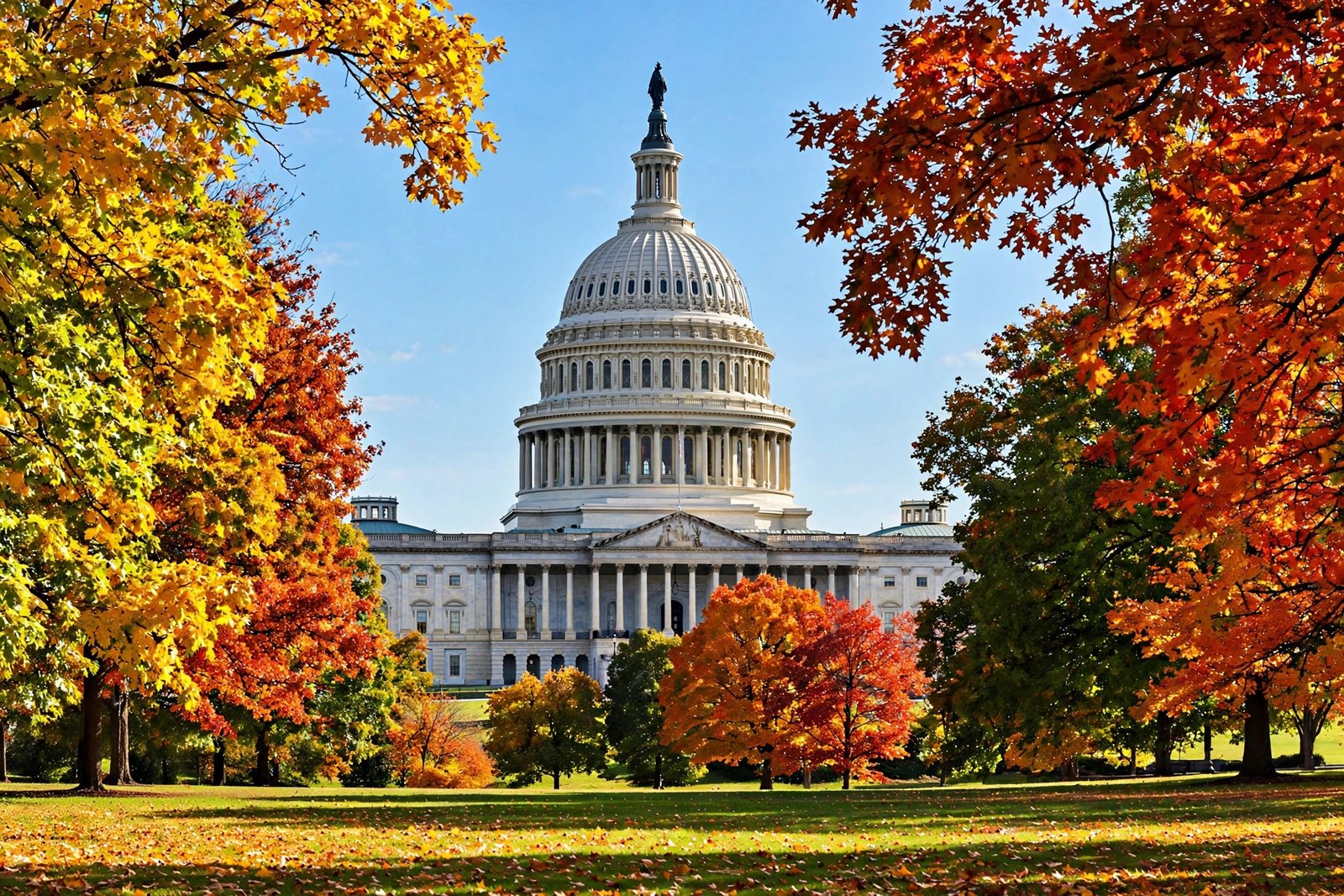
Washington, D.C., is the capital of the United States, home to the White House, the Capitol, and the Supreme Court — and it is not a state. Its roughly 700,000 residents are American citizens who pay federal taxes and serve in the military, yet they have no voting representative in Congress and no senators at all. Their license plates carry the protest slogan “Taxation Without Representation.” It is one of the most distinctive facts about American government, and it is entirely intentional: the Founders designed it that way, and changing it has been debated ever since.
The reason lies in a single clause of the Constitution. Article I, Section 8, Clause 17 — known as the District Clause or Enclave Clause — gives Congress the power to “exercise exclusive Legislation in all Cases whatsoever” over a district, not exceeding ten miles square, that would become the seat of government. The Founders wanted the national capital to sit on neutral ground, under Congress’s direct control, so that no single state could hold leverage over the federal government by hosting it. That decision, made in the 1780s, still shapes the lives of D.C. residents today.
Why the Founders wanted a federal district
The idea did not come from nowhere. In the 1780s, under the Articles of Confederation, Congress met in various cities, and in 1783, unpaid soldiers marched on Congress in Philadelphia demanding back pay. Pennsylvania’s government declined to protect the legislators, who fled the city. The episode, sometimes called the Pennsylvania Mutiny, convinced many Founders that the national government should not depend on a state for its own safety. James Madison argued the point in Federalist No. 43: a federal district, under Congress’s exclusive authority, would keep the seat of government independent of any state’s politics or militia.
The Constitution therefore authorized a district, but it left the details — including where it would be — to Congress. The Residence Act of 1790 authorized President George Washington to select a site along the Potomac River, with Philadelphia serving as the temporary capital for ten years while the new city was built. Washington chose a diamond-shaped tract straddling the Potomac, drawing roughly 69 square miles from Maryland and 31 from Virginia, forming the original 100-square-mile district. The federal government moved into the new capital in 1800.
What the Founders did not do was provide for the district’s future residents. The Constitution allocates House seats, Senate seats, and Electoral College votes among the states — and the district is not a state. At the time, few people lived in the swampy new capital, and the omission may have seemed theoretical. Within a generation, it was a real grievance, and it has never fully gone away.
The district shrinks, and the residents stay voiceless
The district’s shape changed early. In 1846, Congress returned the Virginia portion of the district — the area that is now Arlington County and part of Alexandria — to Virginia, a process known as retrocession. The district that remained was the Maryland portion, about 68 square miles, and it has kept roughly that shape ever since. The retrocession is sometimes raised in modern statehood debates, but historians note that Maryland’s original cession stipulated that the land was ceded “forever” in full and absolute right, which complicates any argument that Maryland’s consent would be required for statehood.
For most of the nineteenth and twentieth centuries, D.C. residents lived under direct congressional rule with little local self-government. Congress occasionally granted and withdrew local charters, and for a long stretch the district was run by commissioners appointed by the president. The Home Rule Act of 1973 changed that, giving D.C. an elected mayor and council with authority over local laws and budgets — but Congress retained the final say, including the power to review and overturn local legislation, and control over the district’s budget and courts remained partly federal.
One partial remedy arrived in 1961, when the 23rd Amendment gave the district presidential electors — the same number it would receive if it were a state, capped at the number given to the least populous state. In practice, that means three electoral votes, which D.C. has cast in every presidential election since 1964. But the amendment did not touch Congress. D.C. elects a delegate to the House of Representatives who can introduce legislation, vote in committees, and speak on the floor — but cannot vote on final passage of bills. In the Senate, D.C. has no representation at all.
What statehood would actually require
Statehood proposals, most recently in the form of the Washington, D.C. Admission Act (H.R. 51), would admit most of the current district as a new state — in recent bills, named Washington, Douglass Commonwealth, in honor of abolitionist Frederick Douglass — while leaving a small federal enclave around the Capitol, White House, and Supreme Court as the remaining district. The House passed H.R. 51 in 2020 and again in 2021, but the bill stalled in the Senate, and it has not become law.
Supporters argue that admission by ordinary legislation is consistent with how the other 37 non-original states were admitted, from Vermont in 1791 to Hawaii in 1959, under Congress’s power in Article IV to admit new states. They also point out that D.C.’s population is larger than that of Wyoming or Vermont, and that its residents meet every obligation of citizenship without the full rights that accompany it. The Brennan Center for Justice and other supporters frame the issue simply: nearly 700,000 Americans lack full voting representation in the government that taxes them and can send them to war.
Opponents raise constitutional objections. Some argue that the 23rd Amendment, which guarantees the district electoral votes, would create a strange situation if most of the district became a state — the tiny remaining federal enclave, with few or no residents, would still technically hold three electoral votes. Others argue that the Founders intended the capital to remain outside any state permanently, and that statehood would require a constitutional amendment rather than a statute. Legal scholars disagree sharply on both points, and nearly forty constitutional scholars have argued that H.R. 51’s approach — shrinking the federal district to a small enclave — is constitutionally permissible. The debate is, in short, unresolved, which is one reason the issue persists.
The politics behind the stalemate
It would be dishonest to pretend the debate is purely legal. Statehood would add two senators and a House member, and because D.C. votes overwhelmingly Democratic in presidential elections, the partisan consequences are obvious to everyone involved. Supporters say that is not a reason to deny representation; opponents say the Founders’ design should not be overturned for partisan gain. The result is a stalemate that has lasted for decades, punctuated by House votes that go nowhere in the Senate.
Meanwhile, D.C. residents have pursued other paths. In 2016, district voters approved a statehood referendum and a proposed state constitution in an advisory vote, and local leaders have promoted what they call the “Tennessee Plan,” modeled on the way Tennessee and other territories organized state governments and sent representatives to Congress before formal admission. The district’s license-plate slogan, its “Taxation Without Representation” flag, and its annual statehood advocacy days keep the issue visible, even when Congress does not act.
There is also a human side that statistics miss. D.C. is a real city, not just a government campus: it has neighborhoods, schools, sports teams, restaurants, and a local culture that its residents are fiercely proud of. The statehood debate, for them, is not an abstraction about constitutional clauses. It is about whether their votes count the same as their cousins’ votes in Maryland or Virginia.
Could the answer be something else?
Over the years, alternatives to full statehood have been floated. One is retrocession of the residential parts of D.C. to Maryland, which would give residents voting representation as Marylanders — an idea that has little support in either D.C. or Maryland. Another is granting D.C. a voting House member without full statehood, which Congress has also failed to pass. A third is simply accepting the status quo and treating the delegate’s limited powers as enough. None of these has gained traction, and statehood remains the proposal with the most organized support.
For readers outside the district, the simplest takeaway is this: Washington, D.C., is not a state because the Constitution created it as something else — a federal district under Congress’s exclusive control — and because no political coalition has yet assembled the votes to change that status. The arrangement made sense to the Founders as a safeguard for a young republic. Whether it still makes sense for a city of 700,000 people is a question Americans will keep arguing about, probably for a long time.
Frequently asked questions
Why isn’t Washington, D.C., a state? The Constitution’s District Clause created the capital as a federal district under Congress’s control, not as a state, and the Founders wanted the seat of government independent of any single state.
Do D.C. residents vote for president? Yes. The 23rd Amendment, ratified in 1961, gives the district three electoral votes in presidential elections.
Does D.C. have members of Congress? D.C. elects a nonvoting delegate to the House, who can vote in committees but not on final passage, and it has no senators.
What would statehood change? Under recent bills, most of the district would become the state of Washington, Douglass Commonwealth, with two senators and a voting House member, while a small federal enclave around the Capitol and White House would remain a district.
Has the House ever passed D.C. statehood? Yes. The House passed the Washington, D.C. Admission Act in 2020 and again in 2021, but the bills did not advance in the Senate.
Related reading
- The US Capitol in Numbers: Hidden Stories Behind America’s Most Famous Building
- The Pledge of Allegiance: From 1892 to Today
- 12 US State Facts That Sound Fake but Are 100% True
Sources: Brennan Center for Justice, “DC Statehood, Explained” (brennancenter.org); Library of Congress, Residence Act primary documents.