
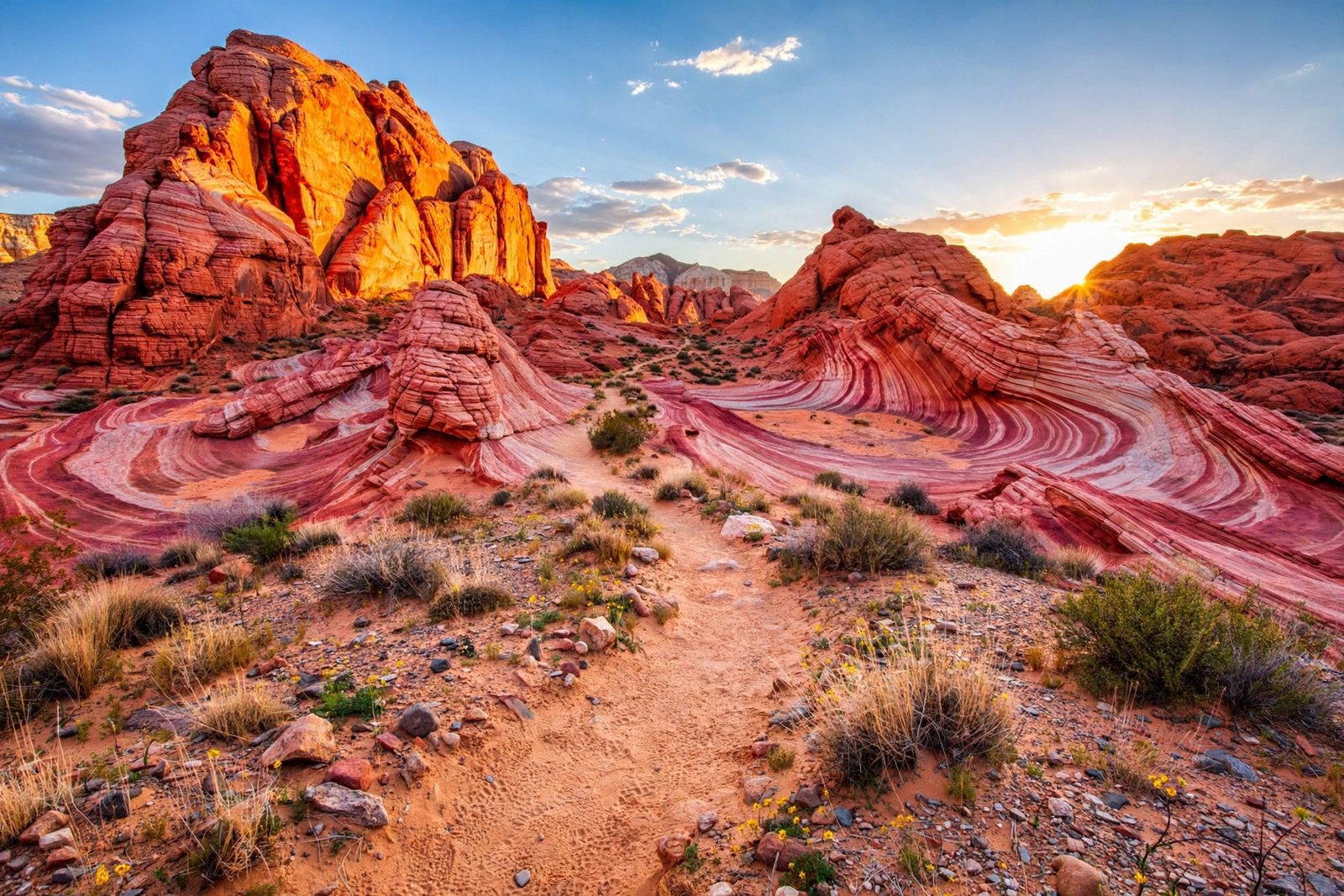
About an hour northeast of Las Vegas, the desert changes color. The pale browns and grays of the Mojave give way to cliffs and domes of blazing red sandstone, sculpted by wind and water into fins, arches, and waves that look, at sunset, exactly like their name suggests: on fire. This is Valley of Fire State Park, Nevada’s oldest and largest state park, and it remains one of the great underrated escapes in the American West — a place where you can walk among 150-million-year-old dunes, read petroglyphs left by people who lived here thousands of years ago, and be back in Las Vegas in time for dinner.
Valley of Fire covers roughly 40,000 to 46,000 acres, depending on the survey you consult, in the Moapa Valley near the small community of Overton. It is a Nevada state park, not a national park, which means your national park pass will not get you through the gate — a detail that surprises more than a few first-time visitors. What it offers in return is a landscape that rivals the famous red-rock parks of Utah, with a fraction of their crowds, plus a human history that reaches back far further than the neon city an hour away.
How the valley got its name — and its park
The park’s name dates to the 1920s, when an official of the American Automobile Association, traveling the Arrowhead Trail between Salt Lake City and Los Angeles at sunset, reportedly remarked that the red sandstone looked as if it were on fire. The name stuck. A few years later, in 1931, a federal land transfer of 8,760 acres gave Nevada the core of what would become the park, and Civilian Conservation Corps crews arrived in 1933 to build roads, campgrounds, trails, and the sandstone cabins that still stand today.
Valley of Fire was formally opened on Easter Sunday in 1934, and the Nevada Legislature gave it legal designation as the state’s first state park in 1935, alongside Beaver Dam, Cathedral Gorge, and Kershaw-Ryan — the founding class of the Nevada state park system. The park was later designated a National Natural Landmark in 1968, and Nevada Historical Marker No. 150 commemorates it as the state’s first park. A new visitor center opened on November 10, 2025, giving the park a modern front door for its next century.
The red rock itself, known as Aztec Sandstone, formed from shifting sand dunes some 150 million years ago, when dinosaurs walked a very different Nevada. Later uplift and erosion carved those dunes into the shapes visitors see today. Walking the park is, in a very literal sense, walking through deep time — and the park’s geology is part of why photographers love it. The light at sunrise and sunset turns the stone from rust to crimson to gold within minutes.
Petroglyphs: messages thousands of years old
Long before it was a park, the valley was home to people. The Ancestral Puebloans and, before them, the Basketmaker people lived in and around the Moapa Valley, and they left petroglyphs — images pecked and carved into the desert varnish of the rocks — that span thousands of years. Atlatl Rock, one of the park’s most visited sites, features a staircase leading to a panel of carvings high on a boulder, including figures that archaeologists interpret as atlatls, the spear-throwing tools that predated the bow and arrow.
Mouse’s Tank, named for a Southern Paiute renegade who reportedly hid in the area in the 1890s, combines a short, sandy canyon hike with petroglyph panels along the way. The reward at the end is a natural water basin that collects rainwater — a reminder that in the desert, water is everything, and the people who lived here knew exactly where to find it. Petroglyph Canyon, near the park’s east side, holds more panels, and the park asks visitors to look but never touch: the oils on human hands damage the fragile desert varnish, and a carving that survived thousands of years can be ruined in seconds.
There is an etiquette to visiting these places that matters. Stay on marked trails, do not climb on panels, and never add your own carving. The petroglyphs are not decorations; they are a record, left by people whose descendants still live in the region. Treat them the way you would treat a library’s oldest books — with curiosity, and with care.
The trails and sights worth your time
Valley of Fire rewards both drivers and hikers. The scenic drive through the park, along Valley of Fire Road, passes the most famous formations with pullouts for photos. Elephant Rock, near the east entrance, really does resemble an elephant, and it is an easy first stop for families. The Beehives, odd sandstone domes striped by mineral deposits, sit near the west entrance and glow beautifully in morning light.
For hikers, the Fire Wave is the park’s signature short trail: a striped swirl of red and white sandstone that looks like a frozen wave, reached by a relatively easy walk of under two miles round trip. The White Domes Loop winds past a slot canyon and the remains of a movie set, and the Rainbow Vista trail offers a sweeping overlook of the valley’s colors. More ambitious hikers can tackle the Prospect Trail or the Seven Wonders Loop, but desert hiking demands respect: carry more water than you think you need, wear a hat and sunscreen, and start early, especially outside the cooler months.
November is one of the best times to visit. Summer in Valley of Fire is brutally hot — the park has in recent years closed several trails during the hottest months after heat-related rescues — but autumn brings mild days that make hiking a pleasure rather than an endurance test. Winter days are cool and clear, and spring brings wildflowers to the washes. If you can choose, choose the cooler half of the year.
Planning your visit in late 2026
A few practical notes will save you trouble. First, check conditions before you go. Travel Nevada reports that the park’s west entrance is closed Monday through Thursday through the end of 2026 for construction, and the entire park is scheduled to close temporarily from December 1 to 14, 2026, for maintenance and improvement projects, reopening December 15. Those dates matter if you are planning a trip around this article — and they are a good reminder to check the Nevada State Parks website before any desert trip, since conditions change.
Second, bring cash or a card for the entrance fee, and note that the park is open from sunrise to sunset. Camping is available at two campgrounds, Atlatl Rock and Arch Rock, with sites that can be reserved; desert camping under the red cliffs, far from city lights, is one of the park’s quiet pleasures, and the night sky here is far darker than the one over Las Vegas. There are no restaurants inside the park, so pack food and, above all, water.
Third, pair the park with the region. The nearby town of Overton and the Moapa Valley offer a glimpse of rural Nevada, and the Lost City Museum in Overton tells the story of the Ancestral Puebloan communities of the valley. Lake Mead National Recreation Area lies to the south. Many visitors combine Valley of Fire with a Las Vegas trip, but the park deserves a full day of its own — it is not a roadside photo stop, even though it photographs like one.
Why Valley of Fire still feels undiscovered
It is a paradox of American travel that a park an hour from one of the world’s most visited cities can still feel like a secret. Part of the reason is the state-park label: travelers planning a national-parks tour of the Southwest often skip Nevada entirely, heading straight for Utah and Arizona. Part of it is that Valley of Fire does not advertise itself loudly. It has no lodge, no shuttle system, no reservation lottery for its trails.
That quiet is the park’s gift. On a weekday in November, you can walk the Fire Wave trail with only a handful of other people, sit beside a petroglyph panel in silence, and watch the light move across stone that is older than the idea of America by an almost unimaginable margin. In a travel culture obsessed with bucket lists and photo backdrops, Valley of Fire asks for something simpler: slow down, look closely, and remember that the desert was never empty.
Frequently asked questions
Where is Valley of Fire State Park? About an hour northeast of Las Vegas, near Overton, Nevada, in the Moapa Valley. Its official address is 29450 Valley of Fire Road, Overton, NV 89040.
Why is it called Valley of Fire? The name reportedly comes from a 1920s traveler who said the red sandstone looked on fire at sunset.
When was it established? It opened in 1934 and was legally designated Nevada’s first state park in 1935. It was named a National Natural Landmark in 1968.
Is it a national park? No. It is a Nevada state park, so national park passes are not honored at the gate.
When is the best time to visit? Autumn, winter, and spring offer the mildest weather for hiking. Summer can be dangerously hot, and some trails close in extreme heat.
Related reading
- Providence Canyon: Georgia’s Little Grand Canyon
- Hocking Hills, Ohio: The Hidden Gem of Waterfalls and Gorges
- Devil’s Kettle: Minnesota’s Disappearing River
Sources: Nevada State Parks history (parks.nv.gov); Travel Nevada Valley of Fire guide (travelnevada.com).