
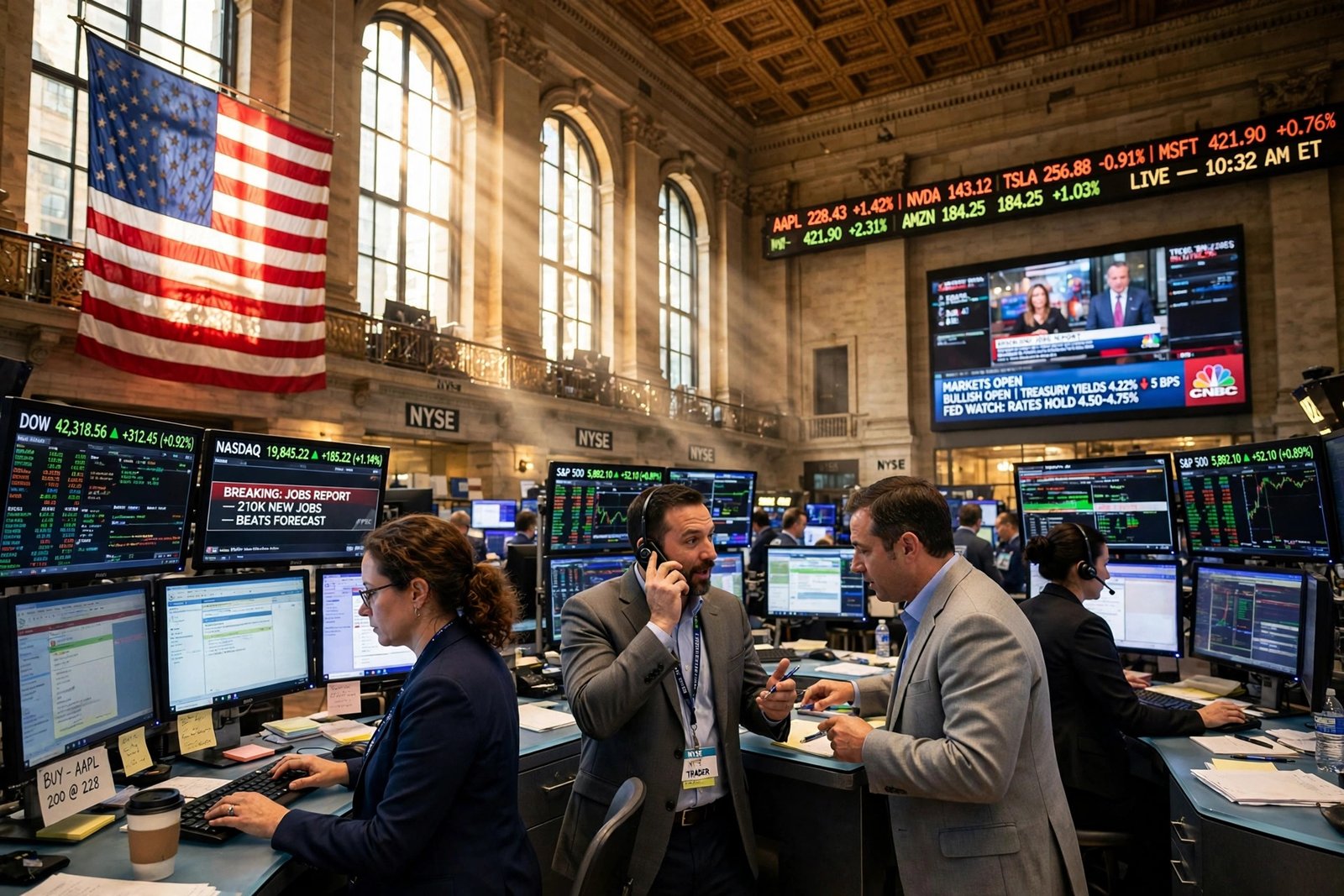
Monday, November 9, 2026, was one of those days on Wall Street that people will be talking about for a while. After a brutal sell-off the previous week that had investors questioning everything about the artificial intelligence boom, American stocks came roaring back in a single session. The Dow Jones Industrial Average jumped 1,104 points, the S&P 500 posted its biggest one-day gain in seven months, and the Nasdaq surged nearly 3 percent. In total, Wall Street added roughly $1.5 trillion in market value in a single day.
It was a classic Wall Street reversal: fear on Thursday, bargain-hunting on Monday. But the rally had a twist that made it stranger than a simple bounce. The market’s most-watched stock, Nvidia, went the other way entirely, falling more than 4 percent while almost everything else rose. The reason had nothing to do with earnings and everything to do with a boardroom investigation that had dominated the weekend’s headlines.
Here is what actually happened on November 9, why stocks surged, what drove the Nvidia sell-off, and what it all means for American investors heading into a week that includes a closely watched inflation report.
The Numbers: A Clean Sweep for the Major Indexes
By the closing bell on Monday, the scoreboard looked like this. The Dow Jones Industrial Average rose 1,104.02 points, or 2.15 percent, to close at 52,389.75. The S&P 500 gained 173.08 points, or 2.34 percent, to 7,549.94, its largest single-day percentage gain since April 8. The Nasdaq Composite jumped 673.71 points, or 2.74 percent, to 25,253.14, its biggest single-day rise since July 30.
Those are big numbers by any standard, and they were even more striking because they came on the heels of one of the worst weeks of the year. The previous Thursday had delivered a historic tech rout, with chip stocks and AI-related names leading the market sharply lower as investors suddenly questioned how much companies were spending on data centers and whether the returns would ever justify the cost. The Philadelphia Semiconductor Index, which had dropped 13 percent the week before, surged back above the 10,000 level on Monday with a gain of nearly 7 percent.
Oil prices helped set the tone. Crude fell sharply on reports of progress in US-Iran nuclear talks, easing a geopolitical worry that had been hanging over the market. Falling oil tends to lift stocks in two ways: it eases inflation pressure, and it leaves consumers and businesses with more money to spend. Traders took both signals and ran with them.
AMD Led the Comeback as Chip Stocks Roared Back
If one stock summed up the day, it was Advanced Micro Devices. AMD shares jumped about 13 percent, the best performance among major chipmakers, after investment bank Oppenheimer upgraded the stock to Outperform from Market Perform and set a $600 price target. The upgrade cited AMD’s growing AI business and its partnership with Google Cloud, whose newly launched TPU systems use AMD’s latest processors.
AMD was not alone. Broadcom rose about 8.8 percent. Intel gained around 5.5 percent. Storage makers Western Digital and Seagate each climbed roughly 10 percent. The iShares Semiconductor ETF, which tracks the chip sector, rose 7 percent in a single day. The message from buyers was clear: last week’s sell-off had gone too far, and the AI trade was not dead, just dented.
The so-called Magnificent Seven mega-cap technology stocks joined in as well. Tesla climbed about 5.5 percent to close near $378. Amazon rose around 3 percent, Microsoft gained about 2.75 percent, and Apple added more than 2 percent. Only one of the giants refused to participate, and it was the one everyone was watching.
The Nvidia Exception: A Board Investigation Steals the Spotlight
While the rest of the market celebrated, Nvidia fell 4.3 percent to close at $178.67, wiping out more than $190 billion in market value in a single session. The reason was a story that had broken over the weekend: Nvidia’s board of directors has launched an independent investigation into chief executive Jensen Huang after he admitted to an extramarital affair with a businesswoman whom US intelligence officials suspect of sharing information with China.
According to reports, Huang has acknowledged the affair. What has not been established is whether any sensitive technology or national security information was compromised. Nvidia has said it has no reason to believe that happened, and the investigation is ongoing. President Donald Trump told reporters that the FBI is looking into the matter, adding another layer of attention to a story that was already the most-read business news of the weekend.
The market reaction was a study in contrasts. Nvidia shares fell nearly 9 percent at one point during intraday trading before recovering some ground. The stock’s slide stood out precisely because the rest of the chip sector was surging. Investors were, in effect, drawing a line between a company-specific controversy and the broader AI investment story, buying the sector while selling its leader.
Why the Rally Happened: Three Forces Came Together
Market rallies like this one rarely have a single cause. Three forces lined up on the same day. First, there was simple bargain-hunting. After Thursday’s rout, valuations across the tech sector had dropped enough to tempt buyers who had been waiting on the sidelines. The selling had been driven by doubts about AI spending, and by Monday those doubts looked overdone to many traders.
Second, the geopolitical backdrop improved. Reports of substantive progress in US-Iran nuclear talks eased fears of a wider conflict in the Middle East, and oil prices fell in response. Lower oil prices are a tailwind for stocks because they reduce costs for businesses and leave households with more disposable income.
Third, the calendar cooperated. The rally arrived just before the release of the October consumer price index on Tuesday, November 10. Inflation data is the single most important input for the Federal Reserve’s December decision on interest rates, and traders were positioning ahead of it. A cooler-than-expected inflation reading would strengthen the case for a rate cut; a hot one would do the opposite. Monday’s rally was, in part, a bet that the number would come in friendly.
What the Rally Does Not Mean
It is tempting to read a 1,100-point day as a verdict on the market’s direction. History says to be careful. The same indexes that surged on Monday are still well below where they stood before last week’s sell-off, and the questions that triggered the rout have not gone away. Companies are still spending enormous sums on data centers and AI infrastructure, and investors are still waiting for proof that the spending will pay off.
The federal budget picture is another reminder that the backdrop is complicated. The Treasury Department reported on November 9 that the federal budget deficit for the 2026 fiscal year, which ended September 30, totaled $2.0 trillion, up $217 billion, or 12 percent, from the previous year. Big deficits can push interest rates higher, and higher rates are the natural enemy of stock valuations.
None of that takes away from what Monday was: a powerful, broad-based rebound that showed how quickly sentiment can turn when prices fall far enough. The S&P 500 is now just about 4 percent away from its record high, a fact that would have seemed unlikely during Thursday’s sell-off. Whether the rally holds will depend on the inflation data, the Fed’s next move, and whether the AI spending story can win back the skeptics.
What to Watch Next
The immediate focus is the October CPI report, due Tuesday morning. It is the first major inflation reading since the midterm elections reshaped Congress, and it will shape expectations for the Federal Reserve’s December meeting. A second item to watch is Nvidia itself: the board’s investigation is still in its early stages, and any new disclosure could move not just Nvidia’s stock but the entire chip sector.
Longer term, the question is whether the AI investment cycle that powered the market for two years can survive its first real test of confidence. Monday’s rebound suggests that plenty of investors still believe in it. Thursday’s rout suggested that plenty do not. The market’s next few weeks will be an argument between those two camps, settled one trading day at a time.
Frequently Asked Questions
How much did the Dow rise on November 9, 2026?
The Dow Jones Industrial Average rose 1,104.02 points, or 2.15 percent, to close at 52,389.75 on Monday, November 9, 2026. The S&P 500 gained 2.34 percent and the Nasdaq Composite rose 2.74 percent.
Why did stocks rally on November 9?
Three forces came together: bargain-hunting after the previous week’s sharp tech sell-off, falling oil prices on reports of progress in US-Iran nuclear talks, and positioning ahead of the October inflation report. Chip stocks led the rebound, with AMD up about 13 percent.
Why did Nvidia fall while the rest of the market rose?
Nvidia fell 4.3 percent after its board launched an independent investigation into CEO Jensen Huang, who admitted to an affair with a businesswoman suspected by US intelligence of sharing information with China. The company says it has no reason to believe sensitive technology was compromised.
What is the next big event for the stock market?
The October consumer price index is due Tuesday, November 10. The inflation reading will shape expectations for the Federal Reserve’s December decision on interest rates, which is the market’s biggest near-term question.
How much value did Wall Street gain on November 9?
Wall Street added roughly $1.5 trillion in market value in a single session, according to market reports, as the three major indexes each rose more than 2 percent.
Sources
- TipRanks — U.S. Market Rallies into the Close as Oil Prices Fall and Tech Stocks Rebound
- The Economic Times — US stock market stages massive rally, adds $1.5 trillion
- TradingView / dpa-AFX — U.S. Stocks Rally Amid Extended Tech Sector Recovery
- Longbridge / Zhitong Finance — Overnight US Stocks: Three Major Indices Rise Over 2%