
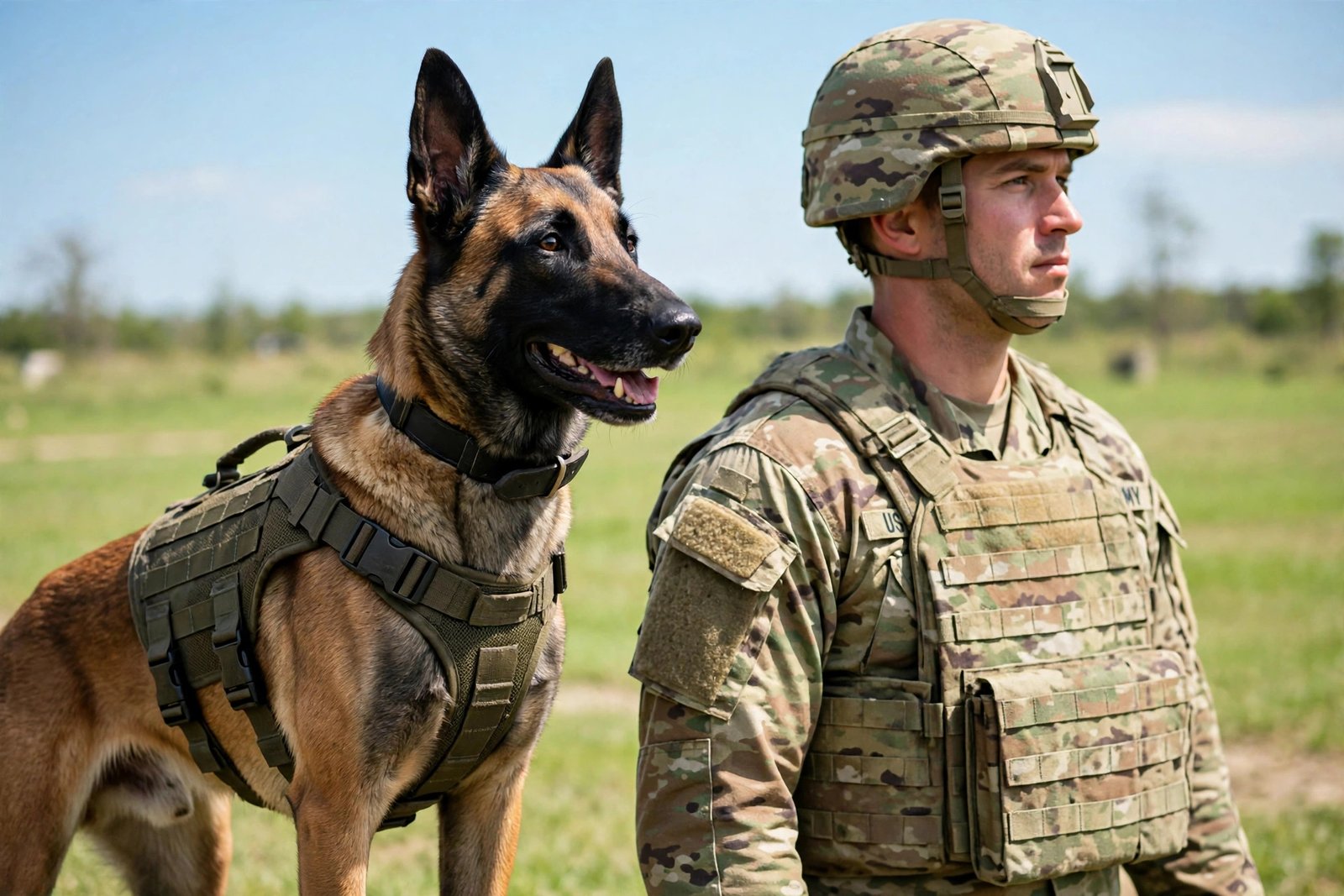
They do not wear a uniform, they do not draw a paycheck, and they cannot tell you in words what they have seen. Yet ask any American service member who has patrolled a base at night, cleared a road in a war zone, or searched a building for hidden explosives, and they will tell you the same thing: the dog beside them was not a pet. The dog was a partner, a protector, and in many cases the reason everyone came home alive. Military working dogs have served alongside American troops for more than eighty years, from the beaches of World War II to the mountains of Afghanistan and the bases that guard the United States today. They sniff out bombs that machines miss, track enemies through darkness, guard gates through long nights, and comfort wounded troops with a loyalty that needs no translation.
Today, more than 1,600 military working dogs serve on active duty in the United States military, according to a 2025 White House message marking National K-9 Veterans Day, which also noted that more than 30,000 working dogs have served since the K-9 Corps began. They work on Army posts, Air Force bases, Navy ships and stations, and Marine Corps installations around the world, and they deploy overseas with the units they protect. This is the story of who these dogs are, how they are chosen and trained, what they do on the job, and what happens when their service ends and they finally get to go home.
A Tradition That Began in World War II
Dogs have walked beside soldiers for as long as there have been armies, but the modern American military working dog program began in earnest during World War II. In 1942, the United States Army launched its War Dog program, known as the K-9 Corps, to put dogs to work in a war that stretched across oceans and continents. Dogs served as sentries, scouts, messengers, and mine detectors, and they quickly proved that a trained dog could do jobs no soldier and no machine could do as well. The program grew from that wartime beginning into a permanent part of the American military, and dogs have served in every major conflict since, including Korea, Vietnam, Iraq, and Afghanistan.
The Department of Defense now observes K-9 Veterans Day every year on March 13 to honor the service and sacrifice of military working dogs. The date is a reminder that these animals are not equipment to be used and discarded. They are service members in every sense that matters: they train, they deploy, they face danger, and they are remembered when they fall. Handlers speak of their dogs the way soldiers speak of their closest comrades, because that is what they are. A handler and a dog train together, live together, deploy together, and learn to read each other so well that a glance, a gesture, or a change in the dog’s posture can mean the difference between safety and disaster. That bond is the heart of the whole program, and it is why the story of military working dogs is really a story about trust.
The Breeds That Make the Cut
Not every dog can be a military working dog. The job demands intelligence, courage, drive, stamina, and a temperament that can switch in an instant from playful to focused and back again. Dozens of breeds have served in the armed forces over the years, but today’s military working dogs are predominantly Belgian Malinois, German Shepherds, Dutch Shepherds, and Labrador Retrievers, according to the United States Postal Service, which honored the dogs with a special stamp dedication at Lackland Air Force Base in 2019. Each breed brings something different to the job, and trainers match the dog to the mission with the same care a coach matches a player to a position.
The Belgian Malinois has become the star of the modern program. Smaller and lighter than a German Shepherd, the Malinois is fast, agile, intensely driven, and famously eager to work. It is the breed of Cairo, the dog who took part in the raid that killed Osama bin Laden, and of Conan, the dog who chased Abu Bakr al-Baghdadi into a tunnel in Syria. German Shepherds remain a mainstay for patrol and protection work, prized for their strength, intelligence, and steady nerve. Labrador Retrievers, meanwhile, are prized above all for their extraordinary sense of smell, and they are often trained as specialized search dogs for explosive detection.
Training at Lackland Air Force Base
Every military working dog in the United States, no matter which branch it will serve in, passes through the same place: Joint Base San Antonio-Lackland in Texas. Lackland is home to the 341st Training Squadron, which serves as the Department of Defense’s executive agent for military working dog training. Dogs and handlers from the Army, Air Force, Navy, and Marine Corps all train there, along with teams from other federal agencies. The arrangement gives every branch the same high standard. The base also runs the Defense Department’s Military Working Dog Breeding Program, which breeds Belgian Malinois puppies for service. Only Belgian Malinois are accepted into that breeding program, and 50 to 90 puppies are born into it each year. Roughly one in eight active-duty military dogs is a graduate of the breeding program, while the rest come from breeders in the United States and around the world.
Training is long, demanding, and careful. A young dog entering the program goes through about 120 days of training that teaches it to patrol, to detect drugs and explosives, and to work as a team with a handler. The dogs learn obedience, controlled aggression, searching, tracking, and how to respond to commands in noisy, stressful, and unfamiliar places. Handlers train alongside their dogs, learning to read the animal’s signals, to trust its nose, and to give commands clearly and calmly under pressure. The handler course certifies hundreds of handlers every year, and the dog training section produces hundreds of trained dogs annually for service around the world. Not every dog makes it, and those that wash out are usually given a different path, often adoption into a civilian home. You can read about how puppies become troops in the breeding program in this Defense Visual Information Distribution Service report.
On the Job: Patrol, Detection, and Tracking
Once a dog and handler graduate from Lackland, they are assigned to a unit and the real work begins. The most common roles are patrol and detection, and many dogs are trained in both, becoming what the military calls dual-certified dogs. A patrol dog guards gates, walks the perimeter of a base, searches buildings, and can apprehend a person on command, holding them until the handler arrives. The dog’s presence alone is a powerful deterrent, and its speed and courage can stop a threat before it reaches the troops it protects. A detection dog, meanwhile, uses its nose to find what human eyes and machines cannot: explosives hidden in a vehicle, drugs concealed in a shipment, or a bomb buried beside a road. The dog is trained to signal when it finds a scent, sitting or lying down quietly beside the source, so that the handler and the bomb disposal team can take over safely.
Beyond patrol and detection, military working dogs take on specialized missions that show just how versatile they are. Combat tracking dogs follow a scent trail across rough ground to find a missing person or a fleeing enemy, sometimes over long distances and in terrible conditions. Search and rescue dogs look for survivors after a disaster, using their noses to find people buried under rubble or lost in the wilderness. Wherever American troops need an extra set of senses and an extra measure of courage, there is usually a dog nearby, doing a job that no technology has yet replaced.
Cairo and Conan: Dogs Who Made History
Two dogs have become famous enough that most Americans know their names, and their stories show what military working dogs can do at the very highest level of service. The first is Cairo, a Belgian Malinois who served with Navy SEAL Will Chesney. Cairo and Chesney met in 2008, and Cairo quickly proved himself in Afghanistan, where he was shot in the chest and a front leg during a firefight in 2009 and survived after emergency surgery. On May 2, 2011, Cairo was part of the team of Navy SEALs who flew into Abbottabad, Pakistan, in Operation Neptune Spear, the mission that killed Osama bin Laden. Cairo wore a Kevlar vest and night-vision goggles on the raid, and when the mission was over, his was the only name from the team released to the public. He was the only member of the team not awarded a Silver Star, because at the time service dogs were not eligible for military decorations. Cairo died in 2015 after an inoperable cancer was found, and Chesney later told his story in the book No Ordinary Dog. The full account is told in this Military.com story about Cairo and Chesney.
The second is Conan, a female Belgian Malinois who took part in the 2019 raid in Syria that killed Abu Bakr al-Baghdadi, the leader of ISIS. Conan chased al-Baghdadi into a tunnel beneath a compound, where he detonated a suicide vest, injuring her in the blast. She recovered and was praised by military leaders and the White House for her bravery. General Frank McKenzie, who then led United States Central Command, told reporters that Conan had worked with special operations forces for four years and taken part in about 50 missions, calling working dogs like her critical members of the force. Cairo and Conan were combat assault dogs, trained to an even higher standard for special operations, and their stories show what thousands of military working dogs do every day.
Retirement, Adoption, and Life After Service
A military working dog does not serve forever. Most dogs retire after years of hard work, when age, injury, or health makes the job too much for them. For a long time, retirement was not guaranteed to be a happy ending. Dogs who retired overseas were sometimes left in the country where they had served, because once they were no longer on active duty they could not travel home on military aircraft, and their handlers often had to pay out of pocket to bring them back, if they could bring them back at all. That changed with the 2016 National Defense Authorization Act, signed into law by President Obama in November 2015. For the first time, the law required that retiring military working dogs be returned to United States soil, and it gave their former handlers and their families the first right to adopt them.
The change built on an earlier law, known as Robby’s Law, signed in 2000 and named for a Vietnam-era war dog, which first opened the door to adoption of retired military working dogs. The 2016 law strengthened that promise and made it a guarantee: the dog comes home, and the handler who knows and loves the dog best gets the first chance to give it a home. The adoption process is managed through the Military Working Dog School at Lackland Air Force Base, where prospective adopters must show they can provide proper care for a retired working dog. The law also gives preference to the former handler when a dog is retired, and it sets clear rules for cases where a handler is killed or wounded in action, so that the dog goes to the handler or the handler’s family. You can read about the law and what it changed in this Military.com report on the 2016 law.
Life after service is usually a gentler one, and it is well earned. A retired military working dog may still be alert, driven, and protective, and it may need patience, exercise, and a home that understands a working dog’s needs. Many handlers describe adoption as the best day of their lives, because it means the partnership does not have to end when the uniform comes off. For the dog, it means the bond that carried it through danger now carries it into a peaceful retirement. For the handler, it means the friend who watched over them in the hardest places on earth gets to grow old beside them at home. That is the ending these dogs have earned, and thanks to the law and to the people who fought for it, it is now the ending they are promised.
FAQ
How many military working dogs serve in the US military?
More than 1,600 military working dogs serve on active duty, according to a 2025 White House message marking National K-9 Veterans Day. The same message noted that more than 30,000 working dogs have served since the K-9 Corps began in 1942. The dogs serve in every branch of the armed forces, at home and overseas.
Where are US military working dogs trained?
All military working dogs are trained at Joint Base San Antonio-Lackland in Texas, home to the 341st Training Squadron, which serves as the Department of Defense’s executive agent for military working dog training. Dogs and handlers from every branch train there, and the base also runs the breeding program for Belgian Malinois puppies.
What breeds are used as military working dogs?
The main breeds are Belgian Malinois, German Shepherds, Dutch Shepherds, and Labrador Retrievers. Belgian Malinois are prized for speed and drive, German Shepherds for strength and steady nerve, and Labradors for their extraordinary sense of smell in explosive detection work.
Who were Cairo and Conan?
Cairo was a Belgian Malinois who served with Navy SEAL Will Chesney and took part in the May 2, 2011 raid that killed Osama bin Laden. Conan was a female Belgian Malinois who chased Abu Bakr al-Baghdadi into a tunnel during the 2019 raid in Syria that killed the ISIS leader. Both dogs were celebrated as heroes of their missions.
Can handlers adopt their military working dogs after retirement?
Yes. The 2016 National Defense Authorization Act requires retiring military working dogs to be returned to United States soil and gives their former handlers and families the first right to adopt them. The adoption process is managed through the Military Working Dog School at Lackland Air Force Base.