
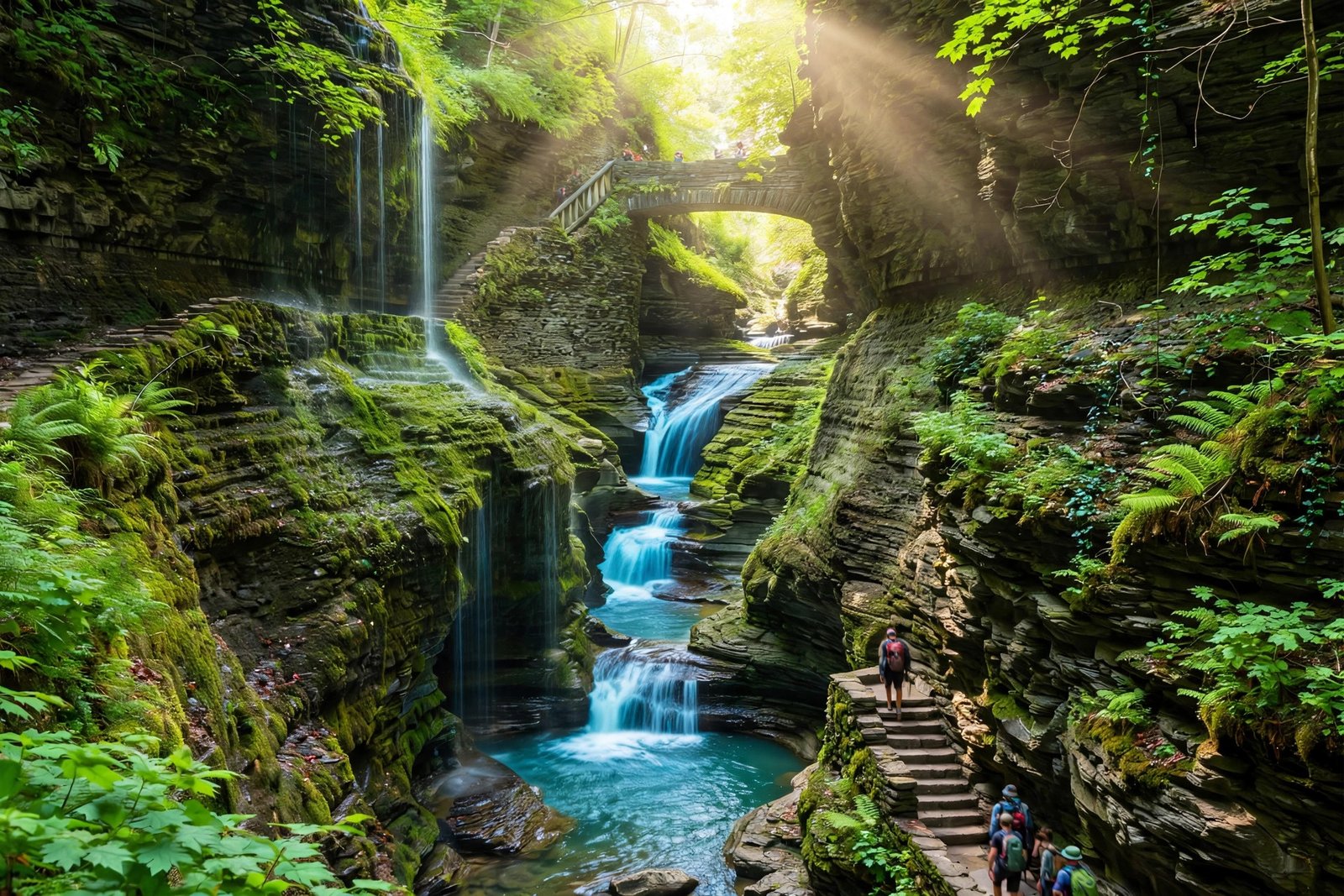
There are places in America that look like they were designed by a movie studio, and then there is Watkins Glen State Park, a place that needs no special effects at all. Tucked into the village of Watkins Glen at the southern end of Seneca Lake in New York’s Finger Lakes region, this park hides a narrow, 400-foot-deep gorge cut through solid rock by Glen Creek. Inside that gorge, along a trail of roughly two miles, water falls nineteen times. It is the kind of place that makes first-time visitors stop mid-step, look up at cliffs rising on both sides, and wonder how something this dramatic stayed a secret for so long.
The magic of Watkins Glen is not just the number of waterfalls. It is the way you experience them. On the Gorge Trail, you do not stand behind a railing and gaze at a distant cascade. You walk over stone bridges, duck through hand-carved tunnels, climb more than 800 stone steps, pass directly behind one waterfall, and walk underneath another as its spray catches the sunlight. This guide covers where the park sits, how the gorge was formed, what the trail is really like, the falls you should not miss, the history of the place, the best seasons to visit, and the practical details on fees, parking, and camping.
Where Watkins Glen Sits in the Finger Lakes
Watkins Glen State Park is located in the village of Watkins Glen, south of Seneca Lake in Schuyler County, in New York’s Finger Lakes region. The park’s main entrance sits right at the edge of the village, at 1009 N. Franklin Street, which means you can park your car, walk a few minutes, and suddenly be standing inside a gorge that feels a world away from the shops and restaurants behind you. That easy access is part of the park’s charm. You do not need a long drive down a dirt road or a strenuous approach hike to reach the scenery.
Seneca Lake is the setting that makes the whole region work. The Finger Lakes are a chain of long, narrow lakes carved by glaciers, and Seneca stretches north from Watkins Glen toward Geneva. The village sits at the lake’s southern tip, where the water meets the hills, and the park climbs from the village up through the gorge into open woodland. The lower part of the park is the dramatic part, all cliffs and waterfalls, while the upper part opens out into woods, picnic areas, a campground, and an Olympic-size swimming pool. Together, the park covers 778 acres, yet most visitors spend their time in the narrow ribbon of the gorge itself.
How Glen Creek Carved a Gorge of Stone
To understand Watkins Glen, it helps to understand what the glaciers did here. During the Ice Age, massive glaciers deepened the Seneca Valley, carving out the basin that would become Seneca Lake. Glen Creek, a smaller tributary stream, was left hanging high above the newly deepened valley, and that height difference gave the creek a steep gradient. Over thousands of years, the stream cut downward through layers of shale, limestone, and sandstone. Wherever it met a layer of hard rock, the water dropped suddenly, and a waterfall formed. Repeat that process nineteen times over two miles, and you get Watkins Glen.
The result is a gorge about 400 feet deep, with cliffs that rise as high as 200 feet on either side of the creek. The rock walls are layered like a cake, and you can see the different bands of stone as you walk, especially where the trail passes close to the cliff face. In places the gorge narrows so much that the trail squeezes between the rock and the water, and in other places it opens into pools where the creek slows and deepens. The stone bridges, walls, and stairways that carry the trail through the gorge were built to blend with this landscape, using local stone so that the human work feels like a natural extension of the rock itself.
Walking the Gorge Trail Past 19 Waterfalls
The Gorge Trail is the heart of the park, and it is the reason most people come. The trail runs for roughly two miles through the gorge, staying close to Glen Creek the whole way. According to the park’s history and trail description, it passes over, under, and alongside the park’s 19 waterfalls by way of stone bridges and more than 800 stone steps. The trail climbs about 400 feet from the main entrance to the upper entrance, and while the climb is spread out, your legs will know about it by the end. Take your time, wear sturdy shoes with good grip, and plan on two to three hours if you like to stop for photos, which you will.
The trail begins at the main entrance in the village, where you pass through a tunnel entrance and cross the Sentry Bridge, one of the most photographed spots in the park. From there, the path winds upward past a series of named falls, each with its own character. Some are tall and narrow, dropping in a single white ribbon. Others are wide and stair-stepped, spilling over ledges in a series of small drops. Stone stairways connect the levels, and at several points the trail passes through short tunnels carved into the rock, so you emerge from darkness into a sudden view of falling water.
Two of the most famous moments on the trail come about halfway along. At Cavern Cascade, the trail passes directly behind the falling water, through a curved grotto in the rock, so you can stand in the cool shadow and watch the creek pour down in front of you. A little farther along, Rainbow Falls earns its name on sunny days, when the spray catches the light and throws a rainbow across the path. The trail passes underneath this fall, so you walk through the mist itself, which is refreshing on a hot summer day. There are also two rim trails, the Southern Rim Trail and the Indian Trail, which run along the wooded rim above the cliffs and offer overlooks down into the canyon.
The Waterfalls You Should Not Miss
With nineteen waterfalls in two miles, it would be easy to assume they all blur together. They do not. Each one has its own shape, sound, and setting, and part of the fun of the Gorge Trail is learning to tell them apart. The falls near the main entrance are the most dramatic for first-time visitors, because they arrive so quickly after you enter the gorge. The Sentry Bridge frames one of the early cascades perfectly, and it is the view that appears on most postcards and travel guides for a reason. It is the park’s front door, and it makes a strong first impression.
Cavern Cascade and Rainbow Falls deserve special attention, because they show what makes Watkins Glen different from other waterfall hikes. At most parks, you look at a waterfall. Here, you walk through it. Standing behind Cavern Cascade, with the water falling in a curtain in front of you and the rock curving overhead, feels less like sightseeing and more like stepping inside the landscape. Walking under Rainbow Falls, with mist on your face and a rainbow forming in the spray, is the kind of moment that stays with you long after the hike is over. For photographers, the best light is in the morning, when the sun angles into the canyon, and in the late afternoon, when the light turns warm and golden. Bring a small towel or a waterproof cover for your camera, because the spray near these two falls is real, and it will find you.
From Private Resort to Public Treasure
Watkins Glen has been a tourist attraction for much longer than it has been a state park. The gorge was known locally for years, but it was not until 1863 that a Vermont newspaper editor named Morvalden Ells opened the site to the public. Ells had crude wooden bridges, stairs, and railings built to make the gorge navigable for visitors, and he announced that Watkins Glen would open as a summer resort on July 4, 1863, in the middle of the Civil War. Thousands of visitors came that first season, and the glen quickly became a popular destination.
In the decades that followed, Watkins Glen grew into a nationally known resort. John Lytle became the glen’s proprietor in 1873 and built a hotel called the Glen Mountain House on the property. By the early 1900s, the New York Central Railroad was selling Sunday excursion tickets to the glen from New York City. Public ownership came in 1906, when New York State purchased the property and established it as the Watkins Glen State Reservation. It was first managed by the American Scenic and Historic Preservation Society before being turned over to full state control in 1911, and since 1924 it has been managed by the Finger Lakes Region of the New York State Office of Parks, Recreation and Historic Preservation. The stonework that defines the trail today came in the 1930s, when the Civilian Conservation Corps rebuilt many of the stone walls, bridges, and pathways in the gorge.
The Best Time to Visit Watkins Glen
The park itself is open year-round, from dawn to dusk, but the Gorge Trail is a seasonal experience, and timing your visit makes a real difference. The Gorge Trail typically opens in mid to late May, once the ice has cleared and the trail has been checked for winter damage, and it typically closes in mid to late October, when cold weather and ice make the stone steps unsafe. The exact dates vary from year to year, so it is always worth checking the official New York State Parks page before you travel. The rim trails, by contrast, remain open through the winter, offering a quieter, snow-dusted view of the gorge.
Late spring is one of the best times to visit. The trail has just reopened, the creek is running high with snowmelt and spring rain, and the waterfalls are at their fullest and loudest. Early summer brings warmer weather and the opening of the park’s Olympic-size swimming pool, which runs from around Memorial Day weekend through Labor Day weekend. Summer is the busiest season, especially on weekends, so arrive early in the morning or later in the afternoon. Autumn may be the most beautiful season of all, when the hardwood forest turns shades of red, orange, and gold. The catch is that the Gorge Trail can close early if cold weather arrives sooner than expected, so an October visit calls for a quick check of the trail status first.
Planning Your Visit: Fees, Parking, and Camping
A visit to Watkins Glen is refreshingly affordable. The park charges a vehicle use fee of $10 per vehicle, collected from mid-May to mid-October, and that fee includes access to the swimming pool during pool season. Outside the fee-collection season, entry is generally free. Fees can change, so confirm the current rates on the official New York State Parks page before your trip, but the park remains one of the best values in the Finger Lakes for a full day of scenery.
Parking is the part of the visit that catches many first-timers by surprise. The main entrance lot, near the village and the start of the Gorge Trail, fills up quickly on summer weekends and holidays, sometimes by mid-morning. There are additional parking areas at the upper entrance, and a shuttle service runs between entrances during the busy season, for a small per-person fare each way.
The village of Watkins Glen makes a fine base for the trip, with restaurants, shops, and lodging within walking distance of the main entrance, and the Seneca Lake wine trail is close by for an afternoon tasting after the hike. Pairing the gorge with a winery stop or a lakeside dinner turns a good day trip into a full Finger Lakes weekend, and it is one of the easiest two-day itineraries in upstate New York.
For visitors who want to stay longer, the park’s campground sits in the upper, wooded part of the park and offers tent and trailer campsites along with rustic cabins, bookable by reservation through ReserveAmerica. Wear sturdy, closed-toe shoes with good traction, because the stone steps can be wet and slippery. Pets are not allowed on the Gorge Trail, and visitors should stay on the marked trail and leave the gorge as they found it.
FAQ
How many waterfalls are in Watkins Glen State Park?
There are 19 waterfalls along the Gorge Trail, spread across roughly two miles of gorge, including Cavern Cascade, where the path goes behind the falling water, and Rainbow Falls, where the path passes underneath the spray.
When is the Gorge Trail open?
The Gorge Trail typically opens in mid to late May and closes in mid to late October, depending on weather. The park is open year-round from dawn to dusk, and the rim trails remain open in winter. Check the official New York State Parks page before visiting.
How long does it take to hike the Gorge Trail?
Most visitors take two to three hours to walk the Gorge Trail one way, including photo stops on the more than 800 stone steps. The trail is about two miles long and climbs roughly 400 feet.
How much does it cost to visit Watkins Glen State Park?
The park charges a vehicle use fee of $10 per vehicle, collected from mid-May to mid-October, which includes pool access during pool season. Camping is priced separately by the night. Confirm current fees on the official park page before your visit.
Is Watkins Glen State Park good for families?
Yes, families love Watkins Glen, but the Gorge Trail is a real hike with hundreds of stone steps, wet surfaces, and narrow passages, so it suits children who can walk steadily and hold a hand on stairs. The pool, picnic areas, and campground give younger children plenty to enjoy.