
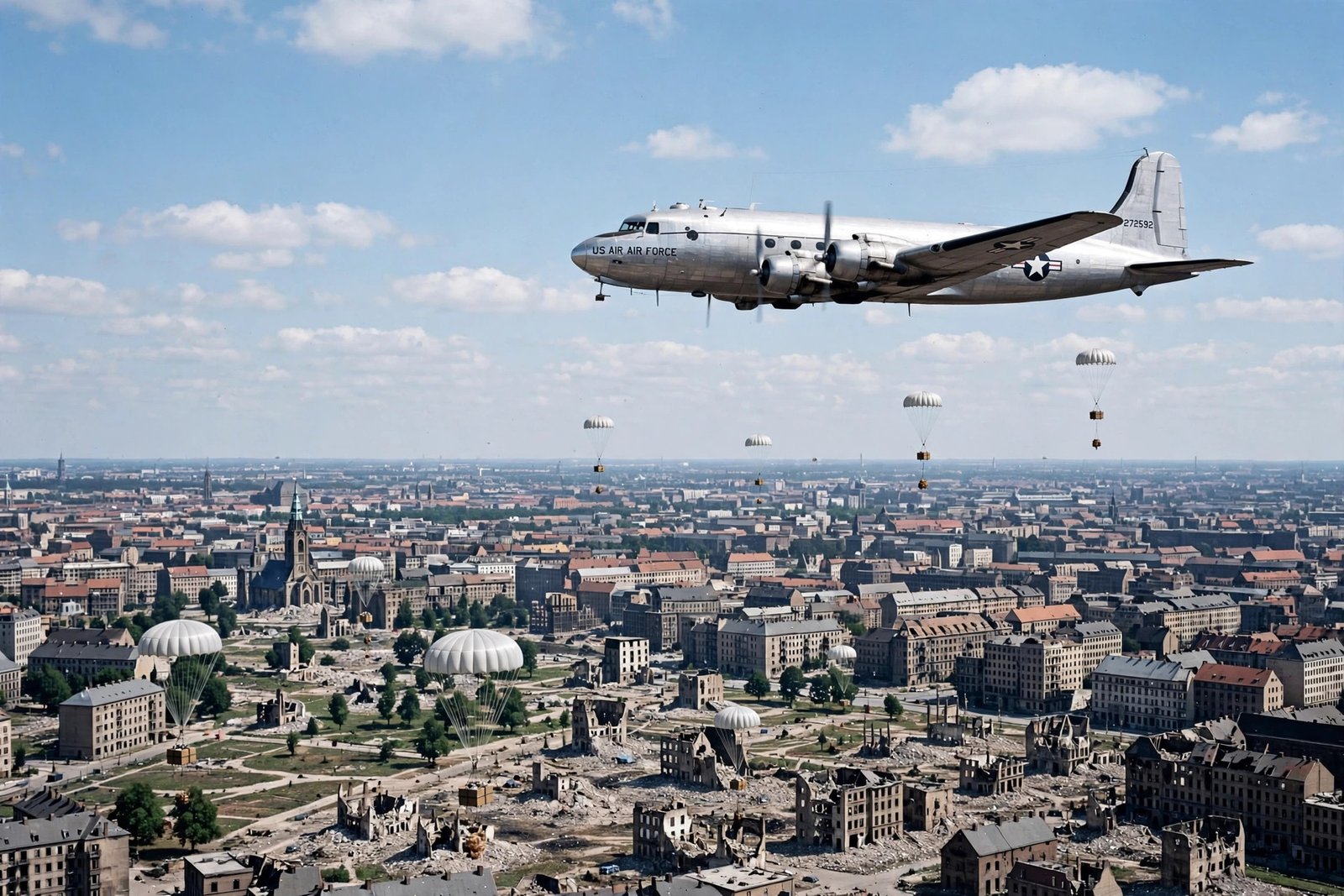
On June 24, 1948, the two million people of West Berlin woke up to a city under siege. Overnight, the Soviet Union had closed every road, railway, and canal connecting the western sectors of Berlin to the outside world. No food could come in by truck. No coal could arrive by train. No fuel could float down the canals. A city of more than two million people, deep inside the Soviet occupation zone of Germany, had been cut off from the world — and it had fewer than 36 days of food and about 45 days of coal.
What followed was one of the greatest logistical feats in history. For the next 15 months, American and British aircraft flew around the clock, landing in Berlin every 90 seconds at the height of the operation, delivering more than 2.3 million tons of food, coal, and supplies to a city that refused to surrender. It was called the Berlin Airlift, and it changed the Cold War before the Cold War had a name.
Here is how the airlift began, how it worked, and why the candy-dropping pilots of Operation Vittles are still remembered as heroes in Berlin today.
The Blockade: Stalin’s Gamble
The roots of the crisis lay in the division of Germany after World War II. The victorious Allies had split the country into four occupation zones, and Berlin, the capital, sat 110 miles inside the Soviet zone but was itself divided into four sectors. The western sectors — American, British, and French — were islands of Western control surrounded by Soviet territory.
In June 1948, the Western Allies introduced a new currency, the Deutsche Mark, in their zones. The Soviet Union saw the move as a step toward a separate West German state and responded by blockading the city. The calculation was straightforward: West Berlin could not feed itself, and the Soviets believed the Western Allies would have to abandon the city or accept Soviet terms. Either way, Berlin would fall under Communist control.
General Lucius D. Clay, the American military governor in Germany, refused to accept that choice. Withdrawing from Berlin, he argued, would be a humiliation that would embolden the Soviets across Europe. Sending an armed convoy through the Soviet zone risked starting a war. There was a third option, one that almost everyone considered impossible: supply the entire city by air.
Operation Vittles Takes Off
On June 25, 1948, Clay ordered the first American airlift flights into Berlin. The operation was given the code name Operation Vittles — vittles being American slang for food, a deliberately plain-spoken signal of the mission’s purpose. The British called their effort Operation Plainfare.
The first day was modest. On June 26, 32 C-47 Dakota transport aircraft flew into the city carrying 80 tons of cargo, mainly powdered milk, flour, and medicine. The C-47 could carry only about 3.5 tons per flight, far too little for a city of two million. The larger C-54 Skymaster, which could carry 10 tons, was rapidly brought in and became the backbone of the operation.
The scale of the task was staggering. Planners calculated that Berlin needed a minimum of 4,500 tons of supplies every day just to survive — 1,435 tons of food, more than 3,000 tons of coal, plus fuel, medicine, and raw materials for industry. In the early weeks, the airlift fell far short. But the operation grew with extraordinary speed. By July, American aircraft were completing more than 1,000 flights a day. By August, the airlift surpassed the 4,500-ton daily target for the first time.
The Air Bridge: A Plane Every 90 Seconds
The man who turned the airlift from a desperate improvisation into a machine was Major General William H. Tunner, appointed in October 1948 to head the Combined Airlift Task Force. Tunner had run the airlift over the Himalayas during World War II, and he brought the same discipline to Berlin.
Under Tunner, the operation ran like a conveyor belt. Aircraft flew in three corridors at fixed altitudes, one level for each direction, landing at Tempelhof Airport in the American sector and Gatow in the British sector. Planes landed every few minutes, were unloaded by German ground crews in as little as 30 minutes, and took off again. At the peak, a plane was landing in Berlin every 90 seconds.
The showcase came on April 16, 1949, in an event the crews called the Easter Parade. In a single 24-hour period, the Allies delivered 12,940 tons of supplies on 1,398 flights — a plane landing on average every 62 seconds. It was three times the daily requirement, and it proved beyond doubt that the airlift could outlast the blockade.
The airlift was not bloodless. More than 70 airmen and civilians lost their lives in crashes during the operation, and records count 101 fatalities connected to the mission, including 31 Americans and 40 Britons. The crews flew through fog, snow, and Soviet harassment, including searchlights, flak, and fighter aircraft buzzing the transports. They kept flying anyway.
The Candy Bomber
The most beloved figure of the airlift was not a general but a young pilot named Gail Halvorsen. While talking to children gathered at the fence at Tempelhof Airport, Halvorsen noticed they had not asked for anything for themselves — they only wanted to know if the planes would keep coming. He promised to drop candy for them on his next flight, and he began tying chocolate bars and chewing gum to tiny handmade parachutes and dropping them from his C-54.
Word spread quickly. Other pilots joined in, and Operation Little Vittles was born. Candy, gum, and handkerchief parachutes rained down on the children of Berlin for the rest of the airlift. The pilots became known as the Raisin Bombers, and Halvorsen became the Candy Bomber, a nickname he carried for the rest of his life. When he returned to Berlin decades later, crowds still greeted him as a hero.
The candy drops were a small part of the airlift’s tonnage, but they were an enormous part of its meaning. The airlift was not just a supply operation. It was a message to the people of Berlin — and to the world — that the West would not abandon them.
Victory and Legacy
By the spring of 1949, the blockade had failed. The airlift was delivering more supplies on some days than had arrived by road, rail, and water before the blockade. The Soviet Union, facing international condemnation and the embarrassment of a blockade that was not working, lifted the restrictions on May 12, 1949. General Clay kept the airlift running until September 30, 1949, to build up reserves in case the Soviets tried again. They never did.
The final numbers tell the story. Over 15 months, American and British aircraft made 278,228 flights to Berlin, delivering 2,334,374 tons of supplies — nearly two-thirds of it coal. The US Air Force delivered 1,783,573 tons, about 76 percent of the total, and the Royal Air Force delivered 541,937 tons. The aircraft flew more than 92 million miles in the process, nearly the distance from the Earth to the Sun. Some 227,655 passengers were also carried in and out of the city.
The Berlin Airlift did more than save a city. It convinced Western Europe that the United States would stand by its commitments, it gave the new NATO alliance its first purpose, and it established the pattern of the Cold War: a confrontation that would be fought with resolve and logistics rather than with armies. When Berliners celebrated the 75th anniversary of the airlift, they did so in a free and united city — and they still remembered the pilots who kept them alive from the sky.
Frequently Asked Questions
What was the Berlin Airlift?
The Berlin Airlift was a 15-month operation from June 1948 to September 1949 in which American and British aircraft supplied West Berlin with food, coal, and fuel after the Soviet Union blockaded all ground access to the city. It delivered more than 2.3 million tons of supplies on 278,228 flights.
Why did the Soviet Union blockade Berlin?
The Soviets blockaded Berlin in response to the Western Allies introducing the Deutsche Mark in their occupation zones. They hoped to force the West to abandon the city or accept Soviet terms. The blockade failed because the airlift kept the city supplied.
How much did the airlift deliver each day?
Berlin needed a minimum of 4,500 tons a day to survive. At the peak, on April 16, 1949 — the Easter Parade — the Allies delivered 12,940 tons in a single day on 1,398 flights.
Who was the Candy Bomber?
US Air Force pilot Gail Halvorsen, who began dropping candy bars and gum on tiny parachutes to the children of Berlin. His gesture grew into Operation Little Vittles, and the pilots became known as the Raisin Bombers.
When did the Berlin Airlift end?
The Soviet Union lifted the blockade on May 12, 1949, but the airlift continued until September 30, 1949, to build up reserves in case the blockade was reimposed.
Sources
- Smithsonian National Air and Space Museum — Supplying a City by Air: The Berlin Airlift
- DVIDS / American Forces Press Service — Berlin Airlift Dispensed Food, Delivered Blow to Communism
- Allied Museum Berlin — The Berlin Airlift 1948/49
- Wikipedia — Berlin Blockade