
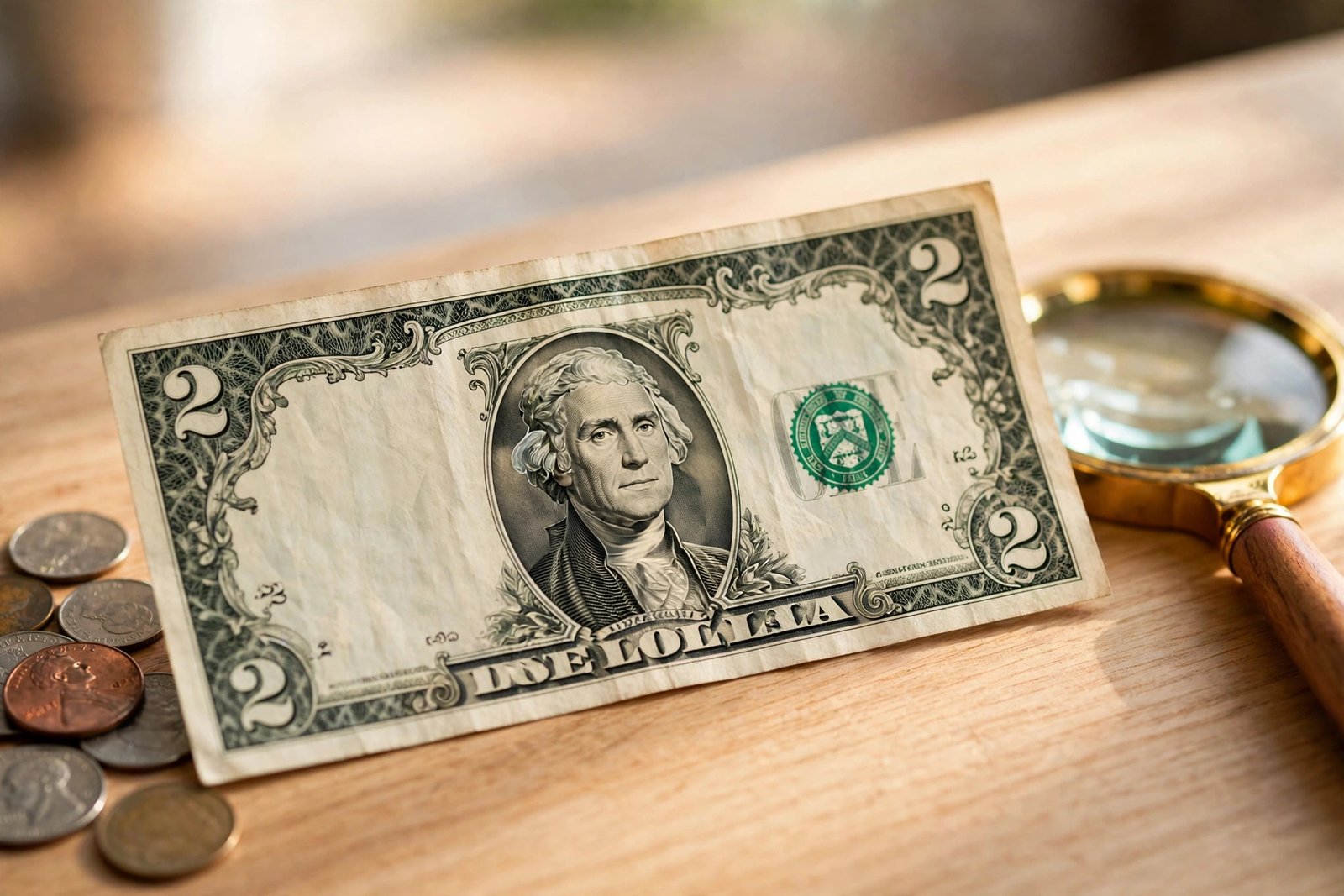
Ask most Americans when they last saw a $2 bill and you will get a pause, a laugh, and then a story. Someone’s grandfather kept one in a wallet. A casino paid one out in change. A relative tucked one into a birthday card for luck. The bill itself is familiar — Thomas Jefferson on the front, the signing of the Declaration of Independence on the back — yet it feels almost mythical, like something from another era that somehow survived into the present. That feeling is so strong that many people are convinced the $2 bill was discontinued years ago, or that it is rare, valuable, or even fake when they finally see one.
None of that is true, and the real story is stranger than the myth. The $2 bill is a current denomination of United States currency. It is legal tender, it is still printed, and there are more than a billion of them in circulation. Yet almost nobody uses one, almost no shop stocks them, and most banks have to be asked specially to order them. The bill nicknamed Tom has spent more than 160 years caught between two facts: the government keeps making it, and the public keeps ignoring it. This is the story of why America still prints a bill almost nobody uses.
A Bill Born In The Civil War
The $2 bill was first issued in 1862 as a United States Note during the Civil War, when the federal government needed new ways to finance the war and to put paper money into circulation. The first design featured Alexander Hamilton, the first Secretary of the Treasury, on the front. In 1869, Hamilton was replaced by Thomas Jefferson, the third president, who served from 1801 to 1809. Jefferson has remained on the front ever since, and his portrait on the $2 bill is the oldest obverse design of all current United States currency — older than the faces on the $1, $5, $10, or any other bill in your wallet today.
The reverse originally showed Monticello, Jefferson’s Virginia home. That changed with the 1976 reissue, when the back was redesigned to show an engraving of John Trumbull’s painting of the presentation of the Declaration of Independence. The choice was deliberate: Jefferson was the principal author of the Declaration, and the new design tied the bill to the nation’s founding story.
The Disappearance And The 1976 Comeback
For all its history, the $2 bill has never been popular. By the 1960s, it was used so rarely that production stopped in 1966, when United States Notes were phased out. For a decade, the denomination effectively vanished from new production, and the bills already in circulation slowly wore out or disappeared into drawers, collections, and cash registers where they sat untouched.
Then came the Bicentennial. The bill was reissued on April 13, 1976 — Jefferson’s birthday, in the year of the American Bicentennial — as a Federal Reserve Note, the same type of note as the other bills in circulation today. The Treasury ordered 400 million notes for the reissue, hoping that a fresh design, a patriotic moment, and a practical argument would finally make the denomination catch on. Production of the Series 1976 notes totaled 590,720,000, with the final run printed in 1978. The comeback, however, did not take. The bill returned to circulation, but the public’s habits did not change with it.
Why It Never Caught On
The reason the $2 bill never caught on is not a mystery, and it is not a conspiracy. It is a loop, and it has been running for decades. Because businesses’ banking policies do not rely on $2 bills, few are produced and they circulate much less than other denominations. Cash registers are built with slots for $1, $5, $10, and $20 bills, and there is often no obvious place to put a $2. Banks rarely order them because their business customers rarely ask for them. Customers rarely ask for them because they rarely receive them in change. And shops rarely give them in change because they rarely receive them from banks.
How Many $2 Bills Are Really Out There?
The numbers tell the same story from the other side. Federal Reserve data show that roughly 1.6 billion $2 bills were in circulation as of 2023, worth about $3.2 billion in total. That sounds like a lot, and it is — until you compare it with the roughly 14.5 billion $1 bills in circulation at the same time. The $1 bill outnumbers the $2 by about nine to one, and the gap only widens when you look at how often each bill actually changes hands.
Measured by share of actively circulating paper currency, $2 notes make up under 3 percent of the total, the smallest share of any denomination. In other words, the bill exists in large numbers but moves slowly. Many of those 1.6 billion notes are sitting in drawers, safes, and collections, or circulating so rarely that they barely register in daily commerce. They are real money, legally spendable anywhere, but they behave more like souvenirs than working currency.
Production reflects that reality. Print orders for $2 bills swing wildly by year — hundreds of millions in some years, none in others — because banks rarely order them and the Federal Reserve only prints what the banking system asks for. More than 200 million $2 bills were printed in 2024, a large order by recent standards, but that figure says more about restocking and inventory than about a sudden surge in public demand. In a year when banks do not order any, none are printed at all, which is another reason people assume the bill has been discontinued: in some years, in practical terms, it has not been made.
The Myths That Follow Tom
The $2 bill’s strange status has produced a set of myths that follow it wherever it goes. The most common is that it was discontinued, which is false: it is a current denomination, still printed, and still legal tender. Another is that it is rare and valuable, which is also false for the ordinary modern bill. A modern $2 bill in ordinary circulated condition is worth exactly $2, no more and no less, and a shop that refuses it is refusing legal money, not a collector’s item.
Only rare old series carry collector premiums, and those are specific notes from specific years and printings — for example, some 1928 red-seal notes — not the bills printed in recent decades. Anyone who tells you that an ordinary $2 bill from your wallet is worth far more than its face value is either mistaken or trying to sell you something. The bill’s nickname, Tom, is real enough, a friendly shorthand for Thomas Jefferson, but the idea that every Tom is a treasure is not.
Why The Government Keeps Printing It
If almost nobody uses the $2 bill, why does the government keep printing it? Part of the answer is that it costs little to keep the denomination alive, and part of it is that the case for the bill has never quite gone away. Supporters have long argued that a $2 bill is a sensible middle step between $1 and $5, useful for tips, for vending, for transit fares, and for any transaction where a single dollar is not quite enough and five dollars is too much. In theory, it could reduce the number of $1 bills needed and make change simpler.
In practice, that argument has never overcome habit. The United States has repeatedly failed to persuade the public to adopt the $2 bill, just as it has failed to persuade the public to give up the $1 bill in favor of a coin. Both efforts ran into the same wall: people use the money they are used to, shops stock the money their customers use, and nobody wants to be the first to change. The $2 bill survives not because it won the argument, but because nobody has formally lost it either. It remains on the books, printed when banks order it, ignored when they do not.
What To Do If You Get One
If you receive a $2 bill, you can spend it exactly like any other bill. It is legal tender for all debts, public and private, and any business that accepts cash is required to accept it, even if the cashier has never seen one before. If a cashier questions it, a calm explanation and, if needed, a request for a manager will usually settle the matter. The bill is not counterfeit, it is not discontinued, and it is not a special promotion.
Frequently Asked Questions
Is the $2 bill still legal tender? Yes. The $2 bill is a current denomination of United States currency and legal tender. It can be spent anywhere that accepts cash, and it has never been withdrawn from circulation.
Was the $2 bill discontinued? No. Production stopped in 1966, but the bill was reissued on April 13, 1976, as a Federal Reserve Note. It is still printed when banks order it, and more than 200 million $2 bills were printed in 2024.
How much is a $2 bill worth? A modern $2 bill in ordinary circulated condition is worth exactly $2. Only rare old series, such as some 1928 red-seal notes, carry collector premiums. Do not expect an ordinary modern bill to be worth more than its face value.
Who is on the $2 bill? Thomas Jefferson, the third president, is on the front. His portrait on the $2 is the oldest obverse design of all current United States currency. The back shows an engraving of John Trumbull’s painting of the presentation of the Declaration of Independence.
Why is the $2 bill so rarely seen? Because businesses’ banking policies do not rely on $2 bills, few are produced and they circulate much less than other denominations. Cash registers, banks, and shops are set up around $1, $5, $10, and $20 bills, so the $2 rarely enters circulation even though more than a billion are in existence.
Sources
- Wikipedia: United States two-dollar bill
- Federal Reserve: Currency and Coin in Circulation
- Federal Reserve: Currency Print Orders 2024 (PDF)