
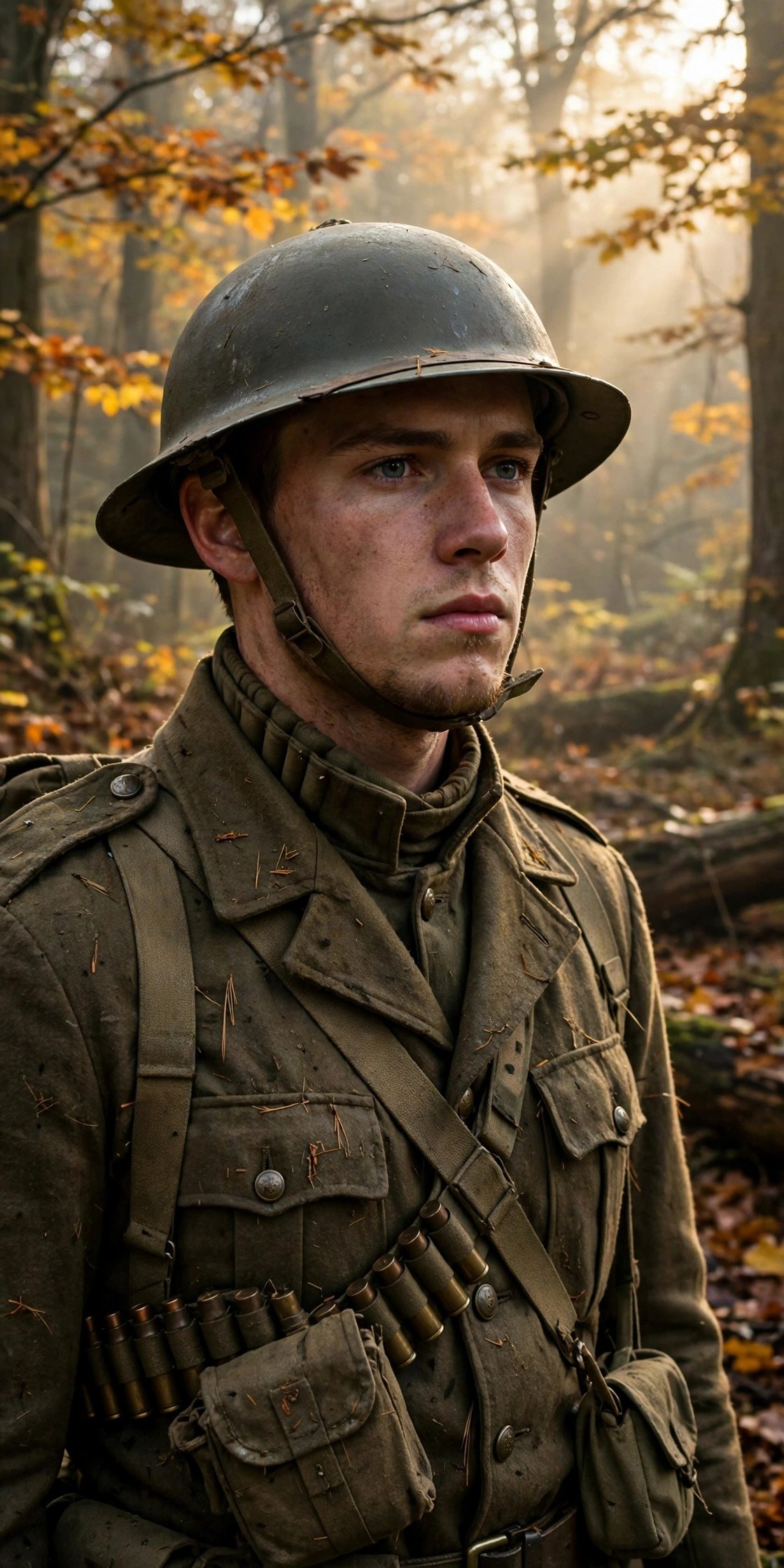
Alvin Cullum York was born on December 13, 1887, in a log cabin near Pall Mall, Tennessee, in the hills of Fentress County. He grew up in a large family supported by subsistence farming and hunting, learning to shoot with the kind of patient accuracy that country life demanded. Nothing about that upbringing suggested that he would one day become the most famous American soldier of World War I, or that his name would be taught in schools, carved into a state park, and played on screen by Gary Cooper. Yet York’s story is not only about one extraordinary morning in France. It is about faith, reluctance, duty, and what a man does after fame arrives.
York is remembered today as Sergeant York, though on the morning that made him famous he was still a corporal. His Medal of Honor action on October 8, 1918, during the Meuse-Argonne Offensive, turned a quiet Tennessee mountaineer into a national hero almost overnight. The details have been retold so often that legend and record sometimes blur, but the core facts, preserved in Army and government accounts, are remarkable enough without embellishment. This is the story of how a reluctant soldier became a symbol of American courage, and why he spent the rest of his life trying to use that fame for his neighbors back home.
Growing Up in the Tennessee Hills
Pall Mall in the late nineteenth century was a remote farming community, far from the cities and rail hubs that were reshaping America. York was one of eleven children, and like many boys in the Cumberland Mountains, he learned early to hunt, farm, and work with his hands. His father died when York was still young, leaving the family to make do with less, and York took on responsibilities that left little time for formal schooling. What he did learn, though, he learned thoroughly: how to move quietly through woods, how to judge distance, and how to hit what he aimed at.
As a young man, York was known for hard living as much as hard work, spending time drinking and fighting in the rough social world of the mountain towns. That changed after a religious conversion in his late twenties, when he joined the Church of Christ in Christian Union, a denomination that taught pacifism and forbade violence. The change was sincere and it reshaped his life, giving him a discipline and a sense of purpose he had not had before. It also set up the central tension of his wartime story: a man who believed deeply in peace would soon be asked to fight in the largest war the world had ever seen.
Drafted Against His Conscience
When the United States entered World War I in 1917, York was drafted. He applied for conscientious objector status, arguing that his faith forbade killing, but his claim was denied. The Army’s reasoning reflected the rules of the time: his denomination was not among the recognized peace churches that traditionally qualified for exemption, and the local board did not accept his application. York reported for duty anyway, a decision that says a great deal about how he understood obedience, citizenship, and his own conscience working together rather than in opposition.
At Camp Gordon, Georgia, York trained with Company G, 2nd Battalion, 328th Infantry Regiment, 82nd Division. His officers soon noticed two things about him: he was an exceptional marksman, and he was troubled by the moral question of taking a life. His commanders gave him time to wrestle with that question, and York studied scripture and talked with fellow soldiers about whether a just war could be reconciled with his faith. He eventually concluded, in his own way, that defending others and his country could be consistent with his beliefs. He did not abandon his faith to become a soldier; he carried it with him into uniform, and that inner struggle became part of why later generations found his story so compelling.
France, Saint-Mihiel, and the Meuse-Argonne
York arrived in France in 1918, as American forces were taking on a larger role on the Western Front. His regiment first fought in the Saint-Mihiel Offensive in September 1918, an operation that gave American troops valuable experience and confidence. Soon after, the division moved into the Meuse-Argonne Offensive, the largest American operation of the war and the final Allied push against German forces on the Western Front. The fighting there was brutal: dense forest, steep hills, entrenched machine-gun positions, and an enemy determined to hold the Hindenburg Line as long as possible.
By early October, York had been promoted to corporal and given command of his own squad. The men of the 82nd Division were exhausted, under-supplied in places, and fighting through terrain that made communication and coordination painfully difficult. Yet the offensive mattered enormously. American commanders believed that breaking through in the Argonne could help force Germany toward an armistice, and every hill and ridge taken brought that goal closer. It was in this grinding, costly campaign, not in a single set-piece battle, that York’s moment arrived.
October 8, 1918: The Morning in the Argonne Forest
On the morning of October 8, 1918, York was part of a patrol of seventeen men ordered to silence German machine-gun positions that were holding up the advance near Chatel-Chehery, in the Argonne Forest. The patrol worked its way behind enemy lines and initially captured a group of German soldiers without a shot, but then came under devastating machine-gun fire from positions on a nearby hill. The patrol suffered heavy casualties, including the loss of its senior noncommissioned officers, and command fell to York. He was suddenly responsible for the survivors, the prisoners, and a mission that seemed impossible.
What happened next is recorded in York’s Medal of Honor citation and in Army histories. Leading the seven men who remained able to fight, York charged a machine-gun nest that was pouring fire onto his platoon. Using his rifle and pistol with the accuracy of a lifetime hunter, he picked off gunners one by one, moving and firing in a way that made the Germans believe they faced a much larger force. When German soldiers charged him, he met them with his pistol. When the enemy commander realized the position could not hold, he surrendered, and the prisoners began to accumulate. By the time York led his column back to American lines, the patrol had captured 132 German soldiers in total, a figure reflected in the citation’s count of four officers and 128 men taken with the machine-gun nest, plus additional prisoners gathered on the way back.
Accounts differ slightly on the exact number of Germans killed that morning, with government summaries commonly reporting about 25, while other accounts put the figure slightly higher or lower. The variation is understandable in the confusion of close combat, and it does not change the scale of what happened. York also helped capture dozens of machine guns, a haul that weakened the German position and allowed the advance to continue. He had done what his battalion needed most that day: he removed a deadly obstacle, protected his surviving men, and brought back prisoners who could provide intelligence, all while outnumbered and under fire.
From Corporal to Sergeant, and a Hero’s Welcome
York was promoted to sergeant, with the promotion dated in early November 1918, just before the Armistice ended the fighting on November 11. The following spring, he received the Medal of Honor, the nation’s highest military decoration for valor above and beyond the call of duty, along with the Distinguished Service Cross and decorations from France and other Allied nations, including the French Croix de Guerre. General John J. Pershing, commander of the American Expeditionary Forces, praised him in terms that helped make his fame permanent, describing him as an outstanding example of the citizen soldier.
When York returned to the United States in May 1919, he came home to a hero’s welcome, with parades, speeches, and offers that could have made him wealthy. Newspapers called him the war’s biggest hero, and admirers wanted to buy him houses, farms, and businesses. York accepted some help, including a farm in Tennessee raised by public subscription, but he turned away much of the commercial fame that was offered to him. He was uncomfortable with celebrity, and he was determined not to profit from a day when other men had died beside him. That reluctance, as much as the battle itself, shaped how Americans remembered him.
The School, the Film, and a Life of Service
York’s most lasting peacetime work was education. He founded the York Agricultural Institute, later known as the Alvin C. York Institute, a school for children in his home region who otherwise had limited access to a good education. He believed that the mountain children of Tennessee deserved the same opportunities as children anywhere else, and he poured his fame and his energy into raising support for the school. It was a practical, unglamorous form of service, far from the battlefield, but it reflected the same sense of duty that had carried him through the Argonne.
In 1941, York’s life reached an even wider audience with the film Sergeant York, starring Gary Cooper in the title role. Cooper won an Academy Award for his performance, and the film, released as America moved closer to World War II, presented York as a model of the reluctant warrior who fights only when he believes the cause is just. York himself had been cautious about the film, insisting that it be made honestly and that part of the proceeds support his school and community. The movie’s success ensured that his name would outlive the generation that had known him personally, even if Hollywood smoothed some of the rougher edges of his story.
York served again in World War II, in the Army Signal Corps and later in the Tennessee State Guard, though his health limited his role. He remained a public figure, speaking about patriotism, education, and the responsibilities of citizenship, but his later years were marked by illness and financial difficulty. He died on September 2, 1964, in Nashville, Tennessee, and was buried at Wolf River Cemetery in Pall Mall, near the hills where he had grown up. Today, his birthplace and farm are preserved as part of Sgt. Alvin C. York State Historic Park, and his Medal of Honor is displayed at the Tennessee State Museum in Nashville.
Why Sergeant York Still Matters
Sergeant York endures because his story asks a question that has not gone away: what does a person of conscience do when duty and belief seem to pull in opposite directions? York did not resolve that question with slogans. He wrestled with it, sought counsel, made a decision he could live with, and then acted with extraordinary steadiness when other lives depended on him. That combination of moral seriousness and practical courage is rarer, and more instructive, than simple fearlessness, and it is why his story is still told to new soldiers and students more than a century later.
There is also a quieter lesson in York’s later life. Fame did not change what he valued. He went back to Tennessee, built a school, and tried to leave his community better than he found it. In an age when celebrity often becomes an end in itself, York’s decision to use his moment in the spotlight for a schoolhouse in the mountains feels almost radical. The hero of the Argonne Forest is worth remembering not only for what he did in a few hours in October 1918, but for what he chose to do with the decades that followed.
Frequently Asked Questions
Who was Sergeant Alvin York?
Alvin Cullum York was an American soldier from Pall Mall, Tennessee, and one of the most decorated United States soldiers of World War I. Born on December 13, 1887, he served in Company G, 328th Infantry Regiment, 82nd Division, and received the Medal of Honor for his actions on October 8, 1918, during the Meuse-Argonne Offensive in France.
What did Alvin York do on October 8, 1918?
After his patrol of seventeen men came under heavy machine-gun fire near Chatel-Chehery and suffered heavy casualties, York, then a corporal, assumed command. Leading the remaining men, he attacked the machine-gun position, killed about 25 German soldiers according to government summaries, and helped capture 132 prisoners and dozens of machine guns, allowing his unit’s advance to continue.
Was Alvin York a conscientious objector?
York applied for conscientious objector status after being drafted in 1917, citing his faith in the Church of Christ in Christian Union, which forbade violence. His claim was denied, and he reported for duty. He later reconciled military service with his faith after study and discussion with his officers, a struggle that became central to his life story.
What happened to Alvin York after World War I?
York returned home to a hero’s welcome in May 1919, was promoted to sergeant, and received the Medal of Honor and Allied decorations. He founded a school for mountain children, later the Alvin C. York Institute, and his life was portrayed in the 1941 film Sergeant York, starring Gary Cooper. He died on September 2, 1964, and is buried in Pall Mall, Tennessee.
Related reading
More American stories worth reading next:
- The Coast Guard Pendleton Rescue of 1952
- The Tuskegee Airmen and the Red Tails of World War II
- The Great Molasses Flood of 1919 in Boston
For further reading, see the U.S. Department of Veterans Affairs profile of Sergeant York, the Department of War feature on his Medal of Honor action, and the Britannica biography of Alvin York.