On November 19, 1863, in a small Pennsylvania town still burying its dead, President Abraham Lincoln stood up and spoke for about two minutes. He delivered just over 270 words, by most counts, after the day’s featured speaker had talked for more than two hours. Lincoln himself was disappointed in the speech at first. Within a few years, it was being memorized by schoolchildren. Today, the Gettysburg Address is the most famous speech in American history, carved into the wall of the Lincoln Memorial and quoted in every corner of public life. Its anniversary, November 19, is the perfect moment to revisit what Lincoln actually said, why he said it, and why a two-minute speech outlasted the war it was meant to mourn.
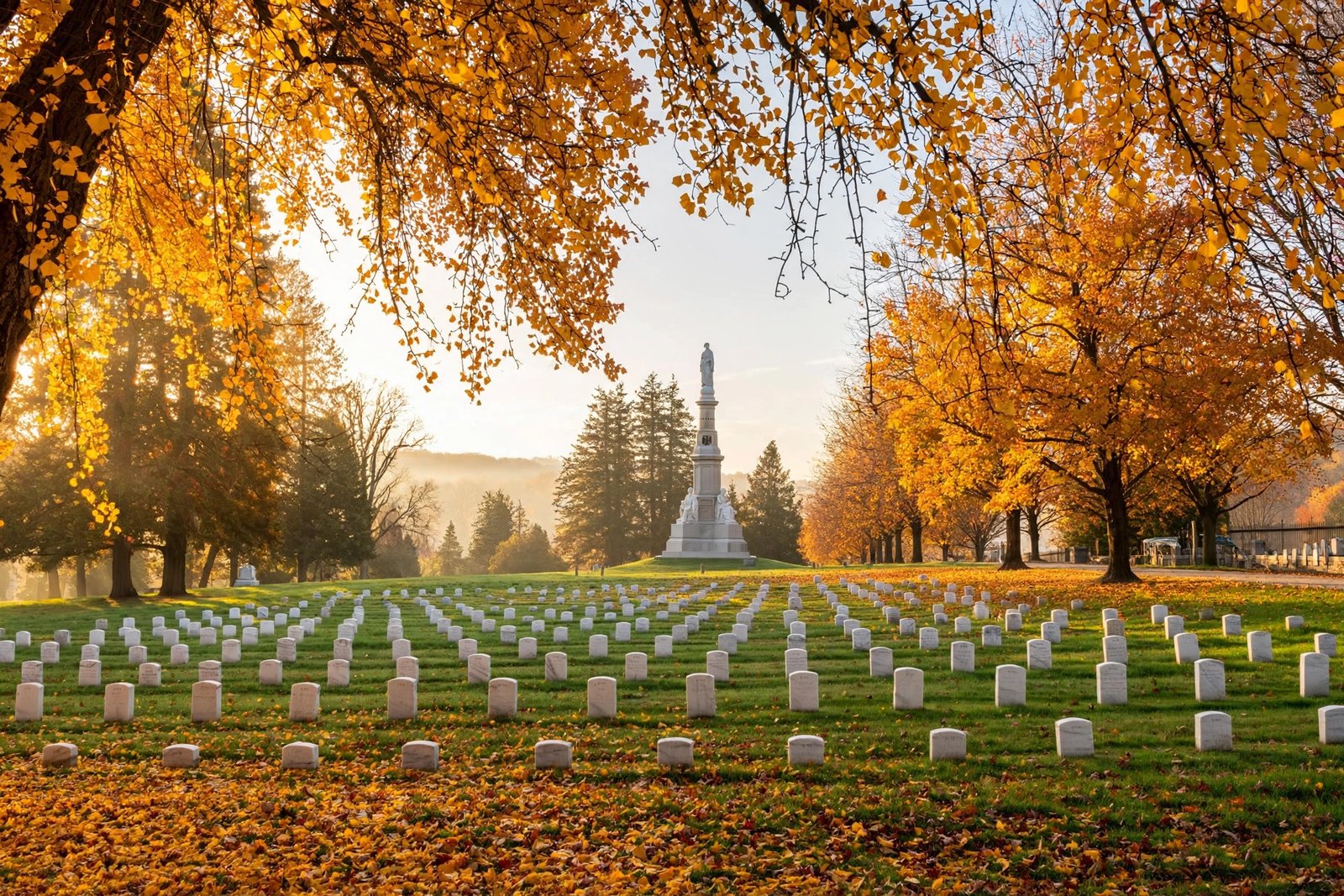
The occasion was the dedication of the Soldiers’ National Cemetery at Gettysburg, the burial ground for the Union soldiers killed in the Battle of Gettysburg, fought July 1-3, 1863. The battle was the bloodiest of the Civil War and a turning point: the Union Army of the Potomac repelled the Confederacy’s second invasion of the North, and more than 51,000 Confederate and Union soldiers were wounded, missing, or dead. Many of the dead had been laid in makeshift graves along the battlefield. Pennsylvania Governor Andrew Curtin commissioned attorney David Wills to buy land for a proper cemetery, and Wills acquired 17 acres, planned by landscape architect William Saunders. The dedication was set for November 19, 1863.
The two-hour speech and the two-minute speech
The main speaker that day was Edward Everett, one of the nation’s foremost orators, a former senator, governor, and secretary of state. Everett spoke for more than two hours, in the grand style of the age, reviewing the battle, the war, and the history of the republic. Lincoln was invited almost as an afterthought, asked as chief executive to offer a few appropriate remarks to formally set apart the grounds. He did, in about two minutes, and then sat down.
The contrast is the stuff of legend, and it is true in its essentials. Everett’s speech was learned, thorough, and largely forgotten. Lincoln’s was brief, plain, and immortal. Everett himself knew it immediately: the next day, he wrote to Lincoln that he wished he had come as near to the central idea of the occasion, in two hours, as Lincoln had in two minutes. The story has been told so often that it risks sounding like a fable, but the letter survives, and so does the point it makes. Brevity is not the same as shallowness, and Lincoln’s brevity was the product of deep thought, not haste.
Lincoln had given the speech a lot of thought, even though it was short. He saw meaning in the fact that the Union victory at Gettysburg coincided with the nation’s birthday season, but he chose not to focus on the battle itself. Instead, he made a broad statement about the larger significance of the war, invoking the Declaration of Independence and its principles of liberty and equality, and speaking of a new birth of freedom. In doing so, he reshaped the aims of the war for the American people, transforming it from a war for Union alone into a war for Union and freedom.
What the Address actually says
The Address opens with its most famous line: Four score and seven years ago our fathers brought forth on this continent, a new nation, conceived in Liberty, and dedicated to the proposition that all men are created equal. Four score and seven is 87 years, counting back from 1863 to 1776, the year of the Declaration of Independence. Lincoln deliberately anchored the nation not in the Constitution of 1787, but in the Declaration’s promise of equality — a choice that mattered enormously in a war over slavery, because it made equality, not just union, the founding principle.
The speech then moves, in three short movements, from the past to the present to the future. The past is the founding and its proposition. The present is the great civil war testing whether a nation so conceived can long endure, and the gathering on a great battlefield to dedicate a portion of that field as a final resting place for those who gave their lives that the nation might live. The future is the resolution: that these dead shall not have died in vain, that this nation, under God, shall have a new birth of freedom, and that government of the people, by the people, for the people, shall not perish from the earth.
The middle of the speech contains its most quoted paradox. In a larger sense, Lincoln says, we cannot dedicate, we cannot consecrate, we cannot hallow this ground, because the brave men, living and dead, who struggled here have consecrated it far above our poor power to add or detract. The world will little note, nor long remember what we say here, but it can never forget what they did here. Lincoln was wrong about the first half of that sentence — the world has remembered what he said — and right about the second. The speech works because it refuses to claim more for words than words can do, and then uses words to do exactly what it claims they cannot.
The five copies and the text we quote
There is no single original manuscript of the Gettysburg Address in Lincoln’s hand that matches the speech as delivered. There are five known copies in Lincoln’s handwriting, differing slightly in wording and punctuation, and historians debate which is closest to what he actually said. The Bliss Copy, the last one Lincoln wrote, is the version most often quoted and the one inscribed, with small variations, on the Lincoln Memorial in Washington. The version on the memorial wall is the text most Americans know by heart, even if they do not know its name.
The differences between the copies are small — a word here, a comma there — but they remind us that the Address was a living document, revised by its author even after delivery. Lincoln gave copies to friends and to charitable causes, and he polished the language as he copied it. The speech’s famous closing, government of the people, by the people, for the people, appears in all the copies, and it is the line that has traveled furthest, quoted by leaders around the world in struggles for democracy that Lincoln never imagined.
A detail worth knowing: the speech is short enough to read aloud in about two minutes, and reading it aloud is the best way to feel its rhythm. Lincoln built it in balanced phrases and threes — of the people, by the people, for the people — and the cadence does much of the work. Schoolchildren once memorized it as a matter of course, and the practice is worth reviving: a speech this short rewards the effort many times over.
Why the Address still matters
The Gettysburg Address matters for two reasons, one historical and one living. Historically, it marks the moment when the Civil War’s meaning was publicly redefined. Before Gettysburg, the war’s stated purpose for the North was preserving the Union. After Lincoln’s speech, and after the Emancipation Proclamation that preceded it, the war was also, explicitly, a war for a new birth of freedom — a phrase that pointed toward emancipation and, eventually, toward civil rights. Lincoln did not end slavery with a speech, but he gave the nation a language for understanding what the war was for.
The living reason is that the Address states America’s founding promise in its most demanding form. Conceived in liberty and dedicated to the proposition that all men are created equal is a claim that America has never fully lived up to, and Lincoln knew it. The speech’s power comes from its honesty about that gap: it honors the dead by committing the living to unfinished work, rather than by declaring the work done. That is why the Address is quoted in every era, by every movement that claims the promise and demands its fulfillment. It belongs to no party and no decade, because it states an aspiration, not an achievement.
Visiting Gettysburg today makes the speech concrete. The Soldiers’ National Cemetery is now part of Gettysburg National Military Park, and the town preserves the battlefield, the cemetery, and the house where Lincoln finished his remarks. November 19 brings annual commemorations, including a ceremony at the cemetery and events in the town. But you do not need to travel to mark the anniversary. Read the speech aloud, slowly, and notice how much it says in how little space. Two minutes, 272 words, and a nation still trying to live up to them.
Frequently asked questions
How long was the Gettysburg Address?
Just over 270 words, delivered in about two minutes on November 19, 1863. The featured speaker that day, Edward Everett, spoke for more than two hours.
What was the occasion for the Gettysburg Address?
The dedication of the Soldiers’ National Cemetery at Gettysburg, Pennsylvania, the burial ground for Union soldiers killed in the Battle of Gettysburg, fought July 1-3, 1863.
Why does Lincoln say four score and seven years ago?
Four score and seven is 87 years, counting back from 1863 to 1776, the year of the Declaration of Independence. Lincoln anchored the nation in the Declaration’s promise that all men are created equal.
Which version of the Gettysburg Address should I read?
The Bliss Copy is the most commonly quoted version and the basis for the text inscribed on the Lincoln Memorial. Five copies in Lincoln’s hand survive, differing slightly in wording and punctuation.
Related reading
For more American history, read about Black Tuesday 1929 and the Great Depression, the Pony Express and its 18-month legend, and Sergeant Alvin York, the World War I hero from Tennessee.
Sources for this article include the National Archives’ account of the Gettysburg Address, Ben’s Guide to the text of the Gettysburg Address, and the National Archives’ Gettysburg Address document resources.