
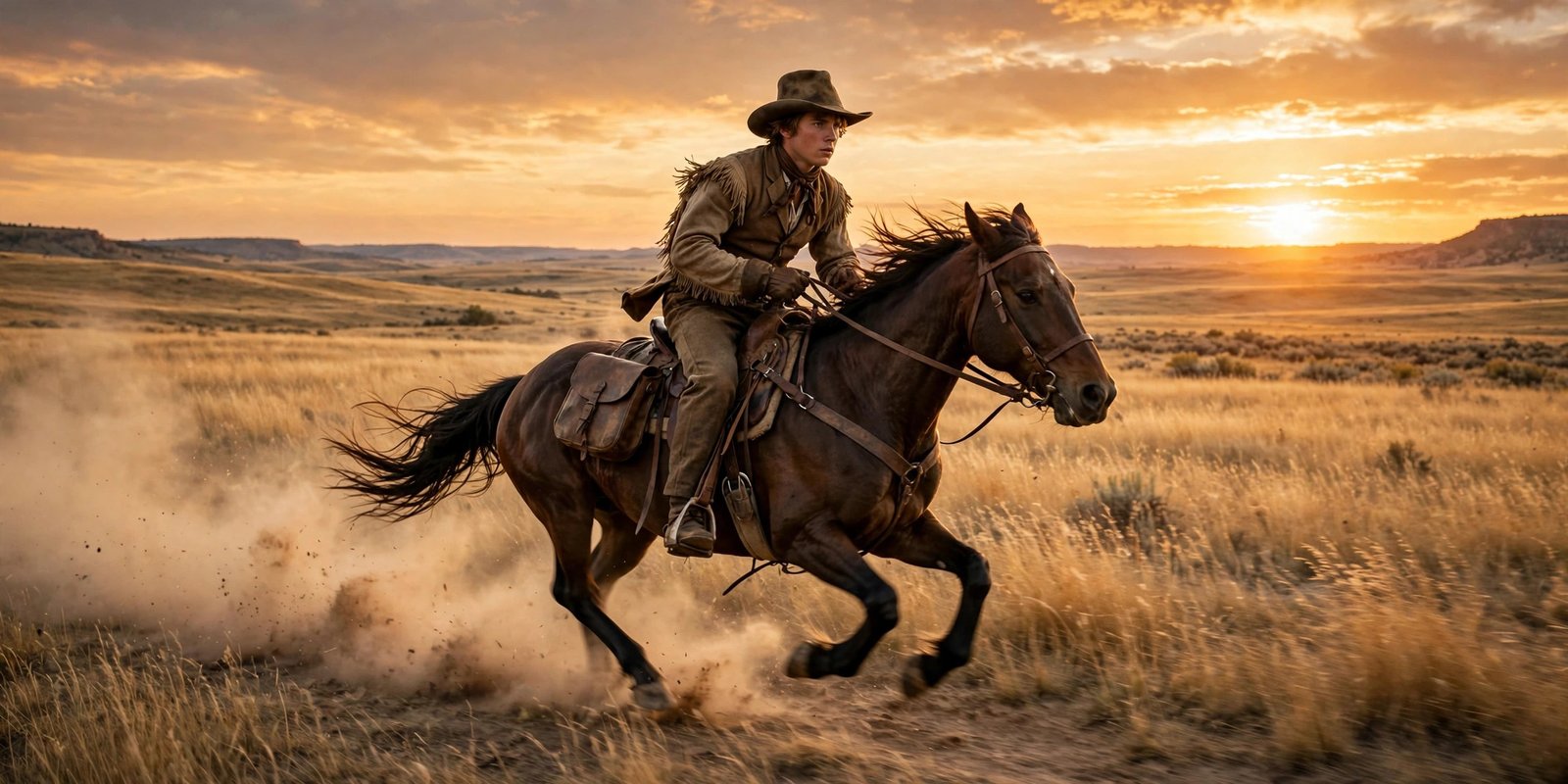
Ask a room of Americans to name the most famous mail service in history and you will not hear about a truck, a plane or a postal code. You will hear about teenagers on horses, galloping across deserts and mountain passes with leather bags of letters — in a business that lasted barely a year and a half and lost money from the day it opened. The Pony Express ran for just 18 months. It has been famous for more than 160 years. Here is how a doomed company turned itself into an American legend.
The Problem: California Was a World Away
By 1860, California had been a state for a decade and the Gold Rush had filled it with people hungry for news from back East. Getting a letter there was miserable. Mail traveled by ship around South America or across Panama, or crawled overland by stagecoach on southern routes that could take three weeks or more. In a nation sliding toward civil war, with California’s loyalty and gold both vital to the Union, the East and West coasts were effectively strangers.
Three Missouri freighting partners — William H. Russell, Alexander Majors and William B. Waddell — bet they could fix that with horses. Their Central Overland California and Pikes Peak Express Company proposed a relay: fast riders, fresh horses every few miles, and a straight central route across the continent. Many thought it impossible, especially through winter. The partners built it anyway, in a matter of weeks: nearly 2,000 miles of trail, roughly 190 stations, hundreds of horses and a small army of riders and station keepers.
How the Relay Worked
The Pony Express began on April 3, 1860, running between St. Joseph, Missouri and Sacramento, California — 1,966 miles, according to the National Park Service, covered in about 10 days. Riders left simultaneously from both ends, and the system ran on a beautifully simple machine: the mochila.
The mochila was a leather cover that slipped over the saddle, with four locked pockets in its corners for the mail. A rider galloped 10 to 15 miles to a relay station, where a fresh horse stood saddled and waiting. In the best stops, the rider was moving again in about two minutes — swing off, throw the mochila onto the new horse, swing up, ride. After roughly 75 to 100 miles of this, a rider handed the mochila to the next man and rested. Day and night, in blizzards, floods and desert heat, the leather bag never stopped moving.
The price matched the audacity: at launch, sending a half-ounce letter cost five dollars — serious money in 1860. Newspapers, government dispatches and urgent business letters made up much of the load, along with personal mail from people willing to pay for speed. The fastest celebrated runs cut the crossing to about a week; the delivery of President Lincoln’s inaugural address in March 1861 took seven days and seventeen hours, a record that showed what the relay could do at full stretch.
The Riders: Young, Light and Orphaned Preferred
Legend says the company advertised for ‘young, skinny, wiry fellows not over eighteen — must be expert riders, willing to risk death daily. Orphans preferred.’ Historians have never confirmed that exact advertisement existed, which makes it a perfect Pony Express story: too good to verify, too beloved to discard. What is documented is that riders were indeed young — many in their late teens — light enough not to wear out the horses, and paid well for the era for work that was genuinely dangerous.
The route crossed eight present-day states and some of the hardest country on the continent: the Great Plains, the Rockies, the Great Salt Lake desert and the Sierra Nevada. Riders faced searing heat, snow that buried the trail, and, during the brief Pyramid Lake War in 1860, attacks that closed stations and cost lives. The most famous rider of all, William F. ‘Buffalo Bill’ Cody, later claimed long, heroic rides for the Express as a teenager — claims historians treat with some caution, since Cody was never a man to undersell his own legend. But whatever the embellishments, the ordinary riders’ reality needed none: hundreds of miles a week, alone, at a gallop, in all weather.
The Invisible Army Behind the Riders
The lone rider is the icon, but the Express ran on an invisible army. Historians generally put the operation at roughly 80 riders in the saddle at any given time, about 400 horses rotating through the stations, and hundreds of station keepers, stock tenders and support staff strung across the continent. The riders got the glory; the keepers, in many ways, got the danger. Relay stations in Nevada and Utah stood utterly alone, days from help, and during the Pyramid Lake War of 1860 — a conflict between settlers and Paiute people in present-day Nevada — stations were attacked and burned, employees were killed, and the company temporarily suspended service on part of the route at enormous cost to rebuild.
The logistics were a marvel of improvisation. Horses had to be bought, fed and shod across deserts where grass and water were strategic resources. Stations needed food flown — well, wagoned — in over hundreds of miles. Winter storms in the Sierra could bury the trail entirely, and riders sometimes crossed on snowshoes or led horses through drifts, still trying to keep the mail’s schedule. Every famous gallop in the legend rests on this unglamorous scaffolding: a continent-wide supply chain, built in weeks, run at a loss, that somehow delivered the mail with remarkable reliability — only a single mochila is generally believed to have been lost in the entire 18 months.
The Wire That Killed the Horse
The Pony Express was racing technology from the start, and technology was faster. While the riders rode, Congress had authorized support for a transcontinental telegraph in June 1860, and crews began stringing wire inward from both ends of the country. Through 1861, the Pony Express increasingly became a bridge between the advancing wire ends — carrying news by horse across the shrinking gap the telegraph had not yet closed.
On October 24, 1861, the gap closed: the transcontinental telegraph was completed, and a message could cross America in moments instead of ten days. The Pony Express announced the end of its service on October 26, 1861, with the last letters arriving at their destinations in November, as the National Park Service timeline records.
The company had never made money. It was built in hope of winning a lucrative government mail contract that went elsewhere, its costs were enormous, and its parent firm collapsed in debt — losses commonly estimated in the hundreds of thousands of dollars. As a business, the Pony Express was a failure. As everything else, it was a phenomenon.
A Relay for the History Books
One episode captures the service at its best. When the Civil War began in April 1861, the fastest communication between Washington and Union-loyal California was not a courtesy — it was strategy. California’s gold, its ports and its allegiance mattered to a Union suddenly fighting for survival, and every piece of war news that crossed the continent by mochila helped bind the far coast to the cause. The Express also carried the results of Lincoln’s election in 1860 westward at record pace, shrinking a political eternity — Californians once waited weeks to learn who governed them — into days. For a young country wondering whether it was one nation or two coasts sharing a flag, that shrinkage was the entire point.
The company’s founders never got their reward: the big federal mail contract went to a rival southern route just before the war made that route untenable. Russell, Majors and Waddell were left with the glory and the debts. It is a fittingly American ending — the men who built the legend went broke, and the legend went on without them, compounding interest for a century and a half.
Eighteen Months, Immortal Forever
Why does a bankrupt, 18-month mail relay loom so large in American memory? Timing is part of it. The Express operated during the last months of peace and the first months of the Civil War, carrying the news that bound California to the Union — including word of Lincoln’s election and the war’s outbreak — at the fastest speed the continent had ever seen. For a brief moment, the future of the nation quite literally rode on those horses.
The rest is image. The Pony Express distilled the frontier myth into a single, perfect picture: a lone young rider, a fast horse, an empty horizon and a deadline. Wild West shows — Buffalo Bill’s above all — carried that picture around the world. Hollywood followed. Today the route survives as the Pony Express National Historic Trail, administered by the National Park Service since 1992, and every year the National Pony Express Association stages a Re-Ride, with hundreds of riders carrying commemorative letters in a mochila over 1,800 miles of the old trail in ten days — the same ten days, at the same gallop.
The telegraph wire won, of course. It always does. But nobody writes songs about a wire. The Pony Express lasted 18 months, lost a fortune, and delivered perhaps 35,000 letters. It also delivered something harder to price: proof, at the moment America needed it most, that the continent could be crossed, connected and held together — one rider, one horse, one leather bag at a time.