
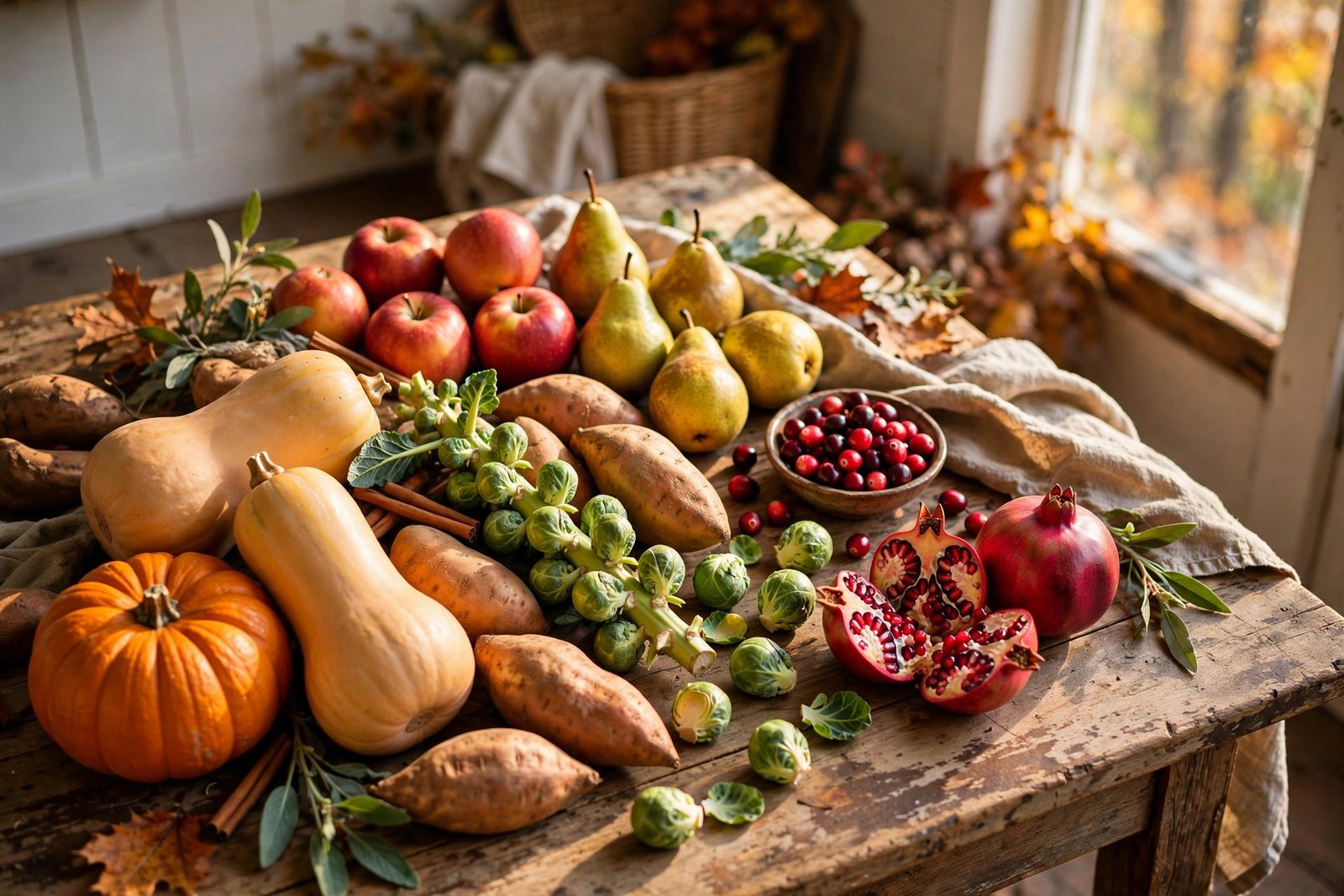
November is the month when American cooking turns inward. The farmers market thins out, the grill goes quiet, and the kitchen fills with the smells of roasting roots, braising greens, and baking apples. It is also one of the best months of the year to eat well for less, because the produce in season now is the produce that stores well, travels well, and tastes best after a frost. Apples, pears, cranberries, pomegranates, sweet potatoes, Brussels sprouts, winter squash, and hearty greens are all at their peak, and the regional differences across a country this large mean that November’s table looks different in Maine, Florida, and California — and that is part of the fun.
This guide covers what is in season in November across the United States, how to choose it, and how to use it, from weeknight roasts to the Thanksgiving table. The lists below reflect the peak-season produce for November, drawing on seasonal guides from across the country. Availability varies by region and weather, and a late frost or an early storm can shift a harvest by a week or two, but the broad picture is reliable: November belongs to roots, brassicas, squash, and late fruit.
The November fruit list
Late-season apples are the star of November fruit. Varieties such as Fuji, Gala, Pink Lady, Braeburn, and Honeycrisp are still in good supply, and they are at their best now: crisp, sweet-tart, and versatile enough for eating, baking, and saucing. Pears run from September into November, with Bartlett, Bosc, Comice, and D’Anjou all available, and a ripe pear — one that gives slightly at the neck — is one of the month’s simplest pleasures. Buy pears firm and ripen them at home for the best flavor.
Cranberries arrive just in time for November’s celebrations. Fresh cranberries, available for a short window in the fall, are tart, bright, and far better than canned sauce for anyone willing to simmer them with sugar and orange zest for ten minutes. Pomegranates are also at their best now: one pomegranate yields roughly six to eight ounces of seeds, or arils, which are superb scattered over fall salads, roasted vegetables, and yogurt. November marks the end of fig season, so it is the last chance for fresh figs, best roasted with vegetables or served with cheese.
Winter citrus begins to appear in November, with grapefruit, kumquats, and clementines starting their seasons, and Florida’s November harvest adds avocados, guava, passion fruit, carambola, and strawberries to the southern table. Grapes, in season in the United States from June through November, are at the end of their run, which is when the more unusual varieties appear. The practical rule for November fruit is simple: buy what is local and late, and let citrus from the South fill the gaps.
The November vegetable list
November vegetables divide into three families, and all three love cool weather. The roots and tubers — sweet potatoes, potatoes, beets, carrots, parsnips, rutabaga, turnips, and celery root — are at their peak, and they are the backbone of November cooking: roasted, mashed, or simmered into soups and stews. Sweet potatoes deserve special attention, because they are in season from September through February and they carry a whole holiday meal on their own, from casserole to pie.
The brassicas — Brussels sprouts, broccoli, cauliflower, cabbage, and kale — are the second family, and they are better after a frost, which sweetens them. Brussels sprouts, in season from September through November, are the classic November vegetable: roasted at high heat until crisp at the edges, they convert even skeptics. Broccoli and cauliflower, also in fall season, roast just as well, and cabbage, available from September through November, makes slaws, soups, and braises that feed a crowd cheaply.
The third family is the greens and squash: collard greens, mustard greens, chard, spinach, and lettuce, all in fall season, plus winter squash — butternut, acorn, delicata, kabocha, and pumpkin — in season from September through November. Winter squash is November’s workhorse: it roasts, soups, mashes, and bakes, and it keeps for weeks in a cool pantry, which is why it was a staple long before refrigeration. If you buy one thing this month, make it a butternut squash and a bag of Brussels sprouts, and you will eat well all week.
November produce by region
The United States is too large for a single November list, and the regional differences are worth knowing. In the Northeast, November brings apples, beets, broccoli, cabbage, carrots, cauliflower, kale, parsnips, turnips, winter squash, and, in Maine, cranberries and leeks. Massachusetts’ growing season is largely dormant by November, so the region leans on storage crops — the apples, roots, and squash harvested in September and October and kept for winter.
In the South, the season runs longer. Alabama offers collard greens, citrus, pecans, persimmons, sweet potatoes, and winter squash; Georgia offers apples, kale, lettuce, sweet potatoes, and Vidalia onions; Louisiana offers cucumbers, okra, peppers, persimmons, and sweet potatoes. Florida is the outlier, with a November harvest that reads like summer elsewhere: avocados, bell peppers, cucumbers, eggplant, green beans, guava, mushrooms, oranges, snap beans, strawberries, sweet corn, and tomatoes.
In the Midwest, November means apples, cabbage, onions, peppers, pumpkins, spinach, sweet potatoes, and winter squash in Illinois, with similar storage crops across the region, though Michigan and Wisconsin are largely dormant by November and rely on stored produce. In the West, California’s long season keeps a wider range available, and the Southwest adds pecans and late peppers. The lesson is practical: shop the farmers market or the local section of your grocery store, and you will automatically eat what is freshest near you.
How to cook November produce
The best November cooking is simple cooking. Roots and squash want high heat and oil: cut them into even pieces, toss with olive oil and salt, roast at 425 degrees until caramelized at the edges, and finish with herbs. Brassicas want the same treatment, with Brussels sprouts halved and placed cut-side down for maximum crispness. Greens want a quick braise with garlic and a splash of vinegar, which balances their earthiness. None of this requires a recipe, and all of it rewards good produce.
Soups and stews are November’s natural form. A pot of butternut squash soup, a beef and root vegetable stew, or a pot of collard greens with smoked turkey feeds a family for days and improves on the second day. November is also the month to bake: apple pie, pear tart, sweet potato casserole, and pumpkin pie all depend on produce at its peak, and the difference between a November apple and a March apple, baked into a pie, is the difference between a good dessert and a great one.
Storage is part of the skill. Winter squash, potatoes, onions, and sweet potatoes keep for weeks in a cool, dark, dry place — not the refrigerator, which makes potatoes sweet and onions soft. Apples keep for weeks in the refrigerator’s crisper drawer. Fresh cranberries freeze beautifully, so buy an extra bag now and freeze it for December baking. Buying in season and storing well is how November’s abundance stretches into winter.
Eating seasonally without overthinking it
Seasonal eating is often presented as a discipline, but in November it is mostly common sense. In-season produce tastes better, because it was picked ripe rather than shipped unripe; it costs less, because it is abundant; and it supports nearby farmers, because it did not travel thousands of miles. You do not need to memorize a chart. If you shop the outer edges of the grocery store, buy what is on sale in the produce section, and cook the roots, squash, and greens that fill the displays, you are eating seasonally already.
November also rewards a small shift in habit: cook one new vegetable a week. If you have never tried celery root, roast it with carrots and parsnips. If you have never cooked collard greens, braise them with garlic and vinegar. If you have never used a pomegranate, cut it open over a bowl of water — the seeds sink, the pith floats — and scatter the seeds over a salad. November’s produce is forgiving, flavorful, and cheap, which is the best possible combination for trying something new.
Frequently asked questions
What fruit is in season in November?
Late-season apples, pears, cranberries, and pomegranates are the highlights, with winter citrus such as grapefruit, kumquats, and clementines just starting, and Florida adding avocados, guava, and strawberries.
What vegetables are in season in November?
Roots and tubers (sweet potatoes, potatoes, beets, carrots, parsnips, turnips), brassicas (Brussels sprouts, broccoli, cauliflower, cabbage, kale), hearty greens, and winter squash (butternut, acorn, delicata, pumpkin).
Does in-season produce really taste better?
Yes, generally. In-season produce is picked ripe and travels less, so it is fresher and more flavorful than out-of-season produce picked early and shipped long distances. It is also usually cheaper.
How long does winter squash keep?
Whole winter squash keeps for weeks in a cool, dark, dry place. Cut squash should be refrigerated and used within a few days. Sweet potatoes and potatoes also store well for weeks under the same conditions.
Related reading
For more fall flavor, read our guide to pumpkin everything and fall baking, National Candy Corn Day and the Halloween candy economy, and road-trip gas station snack culture.
Sources for this article include The Practical Produce Guide for November 2026, US Foods’ seasonal produce guide, and Florida’s November in-season list.