
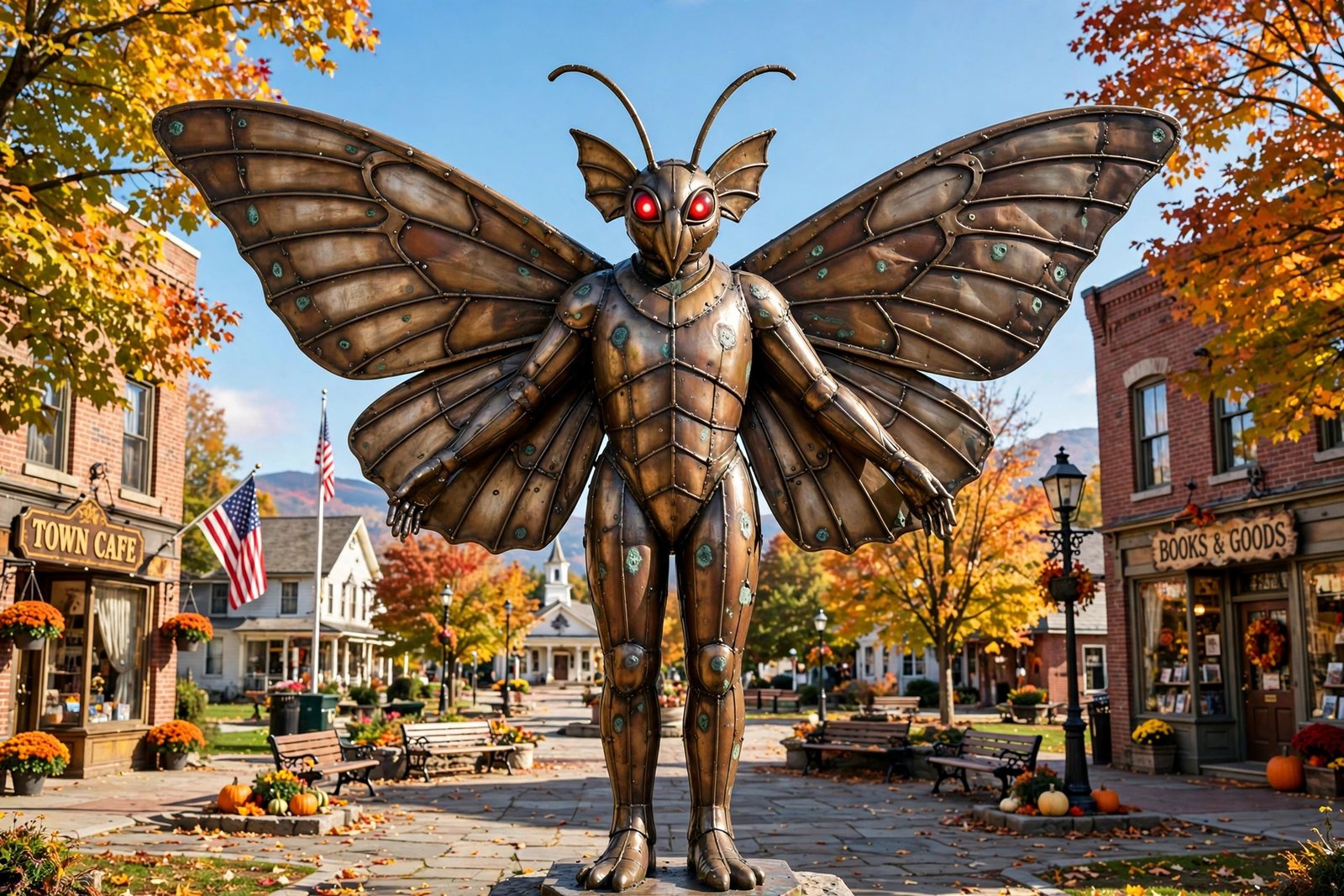
Sixty years ago this month, two young couples out for a night drive near Point Pleasant, West Virginia, said something with huge wings and glowing red eyes chased their car. They said it kept up with them at highway speed, gliding back and forth over the back of the car, and then vanished. The next day, the local newspaper called it a man-sized bird, a creature, something. Within days, it had a name borrowed from Batman’s world: Mothman. This November 15 marks the 60th anniversary of that night, and the legend has outlived every attempt to explain it away. Point Pleasant now has a 12-foot steel Mothman statue, a museum, and a festival that draws about 20,000 visitors a year to a town of fewer than 5,000 people.
Mothman is one of America’s favorite folk legends, and its staying power is worth understanding. It is not the oldest American monster, nor the scariest, nor the best documented. It is, however, one of the few that comes with a specific date, named witnesses, a newspaper record, a skeptical explanation, a famous book, a Hollywood film, and a town that embraced it rather than hiding from it. The 60th anniversary is a good moment to separate what is known from what is claimed, and to ask why a story from a West Virginia back road in 1966 still draws crowds in 2026.
The night of November 15, 1966
The famous sighting happened on the night of November 15, 1966. Roger and Linda Scarberry and Steve and Mary Mallette were driving past an abandoned World War II ammunition plant known as the TNT area, about seven miles north of Point Pleasant, when they said a tall, winged figure with red eyes came after their car. Linda Scarberry later recalled, in an archival recording aired by NPR in 2025, that they were going between 100 and 105 miles per hour down a straight stretch and the thing was just gliding back and forth over the back end of the car. The couples drove to town and reported what they had seen to the police.
The next day, November 16, 1966, the Point Pleasant Register published the story under the headline Couples See Man-Sized Bird, Creature, Something. The hedging in that headline is telling: the newspaper did not know what to call it either. An editor at the Athens Messenger in Ohio then dubbed the creature Mothman, a name inspired by Batman and his foe Killer Moth, and the name stuck. Within weeks, the national press picked up the story, and sightings multiplied. Over the following thirteen months, an estimated 100 Mothman sightings were reported in the Point Pleasant area, with witnesses claiming to see the creature rising from the ground, stalking airplanes, and chasing cars.
The first sighting may actually have come three days earlier. On November 12, 1966, a man named Kenneth Duncan said he saw a figure gliding through the trees while digging a grave at a cemetery near Clendenin, West Virginia, and the plaque on the Mothman statue in Point Pleasant lists November 12 as the first sighting. The gravediggers’ report, in which a group of men digging a grave reported a six-foot-tall winged creature soaring through the trees, is also part of the record. The November 15 car chase is the famous one, but the legend’s beginning is a cluster of reports, not a single night, which is part of why it felt, at the time, like something was happening in the area rather than a single prank.
The Silver Bridge and the harbinger idea
The sightings stopped, abruptly, after a tragedy. On December 15, 1967, about thirteen months after the first reports, the Silver Bridge, connecting Point Pleasant to Gallipolis, Ohio, across the Ohio River, collapsed during evening rush-hour traffic. Forty-six people died, making it one of the deadliest bridge collapses in American history. The National Transportation Safety Board later traced the collapse to a crack in a single steel eyebar, caused by stress corrosion and corrosion fatigue — a structural failure, not a supernatural one. A new bridge, the Silver Memorial Bridge, opened in 1969.
But the timing — sightings ending on the day of the collapse — transformed the legend. Over time, Mothman was reinterpreted as a harbinger of doom, a creature whose appearance warned of disaster to come. That idea was popularized by investigative journalist John Keel in his 1975 book The Mothman Prophecies, which linked the sightings to the bridge collapse and to other paranormal events Keel claimed to have investigated in the area. Keel’s book was heavily fictionalized in places, as even sympathetic accounts acknowledge, and it came five years after Gray Barker’s The Silver Bridge, which had explored similar ideas. But Keel’s version is the one that stuck, and it gave Mothman a meaning beyond a strange bird: a warning that nobody understood until it was too late.
It is worth being clear about what is established and what is not. The bridge collapse had a documented engineering cause. No evidence connects the sightings to the collapse except timing, and timing, in a town where sightings were already being reported for a year, is a weak thread. The harbinger idea is folklore, not fact, and it says more about how people make sense of tragedy than about what happened on the road in 1966. That does not make it uninteresting — folklore is how communities process grief — but it does mean the legend should be told as legend, with its claims labeled as claims.
What Mothman probably was
The skeptical explanations are strong, and they have been consistent for decades. West Virginia University wildlife biologist Robert L. Smith said at the time that the creature was probably a sandhill crane that had wandered off its migration route. Sandhill cranes are tall, large-winged birds with reddish skin around their eyes, and a crane seen at night, in headlights, could plausibly be misread as something stranger. Audubon magazine later noted that sandhill cranes are not native to West Virginia, which weakens the crane theory somewhat, but wandering birds do appear far outside their ranges, and the TNT area’s ponds and wetlands would attract large birds.
Skeptical investigator Joe Nickell has pointed to a different bird: the barred owl. Barred owls, he told Audubon in 2018, have crimson eyeshine and otherwise fit the description, big-winged and so forth, with silent flight, and he added that owls have almost certainly been responsible for monster sightings, maybe more than any one creature. An owl’s eyeshine in headlights glows red, its wingspan is broad, and its silent flight is unnerving at night. A large owl, seen briefly and at speed, could easily become a seven-foot creature with a ten-foot wingspan in a frightened retelling. Neither explanation can be proven for a specific night in 1966, but both fit the descriptions better than a supernatural creature, and neither requires inventing new biology.
The legend’s other elements — the UFO reports, the visits from men in black, the strange phone calls and prophecies in Keel’s book — belong to a different category. They are claims from a single author’s investigation, not corroborated reports, and they should be read as part of the Mothman mythos rather than as evidence. The core sightings, by contrast, are documented in contemporary newspapers, which is why Mothman stands apart from many cryptids: the sightings themselves are real reports by real people, even if what they saw was a bird.
Mothman today: statue, museum, festival
Point Pleasant did something unusual with its monster: it embraced it. The town held its first annual Mothman Festival in 2002, the same year the film The Mothman Prophecies, starring Richard Gere and based loosely on Keel’s book, brought the legend to a global audience. In 2003, the town unveiled a 12-foot metallic Mothman statue by artist Bob Roach in the town square, with red eyes and outstretched wings, and it has become one of West Virginia’s most photographed landmarks. The world’s only Mothman Museum, in the town, displays original newspaper clippings, police reports, and film props.
The festival, held every September, now draws about 20,000 visitors to a town of fewer than 5,000 people, according to Mason County’s tourism director. It features guest speakers, vendors, costume contests, and tours of the TNT area, and it has turned a frightening local story into the town’s economic engine. That transformation is part of the legend’s appeal: Point Pleasant did not let Mothman define it as a place of tragedy, but as a place with a story worth telling. The Silver Bridge collapse is memorialized separately, with respect, and the festival keeps the two histories distinct even as the legend links them.
The 60th anniversary, on November 15, 2026, is a quieter milestone than the festival, but it is the real one: sixty years since the night drive, the newspaper headline, and the name. For visitors, the anniversary is a reason to visit outside festival season, when the town is quieter and the TNT area can be explored at a slower pace. The statue is there year-round, the museum is open year-round, and the Ohio River, which the Silver Bridge once crossed, is still there, crossed now by its successor.
Why Mothman endures
Mothman endures because it sits at the intersection of several American appetites: for mystery, for monsters, for small-town stories, and for the idea that something unexplained might be real. It has just enough documentation to feel credible — named witnesses, a dated newspaper report, a police record — and just enough strangeness to resist a tidy explanation. The skeptical answers are plausible but not provable for that night, and the supernatural answers are unprovable by definition, so the story stays open. Open stories last.
It also endures because Point Pleasant keeps telling it well. The statue, the museum, and the festival give the legend a physical home, and the town’s embrace means the story is told by the people who live with it, not just by outsiders. Sixty years on, Mothman is less a mystery to be solved than a piece of American folklore to be visited, photographed, and argued about over dinner. That is a fine fate for a creature that may have been an owl, glimpsed in headlights, on a November night in 1966.
Frequently asked questions
When was the first Mothman sighting?
The famous sighting was on November 15, 1966, when two couples said a winged creature with red eyes chased their car near Point Pleasant, West Virginia. An earlier report, on November 12, 1966, involved a figure seen near Clendenin, and the statue plaque lists November 12 as the first sighting.
What is Mothman supposed to be?
In folklore, Mothman is a tall, winged humanoid with glowing red eyes, later interpreted as a harbinger of disaster after the Silver Bridge collapse on December 15, 1967. Skeptical explanations point to a misidentified large bird, such as a sandhill crane or a barred owl.
How did Mothman get its name?
An editor at the Athens Messenger dubbed the creature Mothman, inspired by Batman and his foe Killer Moth, after the Point Pleasant Register’s November 16, 1966, report called it a man-sized bird, a creature, something.
Is there a Mothman Festival?
Yes. Point Pleasant has held an annual Mothman Festival since 2002, each September, drawing about 20,000 visitors. The town also has a 12-foot Mothman statue and the world’s only Mothman Museum.
Related reading
For more American legends, read about the Stanley Hotel’s haunted history, the Winchester Mystery House, fact versus legend, and the Lost Dutchman gold mine legend.
Sources for this article include History.com’s account of how Mothman became a folk legend, the Mothman overview, and reporting on Mothman’s 60th anniversary.